Choosing the correct flexible cable size is important for electrical safety, equipment performance, and reliable power transmission. Flexible cables are designed to bend and move more easily than many fixed-installation cables, making them useful for appliances, machinery, extension leads, control equipment, portable tools, and other applications where movement is involved.
However, selecting flexible cable size is not simply a matter of choosing the largest conductor that fits the equipment. The correct size depends on load current, conductor material, number of cores, cable construction, insulation type, installation conditions, voltage drop, flexibility requirements, and operating environment.
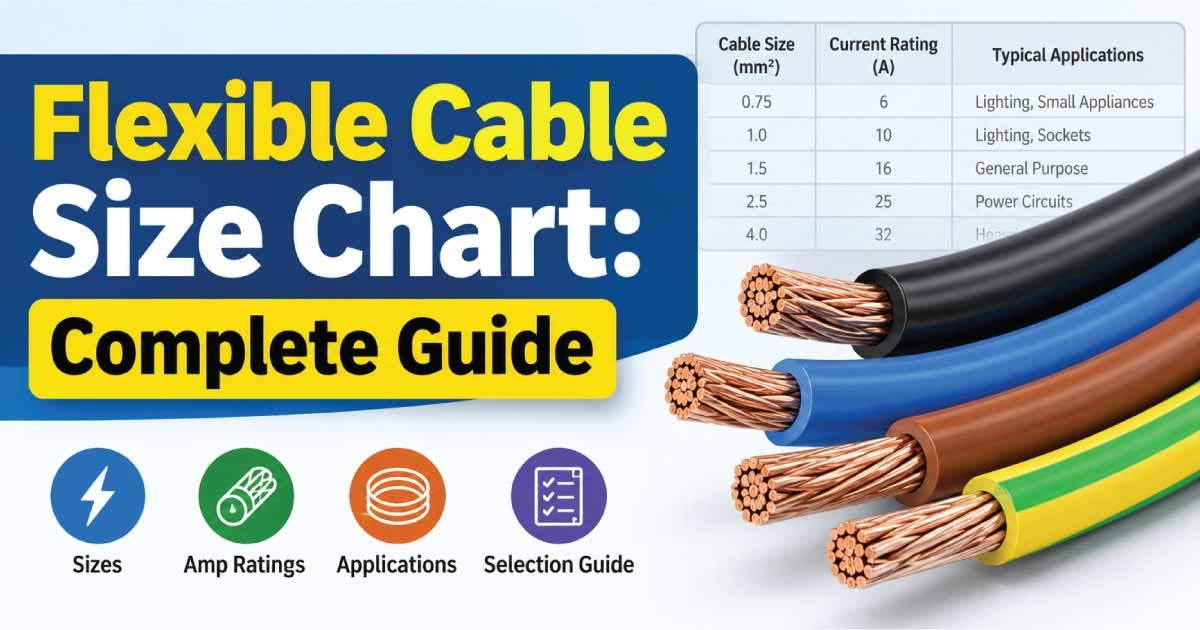
This flexible cable size chart covers common conductor sizes, typical applications, core configurations, ampacity considerations, cable types, voltage drop, and practical selection factors.
What Is a Flexible Cable?
A flexible cable is an electrical cable designed to withstand bending, movement, or repeated flexing while maintaining reliable electrical and mechanical performance.
Flexible cables generally use conductors made from multiple fine wires rather than a single solid conductor. The finer strands allow the conductor to bend more easily.
A flexible cable may contain:
- Fine-stranded copper conductors
- Insulation around each conductor
- Fillers or separators where required
- An outer flexible sheath
- Two or more cores depending on the application
Common flexible cable constructions include 2-core, 3-core, 4-core, and 5-core cables.
Different flexible cables are designed for different environments. Some are intended for occasional movement, while specialized cables can withstand continuous flexing in machinery and automated equipment.
Flexible Cable Size Chart
Flexible cable sizes are commonly identified by conductor cross-sectional area in mm².
| Cable Size | Typical Conductor | Common Application |
|---|---|---|
| 0.5 mm² | Copper | Control and signal wiring |
| 0.75 mm² | Copper | Light-duty flexible wiring |
| 1.0 mm² | Copper | Small equipment and control circuits |
| 1.5 mm² | Copper | Lighting and light power loads |
| 2.5 mm² | Copper | General power applications |
| 4 mm² | Copper | Medium-duty equipment |
| 6 mm² | Copper | Higher-current equipment |
| 10 mm² | Copper | Large flexible power connections |
| 16 mm² | Copper | Industrial equipment |
| 25 mm² | Copper | Heavy-duty power applications |
| 35 mm² | Copper | Industrial power distribution |
| 50 mm² | Copper | High-current equipment |
| 70 mm² | Copper | Heavy-duty industrial applications |
| 95 mm² | Copper | Large power connections |
| 120 mm² | Copper | High-capacity systems |
| 150 mm² | Copper | Large industrial power systems |
| 185 mm² | Copper | Heavy-duty power applications |
| 240 mm² | Copper | High-capacity power systems |
These sizes represent common conductor cross-sectional areas. Ampacity cannot be assigned accurately from size alone, because the allowable current depends on the cable type, insulation, number of loaded cores, ambient conditions, installation method, and applicable standard.
Understanding Flexible Cable Size in mm²
The number printed on a flexible cable, such as 1.5 mm² or 2.5 mm², normally identifies the nominal cross-sectional area of an individual conductor.
For example:
- 0.75 mm² = small conductor
- 1.0 mm² = small power/control conductor
- 1.5 mm² = common light-duty power conductor
- 2.5 mm² = larger general-purpose conductor
- 4 mm² = medium-sized conductor
- 6 mm² = larger power conductor
- 10 mm² = high-current conductor
As the cross-sectional area increases, the conductor generally has greater current-carrying capability and lower resistance.
However, a larger conductor is also generally heavier, less flexible, and more difficult to terminate.
Therefore, cable selection involves balancing electrical capacity with mechanical flexibility.
Flexible Cable Current Carrying Capacity
The current-carrying capacity of a flexible cable is the amount of current it can carry under specified conditions without exceeding its permitted temperature.
There is no universal ampacity value for every flexible cable size.
For example, a 2.5 mm² flexible cable may have different allowable current values depending on:
- Insulation material
- Number of cores
- Number of loaded conductors
- Ambient temperature
- Installation method
- Cable grouping
- Free-air or enclosed installation
- Cable sheath construction
- Applicable cable standard
For this reason, the cable manufacturer’s technical data should be used when an exact ampacity is required.
Flexible Cable Size for Common Amp Loads
The following table provides a simplified reference showing conductor sizes commonly evaluated for different current levels.
| Approximate Circuit Current | Flexible Cable Size to Evaluate | Typical Conductor |
|---|---|---|
| 6 A | 0.75–1.0 mm² | Copper |
| 10 A | 1.0–1.5 mm² | Copper |
| 13 A | 1.5 mm² | Copper |
| 16 A | 1.5–2.5 mm² | Copper |
| 20 A | 2.5–4 mm² | Copper |
| 25 A | 4 mm² | Copper |
| 32 A | 4–6 mm² | Copper |
| 40 A | 6–10 mm² | Copper |
| 50 A | 10 mm² | Copper |
| 63 A | 10–16 mm² | Copper |
These are selection starting points rather than universal ampacity ratings. The final size must be verified against the cable’s actual construction and installation conditions.
Flexible Cable Core Sizes
Flexible cables are available with different numbers of cores.
| Configuration | Typical Construction | Common Application |
|---|---|---|
| 2-Core | Two insulated conductors | Basic single-phase equipment |
| 3-Core | Three insulated conductors | Single-phase power with protective conductor arrangements |
| 4-Core | Four insulated conductors | Three-phase applications |
| 5-Core | Five insulated conductors | Three-phase plus neutral and protective conductor arrangements |
The correct configuration depends on the electrical system and equipment.
For example, a portable single-phase tool may use a 3-core flexible cable, while a three-phase machine may require a 4-core or 5-core cable depending on whether a neutral and protective conductor are required.
Common Flexible Cable Sizes and Applications
Different conductor sizes are suited to different levels of electrical load.
0.5 mm² Flexible Cable
Small flexible conductors can be used for suitable low-current control, signal, or electronic applications.
The exact current rating depends strongly on the cable construction and operating conditions.
0.75 mm² Flexible Cable
0.75 mm² flexible cable is commonly found in light-duty electrical equipment, control applications, and certain appliance connections where its rating is adequate.
1.0 mm² Flexible Cable
1.0 mm² conductors can be used for small equipment and control circuits. They provide greater conductor area than 0.75 mm² while retaining good flexibility in suitable cable constructions.
1.5 mm² Flexible Cable
1.5 mm² is a widely encountered flexible cable size for light-to-moderate power applications.
It may be found in:
- Portable equipment
- Lighting equipment
- Small machinery
- Extension-type applications where permitted
- Electrical appliances
2.5 mm² Flexible Cable
2.5 mm² flexible cable is commonly used for higher-current equipment and general-purpose power connections.
It offers greater current capacity than smaller flexible conductors, but the exact allowable current still depends on the cable type and installation.
4 mm² and 6 mm² Flexible Cable
4 mm² and 6 mm² flexible cables are commonly considered for higher-power equipment.
They can be used for suitable:
- Industrial equipment
- Motors
- Portable machinery
- Power tools
- Temporary power systems
- Heavy-duty electrical equipment
10 mm² and Larger Flexible Cable
Larger flexible cables are generally used for high-current equipment and industrial applications.
Sizes such as 10, 16, 25, 35, 50, 70, and 95 mm² can be found in heavy-duty cable systems.
At these sizes, cable weight, bending radius, termination requirements, mechanical protection, and installation method become increasingly important.
Discover More:
How to Choose the Correct Flexible Cable Size
Selecting flexible cable requires consideration of both electrical and mechanical requirements.
1. Determine the Load Current
First determine the equipment’s expected current.
Check the equipment nameplate or technical documentation for:
- Rated voltage
- Rated current
- Power consumption
- Power factor
- Starting current
- Continuous operating current
Motors and other inductive loads may have significantly different starting characteristics from their normal operating current.
2. Select the Number of Cores
Determine whether the equipment requires:
- Two conductors
- Three conductors
- Four conductors
- Five conductors
Do not select a cable solely by conductor size without checking the required circuit configuration.
3. Select the Conductor Material
Most flexible power cables use copper conductors because copper provides high conductivity and good flexibility when manufactured with fine strands.
The conductor material affects:
- Resistance
- Weight
- Current capacity
- Termination
- Flexibility
- Cost
4. Consider the Cable’s Movement
Ask how often the cable will move.
There is an important difference between:
- Fixed cable that only needs occasional bending
- Portable equipment cable
- Cable that flexes repeatedly
- Cable used in continuous-motion machinery
A cable designed for fixed installation should not automatically be used in a continuous-flexing application.
5. Check the Environmental Conditions
Consider whether the cable will encounter:
- Oil
- Water
- Chemicals
- Heat
- Cold
- Abrasion
- UV exposure
- Mechanical stress
The cable sheath and insulation must be suitable for the actual environment.
Discover More:
Flexible Cable and Voltage Drop
Voltage drop becomes important when flexible cables carry substantial current over long distances.
The longer the cable, the greater the resistance encountered by the current. Higher resistance produces greater voltage drop.
Increasing the conductor size generally reduces resistance.
When selecting flexible cable for long runs, consider:
- Cable length
- Load current
- Conductor size
- Copper or aluminum construction
- System voltage
- Power factor
- Circuit configuration
For example, a 1.5 mm² flexible cable may be suitable for a short connection but may not be the best choice for a long run carrying the same current.
Flexible Cable vs Fixed Cable
Flexible and fixed cables are designed for different installation requirements.
| Feature | Flexible Cable | Fixed Cable |
|---|---|---|
| Conductor Construction | Usually finely stranded | Solid or stranded |
| Bending Ability | High | Lower |
| Movement | Suitable for movement depending on type | Primarily stationary |
| Typical Use | Appliances, tools, machinery | Building wiring and fixed installations |
| Repeated Flexing | Some types are designed for it | Generally unsuitable |
| Mechanical Design | Optimized for flexibility | Optimized for fixed installation |
Not every flexible cable is suitable for continuous motion. Specialized drag-chain and robotic cables are designed specifically for repeated movement.
Types of Flexible Cables
Flexible cables are available in many constructions.
PVC Flexible Cable
PVC flexible cables are commonly used for general-purpose equipment, appliances, control systems, and suitable indoor applications.
Their flexibility depends on conductor stranding, insulation formulation, sheath construction, and cable design.
Rubber Flexible Cable
Rubber-sheathed cables are often selected for demanding environments where flexibility and mechanical durability are important.
They can be used in suitable:
- Industrial equipment
- Construction equipment
- Portable machinery
- Outdoor equipment
- Heavy-duty applications
The exact suitability depends on the specific cable type.
Silicone Flexible Cable
Silicone-insulated cables are designed for applications requiring good flexibility and performance at elevated or low temperatures, depending on the specific product.
They are used in specialized equipment, appliances, lighting, industrial systems, and other applications.
Continuous-Flex Cable
Continuous-flex cables are specifically designed for repeated movement.
They are commonly used in:
- CNC machines
- Robotics
- Automated equipment
- Cable carriers
- Moving machinery
These cables should be selected based on the manufacturer’s specified bending radius, flex cycles, travel speed, and environmental requirements.
Flexible Cable Size and Bending Radius
The minimum bending radius is an important consideration when installing flexible cable.
A cable should not be bent more tightly than its specified minimum radius because excessive bending can damage:
- Conductors
- Insulation
- Shielding
- Fillers
- Sheath
- Internal cable geometry
The allowable bending radius varies by cable design.
Larger cables generally require more space for bending, while highly flexible cables may be designed to tolerate tighter bending.
Always follow the manufacturer’s specified bending radius rather than applying one universal value.
Flexible Cable Applications
Flexible cables are used wherever electrical equipment needs some degree of movement or easier handling.
Common applications include:
- Portable power tools
- Electrical appliances
- Extension leads
- Industrial machinery
- Motors
- Pumps
- Generators
- Construction equipment
- Welding equipment
- Control panels
- Automation systems
- Robotics
- Cable carriers
- Temporary electrical installations
The cable type must match the application’s movement, electrical load, and environment.
Discover More:
Common Flexible Cable Sizing Mistakes
Choosing Cable Size Only by Amperage
Ampacity is important, but voltage drop, environmental conditions, cable construction, and movement requirements can also affect the correct selection.
Using Fixed Cable for Continuous Movement
A standard fixed-installation cable may not survive repeated flexing. Continuous-motion applications require an appropriately designed flexible cable.
Ignoring Bending Radius
Excessive bending can damage the cable even when the electrical load is within its rating.
Ignoring Temperature
High ambient temperatures can reduce allowable current and affect insulation performance.
Ignoring Cable Grouping
Several loaded cables installed together can increase heat accumulation and reduce their allowable current.
Using the Wrong Sheath Material
A cable exposed to oil, chemicals, abrasion, water, or outdoor conditions needs an appropriate sheath and insulation system.
Flexible Cable Size FAQs
What is the most common flexible cable size?
There is no single size suitable for every flexible cable application. 0.75 mm², 1.0 mm², 1.5 mm², and 2.5 mm² are commonly encountered in light-duty and general-purpose applications, while larger sizes are used for higher-current equipment.
What size flexible cable do I need for 10 amps?
A 1.0 mm² or 1.5 mm² copper flexible cable may be considered for a 10-amp application depending on the cable type and installation conditions. The manufacturer’s current rating should always be checked before selecting the final cable.
What size flexible cable is suitable for 16 amps?
1.5 mm² or 2.5 mm² copper flexible cable may be evaluated for a 16-amp load, depending on its construction, insulation, installation method, ambient temperature, and applicable requirements. The exact cable rating should be verified from manufacturer data.
Is a flexible cable better than a rigid cable?
Neither is universally better. Flexible cable is advantageous where bending, movement, or portability is required. Rigid or fixed-installation cable can be more appropriate for permanent wiring where movement is not expected.
Can flexible cable be used for permanent wiring?
It depends on the specific cable type and applicable wiring requirements. Some flexible cables are approved for particular fixed installations, while others are designed primarily for equipment connections or movement. Always check the cable’s intended application and applicable standard.
Final Thoughts on Flexible Cable Size
Selecting the correct flexible cable size requires more than matching conductor area to current. The cable must provide adequate current-carrying capacity, voltage-drop performance, mechanical flexibility, bending capability, environmental resistance, and conductor configuration for the intended application.
Common sizes such as 0.75 mm², 1.0 mm², 1.5 mm², 2.5 mm², 4 mm², and 6 mm² are widely encountered, while larger sizes are available for heavy-duty industrial applications.
Before installation, check the cable manufacturer’s specifications for ampacity, voltage rating, temperature range, bending radius, flexing capability, and environmental suitability. For high-current or continuously moving applications, selecting a cable specifically designed for the intended service is particularly important.