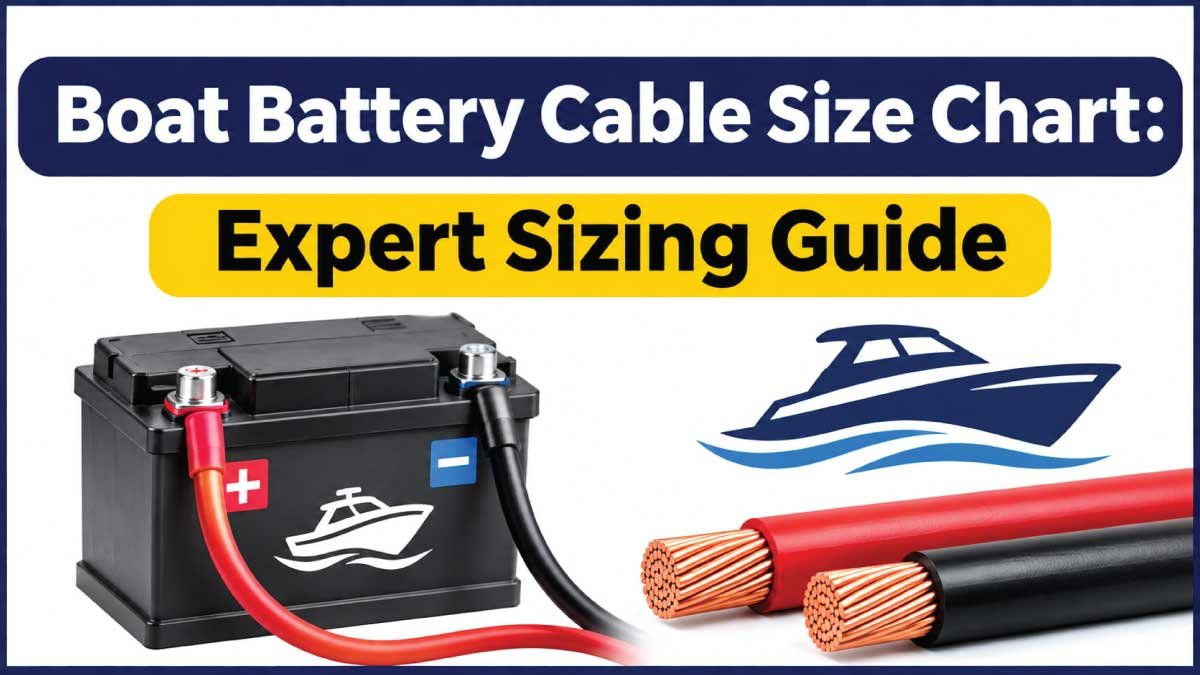
Choosing the correct boat battery cable size is essential for marine electrical safety, reliable engine starting, and consistent power delivery. Battery cables connect the boat’s batteries to starter motors, inverters, alternators, battery switches, distribution panels, and other electrical equipment. Because these connections can carry high current, selecting the right cable size is particularly important.
An undersized marine battery cable can cause excessive voltage drop, slow engine cranking, overheating, damaged insulation, and electrical failures. A properly sized cable helps deliver the required current while maintaining safe operating temperatures and reliable electrical connections.
The correct boat battery cable size depends on several factors, including battery voltage, circuit current, cable length, engine-room temperature, voltage-drop allowance, and conductor type. This guide explains marine battery cable sizes, AWG and metric conversions, cable selection charts, voltage-drop calculations, and practical sizing considerations for different boat applications.
What Is a Boat Battery Cable?
A boat battery cable is a heavy-duty electrical conductor designed to carry direct current (DC) between a marine battery and electrical equipment. It is commonly used for engine starting circuits, house battery connections, charging systems, and high-current accessories.
Marine battery cables are designed for demanding environments where moisture, vibration, salt exposure, and temperature changes can affect electrical connections.
Common applications include:
- Connecting batteries to engine starter motors
- Connecting house batteries to DC distribution panels
- Connecting batteries to marine inverters
- Connecting alternators to battery charging systems
- Connecting battery switches and isolators
- Wiring electric windlasses and bow thrusters
- Connecting battery banks in parallel or series
- Supplying power to marine electrical equipment
For many marine installations, stranded tinned copper cable is preferred because it offers flexibility and improved resistance to corrosion compared with ordinary bare copper cable.
Boat Battery Cable Size Chart
The following chart shows common marine battery cable sizes in American Wire Gauge (AWG) and their approximate metric equivalents.
| Marine Cable Size | Approximate Metric Equivalent | Typical Application |
|---|---|---|
| 16 AWG | 1.5 mm² | Small control circuits |
| 14 AWG | 2.5 mm² | Low-current electrical accessories |
| 12 AWG | 4 mm² | Small DC equipment circuits |
| 10 AWG | 6 mm² | Moderate-current connections |
| 8 AWG | 10 mm² | Small charging and accessory circuits |
| 6 AWG | 16 mm² | Medium-current DC circuits |
| 4 AWG | 25 mm² | Higher-current marine connections |
| 2 AWG | 35 mm² | Heavy-duty battery wiring |
| 1 AWG | 50 mm² | High-current connections |
| 1/0 AWG | 70 mm² | Large battery and inverter connections |
| 2/0 AWG | 95 mm² | High-current starting and battery circuits |
| 3/0 AWG | 120 mm² | Large marine battery installations |
| 4/0 AWG | 120 mm² or larger, depending on the metric cable selected | Very high-current battery connections |
Important: Metric values are approximate comparison sizes, not exact AWG conversions. For example, 1/0 AWG has a conductor area of approximately 53.5 mm², while 2/0 AWG is approximately 67.4 mm². Always verify the actual conductor size and cable specification before purchasing.
This chart is a size-conversion reference, not an ampacity chart. The allowable current depends on insulation temperature rating, installation conditions, conductor construction, and applicable marine standards.
Common Boat Battery Cable Sizes
Different marine electrical circuits require different conductor sizes. The following sections explain where common cable sizes may be used.
4 AWG Marine Battery Cable
4 AWG cable has an approximate conductor area of 21.2 mm². It may be used for certain higher-current marine connections, including selected accessory circuits and short battery connections.
Its suitability depends on the required current, total circuit length, voltage-drop limit, and cable ampacity.
2 AWG Marine Battery Cable
2 AWG cable has an approximate conductor area of 33.6 mm². It is used in some heavy-duty marine electrical circuits and battery connections.
It may be appropriate for certain short, high-current connections when the installation calculations and equipment specifications permit it.
1 AWG Marine Battery Cable
1 AWG cable has an approximate conductor area of 42.4 mm². It is commonly encountered in larger marine electrical installations.
It can be considered for battery and distribution connections where the current and cable distance require a larger conductor.
1/0 AWG Marine Battery Cable
1/0 AWG cable has an approximate conductor area of 53.5 mm². It is used in many high-current marine applications, including some engine-starting and inverter connections.
The correct selection still depends on the starter or inverter manufacturer’s requirements and the total circuit length.
2/0 AWG Marine Battery Cable
2/0 AWG cable has an approximate conductor area of 67.4 mm². It may be used for demanding starting circuits, larger inverters, and high-current battery connections.
3/0 AWG Marine Battery Cable
3/0 AWG cable has an approximate conductor area of 85.0 mm². It is commonly considered for larger battery systems and high-current marine installations.
4/0 AWG Marine Battery Cable
4/0 AWG cable has an approximate conductor area of 107.2 mm². It is a large conductor used in certain high-current battery, inverter, and engine-starting applications.
Large cables may be necessary when current is high or the distance between the battery and equipment is significant.
Boat Battery Cable Size by Voltage
Marine electrical systems commonly use 12V and 24V DC batteries. Some larger vessels and specialized systems also use higher-voltage DC arrangements.
For the same electrical power, a lower-voltage system requires more current than a higher-voltage system.
For example, a 2,400W load requires approximately:
- 200A at 12V
- 100A at 24V
These are idealized calculations using nominal voltage. Actual current depends on equipment efficiency and battery voltage under load.
| Battery Voltage | Example Power | Approximate Current |
|---|---|---|
| 12V | 600W | 50A |
| 12V | 1,200W | 100A |
| 12V | 2,400W | 200A |
| 24V | 600W | 25A |
| 24V | 1,200W | 50A |
| 24V | 2,400W | 100A |
| 48V | 1,200W | 25A |
| 48V | 2,400W | 50A |
This table shows current only. It does not provide a final cable-size recommendation. The cable must also meet the required ampacity and voltage-drop limits.
Marine Battery Cable Size by Application
Different boat circuits have different electrical requirements. Engine starters, inverters, and accessory circuits should not automatically use the same cable size.
| Boat Electrical Application | Common Cable Sizes to Evaluate |
|---|---|
| Small DC accessories | 16–10 AWG |
| Marine electronics | 16–10 AWG |
| Battery charging connections | 10–4 AWG |
| House battery connections | 4–1/0 AWG |
| Small marine inverter | 4–1/0 AWG |
| Larger marine inverter | 1/0–4/0 AWG |
| Engine starter circuit | 2 AWG–4/0 AWG |
| Bow thruster connections | Manufacturer-specific large cable |
| Windlass connections | 6 AWG–4/0 AWG, depending on current and distance |
These are broad examples of cable sizes that may be encountered, not universal recommendations. Starter motors, windlasses, and bow thrusters can have substantial starting or peak currents. Always use the equipment manufacturer’s cable-sizing instructions and verify the circuit calculations.
How to Calculate Boat Battery Cable Size
Choosing a marine battery cable requires checking current, total circuit length, allowable voltage drop, and conductor ampacity.
Step 1: Identify the Circuit Current
Find the current requirement of the equipment connected to the battery.
For example, assume a marine inverter draws 100A from a 12V battery system.
The equipment manual may provide a maximum DC input current. Use that value when available rather than relying only on the inverter’s advertised AC output power.
Step 2: Measure the Total Cable Length
Marine cable sizing charts generally use the complete circuit length, which includes both the positive and negative conductors.
For example:
- Battery to equipment: 10 feet
- Equipment return to battery: 10 feet
- Total circuit length: 20 feet
Do not use only the one-way distance when applying a chart that requires round-trip circuit length.
Step 3: Choose the Voltage-Drop Limit
Marine DC circuit design commonly considers two voltage-drop categories:
3% voltage drop: Often used for critical circuits where reliable operation is important, such as navigation lights, electronics, bilge blowers, and panel main feeders.
10% voltage drop: May be used for certain non-critical loads, such as general lighting, bait pumps, and some other accessories, where the applicable design guidance permits it.
These percentages are common marine wire-sizing chart categories. The equipment manufacturer’s requirements and applicable marine standard should determine the actual acceptable limit.
Step 4: Check Cable Ampacity
Ampacity is the maximum current a conductor can safely carry under specified conditions.
The cable must have sufficient ampacity after accounting for:
- Insulation temperature rating
- Engine-room temperature
- Ambient temperature
- Cable bundling
- Number of loaded conductors
- Installation method
- Terminal temperature ratings
- Applicable marine wiring requirements
A cable that satisfies voltage-drop requirements may still be too small for the required current. Both checks are necessary.
Step 5: Select the Larger Required Cable Size
Compare the cable size required for voltage drop with the cable size required for ampacity.
Select a conductor that satisfies both requirements. If the ampacity calculation requires a larger cable than the voltage-drop calculation, use the larger size.
Read Latest Guide:
Boat Battery Cable Voltage Drop Chart
The following table explains how voltage-drop limits are commonly applied to marine DC circuits.
| Circuit Type | Common Voltage-Drop Allowance | Example Applications |
|---|---|---|
| Critical circuit | 3% | Navigation lights, electronics, bilge blowers |
| Non-critical circuit | 10% | General lighting, bait pumps, some accessories |
For example, Blue Sea Systems provides a marine wire-sizing chart that uses circuit current, total round-trip cable length, and voltage-drop category to select a conductor size. Its chart also requires checking the allowable ampacity of the selected wire. <Cite refs={[“turn801268search0″,”turn801268search1”]}/>
Example: 12V Marine Circuit
Assume:
- System voltage: 12V
- Circuit current: 45A
- Total circuit length: 40 feet
- Voltage-drop allowance: 10%
Using the Blue Sea Systems chart example, an 8 AWG wire is required for these stated conditions.
This example demonstrates why cable length and voltage-drop allowance matter. The same current may require a larger cable when the distance increases or when a tighter voltage-drop limit is selected.
Example: 24V Marine Circuit
Assume:
- System voltage: 24V
- Circuit current: 100A
- Total circuit length: 10 feet
- Voltage-drop allowance: 3%
The Blue Sea Systems reference chart gives 6 AWG for this example.
These examples are specific to the stated chart conditions. They should not be treated as universal cable recommendations for every boat or installation. <Cite refs={[“turn801268search0″,”turn801268search32”]}/>
Read Latest Guide:
Marine Battery Cable Types
Marine battery cables must be suitable for the environment and electrical application in which they are installed.
Tinned Copper Marine Cable
Tinned copper cable is widely used in marine electrical systems. Its copper strands are coated with tin, helping resist corrosion in damp and salty environments.
It is commonly selected for battery connections, engine wiring, and marine DC distribution.
Stranded Copper Battery Cable
Marine battery cables generally use stranded conductors rather than solid conductors. Stranded cable is more flexible and better suited to installations exposed to boat movement and vibration.
Flexible Marine Battery Cable
Flexible battery cable is easier to route through tight spaces and around equipment. It is useful in engine compartments, battery enclosures, and other areas where rigid cable would be difficult to install.
Marine-Grade Insulated Cable
Marine cable insulation must be suitable for the intended temperature, moisture, and installation conditions. Check the manufacturer’s specifications and applicable marine requirements.
Do not assume that an automotive cable or ordinary building wire is suitable for a boat’s electrical system.
Read Latest Guide:
AWG vs. SAE Marine Battery Cable
One important detail when buying boat battery cable is the difference between AWG and SAE wire sizes.
AWG stands for American Wire Gauge. It is a standard wire-sizing system commonly used for marine electrical cable.
SAE wire sizes may use similar gauge numbers but can have smaller conductor cross-sectional areas than equivalent AWG sizes.
For example, an SAE cable marked with the same gauge number as an AWG cable may have higher resistance and lower current-carrying capacity.
When using an AWG marine wire-sizing chart, make sure the cable is actually manufactured to the corresponding AWG specification. Do not assume that an SAE cable with the same printed gauge number is an exact replacement. <Cite refs={[“turn801268search5”]}/>
Boat Battery Cable Fuse and Circuit Protection
Correct cable sizing must be combined with suitable overcurrent protection. A boat battery can deliver very high fault current, which can cause an undersized or unprotected cable to overheat quickly.
A suitable fuse or circuit breaker helps protect the cable against dangerous overcurrent conditions.
Important considerations include:
- Use a protective device rated for the DC system voltage.
- Select a fuse or breaker appropriate for the cable’s allowable ampacity.
- Verify that its interrupting capacity is suitable for the available battery fault current.
- Install protection as close to the battery as required by the applicable marine standard.
- Follow the equipment manufacturer’s protection recommendations.
- Use marine-rated terminals, fuse holders, and circuit breakers.
- Ensure that battery switches and disconnects have appropriate DC ratings.
The fuse should not simply be selected according to battery capacity or inverter wattage. It must be coordinated with the conductor, connected equipment, and applicable marine electrical requirements.
How Engine-Room Temperature Affects Cable Size
Engine compartments can operate at higher temperatures than other areas of a boat. Increased temperature reduces the amount of heat a cable can safely dissipate.
As a result, a conductor that is acceptable in a cooler location may not have the same allowable ampacity when routed through an engine space.
When selecting battery cables:
- Identify whether the cable passes through an engine compartment.
- Check the cable insulation temperature rating.
- Apply the temperature correction required by the applicable standard.
- Check whether cables are bundled with other loaded conductors.
- Follow the equipment and cable manufacturer’s installation instructions.
Blue Sea Systems’ marine sizing guidance distinguishes engine-space and non-engine-space conditions in its wire-sizing information. <Cite refs={[“turn801268search0″,”turn801268search1”]}/>
How to Choose the Correct Boat Battery Cable Size
Follow these steps when selecting a marine battery cable:
- Identify the boat’s DC system voltage, such as 12V or 24V.
- Find the maximum continuous current required by the equipment.
- Check any starting, surge, or peak-current requirements.
- Measure the complete positive and negative cable route.
- Determine whether the circuit requires a 3% or 10% voltage-drop design.
- Check cable ampacity under the actual temperature and installation conditions.
- Select marine-grade stranded cable with the appropriate AWG conductor size.
- Confirm that cable terminals, lugs, battery switches, and fuses are compatible.
- Follow the equipment manufacturer’s recommended cable and protection sizes.
- Have the final installation checked against applicable marine standards.
For engine-starting circuits, use the starter manufacturer’s recommended cable size and maximum circuit length. A starting circuit may have different requirements from an ordinary accessory circuit.
Common Mistakes When Selecting Boat Battery Cable
Using One-Way Distance Instead of Total Circuit Length
Marine wire-sizing charts often use the combined length of the positive and negative conductors. Using only the one-way distance can result in an undersized cable.
Choosing Cable Only by Battery Voltage
Voltage alone does not determine cable size. Current, distance, voltage-drop allowance, and installation temperature are also important.
Ignoring Engine-Room Temperature
High temperatures can reduce allowable cable ampacity. Cables routed through engine spaces must be evaluated for those conditions.
Using Automotive Cable Instead of Marine Cable
Automotive and marine cables may have different conductor, insulation, and corrosion-resistance characteristics. Use cable suitable for the marine environment.
Confusing AWG and SAE Sizes
Similar gauge markings do not always mean identical conductor areas. Check the actual cable specification before purchasing.
Ignoring Voltage Drop
A cable may have enough ampacity but still cause excessive voltage loss over a long run. Always check both voltage drop and ampacity.
Installing Poor Battery Connections
Loose or corroded connections can create resistance and heat. Use appropriate marine terminals and follow the manufacturer’s tightening specifications.
Frequently Asked Questions
What size battery cable do I need for a boat?
The required size depends on the equipment current, battery voltage, total circuit length, voltage-drop allowance, and installation conditions. Common marine cable sizes include 4 AWG, 2 AWG, 1/0 AWG, 2/0 AWG, and 4/0 AWG for different high-current applications.
What size cable is commonly used for a boat starter battery?
Starter battery cable sizes vary according to engine type, starter current, battery location, and cable length. Larger engines and longer cable routes may require larger conductors. Follow the engine manufacturer’s starting-circuit recommendations.
Is 2 AWG cable suitable for a boat battery?
It may be suitable for certain marine battery connections, but it is not appropriate for every application. Check the required current, circuit length, voltage drop, and cable ampacity before selecting it.
What is the difference between 1/0 and 2/0 battery cable?
1/0 AWG cable has a conductor area of approximately 53.5 mm², while 2/0 AWG has approximately 67.4 mm². The 2/0 cable is larger and generally has lower resistance than 1/0 cable of the same material and construction.
Should boat battery cables be tinned copper?
Tinned stranded copper is widely used for marine wiring because the tin coating helps resist corrosion. It is a common choice for battery connections in environments exposed to moisture and salt.
Can I use automotive battery cable on a boat?
Automotive cable should not automatically be treated as suitable marine cable. Marine installations require cable appropriate for the environment, conductor construction, insulation, and applicable marine standards.
What is the difference between AWG and SAE battery cable?
AWG and SAE are different wire-sizing specifications. SAE wire can have a smaller conductor area than AWG wire with the same gauge number. Always confirm the actual specification before using a marine AWG sizing chart.
Why does a boat need larger battery cables?
Boat battery circuits can carry high current, especially during engine starting and inverter operation. Larger cables reduce resistance, voltage drop, and heat when correctly selected for the application.
Does a longer boat battery cable need a larger size?
Usually, yes. A longer cable has greater electrical resistance, which increases voltage drop. A larger conductor may be necessary to maintain acceptable performance and comply with the design requirements.
What voltage drop is acceptable for boat wiring?
Marine wire-sizing guidance commonly uses 3% for critical circuits and 10% for certain non-critical circuits. The appropriate limit depends on the equipment, circuit function, and applicable marine standard.
Conclusion
Selecting the correct boat battery cable size is essential for safe marine electrical performance. Common cable sizes include 4 AWG, 2 AWG, 1 AWG, 1/0 AWG, 2/0 AWG, 3/0 AWG, and 4/0 AWG, depending on the current and cable distance.
The most important factors are circuit current, total round-trip cable length, voltage-drop allowance, conductor ampacity, engine-room temperature, and cable construction. Marine-grade stranded tinned copper cable is widely used because it offers flexibility and corrosion resistance.
Always verify the cable size against the equipment manufacturer’s instructions and applicable marine electrical standards. For high-current starting circuits, battery banks, and inverters, have the final cable and protection selection checked by a qualified marine electrician.