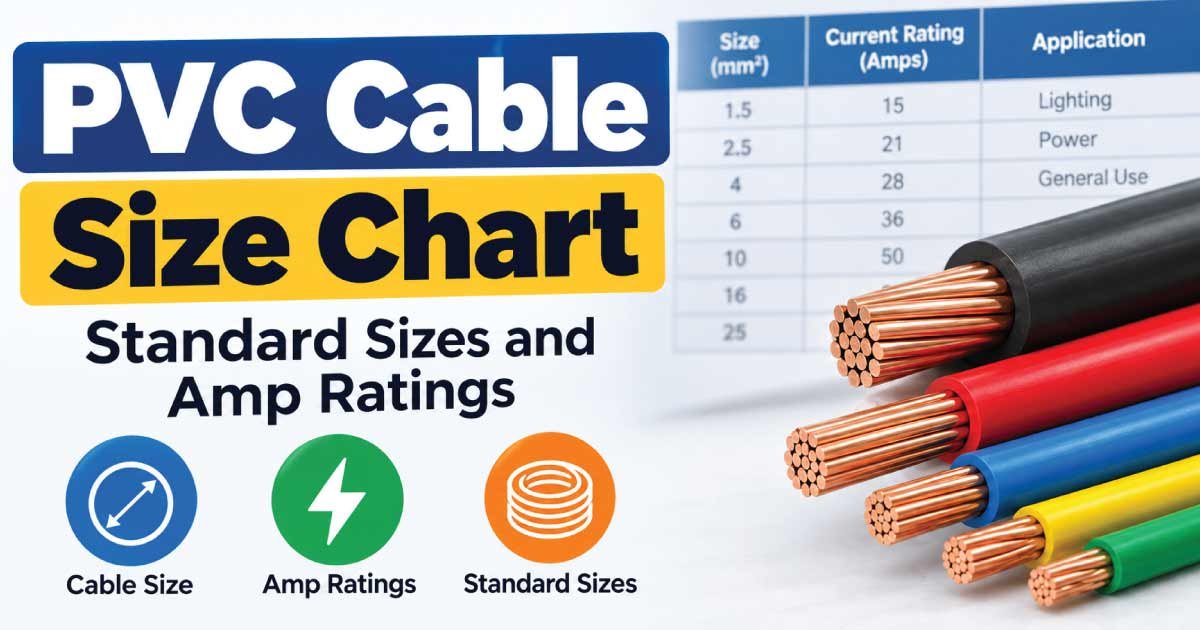
Choosing the correct PVC cable size is essential for safe and reliable electrical installations. PVC-insulated cables are widely used in homes, commercial buildings, industrial facilities, control systems, and electrical distribution because PVC provides practical insulation, mechanical protection, and resistance to moisture and many common environmental conditions.
However, cable size should not be selected by conductor diameter alone. The correct size depends on load current, conductor material, insulation temperature rating, installation method, ambient temperature, number of loaded conductors, voltage drop, and short-circuit requirements.
This PVC cable size chart covers common cable sizes in mm², copper and aluminum conductors, typical applications, current-carrying capacity considerations, cable types, voltage drop, and practical selection guidelines.
What Is a PVC Cable?
PVC cable is an electrical cable that uses polyvinyl chloride (PVC) as insulation around one or more conductors and, depending on its construction, may also use PVC as an outer sheath.
PVC is a thermoplastic material commonly used in electrical wiring because it offers a useful combination of:
- Electrical insulation
- Mechanical protection
- Moisture resistance
- Chemical resistance
- Flexibility in suitable formulations
- Cost-effectiveness
- Ease of manufacturing
PVC cables are available with copper or aluminum conductors and in many different sizes and configurations.
The exact properties of a PVC cable depend on its insulation formulation, conductor material, voltage rating, number of cores, and applicable cable standard.
PVC Cable Size Chart
PVC cables are commonly identified by the conductor’s cross-sectional area in square millimeters (mm²).
The following chart shows common PVC cable sizes and general applications.
| PVC Cable Size | Typical Conductor | Common Application |
|---|---|---|
| 0.5 mm² | Copper | Control and signal circuits |
| 0.75 mm² | Copper | Control and flexible wiring |
| 1.0 mm² | Copper | Lighting and control applications |
| 1.5 mm² | Copper | Lighting circuits |
| 2.5 mm² | Copper | General power circuits |
| 4 mm² | Copper | Medium power loads |
| 6 mm² | Copper | Larger branch circuits |
| 10 mm² | Copper/Aluminum | Feeders |
| 16 mm² | Copper/Aluminum | Distribution circuits |
| 25 mm² | Copper/Aluminum | Larger feeders |
| 35 mm² | Copper/Aluminum | Power distribution |
| 50 mm² | Copper/Aluminum | Higher-current feeders |
| 70 mm² | Copper/Aluminum | Industrial distribution |
| 95 mm² | Copper/Aluminum | Large feeders |
| 120 mm² | Copper/Aluminum | High-current systems |
| 150 mm² | Copper/Aluminum | Power distribution |
| 185 mm² | Copper/Aluminum | Heavy-duty feeders |
| 240 mm² | Copper/Aluminum | High-capacity systems |
| 300 mm² | Copper/Aluminum | Industrial power distribution |
| 400 mm² | Copper/Aluminum | Large power systems |
| 500 mm² | Copper/Aluminum | High-current distribution |
| 630 mm² | Copper/Aluminum | Very large power systems |
This is a reference size chart, not a universal ampacity table. The allowable current varies according to cable construction and installation conditions.
PVC Cable Current Carrying Capacity
The current-carrying capacity, commonly called ampacity, indicates how much current a conductor can carry under specified conditions without exceeding its allowable operating temperature.
There is no single ampacity value that applies to every PVC cable of the same size.
For example, the allowable current for a 10 mm² copper PVC cable can vary depending on whether the cable is:
- Installed in conduit
- Installed in trunking
- Installed on a tray
- Buried underground
- Surrounded by thermal insulation
- Installed alongside other loaded cables
- Exposed to high ambient temperatures
Cable construction also matters.
Therefore, an accurate ampacity calculation should use the appropriate table from the governing electrical standard or the cable manufacturer’s technical data.
PVC Cable Size and Conductor Material
PVC cable can be manufactured with copper or aluminum conductors.
Copper PVC Cable
Copper is widely used because of its high electrical conductivity and favorable termination characteristics.
Common copper PVC cable sizes include:
- 1.0 mm²
- 1.5 mm²
- 2.5 mm²
- 4 mm²
- 6 mm²
- 10 mm²
- 16 mm²
- 25 mm²
- 35 mm²
- 50 mm²
- 70 mm²
- 95 mm²
- 120 mm²
- 150 mm²
- 185 mm²
- 240 mm² and larger
Copper is especially common in building wiring and smaller electrical circuits.
Aluminum PVC Cable
Aluminum is often used in larger power-distribution cables because it offers lower density and can be economical for large conductor systems.
Common sizes include:
- 16 mm²
- 25 mm²
- 35 mm²
- 50 mm²
- 70 mm²
- 95 mm²
- 120 mm²
- 150 mm²
- 185 mm²
- 240 mm²
- 300 mm²
- 400 mm²
- 500 mm²
- 630 mm²
When aluminum is used, terminals and connectors must be suitable for aluminum conductors and installed according to their requirements.
Discover More:
PVC Cable Size in mm²
Unlike AWG wire sizing, which is common in North America, many international electrical systems identify cable conductors by their cross-sectional area in mm².
For example:
- 1.5 mm² indicates a conductor with a nominal cross-sectional area of 1.5 square millimeters.
- 2.5 mm² indicates a 2.5 square millimeter conductor.
- 10 mm² indicates a 10 square millimeter conductor.
- 95 mm² indicates a 95 square millimeter conductor.
As the mm² value increases, the conductor’s cross-sectional area increases.
However, the overall outside diameter of the finished cable will be larger than the conductor itself because it also includes insulation, fillers, screens, armor, and/or an outer sheath depending on its design.
PVC Cable Size by Number of Cores
PVC cables are available in different core configurations.
| Cable Configuration | Typical Construction | Common Application |
|---|---|---|
| 1-Core | One insulated conductor | Single-conductor power systems |
| 2-Core | Two insulated conductors | Single-phase circuits |
| 3-Core | Three insulated conductors | Three-phase or other circuits |
| 4-Core | Four insulated conductors | Three-phase plus neutral |
| 5-Core | Five insulated conductors | Three-phase, neutral, and additional conductor arrangements |
The required number of cores depends on the electrical system.
For example, a three-phase circuit without a neutral may use a three-core cable, while a three-phase system requiring a neutral may use a four-core cable.
PVC Cable Size for Common Electrical Loads
Cable size should always be calculated for the actual installation, but common conductor sizes are frequently associated with different types of electrical loads.
| Cable Size | Typical General Use |
|---|---|
| 1.0 mm² | Control and light-duty circuits |
| 1.5 mm² | Lighting and small loads |
| 2.5 mm² | General socket and power circuits |
| 4 mm² | Medium power circuits |
| 6 mm² | Higher-load branch circuits |
| 10 mm² | Feeders and larger equipment |
| 16 mm² | Distribution feeders |
| 25 mm² | Larger distribution systems |
| 35 mm² | Industrial feeders |
| 50 mm² | Higher-current distribution |
| 70 mm² | Industrial power systems |
| 95 mm² | Large feeders |
| 120 mm²+ | High-capacity distribution |
These are general application examples, not fixed load ratings. Actual cable selection must account for the installation conditions.
Discover More:
How to Choose the Correct PVC Cable Size
Choosing the correct PVC cable size involves several steps.
1. Determine the Load Current
First determine how much current the circuit must carry.
For electrical equipment, check the nameplate or technical documentation for:
- Rated voltage
- Rated current
- Power
- Power factor
- Efficiency
- Starting current where applicable
- Continuous or intermittent operation
For a three-phase system, power and current are related through the system voltage, power factor, and efficiency where relevant.
2. Select the Conductor Material
Decide whether the cable will use:
- Copper
- Aluminum
The conductor material affects resistance, ampacity, weight, cost, and termination requirements.
3. Check the Installation Method
Determine how the cable will be installed.
Possible methods include:
- Conduit
- Cable tray
- Trunking
- Direct burial
- Underground duct
- Free air
- Building cavities
The installation method can significantly affect heat dissipation and allowable current.
4. Apply Correction Factors
Cable ampacity may need to be adjusted for conditions such as:
- High ambient temperature
- Multiple loaded circuits
- Grouped cables
- Thermal insulation
- Soil conditions
- Installation arrangement
These correction factors can increase the required conductor size.
5. Check Voltage Drop
After confirming ampacity, check the voltage drop for the actual cable length.
A longer cable run generally has greater resistance and therefore greater voltage drop.
Discover More:
PVC Cable Voltage Drop
Voltage drop occurs when electrical resistance in the conductor causes part of the supply voltage to be lost between the source and load.
This becomes more important with:
- Long cable runs
- High-current loads
- Low-voltage systems
- Motors
- Pumps
- Heating equipment
- Remote buildings
- Outdoor equipment
A larger cable generally has lower resistance and can reduce voltage drop.
For example, if a 2.5 mm² cable is adequate for a short run but the same load must travel a much greater distance, a larger conductor may be required to maintain an acceptable voltage at the equipment.
The actual voltage-drop calculation should be based on cable resistance/reactance, current, length, power factor, and circuit arrangement.
PVC vs XLPE Cable
PVC and XLPE are two common cable insulation materials.
| Feature | PVC | XLPE |
|---|---|---|
| Insulation Material | Polyvinyl chloride | Cross-linked polyethylene |
| Typical Thermal Rating | Depends on cable design | Commonly higher |
| Electrical Insulation | Good | Excellent |
| Power Distribution | Widely used | Widely used |
| Temperature Performance | Moderate | Higher |
| Typical Cost | Often economical | Often higher |
| Applications | Building and general wiring | Power and distribution systems |
XLPE is often selected where higher conductor operating temperature and power-distribution performance are advantageous.
PVC remains popular for general electrical wiring because it provides a practical and economical insulation system.
Neither should automatically be considered better for every installation.
PVC Cable vs XLPE Cable Current Capacity
For cables with otherwise comparable construction, XLPE insulation can permit a higher conductor operating temperature than many PVC cable designs.
This can result in a higher allowable current under certain installation conditions.
However, current capacity is affected by the complete cable design.
For accurate selection, compare the manufacturer’s data for:
- Conductor size
- Number of cores
- Insulation type
- Installation method
- Ambient temperature
- Cable spacing
- Permitted conductor temperature
This is more reliable than assuming a fixed percentage difference between PVC and XLPE cables.
PVC Cable Applications
PVC cables are used in a wide variety of electrical systems.
Typical applications include:
- Residential wiring
- Commercial buildings
- Industrial facilities
- Lighting circuits
- Socket circuits
- Control panels
- Machinery
- Motor circuits
- Distribution boards
- Feeders
- Building services
- Control and instrumentation systems
- Electrical equipment
The specific PVC cable construction should match the environment and electrical requirements.
For example, a standard PVC-insulated cable should not automatically be assumed suitable for outdoor, underground, high-temperature, or chemically aggressive environments.
PVC Cable Types
PVC is used in several cable constructions.
PVC Insulated Single-Core Cable
Single-core PVC cables contain one conductor with PVC insulation.
They are commonly used inside electrical equipment, control panels, conduits, and other wiring systems where the installation method permits them.
PVC Multi-Core Cable
Multi-core cables contain multiple insulated conductors within one cable assembly.
They can simplify installation because several circuit conductors are combined into one cable.
PVC Armored Cable
Armored PVC cables include an additional metallic protective layer.
Armor may provide mechanical protection in installations where the cable could experience physical damage.
PVC Flexible Cable
Flexible PVC cables are designed for applications where repeated movement or easier routing is required.
The conductor construction and insulation formulation determine the cable’s flexibility and permitted application.
PVC Cable Size and Short-Circuit Protection
Normal operating current is only one part of cable selection.
A cable may also need to withstand the thermal and mechanical effects of a short circuit until the protective device disconnects the fault.
Short-circuit performance depends on factors such as:
- Conductor material
- Conductor cross-sectional area
- Initial conductor temperature
- Maximum permitted conductor temperature
- Fault duration
- Protective-device clearing time
For larger feeders and distribution systems, short-circuit calculations can be particularly important.
Common PVC Cable Sizing Mistakes
Choosing Cable Size Only by Load Current
Ampacity is important, but it is not the only factor. Voltage drop and installation conditions can require a larger cable.
Ignoring Cable Grouping
Several cables installed together can generate additional heat and reduce allowable current.
Confusing Conductor Area With Cable Diameter
A 25 mm² cable normally refers to the conductor cross-sectional area. It does not mean the finished cable has a 25 mm diameter.
Ignoring Ambient Temperature
High temperatures can reduce allowable cable ampacity.
Using the Wrong Cable Construction
A cable designed for indoor building wiring should not automatically be used in wet, underground, high-temperature, or mechanically hazardous environments.
Ignoring Manufacturer Data
Cable manufacturers can provide important information about resistance, current ratings, dimensions, installation conditions, and temperature limits.
PVC Cable Size FAQs
What is PVC cable used for?
PVC cable is widely used for electrical wiring and power distribution in residential, commercial, industrial, and control applications. Depending on its construction, PVC-insulated cable can be used for lighting, power circuits, equipment connections, control systems, and distribution feeders.
What is the most common PVC cable size?
There is no single most common size for every application. 1.5 mm² and 2.5 mm² copper cables are widely encountered in building wiring, while larger sizes such as 4, 6, 10, and 16 mm² are used for progressively larger circuits and feeders.
Is PVC cable suitable for outdoor use?
It depends on the specific cable construction and its markings. Standard PVC insulation alone does not make every cable suitable for outdoor exposure. The complete cable must be rated for the environmental conditions and installation method.
Which is better, PVC or XLPE cable?
Neither is universally better. PVC can be an economical choice for general wiring, while XLPE is commonly selected for power-distribution applications requiring higher thermal performance. The appropriate choice depends on voltage, load, environment, installation method, and applicable standards.
How do I calculate PVC cable size?
Start by determining the load current, then evaluate conductor material, installation method, ambient temperature, grouping, voltage drop, and short-circuit requirements. Compare the resulting requirements with the cable manufacturer’s data or applicable electrical standard to select the appropriate conductor size.
Final Thoughts on PVC Cable Size
The correct PVC cable size depends on the complete electrical installation rather than conductor area alone. Common sizes range from small 0.5 mm² and 0.75 mm² control conductors to very large 300 mm², 400 mm², 500 mm², and 630 mm² power cables.
When selecting a PVC cable, consider load current, conductor material, number of cores, insulation rating, installation method, ambient temperature, cable grouping, voltage drop, short-circuit withstand, and environmental conditions.
A cable-size chart is useful for understanding available sizes, but the final selection should be verified using the applicable electrical standard and manufacturer specifications. For large power systems or complex installations, professional electrical design is recommended.