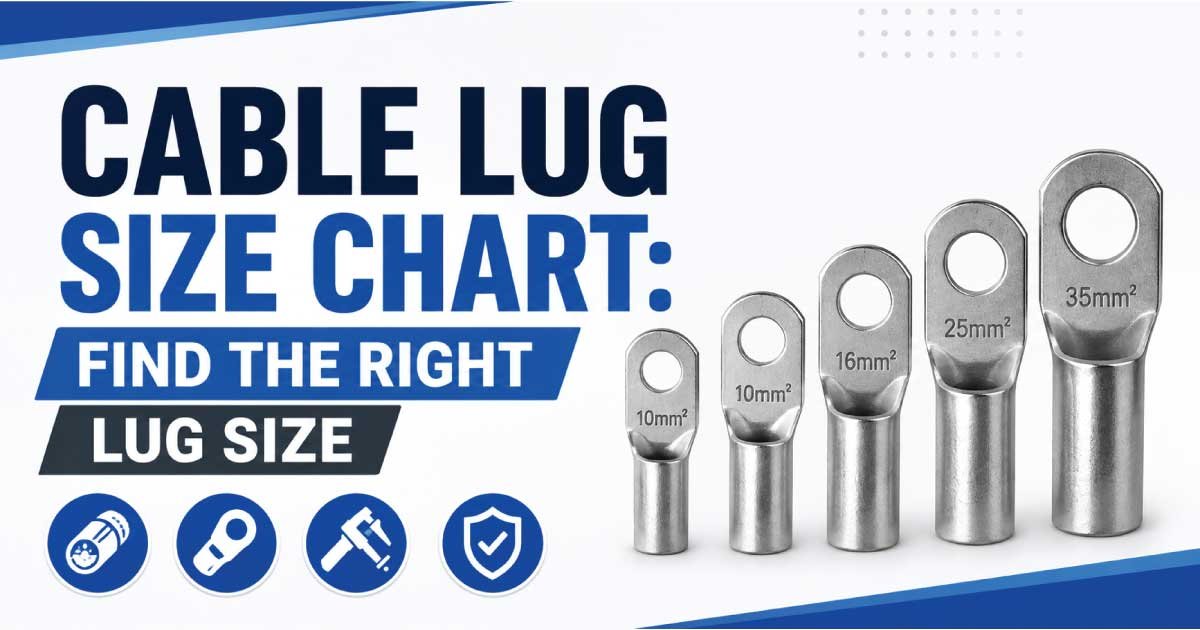
A cable lug size chart helps identify the correct lug for different cable sizes, conductor types, stud diameters, and electrical applications. Cable lugs provide a secure connection between cables and terminals in panels, batteries, switchgear, motors, and electrical equipment.
Choosing the correct cable lug requires matching the cable cross-sectional area, conductor material, lug type, stud-hole diameter, and installation requirements. A properly selected lug improves electrical conductivity and provides a mechanically secure connection.
What Is a Cable Lug?
A cable lug is a connector fitted to the end of an electrical cable to create a reliable connection with a terminal, busbar, breaker, battery post, or other electrical equipment.
Cable lugs are commonly used for:
- Electrical panels
- Distribution boards
- Circuit breakers
- Batteries
- Transformers
- Motors
- Switchgear
- Busbars
- Generators
- Industrial machinery
Lugs are available in different materials, shapes, sizes, and connection methods depending on the application.
How Does a Cable Lug Work?
A cable lug provides a termination point between a conductor and electrical equipment. The stripped cable is inserted into the lug barrel and secured by crimping, compression, soldering, or another approved connection method.
A typical installation involves:
- Removing the required cable insulation.
- Selecting the correct lug.
- Inserting the conductor into the barrel.
- Crimping the lug with the appropriate tool.
- Inspecting the connection.
- Attaching the lug to the terminal.
Correct installation helps reduce resistance, heating, and connection failure.
Cable Lug Size Chart
Cable lug sizes are generally identified according to the cable cross-sectional area and terminal or stud-hole size. The following chart provides common reference sizes for copper and aluminum cable applications.
| Cable Size | Approx. AWG | Common Lug Stud Size |
|---|---|---|
| 1.5 mm² | 16 AWG | M4–M5 |
| 2.5 mm² | 14 AWG | M4–M6 |
| 4 mm² | 12 AWG | M5–M6 |
| 6 mm² | 10 AWG | M6 |
| 10 mm² | 8 AWG | M6–M8 |
| 16 mm² | 6 AWG | M6–M10 |
| 25 mm² | 4 AWG | M8–M10 |
| 35 mm² | 2 AWG | M8–M12 |
| 50 mm² | 1/0 AWG | M10–M12 |
| 70 mm² | 2/0 AWG | M10–M12 |
| 95 mm² | 3/0 AWG | M12 |
| 120 mm² | 4/0 AWG | M12–M14 |
| 150 mm² | 300 kcmil approx. | M12–M16 |
| 185 mm² | 350 kcmil approx. | M14–M16 |
| 240 mm² | 500 kcmil approx. | M16–M20 |
Cable lug dimensions and stud-hole combinations vary by manufacturer and lug series. Always verify the manufacturer’s dimensional chart before installation.
Cable Lug Size by Cable Area
The cable cross-sectional area is one of the most important measurements when selecting a lug. The lug barrel must accommodate the conductor securely without being too small or excessively large.
Common cable sizes include:
- 1.5 mm²
- 2.5 mm²
- 4 mm²
- 6 mm²
- 10 mm²
- 16 mm²
- 25 mm²
- 35 mm²
- 50 mm²
- 70 mm²
- 95 mm²
- 120 mm²
- 150 mm²
- 185 mm²
- 240 mm²
The lug should be specifically designed for the conductor size being terminated.
Cable Lug Size by AWG
In North American electrical systems, cable sizes are often identified using the American Wire Gauge (AWG) system. Cable lugs may therefore be marked with AWG sizes rather than metric cross-sectional areas.
Common AWG sizes include:
| AWG Size | Approx. Metric Equivalent |
|---|---|
| 18 AWG | 0.75 mm² |
| 16 AWG | 1.5 mm² |
| 14 AWG | 2.5 mm² |
| 12 AWG | 4 mm² |
| 10 AWG | 6 mm² |
| 8 AWG | 10 mm² |
| 6 AWG | 16 mm² |
| 4 AWG | 25 mm² |
| 2 AWG | 35 mm² |
| 1/0 AWG | 50 mm² |
| 2/0 AWG | 70 mm² |
| 3/0 AWG | 95 mm² |
| 4/0 AWG | 120 mm² |
These are approximate equivalents because AWG and metric cable sizing systems are based on different standards.
Also Read: USB Cable Size Chart: Find the Right USB Cable Size
Cable Lug Stud Hole Size
The stud-hole diameter determines whether the lug can properly fit onto a bolt, terminal stud, breaker connection, or busbar.
Common stud-hole sizes include:
- M4
- M5
- M6
- M8
- M10
- M12
- M14
- M16
- M20
For example, a lug designed with an M10 hole should be selected when the connection requires the corresponding terminal stud size and clearance.
Cable Lug Types
Cable lugs are available in several designs. Each type is intended for particular termination methods, cable materials, installation environments, or equipment connections.
Common types include:
- Copper cable lugs
- Aluminum cable lugs
- Bimetallic lugs
- Compression lugs
- Mechanical lugs
- Ring lugs
- Fork lugs
- Pin lugs
- Long-barrel lugs
- Short-barrel lugs
Selecting the correct lug type improves both mechanical strength and electrical performance.
Copper Cable Lugs
Copper cable lugs are commonly used with copper conductors because they provide good electrical conductivity and are suitable for many power and control applications.
Copper lugs are commonly found in:
- Electrical panels
- Switchgear
- Motors
- Transformers
- Batteries
- Grounding systems
- Distribution equipment
The lug should match the conductor material and be suitable for the intended operating environment.
Aluminum Cable Lugs
Aluminum cable lugs are designed for terminating aluminum conductors. Aluminum conductors require appropriate termination methods because their physical and electrical properties differ from copper.
When using aluminum lugs, consider:
- Conductor size
- Lug material
- Oxidation
- Crimping method
- Manufacturer instructions
- Terminal compatibility
- Required joint compound where specified
Using the correct aluminum-rated lug helps create a reliable conductor termination.
Bimetallic Cable Lugs
Bimetallic cable lugs are commonly used when an aluminum conductor must connect to copper equipment or terminals. They are designed to help address compatibility issues between the two different conductor materials.
Typical applications include:
- Aluminum power cables
- Copper busbars
- Transformers
- Switchgear
- Distribution equipment
- Electrical panels
The lug must be selected according to the conductor size and terminal requirements.
Also Read: Transformer Wire Gauge Chart: Choose the Right AWG
Compression Cable Lugs
Compression lugs are installed by applying controlled mechanical force with a suitable crimping or compression tool. Proper compression creates a strong electrical and mechanical connection between the cable and lug.
Compression lugs are widely used in:
- Power distribution
- Industrial installations
- Switchgear
- Transformers
- Motors
- Battery systems
The correct die and crimping procedure are essential for reliable installation.
Mechanical Cable Lugs
Mechanical cable lugs use bolts, screws, or shear-head mechanisms to secure the conductor rather than requiring conventional crimping equipment.
Advantages can include:
- Easier installation
- Reusable designs in some applications
- No specialized hydraulic crimper for certain types
- Suitable for larger conductors
- Flexible installation
The manufacturer’s torque specifications must be followed carefully.
Ring Cable Lugs
A ring cable lug has a closed circular terminal opening that fits around a screw or stud. The closed ring helps keep the connection secured when properly installed.
Ring lugs are commonly used for:
- Control wiring
- Ground connections
- Battery terminals
- Electrical panels
- Small power circuits
The ring-hole diameter must match the terminal hardware.
Fork Cable Lugs
Fork or spade lugs have an open-ended terminal shape that can be installed under a screw without completely removing the fastener. They are commonly used in smaller electrical and control applications.
Typical uses include:
- Control panels
- Terminal blocks
- Switches
- Relays
- Small electrical equipment
Fork lugs should be used only where the terminal design permits them.
Cable Lug Barrel Size
The barrel is the section of the lug that receives the stripped conductor. Its internal diameter and length are important for achieving the required electrical and mechanical connection.
A suitable barrel should:
- Match the conductor size.
- Accept the full required conductor length.
- Allow correct crimping.
- Provide adequate mechanical strength.
- Be compatible with the conductor material.
Do not force an oversized conductor into an undersized lug.
Cable Lug Material
Cable lug material should be compatible with the conductor and terminal. Copper, aluminum, and bimetallic designs are commonly used for different applications.
| Lug Material | Common Application |
|---|---|
| Copper | Copper conductors |
| Tinned Copper | Corrosion-resistant connections |
| Aluminum | Aluminum conductors |
| Bimetallic | Aluminum-to-copper connections |
| Nickel-plated | Specialized environments |
Material selection should consider conductivity, corrosion resistance, temperature, and compatibility.
Also Read: Wire Size Chart: Choose the Right Wire Size Every Time
Tinned Copper Cable Lugs
Tinned copper lugs have a protective tin coating over copper. The coating can improve resistance to corrosion and is useful in environments where moisture or other corrosive conditions may be present.
Tinned copper lugs can be useful for:
- Marine equipment
- Battery systems
- Outdoor installations
- Industrial equipment
- Power distribution
- Grounding connections
The lug must still be rated for the specific conductor and application.
Cable Lug Crimping
Correct crimping is essential for compression-type cable lugs. A proper crimp creates the required electrical contact and mechanical grip between the conductor and lug barrel.
A typical crimping process includes:
- Select the correct lug.
- Strip the cable to the specified length.
- Insert the conductor completely.
- Position the correct crimp die.
- Apply the specified compression.
- Inspect the finished crimp.
- Install the lug on the terminal.
- Tighten according to specified torque.
Using the wrong die can produce an unreliable connection.
Cable Lug Size and Current Capacity
Cable lug current capacity is closely related to the conductor size, lug design, material, temperature rating, and installation conditions. A larger cable does not automatically mean every lug of the same nominal size has identical performance.
Consider:
- Cable cross-sectional area
- Conductor material
- Lug material
- Current load
- Temperature
- Installation environment
- Manufacturer rating
- Applicable standards
The lug should be rated for the intended electrical load.
How to Choose the Correct Cable Lug
Selecting the correct cable lug requires matching the conductor, terminal, connection method, and application. Physical fit alone is not enough to guarantee a reliable electrical connection.
Follow these steps:
- Identify cable material.
- Determine cable cross-sectional area.
- Identify AWG size if applicable.
- Select the correct lug material.
- Check barrel size.
- Determine stud-hole diameter.
- Select compression or mechanical type.
- Verify current rating.
- Check temperature rating.
- Follow manufacturer installation instructions.
Common Cable Lug Sizing Mistakes
Incorrect lug selection can cause loose connections, increased resistance, overheating, and premature electrical failure. Many problems occur because users select a lug based only on cable size.
Avoid these mistakes:
- Using the wrong cable size lug
- Ignoring conductor material
- Choosing the wrong stud-hole diameter
- Using an incorrect crimp die
- Over-crimping the lug
- Under-crimping the lug
- Mixing incompatible materials
- Ignoring torque requirements
- Using damaged lugs
- Installing a lug without checking its rating
Key Points to Remember
A cable lug size chart provides a useful starting point for selecting terminals for different cable sizes and electrical applications. However, proper selection requires checking the conductor, lug material, stud size, connection method, and manufacturer specifications.
Always remember:
- Match the lug to cable size.
- Check conductor material.
- Verify stud-hole size.
- Select the correct lug type.
- Use the proper crimping tool and die.
- Follow specified crimping procedures.
- Check current and temperature ratings.
- Use compatible materials.
- Follow terminal torque requirements.
- Replace damaged or deformed lugs.
Cable Lug Size for Different Cable Applications
The correct cable lug depends on the conductor size, material, terminal connection, current, installation environment, and equipment requirements. Different applications may require copper, aluminum, bimetallic, compression, or mechanical lugs.
| Application | Common Lug Type | Typical Cable Range* |
|---|---|---|
| Battery Connection | Copper/Tinned Copper | 4–120 mm² |
| Grounding | Copper | 2.5–120 mm² |
| Electrical Panel | Copper | 1.5–240 mm² |
| Motor Connection | Copper/Aluminum | 6–240 mm² |
| Transformer | Copper/Aluminum/Bimetallic | 25–500 mm² |
| Switchgear | Compression/Mechanical | 16–500 mm² |
| Generator | Copper/Aluminum | 25–500 mm² |
| Busbar Connection | Copper/Bimetallic | 16–500 mm² |
| Industrial Machinery | Compression/Mechanical | 6–300 mm² |
Ranges are general examples. Actual lug selection depends on the conductor, equipment rating, manufacturer specifications, installation method, and applicable standards.
Cable Lug Size for Battery Cables
Battery cables require lugs that can handle high current while providing a secure mechanical connection. Tinned copper lugs are commonly used where corrosion resistance is important, particularly in demanding environments.
When selecting battery lugs, check:
- Cable cross-sectional area
- Battery terminal size
- Lug material
- Stud-hole diameter
- Current capacity
- Cable flexibility
- Environmental conditions
The lug should fit both the cable and battery terminal without excessive movement.
Cable Lug Size for Grounding Cables
Grounding connections require reliable mechanical and electrical contact. Copper lugs are commonly used for grounding conductors, although the correct material depends on the grounding system and equipment.
Consider:
- Ground conductor size
- Grounding terminal
- Stud-hole diameter
- Conductor material
- Corrosion environment
- Fault-current requirements
- Installation method
Grounding connections should be installed according to the applicable electrical code and equipment requirements.
Cable Lug Size for Solar Cables
Solar electrical systems can use specialized cable terminations depending on the system design and equipment. Where conventional lugs are used, the lug must match the cable size, conductor material, and terminal connection.
Important considerations include:
- Solar cable cross-section
- Copper or aluminum conductor
- Equipment terminal
- Outdoor exposure
- UV and moisture conditions
- Temperature rating
- Corrosion resistance
Outdoor connections should use components specifically rated for the environmental conditions.
Cable Lug Size for Inverter Connections
Inverters can carry substantial DC or AC current, particularly in larger solar and battery systems. Correct lug selection is important because a poor connection can create resistance and heat.
Check:
- Maximum inverter current
- Cable size
- DC or AC side
- Terminal stud size
- Lug material
- Temperature rating
- Manufacturer requirements
Always follow the inverter manufacturer’s specified cable and terminal requirements.
Cable Lug Size for Motor Cables
Motor connections experience vibration, temperature changes, and starting currents, making proper cable termination particularly important. Compression lugs or other approved terminal systems may be used depending on the equipment.
Before selecting the lug, verify:
- Motor current
- Cable size
- Conductor material
- Motor terminal size
- Lug hole diameter
- Temperature rating
- Crimping requirements
The finished connection should be mechanically secure and properly torqued.
Cable Lug Size for Transformer Connections
Transformers often use relatively large conductors because their primary and secondary circuits can carry significant current. The lug must be selected according to conductor size and transformer terminal requirements.
Important factors include:
- Transformer rating
- Primary or secondary connection
- Cable size
- Conductor material
- Terminal stud size
- Lug material
- Current rating
- Temperature rating
Bimetallic lugs may be required when aluminum conductors connect to copper terminals.
Cable Lug Size for Generators
Generators require reliable cable connections because their output terminals can carry high continuous current. Proper lug selection is especially important for large generator installations.
Check:
- Generator output
- Cable size
- Conductor material
- Terminal configuration
- Stud diameter
- Lug current rating
- Temperature rating
- Manufacturer requirements
Large generator connections may use compression or mechanical lugs depending on the equipment design.
Cable Lug Size for Switchgear
Switchgear commonly uses large power cables connected to busbars, breakers, or other switching equipment. Cable lugs must be compatible with the equipment terminal and provide sufficient current capacity.
Important selection factors include:
- Cable cross-sectional area
- Terminal type
- Stud-hole diameter
- Lug dimensions
- Current rating
- Short-circuit requirements
- Installation clearance
The lug should fit the switchgear terminal without interfering with adjacent components.
Cable Lug Size for Busbars
Busbar connections require lugs with appropriate hole sizes, barrel dimensions, and conductor capacity. The terminal opening must match the busbar hardware while maintaining sufficient contact area.
Consider:
- Cable size
- Lug width
- Hole diameter
- Bolt size
- Busbar thickness
- Current capacity
- Material compatibility
Proper tightening and contact pressure are important for maintaining a low-resistance connection.
Cable Lug Size for Aluminum Cables
Aluminum cables require appropriately rated aluminum or bimetallic lugs. Using an unsuitable copper-only lug can create compatibility and connection problems.
When terminating aluminum conductors, consider:
- Aluminum-rated lug
- Conductor size
- Oxidation
- Proper preparation
- Manufacturer-approved compound where required
- Correct crimping method
- Terminal material
Follow the lug manufacturer’s instructions for conductor preparation and installation.
Cable Lug Size for Copper Cables
Copper conductors are commonly terminated with copper or tinned copper lugs. The lug should have the correct barrel size and terminal hole for the application.
Copper lugs are widely used in:
- Electrical panels
- Batteries
- Motors
- Transformers
- Grounding systems
- Industrial machinery
Tinned copper can provide additional corrosion resistance in suitable environments.
Cable Lug Size for Flexible Cables
Flexible cables can require specially designed lugs because their strands may be finer and more numerous than those of rigid conductors. The lug should be approved for the specific conductor construction.
Consider:
- Cable flexibility
- Number of strands
- Conductor diameter
- Barrel design
- Crimping method
- Terminal requirements
Using a lug designed for the wrong conductor type can result in an unreliable termination.
Cable Lug Size for Stranded Wire
Stranded conductors require a lug barrel that can accommodate the strands correctly. The conductor should be fully inserted into the barrel before compression.
For stranded cable:
- Strip only the required insulation length.
- Avoid cutting conductor strands.
- Keep strands together.
- Insert the conductor completely.
- Use the correct crimp die.
- Inspect the finished crimp.
Never remove strands simply to make an oversized conductor fit into a smaller lug.
Cable Lug Size for Large Power Cables
Large power cables require appropriately rated compression or mechanical lugs. These lugs must withstand both electrical load and mechanical forces associated with large conductors.
Important factors include:
- Cable size
- Current capacity
- Conductor material
- Lug material
- Stud size
- Crimping system
- Short-circuit withstand
- Installation environment
For large conductors, manufacturer-specific dimensional and installation instructions are especially important.
Cable Lug Crimping Tool Size
The crimping tool and die must match the lug and conductor combination. Using an incorrect die can result in insufficient compression or damage to the lug.
Common tools include:
- Hand crimpers
- Ratchet crimpers
- Hydraulic crimpers
- Battery-powered hydraulic crimpers
- Mechanical compression tools
The tool manufacturer and lug manufacturer should specify the appropriate die and crimp sequence.
Hydraulic Crimping for Cable Lugs
Hydraulic crimpers are commonly used for larger cable lugs because they can provide controlled compression force. They are particularly useful for larger power conductors that require substantial crimping pressure.
A typical process includes:
- Select the correct lug.
- Select the specified die.
- Strip the cable correctly.
- Insert the conductor.
- Position the die.
- Apply the specified compression.
- Complete the required crimps.
- Inspect the finished connection.
Always follow the manufacturer’s crimp pattern.
Cable Lug Torque Requirements
Correct torque is important when fastening a lug to a terminal, breaker, busbar, or equipment connection. Under-tightening can create a loose connection, while excessive torque can damage the terminal or hardware.
Before tightening:
- Check the manufacturer’s torque specification.
- Use a suitable torque wrench.
- Keep contact surfaces clean.
- Align the lug correctly.
- Tighten according to the specified procedure.
Do not guess the required torque for critical electrical connections.
Cable Lug Corrosion Protection
Corrosion can increase electrical resistance and weaken mechanical connections. The appropriate lug material and environmental protection should therefore be considered when installing cables outdoors, near moisture, or in corrosive environments.
Protection may involve:
- Tinned copper lugs
- Suitable terminal compounds
- Protective boots
- Sealing methods
- Corrosion-resistant hardware
- Proper enclosure protection
Only use compounds and protective materials approved for the specific connection.
Cable Lug Temperature Rating
Cable lugs must be suitable for the expected operating temperature of the conductor and connection point. Temperature affects conductor ampacity, insulation performance, and connection reliability.
Consider:
- Cable insulation temperature
- Lug material
- Equipment terminal rating
- Ambient temperature
- Continuous current
- Enclosure temperature
The lowest applicable component temperature rating should be considered when evaluating the complete connection.
Cable Lug Size vs Cable Size
Cable size and lug size are closely related, but they are not exactly the same measurement. The cable size identifies the conductor, while lug dimensions also include barrel length, outside diameter, stud-hole size, and overall geometry.
For example, a 25 mm² cable may require different lug variants depending on whether the connection uses:
- M6 stud
- M8 stud
- M10 stud
- Copper conductor
- Aluminum conductor
- Compression connection
- Mechanical connection
Always check the complete lug specification.
How to Measure a Cable Lug
Measuring an existing lug can help identify a replacement, but measurements should be combined with the original markings whenever possible.
Measure:
- Barrel inside diameter
- Barrel length
- Overall lug length
- Stud-hole diameter
- Lug width
- Conductor entry size
Also record the cable cross-sectional area and conductor material. These measurements can then be compared with the manufacturer’s dimensional chart.
How to Choose the Correct Cable Lug
The correct cable lug should match the cable, terminal, electrical load, environment, and installation method.
Use this selection process:
- Identify cable size.
- Determine conductor material.
- Check cable construction.
- Identify terminal or stud size.
- Select lug material.
- Choose ring, fork, pin, or compression type.
- Check current rating.
- Verify temperature rating.
- Select the correct crimp die.
- Follow installation and torque specifications.
Common Cable Lug Installation Mistakes
Cable lug failures are often caused by incorrect preparation, poor crimping, wrong hardware, or improper tightening. A lug that appears secure may still have a high-resistance connection if it is installed incorrectly.
Avoid:
- Using an undersized lug
- Using an oversized lug
- Cutting conductor strands
- Incorrect stripping length
- Using the wrong crimp die
- Under-crimping
- Over-crimping
- Incorrect torque
- Mixing incompatible metals
- Leaving loose strands outside the barrel
FAQs
How do I know what size cable lug I need?
Choose a cable lug that matches the conductor cross-sectional area, conductor material, and terminal stud size. You should also verify the lug’s current rating, temperature rating, connection method, and manufacturer specifications before installation.
What lug is used for a 10 mm² cable?
A 10 mm² cable commonly uses a lug designed specifically for 10 mm² conductors, with the stud-hole selected according to the terminal hardware. M6 and M8 variants are common, but the exact choice depends on the equipment connection.
What lug is used for a 25 mm² cable?
A 25 mm² cable generally requires a lug with a barrel designed for 25 mm² conductors. The terminal hole may vary, commonly including M8 or M10 configurations depending on the breaker, busbar, battery, or equipment terminal.
Can I use a copper lug on an aluminum cable?
A standard copper lug should not automatically be used with an aluminum conductor. Use an aluminum-rated or appropriately designed bimetallic lug when required, and follow the manufacturer’s conductor preparation and installation instructions.
What size crimping tool do I need for cable lugs?
The crimping tool and die must match the specific lug and cable size. For small conductors, a suitable hand or ratchet crimper may be sufficient, while larger power lugs often require hydraulic or manufacturer-approved compression tooling.
Final Thoughts
A cable lug size chart provides a convenient reference for matching cable sizes with suitable terminal connections. However, selecting the correct lug requires checking conductor material, cable size, stud diameter, lug design, current rating, temperature, and installation method.
Before installing a cable lug:
- Match the lug to the cable size.
- Check conductor material.
- Verify stud-hole diameter.
- Select the correct lug type.
- Use the correct crimping die.
- Follow the specified crimping procedure.
- Check terminal torque.
- Consider environmental conditions.
- Verify current and temperature ratings.
- Follow manufacturer instructions and applicable electrical standards.
A correctly selected and installed cable lug provides a strong electrical and mechanical connection and helps reduce resistance, overheating, and premature connection failure.