
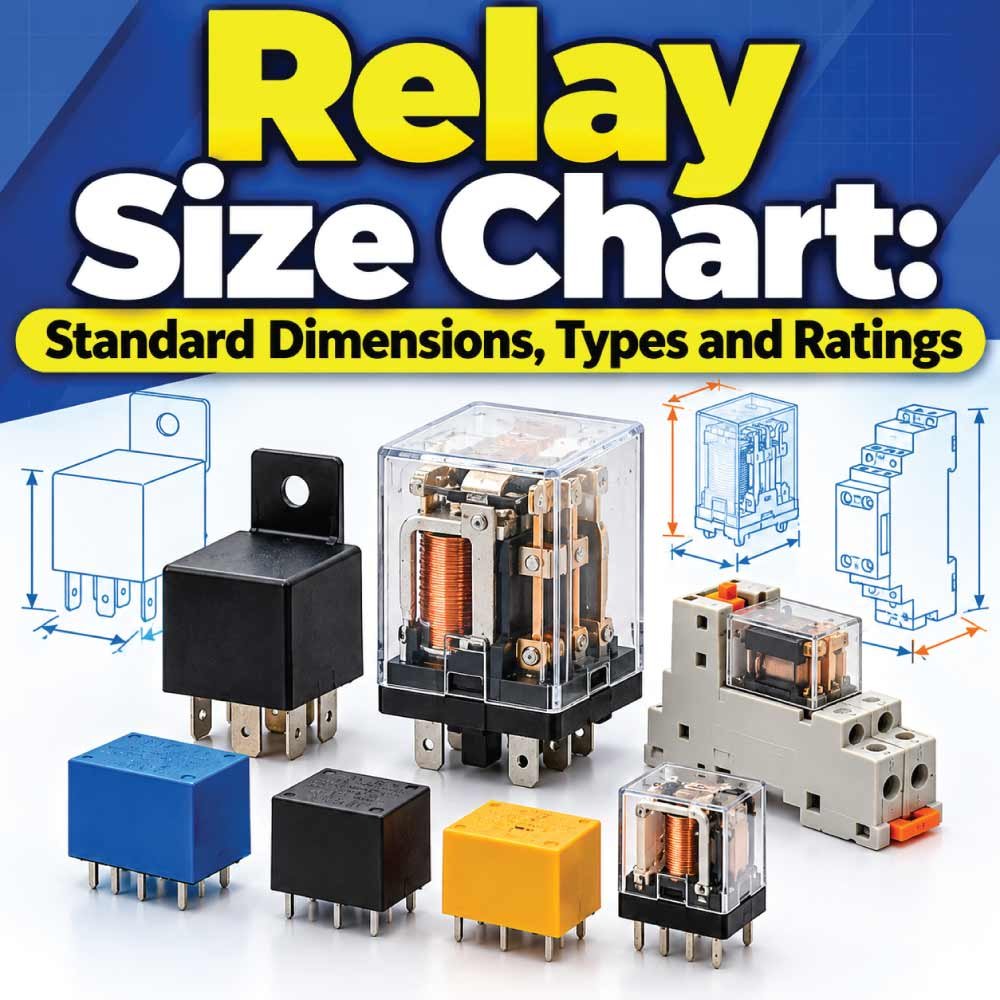
Choosing the correct relay size involves more than matching the physical dimensions. A relay must fit the available space while also meeting the required coil voltage, contact rating, switching capacity, mounting style, and electrical load requirements. Because relay dimensions vary by design and manufacturer, there is no single universal relay size.
This relay size chart explains common relay form factors, typical dimensions, coil specifications, contact arrangements, mounting options, and important selection factors. It is useful when replacing an existing relay, designing a control panel, selecting an automotive relay, or comparing compact and industrial relay types.
What Is a Relay?
A relay is an electrically operated switching device that allows a low-power control circuit to switch another circuit. It uses an energized coil, electronic control mechanism, or solid-state switching element to control electrical contacts or an output circuit.
Relays are used in control panels, industrial equipment, HVAC systems, automotive circuits, appliances, automation systems, power supplies, and electrical protection systems.
The word “size” can refer to several different characteristics:
- Physical body dimensions
- Coil size and construction
- Contact rating
- Number of poles and throws
- Mounting footprint
- Terminal arrangement
- Switching capacity
- Required installation space
Therefore, selecting a relay based only on its outside dimensions can result in an unsuitable replacement.
Relay Size Chart
The following chart provides practical size categories rather than claiming universal dimensions. Actual dimensions should always be checked against the specific relay’s datasheet.
| Relay Size Category | Typical Form | Approx. Width | Approx. Height | Typical Use |
|---|---|---|---|---|
| Micro | Miniature PCB relay | 10–15 mm | 10–15 mm | Compact electronics |
| Miniature | PCB or plug-in relay | 15–25 mm | 15–30 mm | Controls and appliances |
| Slim | Narrow DIN or interface relay | 5–10 mm | 70–100 mm | Control panels |
| Standard | Plug-in or PCB relay | 20–30 mm | 20–40 mm | General control |
| Power | Larger plug-in relay | 25–40 mm | 30–50 mm | Higher-current loads |
| Industrial | Relay module or contact-style unit | 30–50+ mm | 50–100+ mm | Automation and panels |
These ranges are general size categories, not universal standards. Relay dimensions can differ substantially even when two devices have similar electrical ratings.
Common Relay Types and Their Sizes
Relay construction has a major effect on its physical size. A small PCB relay may have a much smaller footprint than an industrial plug-in relay designed for field wiring.
Electromechanical Relays
Electromechanical relays use a coil and mechanical contacts. They are available in miniature, standard, automotive, and industrial packages.
Their size depends on:
- Coil construction
- Number of contacts
- Contact current rating
- Insulation requirements
- Mounting arrangement
- Switching mechanism
Higher-current versions commonly require larger contacts and internal components.
Solid-State Relays
Solid-state relays have no conventional mechanical switching contacts. They use semiconductor components to switch the load.
They can be compact, but physical size is often influenced by load current, heat dissipation, terminal design, and the need for a heat sink.
Automotive Relays
Automotive relays are commonly designed around standardized terminal layouts and compact housings. Common applications include lighting, fans, pumps, horns, motors, and other vehicle circuits.
Automotive relay packages may look similar externally while having different contact configurations and current ratings, so the terminal diagram must be checked before replacement.
Reed Relays
Reed relays use magnetically operated reed contacts. They are generally designed for low-power switching and can have very compact bodies.
They are often selected when small size, low contact capacitance, or electrical isolation is important.
Relay Dimensions to Measure
When replacing a relay, physical dimensions should be measured systematically rather than relying on the product name alone.
Body Width
Measure the widest portion of the relay housing. Make sure nearby wiring, terminal blocks, and enclosure walls do not interfere with installation.
Body Length
Measure from the front to the rear of the housing. For PCB relays, the body length is especially important because it affects the available board area.
Body Height
Relay height matters when the component is installed inside a control cabinet, electrical enclosure, or equipment with limited vertical clearance.
Mounting Footprint
The mounting footprint includes the location and spacing of terminals, pins, sockets, brackets, or mounting holes.
Two relays with nearly identical body dimensions may have completely different mounting footprints.
Terminal Spacing
Terminal arrangement is critical when replacing plug-in or PCB relays. Even a relay with the correct electrical rating may not fit if its terminal pattern is different.
Relay Coil Size and Voltage Chart
The coil is the control portion of an electromechanical relay. Its voltage must match the circuit that energizes it.
| Coil Voltage | Common Application Area | Important Consideration |
|---|---|---|
| 5 V DC | Electronics and control boards | Verify coil current |
| 6 V DC | Specialized low-voltage systems | Match exact specification |
| 9 V DC | Electronic equipment | Less common than 5 or 12 V |
| 12 V DC | Automotive and control systems | Very common in low-voltage systems |
| 24 V DC | Industrial control | Common for control circuits |
| 24 V AC | HVAC and control equipment | Check AC coil specification |
| 48 V DC | Specialized control systems | Confirm insulation requirements |
| 120 V AC | Industrial and building equipment | Use only with correctly rated equipment |
| 230 V AC | Industrial and mains control | Requires appropriate safety ratings |
The coil voltage alone does not completely identify a relay. A 12 V relay, for example, can have different contact configurations, current ratings, physical sizes, and terminal arrangements.
Relay Contact Size and Ratings
Relay contacts are responsible for switching the controlled circuit. Their rating is one of the most important specifications to verify.
A relay may be rated for different loads depending on whether it switches:
- Resistive loads
- Inductive loads
- Motors
- Lamps
- Solenoids
- Heaters
- Electronic equipment
Inductive loads can produce switching conditions that are more demanding than simple resistive loads. For this reason, the relay’s published rating should be matched to the actual application.
SPST Relay
A single-pole single-throw relay provides one switching circuit. It is commonly used when a simple on/off function is required.
SPDT Relay
A single-pole double-throw relay provides a common terminal that can switch between two contacts. This arrangement is useful when a circuit needs to change between two output paths.
DPDT Relay
A double-pole double-throw relay contains two independently switched circuits operated by the same mechanism.
The correct contact arrangement is just as important as the relay’s physical size.
Also Read:
Relay Current Rating Chart
Current ratings vary by relay design and load type, so the following values should be treated as common rating categories rather than universal specifications.
| Contact Rating Category | Typical Application | Selection Priority |
|---|---|---|
| Low current | Signal and electronic circuits | Contact reliability |
| 5 A | Small control loads | Load type |
| 10 A | General-purpose loads | Voltage and load |
| 15 A | Moderate power circuits | Inrush and switching duty |
| 20 A | Higher-current equipment | Contact and thermal rating |
| 30 A+ | Power and automotive applications | Exact manufacturer rating |
Never assume that a relay can safely switch a particular load simply because its current number appears higher than the normal operating current. Voltage, load type, inrush current, switching frequency, and environmental conditions can all affect suitability.
How Relay Size Relates to Current Rating
Physical size and electrical capacity are related in some relay designs, but they are not interchangeable specifications.
A larger relay may have:
- Larger contacts
- Greater internal spacing
- Larger terminals
- Better heat management
- Higher mechanical strength
- Greater clearance and creepage distances
However, a small relay can also have a relatively high rating when it is specifically designed for that application.
Therefore, do not select a relay solely because it looks large enough. Confirm the electrical specifications first, then verify the physical fit.
Also Read:
Relay Mounting Size Chart
Mounting method affects the amount of space required around the relay.
| Mounting Type | Physical Requirement | Typical Application |
|---|---|---|
| PCB Mount | Correct pin footprint | Electronic equipment |
| Socket Mount | Matching relay socket | Control systems |
| DIN Rail Mount | Rail-compatible housing | Industrial panels |
| Panel Mount | Mounting hardware or bracket | Control equipment |
| Chassis Mount | Flat mounting surface | Machinery |
| Plug-In Mount | Matching base/socket | Industrial controls |
When measuring an existing relay, record the mounting type before looking for a replacement. A relay with matching dimensions but a different mounting method may not be usable.
How to Choose the Correct Relay Size
Selecting a relay should begin with the electrical requirements and then move to the physical requirements.
1. Identify the Coil Voltage
Check the voltage supplied by the control circuit. The replacement relay’s coil specification must be compatible with that control voltage.
2. Check the Contact Configuration
Determine whether the application requires SPST, SPDT, DPST, DPDT, or another contact arrangement.
3. Determine the Load
Identify exactly what the relay will switch. A heater, motor, lamp, solenoid, and electronic control circuit may place different demands on relay contacts.
4. Check Voltage and Current Ratings
Verify both the load voltage and current. Do not rely on current alone.
5. Measure the Existing Relay
Record:
- Width
- Length
- Height
- Terminal arrangement
- Pin spacing
- Mounting footprint
- Socket dimensions
- Available clearance
6. Check Switching Duty
If the relay switches frequently, its electrical and mechanical life ratings become more important.
7. Consider the Environment
Temperature, vibration, moisture, dust, and enclosure conditions can influence relay selection.
Also Read:
Relay Size vs. Relay Rating
It is useful to separate physical size from electrical rating when comparing relays.
| Specification | What It Tells You |
|---|---|
| Body dimensions | Whether the relay physically fits |
| Coil voltage | Required control voltage |
| Coil power | Coil energy consumption |
| Contact arrangement | How the output circuit switches |
| Contact current | Maximum specified switching current |
| Contact voltage | Maximum specified switching voltage |
| Mounting type | How the relay is installed |
| Terminal layout | Whether wiring or PCB mounting matches |
| Electrical life | Expected switching endurance |
| Mechanical life | Mechanical operating endurance |
A proper relay selection requires these specifications to work together.
Common Relay Sizing Mistakes
Several mistakes can lead to incorrect relay replacement.
Choosing by Appearance
Two relays can look almost identical but have different coils or contact arrangements.
Matching Only the Coil Voltage
A correct 12 V or 24 V coil does not guarantee that the contacts are suitable for the load.
Ignoring the Load Type
Motor and solenoid loads can have significant starting or switching characteristics that differ from simple resistive loads.
Ignoring Terminal Configuration
The relay may physically fit a space but still have incompatible terminals.
Using the Maximum Rating as a Normal Operating Target
A published maximum rating does not necessarily mean the relay should be operated continuously at that value in every application.
Forgetting Clearance
A relay can fit within an enclosure while still lacking adequate space for terminals, wiring, ventilation, or maintenance access.
How to Read a Relay Label
A relay label can provide several important identification clues. Depending on the manufacturer and relay type, you may find:
- Part number
- Coil voltage
- Contact arrangement
- Contact rating
- Terminal identification
- Wiring diagram
- Approval markings
- Manufacturer information
The part number is particularly useful because it can distinguish between relays that share the same housing but have different electrical specifications.
If the label is unclear, compare the relay’s terminal layout, markings, and dimensions with the manufacturer’s documentation rather than guessing.
Frequently Asked Questions
What is the standard size of a relay?
There is no single standard physical relay size. Relay dimensions vary according to construction, current rating, contact arrangement, mounting method, and intended application.
Does a larger relay have a higher current rating?
Not necessarily. Physical size can be influenced by electrical capacity, but body dimensions alone do not establish a relay’s current rating.
How do I know what size relay I need?
Start with the required coil voltage, contact arrangement, load voltage, load current, and load type. Then verify the relay’s physical dimensions and mounting configuration.
Can I replace a small relay with a larger one?
A larger relay may work if its electrical specifications, terminal configuration, mounting method, and operating requirements are compatible. Physical size alone is not enough.
Are 12 V relays all the same size?
No. Many 12 V relays exist in different physical packages and with different contact arrangements, current ratings, terminal layouts, and applications.
What measurements should I take before replacing a relay?
Measure the relay’s length, width, height, mounting footprint, terminal spacing, and socket or pin arrangement. Also record its coil and contact specifications.
Relay Selection Checklist
Before purchasing or installing a replacement relay, confirm these points:
- Coil voltage matches the control circuit
- Contact arrangement is correct
- Load voltage is within the relay rating
- Load current is appropriate
- Load type is supported
- Terminal configuration matches
- Mounting method is compatible
- Physical dimensions fit the available space
- Environmental conditions are suitable
- Manufacturer specifications have been checked
For safety-critical or high-voltage applications, use the manufacturer’s technical documentation and applicable electrical requirements rather than relying on a general relay size chart.
Conclusion
A relay size chart is useful for comparing physical form factors, but relay selection should never be based on dimensions alone. Coil voltage, contact arrangement, current and voltage ratings, load type, mounting configuration, and environmental conditions are equally important.
For an accurate replacement, measure the existing relay, identify its electrical specifications, and compare the complete part number and technical requirements. This approach helps ensure the new relay fits physically while also performing safely and reliably in its intended application.