Spade terminals, also called fork terminals or spade wire terminals, are electrical connectors designed to attach wires securely to screw or stud terminals. Their fork-shaped opening allows the terminal to be installed or removed without completely taking the screw or nut off the terminal post.
They are commonly used in automotive wiring, control panels, appliances, electrical equipment, circuit boards, power supplies, and general low-voltage electrical connections. Choosing the correct spade terminal size is important because the connector must match both the wire gauge and the terminal stud or screw size.
A correctly selected terminal provides a secure mechanical connection, good electrical conductivity, and reliable resistance to vibration and movement. An incorrectly sized terminal can create a loose connection, excessive resistance, heat buildup, or intermittent electrical problems.
This guide covers spade terminal sizes, wire gauges, stud openings, insulation colors, terminal types, crimping methods, applications, and how to select the correct fork terminal for different electrical connections.
Spade Terminal Size Chart
Spade terminals are generally selected using two main measurements: wire size and stud or screw opening.
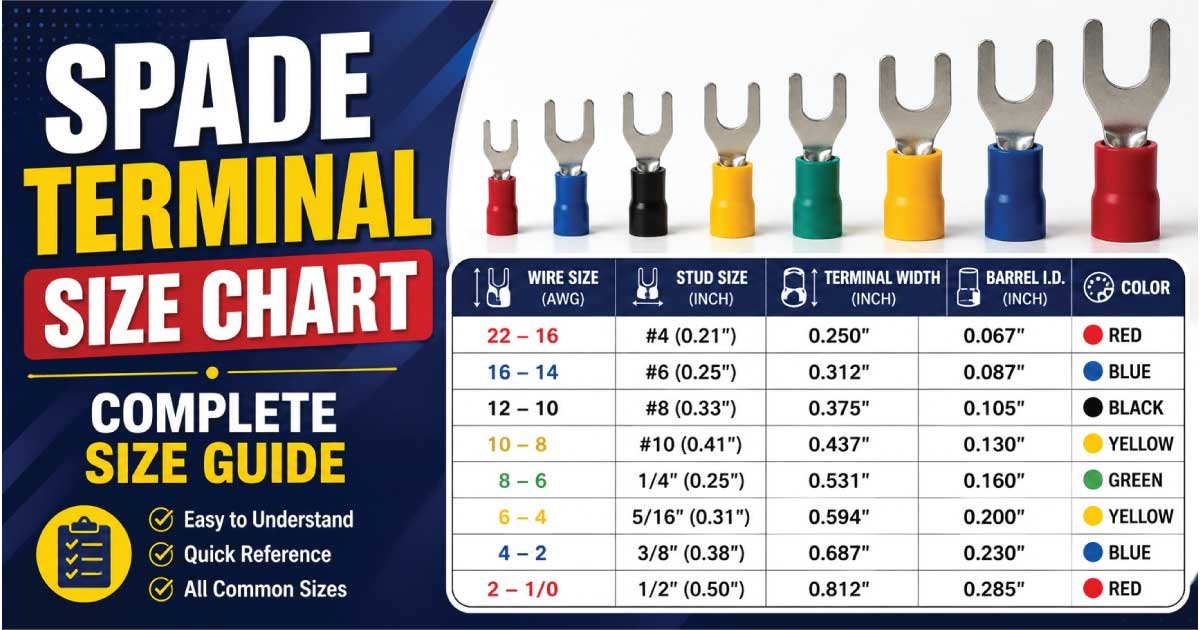
| Spade Terminal Size | Common Wire Gauge | Approx. Wire Cross Section | Common Stud/Screw Size | Typical Use |
|---|---|---|---|---|
| 22–18 AWG | 22–18 AWG | 0.33–0.82 mm² | #4–#6 | Small electronics and controls |
| 16–14 AWG | 16–14 AWG | 1.31–2.08 mm² | #6–#8 | Lighting and general wiring |
| 12–10 AWG | 12–10 AWG | 3.31–5.26 mm² | #8–#10 | Higher-current circuits |
| 8 AWG | 8 AWG | 8.37 mm² | #10–1/4 in | Heavy-duty wiring |
| 6 AWG | 6 AWG | 13.3 mm² | 1/4–5/16 in | High-current applications |
| 4 AWG | 4 AWG | 21.2 mm² | 5/16–3/8 in | Battery and power connections |
| 2 AWG | 2 AWG | 33.6 mm² | 3/8–1/2 in | Very high-current systems |
The exact terminal dimensions vary by manufacturer, terminal series, material, and design. Always verify the manufacturer’s specifications before selecting a terminal for a critical electrical application.
What Is a Spade Terminal?
A spade terminal is a type of crimp electrical connector with a fork-shaped metal end.
The fork slides around a screw or threaded terminal, allowing the connection to be made without completely removing the fastener.
A typical spade terminal consists of:
- Wire barrel.
- Fork or spade section.
- Screw or stud opening.
- Insulation sleeve or insulating collar.
- Crimp area.
Spade terminals are particularly convenient where electrical components need to be connected and disconnected during maintenance.
How Spade Terminal Sizes Work
A spade terminal does not have one single size specification.
Instead, its size normally describes two important characteristics:
Wire Size
The terminal barrel must accommodate the conductor.
Common wire ranges include:
- 22–18 AWG.
- 16–14 AWG.
- 12–10 AWG.
- 8 AWG.
- 6 AWG.
- 4 AWG.
- 2 AWG.
Stud or Screw Size
The fork opening must fit around the screw or stud.
Common openings include:
- #4.
- #6.
- #8.
- #10.
- 1/4 inch.
- 5/16 inch.
- 3/8 inch.
- 1/2 inch.
Therefore, a terminal can be described, for example, as a 16–14 AWG spade terminal for a #8 stud.
Spade Terminal Wire Gauge Chart
Wire gauge is one of the most important factors when choosing a spade connector.
| Wire Gauge | Approx. Area | Common Spade Terminal Category |
|---|---|---|
| 22 AWG | 0.326 mm² | Small insulated terminal |
| 20 AWG | 0.519 mm² | Small control wiring |
| 18 AWG | 0.823 mm² | Electronics and controls |
| 16 AWG | 1.31 mm² | Lighting and accessories |
| 14 AWG | 2.08 mm² | General electrical circuits |
| 12 AWG | 3.31 mm² | Medium-current circuits |
| 10 AWG | 5.26 mm² | Higher-current circuits |
| 8 AWG | 8.37 mm² | Heavy-duty applications |
| 6 AWG | 13.3 mm² | High-current systems |
| 4 AWG | 21.2 mm² | Battery and power systems |
| 2 AWG | 33.6 mm² | Very high-current systems |
A terminal designed for 16–14 AWG wire should not be used with 10 AWG wire simply because the wire can physically enter the barrel. The crimp barrel must be designed for the conductor size.
Spade Terminal Stud Size Chart
The second major measurement is the opening that fits around the screw or stud.
| Terminal Opening | Approx. Opening | Common Fastener |
|---|---|---|
| #4 | ~3.2 mm | #4 screw |
| #6 | ~3.7–4.0 mm | #6 screw |
| #8 | ~4.3–4.5 mm | #8 screw |
| #10 | ~5.0–5.3 mm | #10 screw |
| 1/4 in | 6.35 mm | 1/4 in stud |
| 5/16 in | 7.94 mm | 5/16 in stud |
| 3/8 in | 9.53 mm | 3/8 in stud |
| 1/2 in | 12.7 mm | 1/2 in stud |
Actual terminal openings may be slightly larger than the nominal fastener diameter to provide installation clearance.
Spade Terminal Color Codes
Many insulated spade terminals use color coding to indicate the intended wire-size range.
Common color conventions include:
| Insulation Color | Common Wire Range | Typical Use |
|---|---|---|
| Red | 22–16 AWG | Small wires |
| Blue | 16–14 AWG | Medium-small wires |
| Yellow | 12–10 AWG | Larger wires |
Color conventions can vary between manufacturers, so the package or manufacturer’s specification should always be checked.
The color identifies the terminal’s insulation and crimp range; it does not by itself determine the stud opening.
Also Read: Rigid Metal Conduit Size Chart: Complete Guide
Male and Female Spade Terminals
Spade terminals are available in different connection styles.
Female Spade Terminal
A female spade terminal usually slides onto a corresponding male blade or tab.
These are common in:
- Automotive wiring.
- Appliances.
- Relays.
- Switches.
- Electrical equipment.
Male Spade Terminal
A male spade terminal provides the blade or tab that fits into a female connector.
Male and female quick-disconnect terminals are often used together when equipment needs a detachable wiring connection.
A traditional fork terminal is different because it is designed to fit beneath or around a screw or stud.
Fork Terminal vs Spade Terminal
The terms fork terminal and spade terminal are often used interchangeably.
Both typically have an open-ended connection area that can be placed around a screw or stud.
However, manufacturers may use different terminology for different designs.
Common descriptions include:
- Fork terminal.
- Spade terminal.
- Spade lug.
- Fork lug.
- Open-end terminal.
When purchasing a replacement, focus on the actual wire range, stud size, material, insulation rating, and terminal dimensions rather than the name alone.
Insulated Spade Terminals
Insulated spade terminals have an insulating sleeve around the wire-crimping section.
The insulation helps:
- Reduce accidental contact.
- Protect the crimp area.
- Improve handling.
- Identify wire-size categories.
- Reduce the possibility of short circuits.
Common insulation materials include:
- PVC.
- Nylon.
- Heat-resistant polymers.
For high-temperature or demanding environments, select a terminal with an appropriate temperature rating.
Non-Insulated Spade Terminals
Non-insulated spade terminals consist primarily of the conductive metal terminal without a full insulating sleeve.
They are often used in:
- Professional wiring harnesses.
- Electrical control panels.
- Automotive applications.
- High-temperature areas.
- Custom assemblies.
Additional insulation may be applied using heat-shrink tubing where appropriate.
Non-insulated terminals can provide a compact connection but require careful installation to prevent accidental electrical contact.
Spade Terminal Materials
The terminal’s material affects conductivity, corrosion resistance, and mechanical strength.
Common materials include:
Copper
Copper provides excellent electrical conductivity and is widely used for electrical terminals.
Tin-Plated Copper
Tin plating can improve corrosion resistance while maintaining good electrical conductivity.
Brass
Brass is commonly used for certain electrical connectors because of its strength, conductivity, and corrosion resistance.
Aluminum
Aluminum terminals are used in selected applications but require appropriate compatibility with the conductor and electrical system.
For most general-purpose wiring, a properly rated copper or copper-alloy terminal is commonly selected.
How to Choose the Correct Spade Terminal Size
Choosing the right terminal involves matching several specifications.
1. Identify the Wire Gauge
Check the wire’s AWG size.
For example:
14 AWG wire → select a terminal rated for 14 AWG.
Do not assume that a physically larger terminal is automatically suitable.
2. Determine the Stud Size
Measure or identify the screw or threaded stud.
For example:
#8 screw → select a spade terminal with the appropriate #8 opening.
3. Check the Terminal Material
Choose a terminal material suitable for the environment.
4. Check Temperature Rating
Engine compartments, industrial equipment, and heating equipment may require higher-temperature terminals.
5. Select the Appropriate Crimp Type
Use a terminal designed for the correct crimping method and tool.
6. Verify the Manufacturer Specification
For critical electrical systems, always confirm the terminal’s approved wire range and electrical ratings.
Also Read: Transformer Wire Gauge Chart: Choose the Right AWG
Spade Terminal Size for Automotive Wiring
Spade terminals are widely used in automotive electrical systems.
Typical applications include:
- Relays.
- Switches.
- Fuse boxes.
- Gauges.
- Sensors.
- Lighting.
- Motors.
- Accessories.
- Control modules.
Common automotive wire sizes may range from 22 AWG to 10 AWG for smaller circuits, while larger terminals are used for higher-current applications.
Automotive terminals should be rated for vibration, temperature, moisture, and the electrical environment where they will be installed.
Spade Terminal Size for Speaker Wire
Small spade connectors are also used in audio applications.
Speaker terminals may use relatively small conductors such as:
- 22 AWG.
- 20 AWG.
- 18 AWG.
- 16 AWG.
- 14 AWG.
- 12 AWG.
The correct connector depends on the speaker terminal and wire size.
For high-power audio systems, the connector should have adequate current capacity and a secure mechanical connection.
Spade Terminal Size for Circuit Breakers
Spade or fork terminals can be used with certain screw-type electrical terminals, including selected breakers, switches, and control devices.
However, the terminal must be approved for the specific equipment.
Important factors include:
- Wire gauge.
- Screw size.
- Terminal geometry.
- Conductor material.
- Breaker manufacturer requirements.
Do not assume that every fork terminal is acceptable under every circuit-breaker terminal screw.
Spade Terminal Size for Switches
Electrical switches often use screw terminals that can accept fork terminals.
Common applications include:
- Toggle switches.
- Rocker switches.
- Push-button switches.
- Automotive switches.
- Industrial control switches.
The spade terminal should fit securely around the screw without being so large that it can slip out.
Spade Terminal Crimping
Proper crimping is essential for a reliable electrical connection.
A typical process is:
- Strip the correct length of insulation.
- Insert the conductor fully into the terminal barrel.
- Position the terminal correctly in the crimping tool.
- Apply the correct crimp.
- Inspect the connection.
- Perform a gentle pull test.
- Check that no excessive conductor strands are loose.
Avoid crushing the terminal with unsuitable pliers.
A proper crimp should mechanically secure the conductor while maintaining good electrical contact.
How to Strip Wire for a Spade Terminal
Strip only enough insulation to allow the conductor to fully enter the terminal barrel.
If too much insulation is removed:
- Exposed copper may remain outside the terminal.
- The connection may be less protected.
- Accidental short circuits may become more likely.
If too little insulation is removed:
- The conductor may not reach the correct crimp area.
- The terminal may not form a proper electrical connection.
Use an appropriate wire stripper to avoid damaging conductor strands.
Spade Terminal Crimp Quality
A good crimp should have:
- Firm mechanical retention.
- Full conductor insertion.
- No major cracks.
- No loose strands.
- No excessive deformation.
- Proper insulation support where applicable.
After crimping, gently pull the wire to check whether the conductor is securely held.
For critical applications, follow the terminal manufacturer’s approved crimping method and tool specifications.
Spade Terminal Size for Different Applications
| Application | Common Wire Range | Typical Terminal Consideration |
|---|---|---|
| Sensors | 22–18 AWG | Small insulated spade |
| Control panels | 22–14 AWG | Fork terminal matched to screw |
| Automotive accessories | 18–12 AWG | Insulated automotive terminal |
| Lighting | 18–14 AWG | Small to medium spade |
| Appliances | 16–10 AWG | Heat-rated terminal where required |
| Audio | 18–12 AWG | Speaker-compatible connector |
| Industrial controls | 18–10 AWG | Rated industrial terminal |
| Battery/power wiring | 10 AWG and larger | Heavy-duty terminal or lug |
These are general application examples, not universal wire-size requirements.
Spade Terminal vs Ring Terminal
Both spade and ring terminals can be installed on screw or stud connections, but their designs differ.
| Feature | Spade Terminal | Ring Terminal |
|---|---|---|
| Connection shape | Open fork | Closed ring |
| Easy removal | Yes | Usually requires screw removal |
| Vibration resistance | Good when properly installed | Generally excellent |
| Installation speed | Fast | Slower |
| Common use | Serviceable connections | Permanent or secure connections |
A ring terminal is often preferred when maximum retention is important, while a spade terminal is convenient when frequent service or replacement is expected.
Also Read: USB Cable Size Chart: Find the Right USB Cable Size
Spade Terminal vs Butt Connector
These terminals serve different purposes.
A spade terminal connects a wire to a screw, stud, switch, or terminal post.
A butt connector joins two wires end-to-end.
Therefore:
Spade terminal → wire-to-device connection
Butt connector → wire-to-wire connection
Using the correct connector type improves both mechanical reliability and electrical performance.
Common Spade Terminal Sizing Mistakes
Using the Wrong Wire Range
A terminal designed for 16–14 AWG should not be used on 10 AWG wire.
Ignoring Stud Size
The wire may fit perfectly while the fork opening is wrong for the screw.
Using the Wrong Crimp Tool
Improvised crimping can result in weak or damaged connections.
Overstripping the Wire
Excess exposed copper can create a short-circuit risk.
Understripping the Wire
The conductor may not reach the required crimp area.
Choosing by Color Alone
Terminal color coding varies between manufacturers.
Ignoring Environmental Conditions
Outdoor, automotive, marine, and high-temperature applications may require specialized terminal materials and insulation.
How to Measure a Spade Terminal
If you need to identify an existing terminal, measure the following:
Wire Barrel
Measure the wire range or identify the terminal marking.
Fork Opening
Measure the inside width of the opening.
Overall Width
Measure the widest part of the spade section.
Terminal Length
Measure from the end of the wire barrel to the tip of the fork.
Wire Gauge
Determine the conductor size separately if the terminal marking is unavailable.
These measurements can help you find a replacement terminal with similar specifications.
Spade Terminal Size Conversion
AWG is commonly used in North America, while metric conductor sizes are often specified in square millimeters.
| AWG | Approx. Metric Cross Section |
|---|---|
| 22 AWG | 0.326 mm² |
| 20 AWG | 0.519 mm² |
| 18 AWG | 0.823 mm² |
| 16 AWG | 1.31 mm² |
| 14 AWG | 2.08 mm² |
| 12 AWG | 3.31 mm² |
| 10 AWG | 5.26 mm² |
| 8 AWG | 8.37 mm² |
| 6 AWG | 13.3 mm² |
| 4 AWG | 21.2 mm² |
| 2 AWG | 33.6 mm² |
These are approximate conductor cross-sectional areas. Terminal manufacturers may specify slightly different approved wire ranges.
Final Thoughts
Choosing the correct spade terminal requires matching three key factors: wire gauge, stud or screw size, and terminal type. A terminal that fits the screw but is designed for the wrong wire size can create a poor electrical connection, while a correctly sized wire terminal with the wrong fork opening may not attach securely.
For small electrical and control circuits, terminals for 22–18 AWG wires are common. General-purpose wiring frequently uses 16–14 AWG, while higher-current circuits may require 12–10 AWG or larger terminals.
Color-coded insulated terminals can make selection easier, but color should always be confirmed against the manufacturer’s wire-range specification. For demanding automotive, industrial, outdoor, or high-temperature applications, also consider terminal material, insulation type, temperature rating, corrosion resistance, and vibration resistance.
The best spade terminal is not simply the one that physically fits. It should be properly matched to the conductor, fastener, electrical load, installation environment, and approved crimping method.
A correctly selected and properly crimped spade terminal provides a secure, serviceable, and dependable electrical connection.
Frequently Asked Questions
What size spade terminal do I need?
Choose a spade terminal based on both the wire gauge and the screw or stud size. For example, a 16–14 AWG wire requires a terminal rated for that conductor range, while the fork opening must match the screw or stud. Always verify the manufacturer’s specifications.
What do red, blue, and yellow spade terminals mean?
These colors commonly identify wire-size ranges. Red is often used for smaller wires, blue for medium-size wires, and yellow for larger wires. However, color conventions can vary between manufacturers, so always check the terminal packaging or specification rather than relying on color alone.
What is the difference between a spade and fork terminal?
In many applications, spade and fork terminals refer to the same basic open-ended connector designed to fit around a screw or stud. Manufacturers may use either term depending on their product range. The important specifications are wire range, stud opening, material, insulation, and rating.
Can a spade terminal be used on a circuit breaker?
A spade or fork terminal can only be used when the circuit breaker terminal is specifically designed and approved to accept that type of conductor termination. Always follow the breaker’s installation instructions. Do not assume that every fork terminal is acceptable under every breaker terminal screw.
Are spade terminals reliable?
Yes, properly selected and correctly crimped spade terminals can provide reliable electrical connections. Reliability depends on the correct wire range, terminal size, crimping method, material, environmental rating, and secure attachment to the screw or stud.
Can I use pliers to crimp a spade terminal?
A proper crimping tool is strongly recommended. Ordinary pliers may deform the terminal without creating the required mechanical and electrical connection. For reliable results, use a crimp tool designed for the specific terminal and wire-size range.
What wire gauge is commonly used with spade terminals?
Spade terminals are available for many wire gauges, from small 22 AWG control wires to much larger power conductors. Common ranges include 22–18 AWG, 16–14 AWG, and 12–10 AWG. Larger heavy-duty fork terminals are available for higher-current applications.