
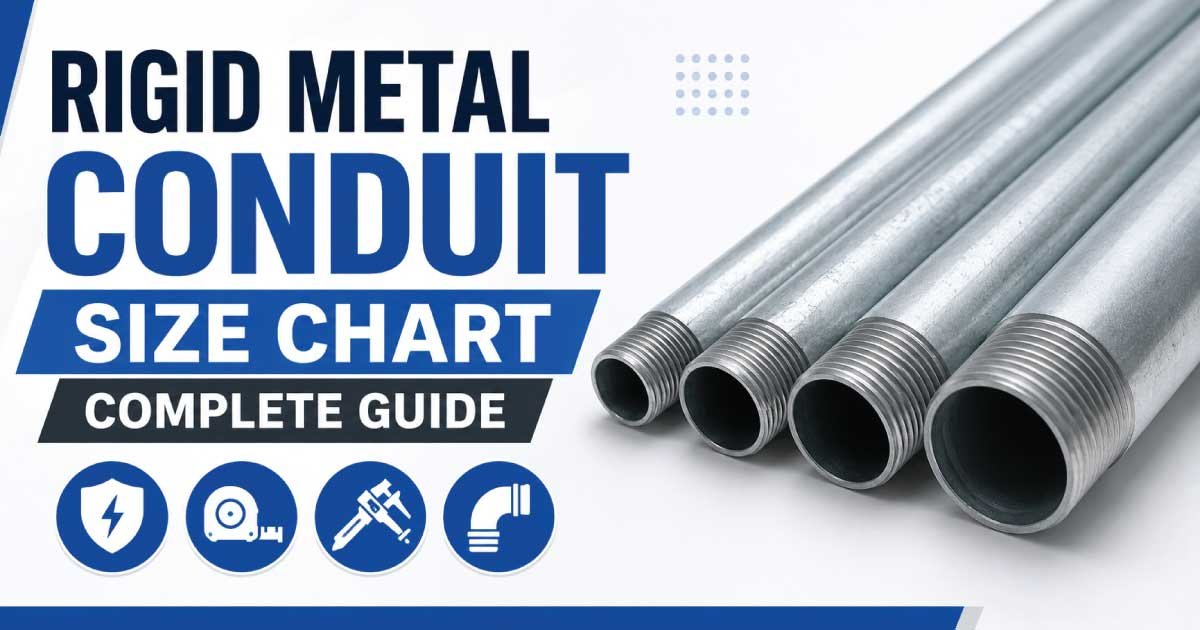
A Rigid Metal Conduit (RMC) size chart helps electricians, contractors, and engineers select an appropriate metallic raceway for protecting electrical conductors. RMC provides strong mechanical protection and is commonly used in commercial, industrial, outdoor, and demanding electrical installations.
Understanding RMC trade sizes, inside diameter, outside diameter, conduit fill, and wire capacity is important for proper raceway selection. This guide explains the most common rigid metal conduit sizes and the factors that affect sizing decisions.
What Is Rigid Metal Conduit?
Rigid Metal Conduit (RMC) is a heavy-duty metallic raceway designed to protect electrical conductors from physical damage and environmental exposure. Its strong construction makes it suitable for locations where electrical wiring requires substantial mechanical protection.
RMC is commonly used for:
- Industrial electrical systems
- Commercial buildings
- Outdoor electrical installations
- Feeders and branch circuits
- Service entrance applications
- Exposed electrical wiring
- Areas subject to physical impact
- Industrial equipment connections
Rigid Metal Conduit Size Chart
Rigid metal conduit is manufactured in several trade sizes to accommodate different conductor arrangements. Smaller sizes are commonly used for branch circuits, while larger raceways provide space for feeders and larger groups of conductors.
| RMC Trade Size | Approx. Outside Diameter | Approx. Inside Diameter |
|---|---|---|
| 1/2 inch | 0.840 in | 0.632 in |
| 3/4 inch | 1.050 in | 0.836 in |
| 1 inch | 1.315 in | 1.063 in |
| 1-1/4 inch | 1.660 in | 1.394 in |
| 1-1/2 inch | 1.900 in | 1.624 in |
| 2 inch | 2.375 in | 2.083 in |
| 2-1/2 inch | 2.875 in | 2.489 in |
| 3 inch | 3.500 in | 3.090 in |
| 3-1/2 inch | 4.000 in | 3.570 in |
| 4 inch | 4.500 in | 4.050 in |
| 5 inch | 5.563 in | 5.073 in |
| 6 inch | 6.625 in | 6.093 in |
Dimensions are approximate reference values. Exact dimensions can vary according to the applicable standard and manufacturer. Verify current product specifications before performing an exact conduit-fill calculation.
Rigid Metal Conduit Trade Sizes
RMC uses trade sizes to identify raceway dimensions. The trade size should not be interpreted as an exact measurement of the conduit inside diameter because wall thickness affects the usable internal space.
Common RMC trade sizes include:
- 1/2 inch
- 3/4 inch
- 1 inch
- 1-1/4 inch
- 1-1/2 inch
- 2 inch
- 2-1/2 inch
- 3 inch
- 3-1/2 inch
- 4 inch
- 5 inch
- 6 inch
Larger rigid metal conduit sizes are available for installations requiring substantial conductor capacity.
Rigid Conduit Inside Diameter
The inside diameter of rigid metal conduit determines the amount of usable space available for electrical conductors. Because RMC has relatively thick walls, its internal diameter is significantly smaller than its outside diameter.
Inside diameter is important when:
- Calculating conduit fill
- Determining conductor capacity
- Planning wire-pulling operations
- Selecting raceway sizes
- Comparing different conduit sizes
- Designing electrical pathways
Always use the correct dimensional data for the exact RMC product being installed.
Rigid Conduit Outside Diameter
The outside diameter of RMC is important when planning the physical installation and selecting compatible fittings. While outside diameter does not determine conductor capacity, it affects the amount of space required around the installed raceway.
Outside diameter matters when:
- Selecting connectors
- Choosing couplings
- Planning conduit supports
- Checking installation clearances
- Designing equipment connections
- Measuring available installation space
Fittings should always be compatible with the specific RMC trade size.
Common Rigid Metal Conduit Sizes
Different RMC trade sizes are used for different electrical applications. Smaller raceways are suitable for smaller conductor groups, while larger sizes provide additional space for feeders, distribution systems, and industrial wiring.
| RMC Size | General Application |
|---|---|
| 1/2 inch | Small branch circuits |
| 3/4 inch | Branch wiring |
| 1 inch | Multiple small conductors |
| 1-1/4 inch | Larger conductor groups |
| 1-1/2 inch | Commercial circuits |
| 2 inch | Feeders |
| 2-1/2 inch | Larger feeders |
| 3 inch | Industrial wiring |
| 3-1/2 inch | Large conductor groups |
| 4 inch | Distribution systems |
| 5 inch | Large cable runs |
| 6 inch | Industrial feeders |
These applications are general examples and should not replace a formal conduit-fill calculation.
What Is Rigid Conduit Fill?
Rigid conduit fill refers to the percentage of the internal raceway area occupied by electrical conductors. Fill limits help prevent excessive crowding and provide adequate space for conductor installation and maintenance.
Commonly referenced maximum fill percentages include:
| Number of Conductors | Maximum Fill |
|---|---|
| 1 conductor | 53% |
| 2 conductors | 31% |
| 3 or more conductors | 40% |
The applicable electrical code should always be consulted for the specific installation and conductor arrangement.
How to Calculate RMC Conduit Fill
Calculating RMC conduit fill requires the actual dimensions of all conductors and the available internal area of the raceway. Wire gauge alone is not sufficient because insulation and conductor construction affect overall diameter.
A basic calculation involves:
- Count the conductors.
- Identify each conductor size.
- Determine the outside diameter of each conductor.
- Calculate the conductor cross-sectional area.
- Add the areas together.
- Determine the permitted fill area.
- Compare the total with the RMC internal area.
This process helps identify a suitable rigid conduit size.
Rigid Metal Conduit Size and Wire Size
Wire size and conduit size describe two different components of an electrical installation. Wire size identifies the conductor, while RMC trade size identifies the protective raceway.
Common electrical conductor sizes include:
- 14 AWG
- 12 AWG
- 10 AWG
- 8 AWG
- 6 AWG
- 4 AWG
- 2 AWG
- 1/0 AWG
- 2/0 AWG
- 4/0 AWG
The correct RMC size depends on conductor quantity, dimensions, insulation, and allowable conduit fill.
How Many Wires Can Fit in Rigid Conduit?
The number of wires that can fit inside rigid metal conduit depends on conductor size, insulation, outside diameter, and the permitted fill percentage. Therefore, one fixed wire-count limit cannot apply to every RMC trade size.
RMC wire capacity depends on:
- Wire gauge
- Conductor insulation
- Conductor outside diameter
- Number of conductors
- RMC internal diameter
- Allowable fill
- Installation conditions
For accurate sizing, calculate the total conductor area rather than relying on a general wire-count estimate.
RMC Conduit for Residential Wiring
Rigid metal conduit can be used in residential installations where a strong metallic raceway is appropriate. It may be useful for exposed wiring, service-related raceways, feeders, and locations requiring substantial mechanical protection.
Residential applications can include:
- Garages
- Workshops
- Utility spaces
- Exposed electrical wiring
- Feeders
- Equipment connections
- Service-related pathways
The appropriate RMC size must be determined from the actual conductors and applicable installation requirements.
RMC Conduit for Commercial Wiring
Commercial buildings often require durable raceways for feeders, branch circuits, equipment connections, and distribution systems. RMC provides strong mechanical protection and can be suitable where exposed electrical wiring needs a robust metallic pathway.
Commercial applications include:
- Office buildings
- Retail facilities
- Warehouses
- Schools
- Electrical rooms
- Commercial equipment
- Distribution systems
- Exposed feeders
Larger RMC sizes can accommodate conductor groups requiring greater internal raceway space.
RMC Conduit for Industrial Applications
Industrial electrical systems often require heavy-duty raceways because wiring may be exposed to machinery, impact, moisture, outdoor conditions, or demanding operating environments. RMC provides substantial mechanical protection for these applications.
Industrial uses can include:
- Manufacturing equipment
- Motor circuits
- Industrial feeders
- Control systems
- Distribution equipment
- Outdoor machinery
- Process equipment
- Heavy-duty electrical systems
The conduit size and material should be selected according to the physical and environmental conditions.
Factors That Affect RMC Conduit Size
Selecting RMC size requires more than counting the wires. Conductor dimensions, insulation, conduit fill, bends, run length, and future expansion can all affect the most practical raceway size.
Important factors include:
- Number of conductors
- Conductor outside diameter
- Insulation type
- RMC inside diameter
- Maximum permitted fill
- Number of bends
- Length of the conduit run
- Installation environment
- Future wiring requirements
Considering these factors helps prevent undersized raceways and difficult conductor-pulling conditions.
Advantages of Rigid Metal Conduit
RMC is widely selected when electrical conductors require strong mechanical protection. Its robust metallic construction makes it suitable for demanding installations where lighter raceway systems may not provide the desired level of physical protection.
Major advantages include:
- Excellent mechanical protection
- Strong metallic construction
- Suitable for demanding installations
- Durable and long-lasting
- Available in multiple trade sizes
- Suitable for commercial applications
- Useful for industrial wiring
- Provides a robust conductor pathway
Its suitability should always be evaluated according to the specific installation requirements.
Rigid Metal Conduit vs IMC
RMC and IMC are both metallic raceways designed to protect electrical conductors, but their construction and weight differ. RMC generally provides heavier-duty protection, while IMC offers a lighter alternative for many applications.
| Feature | RMC | IMC |
|---|---|---|
| Construction | Heavy-duty | Lighter metallic construction |
| Mechanical Protection | Very high | High |
| Weight | Heavier | Lighter |
| Installation | More demanding | Generally easier |
| Typical Use | Heavy-duty applications | Commercial and industrial |
| Conduit Wall | Thicker | Thinner |
The appropriate raceway depends on physical protection requirements, installation conditions, and applicable electrical requirements.
Key Points to Remember
A rigid metal conduit size chart provides useful dimensional information, but the final conduit selection requires an evaluation of conductor quantity, conductor dimensions, conduit fill, installation conditions, and applicable electrical requirements.
Remember these points:
- RMC trade size is not its exact inside diameter.
- Conductor quantity affects required raceway space.
- Wire gauge alone does not determine conduit size.
- Insulation affects conductor dimensions.
- Larger RMC provides greater internal capacity.
- Long runs and bends can affect wire pulling.
- Always verify actual manufacturer dimensions.
- Use the appropriate electrical code and sizing tables.
RMC Conduit Size for Different Wire Gauges
The correct RMC conduit size depends on conductor quantity, conductor outside diameter, insulation, and permitted raceway fill. Wire gauge alone cannot determine the correct raceway because the same wire size may be installed in different conductor quantities.
| Wire Size | Relative Conductor Size | RMC Sizing Consideration |
|---|---|---|
| 14 AWG | Small | Small conductor groups |
| 12 AWG | Small | Common branch circuits |
| 10 AWG | Medium | Requires additional space |
| 8 AWG | Large | More raceway area required |
| 6 AWG | Larger | Check conductor quantity |
| 4 AWG | Large | Larger conduit may be required |
| 2 AWG | Very large | Requires substantial internal area |
| 1/0 AWG | Extra large | Larger RMC typically needed |
| 2/0 AWG | Extra large | Significant internal space required |
| 4/0 AWG | Very large | Used for larger electrical systems |
These are general references. Exact RMC sizing should be based on actual conductor dimensions and applicable fill calculations.
RMC Conduit Size for 12 AWG Wire
12 AWG conductors are commonly used for branch circuits, but the required RMC size depends on how many conductors are placed inside the raceway. More conductors require more internal area.
When sizing RMC for 12 AWG wire, consider:
- Number of conductors
- Insulation type
- Conductor outside diameter
- RMC inside diameter
- Maximum conduit fill
- Grounding conductors
- Raceway bends
A conduit-fill calculation should be completed before selecting the final RMC trade size.
Also Read: Battery Cable Size Chart: Correct AWG Cable Guide
RMC Conduit Size for 10 AWG Wire
10 AWG wire occupies more space than 12 AWG wire, so multiple 10 AWG conductors may require a larger RMC raceway. The actual requirement depends on the conductor construction and insulation.
Consider these factors:
- Total conductor count
- Conductor outside diameter
- Insulation thickness
- RMC trade size
- Available internal area
- Allowable fill percentage
- Number of bends
Using actual conductor dimensions gives a more reliable sizing result than estimating from wire gauge alone.
RMC Conduit Size for 8 AWG Wire
8 AWG conductors require more internal raceway space than smaller branch-circuit conductors. When several 8 AWG wires share one RMC, proper conduit-fill calculations become particularly important.
Before selecting the raceway, check:
- Number of 8 AWG conductors
- Conductor insulation
- Outside diameter
- RMC internal diameter
- Maximum permitted fill
- Raceway length
- Number of bends
A larger raceway can also make conductor pulling easier on long or complicated installations.
RMC Conduit Size for 6 AWG Wire
6 AWG wire requires considerable raceway space, especially when multiple conductors are installed together. RMC selection should account for conductor dimensions, insulation, and the available internal area.
Important considerations include:
- Number of 6 AWG conductors
- Copper or aluminum construction
- Insulation outside diameter
- RMC inside diameter
- Allowable conduit fill
- Raceway length
- Number of bends
Always verify conductor dimensions before making an exact conduit selection.
RMC Conduit Size for Large Conductors
Large conductors such as 4 AWG, 2 AWG, 1/0 AWG, and 4/0 AWG occupy significant raceway space. When multiple large conductors are installed together, a larger RMC trade size may be necessary.
Large-conductor installations may require:
- Larger RMC sizes
- Detailed fill calculations
- Larger junction boxes
- Compatible fittings
- Adequate pulling space
- Proper supports
- Careful raceway routing
The final raceway should provide sufficient space without exceeding the applicable fill limitation.
RMC Conduit Fill Calculation Example
An RMC fill calculation determines whether the combined cross-sectional area of the conductors remains within the permitted raceway area. The calculation should use actual conductor dimensions rather than simply adding AWG numbers.
A basic process is:
- Identify every conductor.
- Determine each conductor’s outside diameter.
- Calculate individual conductor areas.
- Add the conductor areas.
- Determine the RMC internal area.
- Apply the permitted fill percentage.
- Compare the total areas.
For three or more conductors, the commonly referenced maximum fill is 40% of the raceway’s internal area.
RMC Conduit Size for Feeders
RMC is often selected for feeder installations because its strong metallic construction provides substantial mechanical protection. Feeder raceways may contain larger conductors, making accurate conduit-fill calculations especially important.
When sizing RMC for feeders, consider:
- Feeder conductor size
- Number of conductors
- Grounding conductor
- Insulation dimensions
- Raceway fill
- Conduit length
- Number of bends
- Pulling requirements
A larger raceway may be practical when conductor pulling conditions are difficult.
RMC Conduit Size for Service Conductors
Service-related raceways can contain large conductors and may require robust mechanical protection. RMC can provide a strong metallic pathway for suitable service installations when permitted by the applicable electrical requirements.
Important considerations include:
- Service conductor dimensions
- Number of conductors
- Grounding and bonding requirements
- Conduit fill
- Fitting compatibility
- Raceway location
- Physical protection
- Applicable electrical code
Service installations should always be designed and installed according to the requirements governing the specific electrical system.
RMC vs EMT Conduit
RMC and EMT are both metallic raceways, but they differ significantly in wall construction, weight, and mechanical protection. RMC provides heavier-duty protection, while EMT is lighter and generally easier to handle and bend.
| Feature | RMC | EMT |
|---|---|---|
| Wall Construction | Heavy-duty | Thin-wall |
| Weight | Heavier | Lighter |
| Mechanical Protection | Excellent | Good |
| Bending | More difficult | Easier |
| Typical Use | Heavy-duty installations | Commercial wiring |
| Cost | Generally higher | Generally lower |
| Installation | More demanding | Easier |
The correct choice depends on the required level of mechanical protection and installation conditions.
RMC vs PVC Conduit
RMC and PVC provide very different raceway characteristics. RMC offers strong metallic mechanical protection, while PVC provides lightweight construction and excellent corrosion resistance.
| Feature | RMC | PVC |
|---|---|---|
| Material | Metal | Nonmetallic |
| Mechanical Protection | Excellent | Lower |
| Corrosion Resistance | Depends on coating | Excellent |
| Weight | Heavy | Lightweight |
| Conductive | Yes | No |
| Typical Use | Heavy-duty installations | Underground and suitable outdoor applications |
Environmental conditions and physical protection requirements should be considered before selecting either raceway.
Also Read: USB Cable Size Chart: Find the Right USB Cable Size
Advantages of Using Larger RMC
A larger RMC raceway can provide additional conductor space and make installation easier when several conductors share the same pathway. Extra internal room can be especially useful for long runs and installations with multiple bends.
Benefits can include:
- Easier conductor pulling
- More internal working space
- Lower risk of excessive fill
- Better maintenance access
- Easier future modifications
- More flexibility for conductor arrangements
However, larger conduit also increases material, fitting, and installation costs, so sizing should remain practical.
Common RMC Conduit Sizing Mistakes
Incorrect conduit sizing can create installation problems, especially when large conductors or multiple circuits share one raceway. Many errors occur when conduit selection is based on assumptions rather than actual conductor and raceway dimensions.
Common mistakes include:
- Choosing RMC based only on wire gauge
- Ignoring insulation diameter
- Confusing trade size with inside diameter
- Forgetting grounding conductors
- Exceeding permitted conduit fill
- Ignoring bends and pulling conditions
- Using incorrect dimensional information
- Failing to check applicable electrical requirements
Proper calculations help prevent unnecessary rework and material costs.
How to Make RMC Wire Pulling Easier
RMC provides excellent protection, but its rigid construction and heavier weight can make installation more demanding. Proper raceway planning can make conductor pulling easier and reduce stress on cables and installation equipment.
For easier wire pulling:
- Keep raceway routes as direct as possible.
- Minimize unnecessary bends.
- Use properly sized fittings.
- Avoid excessive conduit fill.
- Keep the interior clean.
- Inspect couplings and fittings before pulling.
- Use suitable pulling equipment.
- Plan long runs carefully.
Additional conduit space may be useful when the installation has difficult pulling conditions.
Rigid Metal Conduit Installation Tips
Proper installation helps ensure RMC provides the intended mechanical and electrical protection. Because RMC is a rigid metallic raceway, accurate layout, compatible fittings, secure supports, and proper connections are important.
Important installation practices include:
- Use compatible RMC fittings.
- Make properly aligned connections.
- Secure conduit with suitable supports.
- Protect threads and connections where required.
- Keep the interior free from debris.
- Avoid sharp edges that could damage conductors.
- Maintain appropriate clearances.
- Follow applicable electrical requirements.
Professional installation practices help provide a reliable long-term raceway system.
When Should You Use Rigid Metal Conduit?
RMC is particularly useful where electrical conductors require strong mechanical protection. It can be a suitable choice for industrial facilities, commercial installations, outdoor locations, and other areas where a robust metallic raceway is required.
RMC may be considered for:
- Heavy-duty electrical installations
- Industrial facilities
- Commercial feeders
- Exposed wiring
- Areas subject to physical damage
- Service-related installations
- Outdoor electrical systems
- Equipment connections
The final raceway choice should be based on the specific installation environment.
Also Read: Transformer Wire Gauge Chart: Choose the Right AWG
FAQs:
What is the most common rigid metal conduit size?
1/2-inch, 3/4-inch, and 1-inch RMC are common smaller trade sizes, while 1-1/4-inch and larger sizes are frequently used when additional conductor space is required. The correct size depends on conductor quantity, dimensions, fill, and installation conditions.
What is the inside diameter of 1-inch RMC?
The approximate inside diameter of 1-inch RMC is around 1.063 inches. Exact dimensions can vary according to the applicable product standard and manufacturer, so the manufacturer’s current dimensional information should be used for precise conduit-fill calculations.
What is the difference between RMC and IMC?
RMC is generally heavier and has thicker construction than IMC. IMC provides a lighter metallic raceway option while still offering substantial mechanical protection. Both can be used in demanding electrical installations when permitted by applicable requirements.
Can RMC be used outdoors?
RMC can be suitable for outdoor electrical installations when the conduit and its fittings are appropriate for the environment. Outdoor applications require consideration of corrosion protection, connections, supports, moisture exposure, and the applicable electrical installation requirements.
How many wires can fit in RMC?
The number of wires depends on conductor size, insulation, outside diameter, and allowable conduit fill. There is no universal wire-count limit for every RMC trade size. A proper fill calculation should be performed using actual conductor dimensions.
Is RMC stronger than EMT?
RMC generally provides greater mechanical protection than EMT because it has heavier construction and thicker walls. EMT is lighter and easier to bend, while RMC is commonly selected where electrical wiring requires a more robust metallic raceway.
Is RMC better than PVC conduit?
RMC is not automatically better than PVC because each raceway has different advantages. RMC provides strong mechanical protection, while PVC offers lightweight construction and excellent corrosion resistance. The appropriate choice depends on environmental and physical protection requirements.
What size RMC conduit do I need for electrical wires?
The required RMC size depends on the number, size, insulation, and outside diameter of the conductors. Conduit fill, grounding conductors, bends, and installation conditions must also be considered before selecting the final raceway size.
Final Thoughts
A Rigid Metal Conduit size chart provides a useful starting point for understanding common trade sizes, but selecting the correct raceway requires more than matching wire gauge to conduit size.
Before choosing RMC, remember to:
- Check conductor quantity.
- Identify conductor outside diameter.
- Check insulation type.
- Verify the RMC inside diameter.
- Calculate permitted conduit fill.
- Consider bends and pulling distance.
- Select compatible fittings.
- Consider physical and environmental conditions.
- Follow applicable electrical codes and manufacturer requirements.
Correct RMC sizing helps provide sufficient conductor space while maintaining a durable, reliable, and properly protected electrical raceway system.