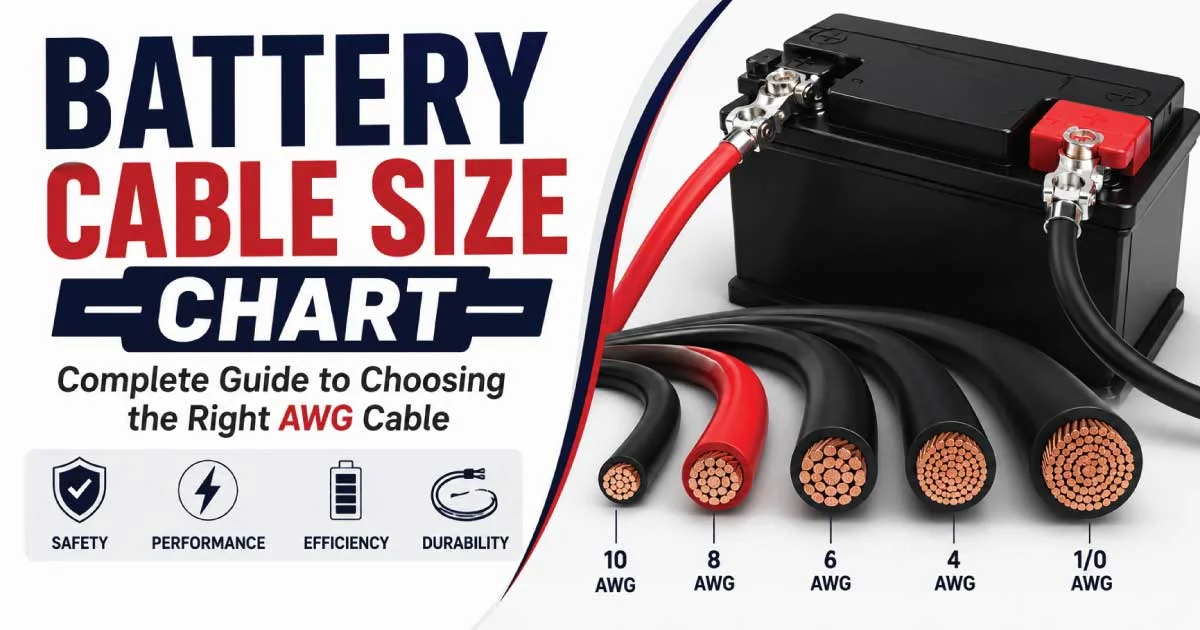
Battery Cable Size Chart: Correct AWG Cable Guide

Choosing the correct battery cable size is essential for electrical safety, efficient power transfer, and reliable equipment performance. Whether you are wiring a car, RV, boat, solar power system, or industrial battery bank, selecting the proper cable gauge minimizes voltage drop, prevents overheating, and extends the lifespan of your electrical components.

This guide covers the fundamentals of battery cable sizing, explains how cable gauges work, and provides practical recommendations to help you choose the right cable for your application.


What Is a Battery Cable Size Chart?

A battery cable size chart is a reference table that helps determine the correct cable gauge based on current (amps), cable length, and system voltage. It simplifies cable selection by showing which wire size can safely carry electrical current while maintaining acceptable voltage drop and preventing excessive heat buildup.

A typical battery cable size chart includes:

  • Cable gauge (AWG or mm²)
  • Maximum current capacity
  • Recommended cable length
  • Voltage drop considerations
  • Typical applications

Instead of guessing cable size, installers rely on these charts to ensure both safety and performance.


Why Battery Cable Size Matters

Using the wrong battery cable size can create serious electrical problems. A cable that is too small restricts current flow, causing voltage loss and excessive heat. An oversized cable may cost more than necessary and be harder to install, although it generally poses no safety concerns.

Proper battery cable sizing provides several important benefits:

  • Improves electrical efficiency
  • Reduces voltage drop
  • Prevents overheating
  • Extends battery life
  • Protects electrical equipment
  • Ensures reliable starting power
  • Meets electrical safety standards

Correct cable sizing is especially important in high-current systems like automotive starters, marine applications, solar battery banks, and heavy-duty equipment.


Understanding Battery Cable Gauge (AWG)

Battery cables in North America are commonly measured using the American Wire Gauge (AWG) system. One unique feature of AWG is that smaller gauge numbers represent thicker cables, while larger numbers indicate thinner wires.

For example:

  • 10 AWG is thinner than 4 AWG.
  • 2 AWG is thicker than 6 AWG.
  • 1/0 AWG (0 gauge) is thicker than 1 AWG.
  • 4/0 AWG is one of the largest commonly used battery cables.

As cable thickness increases:

  • Electrical resistance decreases.
  • Current carrying capacity increases.
  • Voltage drop becomes lower.
  • Heat generation decreases.

Understanding AWG measurements is the first step toward selecting the correct battery cable.


Common Battery Cable Sizes and Their Applications

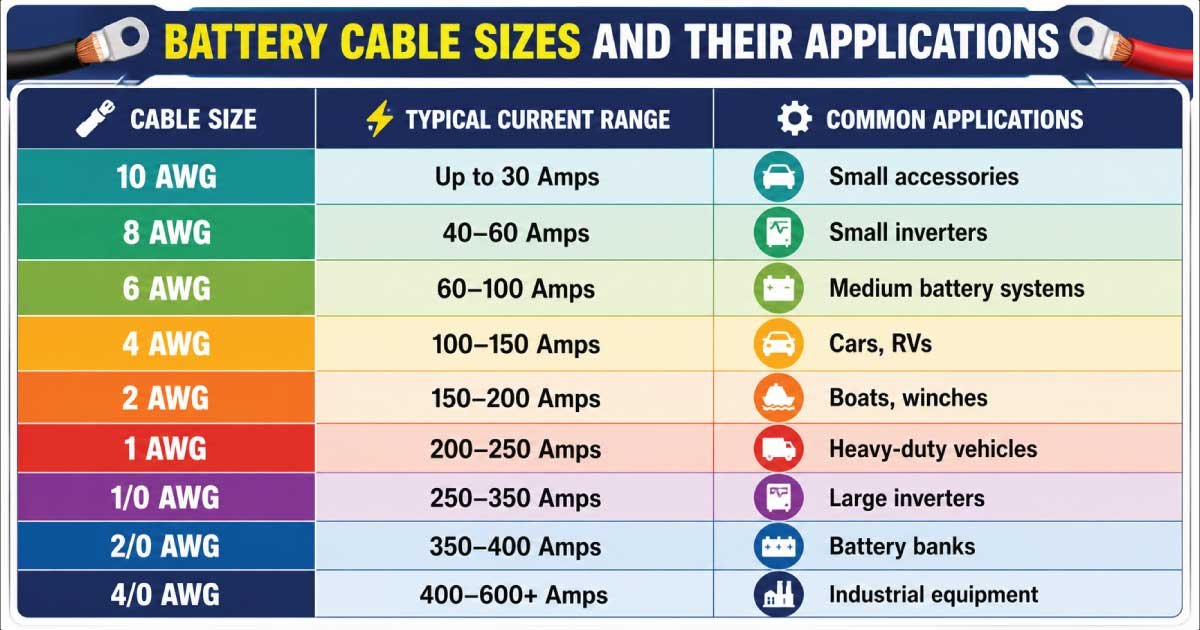
Different battery-powered systems require different cable sizes depending on their current demands.
Battery Cable Sizes

Cable Size Typical Current Range Common Applications
10 AWG Up to 30 Amps Small accessories
8 AWG 40–60 Amps Small inverters
6 AWG 60–100 Amps Medium battery systems
4 AWG 100–150 Amps Cars, RVs
2 AWG 150–200 Amps Boats, winches
1 AWG 200–250 Amps Heavy-duty vehicles
1/0 AWG 250–350 Amps Large inverters
2/0 AWG 350–400 Amps Battery banks
4/0 AWG 400–600+ Amps Industrial equipment

Battery Cable Sizes PDF

Selecting the correct battery cable size is essential for safe and efficient electrical performance. Using the proper cable minimizes voltage drop, prevents overheating, and ensures reliable power delivery. The chart below provides common battery cable sizes, their typical current capacities, and recommended applications for automotive, marine, RV, inverter, and industrial electrical systems.

Battery_Cable_Sizes_and_Their_Applications

These values are general recommendations and may vary depending on insulation type, ambient temperature, and cable length.


How Battery Cable Size Affects Voltage Drop

Voltage drop occurs naturally whenever electricity travels through a wire. Longer cables and smaller gauges create more electrical resistance, resulting in lower voltage reaching the load.

For example, if a 12V battery delivers power through an undersized cable, the equipment may receive only 11 volts instead of the full battery voltage.

Excessive voltage drop can cause:

  • Slow engine cranking
  • Dim lighting
  • Reduced inverter performance
  • Lower charging efficiency
  • Increased energy loss
  • Premature equipment failure

Choosing a thicker cable significantly reduces voltage drop and improves overall system performance.


Factors That Determine Battery Cable Size

Several important variables influence battery cable selection. Relying on current alone is not enough because cable length and operating conditions also affect performance.

The primary factors include:

  • Maximum current (amps)
  • Total cable length
  • Battery voltage
  • Continuous or intermittent load
  • Ambient temperature
  • Installation environment
  • Allowable voltage drop
  • Cable insulation rating

Considering all these factors ensures accurate cable sizing for safe and efficient operation.


Battery Voltage and Cable Selection

Battery voltage plays a major role in determining cable size. Lower-voltage systems require thicker cables because they carry higher current for the same power output.

For example:

  • 12V systems usually require larger cables.
  • 24V systems often use smaller cables.
  • 48V battery banks generally need even smaller conductors for equivalent power.

Higher-voltage systems reduce current requirements, making cable sizing more economical while minimizing voltage loss.


Cable Length and Its Importance

Cable length directly affects resistance. The longer the cable, the greater the voltage drop. This is why long battery cable runs often require significantly larger wire sizes than short installations.

For example:

  • A 3-foot cable may safely use 6 AWG.
  • A 15-foot cable carrying the same current may require 2 AWG.
  • A 25-foot installation could need 1/0 AWG or larger.

Always measure the total circuit length, including both positive and negative cables when calculating voltage drop.


Current Capacity (Ampacity) Explained

Ampacity refers to the maximum electrical current a cable can safely carry without overheating. Every battery cable has an ampacity limit determined by conductor size, insulation type, and installation conditions.

Exceeding ampacity can lead to:

  • Melted insulation
  • Electrical fires
  • Reduced cable lifespan
  • Equipment damage
  • Battery performance issues

Always choose a cable whose ampacity exceeds your system’s maximum expected current.


Battery Cable Materials

Most battery cables are made from copper because it offers excellent electrical conductivity and flexibility.

Common conductor materials include:

  • Pure copper
  • Tinned copper
  • Copper-clad aluminum (CCA)
  • Aluminum

Copper remains the preferred choice because it provides:

  • Lower resistance
  • Higher flexibility
  • Better durability
  • Superior corrosion resistance
  • Improved electrical efficiency

While CCA cables cost less, they generally require larger sizes to carry the same current as pure copper.


Copper vs. Copper-Clad Aluminum Battery Cables

Many buyers compare copper cables with copper-clad aluminum (CCA) alternatives due to cost differences.

Copper Cables

  • Excellent conductivity
  • Longer lifespan
  • Better flexibility
  • Lower resistance
  • Higher current capacity

Copper-Clad Aluminum (CCA)

  • Lower purchase cost
  • Lighter weight
  • Higher resistance
  • Requires larger cable sizes
  • Less efficient under heavy loads

For high-current battery systems, pure copper cables are usually the preferred investment because they provide better long-term reliability.


Battery Cable Insulation Types

Cable insulation protects conductors from moisture, heat, abrasion, oil, and chemicals. Choosing the correct insulation is just as important as selecting the proper conductor size.

Common insulation materials include:

  • PVC
  • XLPE
  • EPDM rubber
  • Welding cable insulation
  • Marine-grade insulation

Marine environments typically require tinned copper conductors combined with moisture-resistant insulation to prevent corrosion and maintain electrical reliability.


Automotive Battery Cable Size Recommendations

Automotive starting systems require cables capable of handling extremely high current for short periods.

General recommendations include:

  • Small cars: 6 AWG to 4 AWG
  • Mid-size vehicles: 4 AWG
  • Trucks: 2 AWG
  • Diesel engines: 1 AWG or 1/0 AWG
  • Performance vehicles: 1/0 AWG or larger

Cold weather increases starter current demands, making proper cable sizing even more important.


Signs Your Battery Cable Is Too Small

An undersized battery cable often produces noticeable performance issues before complete failure occurs.

Watch for these warning signs:

  • Slow engine cranking
  • Hot battery cables
  • Burning insulation smell
  • Frequent blown fuses
  • Dim headlights
  • Reduced inverter output
  • Charging problems
  • Excessive voltage drop

If any of these symptoms appear, inspect the cable size and compare it with your system’s current requirements.


Battery Cable Size Chart for 12V Systems

A 12V electrical system carries higher current than higher-voltage systems delivering the same amount of power. Because of this, 12V installations require thicker battery cables to minimize voltage drop and maintain reliable performance. Proper sizing is especially important for automotive, RV, marine, and off-grid solar applications where efficiency directly impacts battery life.

Current (Amps) Cable Length (Up to 5 ft) Cable Length (5–10 ft) Cable Length (10–20 ft)
50A 8 AWG 6 AWG 4 AWG
100A 4 AWG 2 AWG 1/0 AWG
150A 2 AWG 1/0 AWG 2/0 AWG
200A 1/0 AWG 2/0 AWG 4/0 AWG
300A 2/0 AWG 4/0 AWG 4/0 AWG

Battery Cable Size Chart for 24V Systems

A 24V system delivers the same power with roughly half the current compared to a 12V system. This allows installers to use slightly smaller battery cables while still maintaining acceptable voltage drop. Twenty-four-volt systems are commonly found in commercial vehicles, heavy machinery, and larger solar installations.

Current (Amps) Cable Length (Up to 5 ft) Cable Length (5–10 ft) Cable Length (10–20 ft)
50A 10 AWG 8 AWG 6 AWG
100A 6 AWG 4 AWG 2 AWG
150A 4 AWG 2 AWG 1/0 AWG
200A 2 AWG 1/0 AWG 2/0 AWG
300A 1/0 AWG 2/0 AWG 4/0 AWG

Battery Cable Size Chart for 48V Systems

Forty-eight-volt battery systems are popular in modern solar energy storage, telecommunications, and industrial backup power. Since current requirements are lower, cable sizes can often be reduced without sacrificing efficiency. Even so, installers should still account for cable length, operating temperature, and future system expansion.

Current (Amps) Cable Length (Up to 5 ft) Cable Length (5–10 ft) Cable Length (10–20 ft)
50A 12 AWG 10 AWG 8 AWG
100A 8 AWG 6 AWG 4 AWG
150A 6 AWG 4 AWG 2 AWG
200A 4 AWG 2 AWG 1/0 AWG
300A 2 AWG 1/0 AWG 2/0 AWG

How to Calculate the Correct Battery Cable Size

Calculating the right battery cable involves more than simply checking current ratings. You must consider voltage, cable length, acceptable voltage drop, and the maximum expected load. Accurate calculations help prevent overheating while ensuring electrical devices receive sufficient power during normal operation.

A basic sizing process includes:

  • Determine system voltage.
  • Calculate maximum current draw.
  • Measure total cable length.
  • Choose an acceptable voltage drop percentage.
  • Use a battery cable size chart.
  • Select the next larger cable size if uncertain.

Recommended Voltage Drop Limits

Voltage drop should always remain within acceptable limits to maintain system efficiency. While exact recommendations vary by application, most electrical professionals follow established guidelines that balance performance with installation cost. Lower voltage drop improves equipment reliability and reduces wasted electrical energy.

Typical recommendations include:

  • 1% – Sensitive electronics
  • 2% – Battery charging circuits
  • 3% – Automotive systems
  • 3% – Solar installations
  • 5% – Non-critical accessories

Whenever possible, aim for the lowest practical voltage drop.


Battery Cable Sizing for Solar Power Systems

Solar battery systems often operate continuously, making cable sizing especially important. Undersized cables increase power losses, reducing charging efficiency and lowering overall system performance. Choosing larger cables helps maximize energy harvested from solar panels and delivered to batteries or inverters.

Solar battery cable recommendations include:

  • Use pure copper conductors.
  • Keep cable runs as short as possible.
  • Size cables for continuous current.
  • Minimize voltage drop.
  • Protect cables with proper fuses.
  • Use UV-resistant insulation outdoors.

Battery Cable Sizing for Marine Applications

Marine environments expose electrical systems to moisture, vibration, and saltwater corrosion. Standard automotive cables may deteriorate quickly under these conditions. Marine-grade battery cables use tinned copper conductors and specialized insulation to provide superior durability and dependable long-term performance in harsh environments.

Best practices include:

  • Install tinned copper cables.
  • Seal all cable connections.
  • Support cables properly.
  • Prevent abrasion.
  • Inspect for corrosion regularly.
  • Replace damaged insulation immediately.

Battery Cable Sizing for RVs and Campers

Recreational vehicles often include batteries powering lights, refrigerators, inverters, water pumps, and entertainment systems. These loads can vary significantly throughout the day, making proper battery cable sizing essential. Correct cable selection reduces voltage loss while ensuring appliances operate efficiently during camping or travel.

Common RV battery applications include:

  • Inverters
  • Converter chargers
  • Solar controllers
  • Battery disconnect switches
  • DC fuse panels
  • Auxiliary lighting

Heavy-Duty Battery Cable Applications

Industrial machinery, forklifts, construction equipment, and large trucks often require battery cables capable of carrying several hundred amps. These demanding environments require oversized conductors, heavy-duty insulation, and secure connections that can withstand vibration, mechanical stress, and continuous operation without performance degradation.

Heavy-duty applications include:

  • Construction equipment
  • Mining vehicles
  • Agricultural machinery
  • Emergency generators
  • Large diesel engines
  • Industrial battery banks

Battery Cable Installation Tips

Even the correctly sized cable can perform poorly if installed improperly. Clean connections, proper routing, and secure fastening help reduce resistance while preventing premature wear. Careful installation also improves safety by minimizing the chances of loose terminals, shorts, or accidental cable damage.

Installation best practices:

  • Clean battery terminals thoroughly.
  • Tighten all cable connections securely.
  • Avoid sharp cable bends.
  • Protect cables from heat sources.
  • Use cable clamps for support.
  • Install protective conduit where needed.

Common Battery Cable Sizing Mistakes

Many electrical problems result from simple cable selection errors. Avoiding these mistakes improves reliability and reduces future maintenance. Understanding the causes of poor cable performance helps installers design systems that remain safe and efficient under both normal and peak operating conditions.

Common mistakes include:

  • Choosing cables based only on amperage.
  • Ignoring cable length.
  • Overlooking voltage drop.
  • Using CCA instead of copper without upsizing.
  • Skipping circuit protection.
  • Mixing different cable sizes.
  • Reusing damaged cables.

Battery Cable Maintenance Tips

Routine maintenance helps battery cables deliver consistent performance over many years. Regular inspections identify corrosion, loose terminals, insulation damage, and excessive heat before they lead to costly failures. Preventive maintenance also improves charging efficiency and extends battery service life.

Maintenance checklist:

  • Inspect cables monthly.
  • Clean corrosion from terminals.
  • Tighten loose connections.
  • Replace cracked insulation.
  • Check for overheating.
  • Verify secure cable routing.
  • Test voltage drop periodically.

Safety Precautions When Working with Battery Cables

Battery systems can produce extremely high current, making safety a top priority during installation or maintenance. Disconnecting power, wearing protective equipment, and using insulated tools help prevent electrical shock, accidental short circuits, and equipment damage while ensuring a safer working environment.

Essential safety precautions:

  • Disconnect the negative terminal first.
  • Wear insulated gloves.
  • Use safety glasses.
  • Remove metal jewelry.
  • Avoid short circuits.
  • Use properly rated tools.
  • Follow manufacturer specifications.

Conclusion

A battery cable size chart is an essential tool for selecting the correct cable gauge based on amperage, voltage, and cable length. Choosing the proper cable size ensures safe power delivery and supports efficient operation in a wide range of electrical systems.

Proper battery cable sizing helps minimize voltage drop, improve electrical efficiency, extend battery life, and enhance overall system reliability. It also reduces the risk of overheating, power loss, and unnecessary strain on batteries and connected equipment.

When selecting a battery cable, it is important to consider factors such as current load, cable length, operating voltage, insulation type, and environmental conditions. Evaluating these factors helps ensure the cable can safely handle the required electrical demand while maintaining optimal performance.

Whether you’re installing a battery in a car, boat, RV, solar power system, or industrial application, investing time in accurate cable selection ensures safer operation, lower maintenance costs, and dependable performance for years to come. Regularly referring to a trusted battery cable size chart helps achieve reliable, efficient, and long-lasting electrical installations.

Also Read:  Marine Wire Size Chart: Choose the Right AWG Size


FAQs:

Can I use a larger battery cable than recommended?

Yes. Using a larger battery cable than the minimum recommended size is generally safe and can improve electrical efficiency by reducing voltage drop and resistance. However, larger cables cost more, weigh more, and may be more difficult to route or install in confined spaces or complex electrical systems.

What happens if the battery cable is too small?

An undersized battery cable creates excessive electrical resistance, leading to voltage loss, overheating, reduced equipment performance, and unnecessary energy waste. Over time, it can damage insulation, shorten battery life, reduce starting power, and, in severe cases, increase the risk of electrical fires or component failure.

Does cable length affect battery cable size?

Yes. Cable length has a significant impact on battery cable sizing because longer conductors create greater electrical resistance and increased voltage drop. To maintain proper system performance, always calculate the total circuit length, including both the positive and negative cable runs, when selecting the appropriate cable size.

Is copper better than aluminum battery cable?

Yes. Copper battery cable offers higher electrical conductivity, lower resistance, greater flexibility, and better long-term durability than aluminum or copper-clad aluminum alternatives. Although copper has a higher initial cost, it typically provides more reliable performance, improved efficiency, and a longer service life in demanding applications.

Can I use welding cable as a battery cable?

Yes. Many installers use high-quality welding cable as a battery cable because it is highly flexible and capable of carrying substantial current. However, the cable insulation should be suitable for the intended environment, including exposure to heat, oil, moisture, and abrasion, while also meeting applicable electrical standards and safety requirements.

Leave a Comment