EMT conduit size is an important consideration when installing electrical wiring because the raceway must provide enough space for conductors while offering proper protection. This complete guide covers EMT dimensions, trade sizes, conduit fill, wire capacity, applications, and practical sizing considerations.
EMT stands for Electrical Metallic Tubing and is widely used in residential, commercial, and industrial electrical installations. Understanding EMT conduit sizes helps electricians and contractors select an appropriate raceway for different wiring requirements.
What Is EMT Conduit?
EMT conduit, or Electrical Metallic Tubing, is a thin-wall metal raceway used to protect and route electrical conductors. It is lighter than rigid metal conduit and can be bent with suitable tools, making it practical for many exposed wiring installations.
EMT conduit is commonly used for:
- Electrical branch circuits
- Commercial building wiring
- Industrial electrical systems
- Exposed wiring installations
- Equipment connections
- Indoor electrical raceways
- Some outdoor applications
EMT Conduit Size Chart
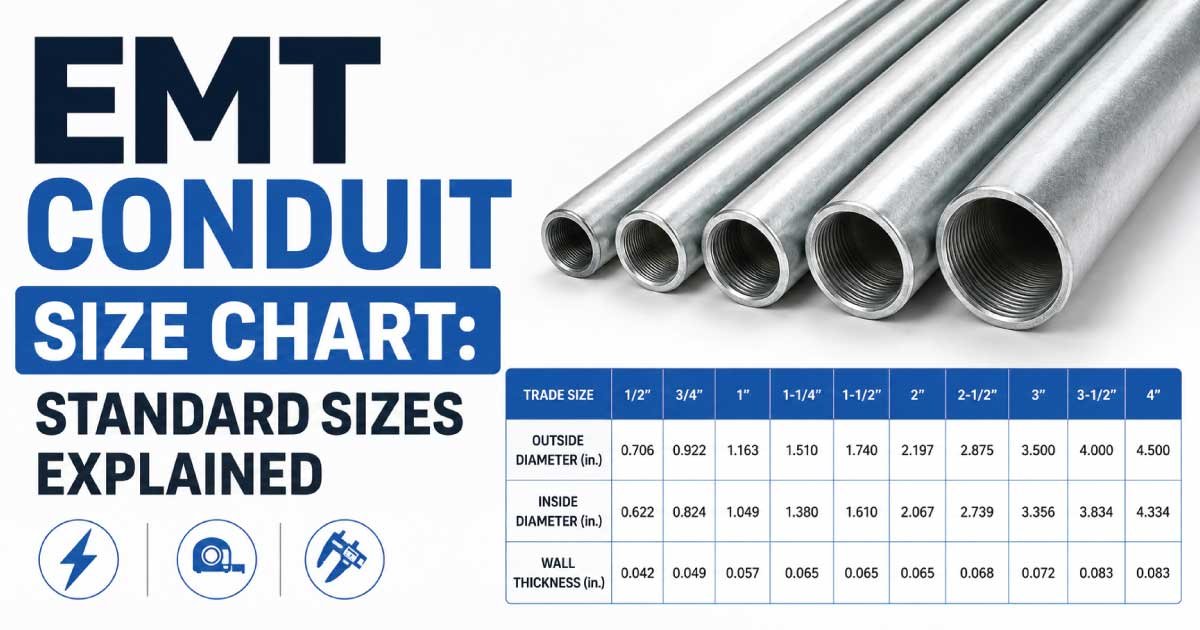
EMT conduit is available in several trade sizes, ranging from small 1/2-inch raceways to larger sizes used for commercial and industrial wiring. The table below shows commonly used EMT dimensions for quick reference.
| EMT Trade Size | Approx. Outside Diameter | Approx. Inside Diameter | Common Application |
|---|---|---|---|
| 1/2 inch | 0.706 in | 0.622 in | Small branch circuits |
| 3/4 inch | 0.922 in | 0.824 in | Residential wiring |
| 1 inch | 1.163 in | 1.049 in | Branch circuits |
| 1-1/4 inch | 1.510 in | 1.380 in | Multiple conductors |
| 1-1/2 inch | 1.740 in | 1.610 in | Larger circuits |
| 2 inch | 2.197 in | 2.067 in | Feeders |
| 2-1/2 inch | 2.875 in | 2.731 in | Large feeders |
| 3 inch | 3.500 in | 3.334 in | Industrial wiring |
| 3-1/2 inch | 4.000 in | 3.834 in | Large cable runs |
| 4 inch | 4.500 in | 4.334 in | Commercial feeders |
Dimensions are approximate reference values. Always verify exact dimensions against the applicable EMT manufacturer’s specifications and electrical code.
EMT Conduit Trade Sizes
EMT is identified using trade sizes, rather than simply its measured inside diameter. This distinction is important because the nominal trade size does not always correspond exactly to the conduit’s actual internal or external measurement.
Common EMT trade sizes include:
- 1/2 inch
- 3/4 inch
- 1 inch
- 1-1/4 inch
- 1-1/2 inch
- 2 inch
- 2-1/2 inch
- 3 inch
- 3-1/2 inch
- 4 inch
Larger EMT sizes are also available for specialized commercial and industrial installations.
EMT Conduit Inside Diameter
The inside diameter of EMT conduit determines how much usable space is available for electrical conductors. Because EMT has a defined wall thickness, its inside diameter is smaller than its outside diameter.
When calculating usable space, consider:
- Actual EMT inside diameter
- Number of conductors
- Conductor outside diameter
- Insulation thickness
- Allowable conduit fill
- Applicable electrical code
The actual dimensions should always be checked using the correct EMT dimensional table before performing an exact conduit-fill calculation.
EMT Conduit Outside Diameter
The outside diameter of EMT is important when selecting connectors, couplings, straps, clamps, and other fittings. Unlike the usable internal space, outside diameter does not determine how many conductors can fit inside the raceway.
EMT outside diameter is useful for:
- Selecting compatible fittings
- Planning conduit supports
- Checking available installation space
- Measuring conduit runs
- Designing electrical raceways
- Determining clearance around conduit
Always use fittings specifically designed for the corresponding EMT trade size.
Common EMT Conduit Sizes
Several EMT sizes are frequently encountered in electrical installations. Smaller raceways are generally used for branch circuits and smaller conductor groups, while larger sizes are used for feeders and installations containing more or larger conductors.
| EMT Size | Typical Use |
|---|---|
| 1/2 inch | Small electrical circuits |
| 3/4 inch | Branch circuits |
| 1 inch | Multiple small conductors |
| 1-1/4 inch | Larger conductor groups |
| 1-1/2 inch | Commercial circuits |
| 2 inch | Feeders |
| 2-1/2 inch | Larger feeders |
| 3 inch | Industrial wiring |
| 3-1/2 inch | Large conductor groups |
| 4 inch | Main feeders and distribution |
These are general applications rather than fixed wire-size rules.
What Is EMT Conduit Fill?
EMT conduit fill refers to the percentage of the raceway’s internal area occupied by electrical conductors. Fill limitations prevent excessive crowding and help make conductor installation, pulling, maintenance, and replacement more manageable.
Common NEC fill percentages are:
| Number of Conductors | Maximum Fill |
|---|---|
| 1 conductor | 53% |
| 2 conductors | 31% |
| 3 or more conductors | 40% |
The exact requirements should be verified using the applicable electrical code and conductor tables.
How to Calculate EMT Conduit Fill
Calculating EMT conduit fill requires the actual dimensions of the conductors and the usable internal area of the raceway. Simply adding wire gauges together is not a correct method because AWG numbers do not represent conductor outside diameter.
A basic calculation process is:
- Count all conductors.
- Identify each conductor size.
- Check the conductor’s outside diameter.
- Determine each conductor’s cross-sectional area.
- Add the conductor areas.
- Determine the permitted EMT fill.
- Compare the total area with the available conduit area.
This calculation identifies whether the selected EMT size provides adequate conductor space.
EMT Conduit Size and Wire Size
Wire size and EMT conduit size are different measurements. Wire size describes the electrical conductor, while EMT trade size describes the raceway containing the conductors.
Common wire sizes include:
- 14 AWG
- 12 AWG
- 10 AWG
- 8 AWG
- 6 AWG
- 4 AWG
- 2 AWG
The required EMT size depends on the number of wires and their actual dimensions, not just the wire gauge.
How Many Wires Can Fit in EMT Conduit?
The number of wires that can fit in EMT depends on conductor diameter, insulation type, wire size, and the permitted conduit-fill percentage. Therefore, there is no single wire-count limit that applies to every EMT size.
For accurate sizing, consider:
- Wire gauge
- Conductor insulation
- Number of conductors
- Conductor outside diameter
- EMT inside diameter
- Applicable fill requirements
A conduit-fill calculation should be performed whenever the exact number of conductors needs to be determined.
EMT Conduit Size for Residential Wiring
EMT is commonly used in residential electrical work where exposed metal raceways are appropriate. Smaller EMT sizes may be suitable for branch circuits, while larger raceways can be required when several conductors share the same pathway.
Residential EMT applications can include:
- Garage wiring
- Workshop circuits
- Exposed basement wiring
- Service-related raceways
- Equipment connections
- Branch circuits
The required size should always be calculated from the actual conductors being installed.
EMT Conduit Size for Commercial Wiring
Commercial electrical systems often require EMT because it provides a durable metallic pathway while remaining relatively lightweight and easy to install. Larger EMT sizes may be required for feeders, distribution circuits, and multiple conductor groups.
Commercial applications include:
- Office buildings
- Retail facilities
- Warehouses
- Schools
- Industrial buildings
- Electrical rooms
- Commercial equipment
Larger raceways can also make conductor pulling easier on long or complicated runs.
Factors That Affect EMT Conduit Size
Selecting EMT size requires consideration of several installation factors. Wire count alone is not enough because conductor dimensions, insulation, bends, and future expansion can all influence the practical raceway size.
Important factors include:
- Number of conductors
- Conductor outside diameter
- Wire insulation type
- EMT internal diameter
- Allowable conduit fill
- Number of bends
- Length of conduit run
- Installation environment
- Future wiring requirements
Considering these factors helps prevent undersized raceways and difficult conductor-pulling situations.
Key Takeaways
Choosing the correct EMT conduit size requires more than selecting a trade size from a chart. The final selection should consider conductor dimensions, quantity, allowable fill, installation conditions, and applicable electrical requirements.
Remember these points:
- EMT trade size is not its exact inside diameter.
- Conductor count affects conduit fill.
- Wire gauge alone does not determine EMT size.
- Insulation changes conductor outside diameter.
- Larger raceways can simplify difficult wire pulls.
- Always verify dimensions with the correct EMT tables.
- Follow the electrical code applicable to your installation.
EMT Conduit Size for Different Wire Gauges
The correct EMT conduit size for a particular wire gauge depends on the number of conductors installed and their overall diameter. A single large conductor requires different conduit space than several smaller conductors with the same nominal raceway.
| Wire Size | General Conductor Size | EMT Sizing Consideration |
|---|---|---|
| 14 AWG | Small | Commonly used in smaller raceways |
| 12 AWG | Small | Common branch-circuit wiring |
| 10 AWG | Medium | Requires more space |
| 8 AWG | Larger | Requires additional conduit area |
| 6 AWG | Large | Consider conductor quantity carefully |
| 4 AWG | Larger | Often requires larger raceways |
| 2 AWG | Very large | Requires substantial internal area |
| 1/0 AWG | Extra large | Usually requires larger EMT |
| 2/0 AWG | Extra large | Requires significant conduit space |
| 4/0 AWG | Very large | Used in larger electrical systems |
These are general sizing references rather than fixed wire-to-EMT combinations. Always calculate the actual conductor fill.
Also Read: Solar Cable Size Chart: Choose the Right Cable Size
EMT Conduit Size for 12 AWG Wire
12 AWG wire is commonly used for branch circuits, but the appropriate EMT size depends on how many conductors are installed. A raceway carrying only a few conductors may require less space than one containing several circuit conductors.
When sizing EMT for 12 AWG conductors, consider:
- Number of 12 AWG conductors
- Conductor insulation type
- Actual conductor outside diameter
- EMT internal diameter
- Permitted conduit fill
- Number of bends in the raceway
- Future expansion requirements
Never assume a specific EMT size is correct solely because 12 AWG wire is being used.
EMT Conduit Size for 10 AWG Wire
10 AWG wire has a larger conductor and generally requires more internal raceway space than 12 AWG wire. The required EMT size increases when multiple 10 AWG conductors are installed together.
Important considerations include:
- Number of conductors
- Wire insulation thickness
- Conductor outside diameter
- EMT trade size
- Allowable fill percentage
- Installation length and bends
For exact sizing, use the conductor dimensions and applicable conduit-fill tables rather than estimating from the wire gauge alone.
EMT Conduit Size for 8 AWG Wire
8 AWG conductors occupy considerably more space than smaller branch-circuit conductors. When several 8 AWG wires are installed in one EMT raceway, careful conduit-fill calculations become especially important.
Before selecting EMT, check:
- Conductor quantity
- Actual outside diameter
- Insulation type
- EMT inside diameter
- Conduit-fill requirements
- Raceway length
- Number of bends
A larger EMT raceway may also make conductor pulling easier when the installation contains long runs or multiple bends.
EMT Conduit Size for 6 AWG Wire
6 AWG wire requires more raceway space than 8, 10, or 12 AWG conductors. The required EMT size depends on how many conductors are installed and the actual dimensions of the selected conductor construction.
For 6 AWG wiring, consider:
- Total conductor count
- Copper or aluminum conductor
- Insulation type
- Conductor outside diameter
- EMT internal area
- Maximum permitted fill
- Pulling conditions
Always use the applicable conductor and raceway tables for an exact calculation.
Also Read: Welding Cable Size Chart: Choose the Right Cable Size
EMT Conduit Size for Larger Conductors
Large conductors such as 4 AWG, 2 AWG, and 1/0 AWG can occupy significant internal space. When several large conductors share one raceway, selecting the correct EMT size becomes increasingly important.
Larger conductor installations may require:
- Larger EMT trade sizes
- More careful fill calculations
- Larger junction boxes
- Compatible fittings
- Appropriate supports
- Additional pulling considerations
The raceway should provide adequate room for the conductors without exceeding the applicable fill limits.
EMT Conduit Fill Calculation Example
A basic EMT fill calculation begins by determining the total cross-sectional area of all conductors. That area is then compared with the maximum permitted percentage of the EMT’s internal area.
The process can be summarized as:
Total conductor area = conductor area × number of conductors
Then compare the result with the permitted EMT fill area.
For three or more conductors, the commonly referenced NEC fill limit is 40% of the available internal raceway area. The exact calculation should use the applicable code tables and conductor dimensions.
EMT Conduit Size vs PVC Conduit Size
EMT and PVC conduit use similar trade-size concepts, but their physical dimensions and characteristics are different. A trade size should not automatically be assumed to have identical internal dimensions across different conduit materials.
| Feature | EMT | PVC |
|---|---|---|
| Material | Metal | Nonmetallic |
| Weight | Lightweight metal | Very lightweight |
| Corrosion Resistance | Moderate | High |
| Mechanical Protection | Good | Depends on schedule |
| Common Installation | Exposed wiring | Underground and wet locations |
| Bending | Commonly bent | Uses appropriate fittings |
| Conductive | Yes | No |
| Typical Environment | Commercial/industrial | Underground/outdoor |
Always use the correct dimensional tables for the specific raceway type.
EMT vs Rigid Metal Conduit
EMT and rigid metal conduit both provide metallic protection, but they differ in construction, weight, installation, and typical applications. EMT has thinner walls, while rigid metal conduit provides heavier-duty mechanical protection.
| Feature | EMT | RMC |
|---|---|---|
| Wall Construction | Thin-wall | Heavy-wall |
| Weight | Lighter | Heavier |
| Installation | Relatively easy | More demanding |
| Mechanical Protection | Good | Excellent |
| Common Use | Commercial wiring | Heavy-duty installations |
| Bending | Easier | More difficult |
The appropriate choice depends on physical protection requirements and the applicable electrical installation rules.
Advantages of EMT Conduit
EMT is popular because it combines reasonable mechanical protection with relatively easy handling and installation. Its metallic construction also provides a durable pathway for electrical conductors in many commercial and industrial applications.
Major advantages include:
- Lightweight compared with rigid metal conduit.
- Relatively easy to bend.
- Provides mechanical protection.
- Available in many trade sizes.
- Widely available with compatible fittings.
- Suitable for many exposed installations.
- Provides a neat appearance.
- Can be installed efficiently by experienced electricians.
Disadvantages of EMT Conduit
Although EMT has many advantages, it is not suitable for every electrical environment. Installation requirements, corrosion exposure, physical conditions, and local electrical codes should be evaluated before selecting EMT.
Potential limitations include:
- Can corrode in unsuitable environments.
- Requires appropriate fittings and connections.
- May require specialized bending tools.
- Can be damaged by severe physical conditions.
- Requires proper support and installation.
- Not automatically suitable for every wet or corrosive location.
Choosing the correct raceway material is just as important as selecting the correct size.
Common EMT Conduit Sizing Mistakes
Incorrect sizing can make electrical installation more difficult and may result in unnecessary material changes. Many mistakes happen when conduit selection is based on a simple wire-count estimate rather than an actual fill calculation.
Common mistakes include:
- Choosing EMT based only on wire gauge.
- Ignoring conductor insulation diameter.
- Forgetting additional grounding conductors.
- Confusing trade size with inside diameter.
- Using the wrong dimensional table.
- Ignoring the number of bends.
- Failing to consider future wiring.
- Overlooking applicable electrical code requirements.
Proper planning before installation can prevent many of these problems.
How to Make EMT Wire Pulling Easier
Even when an EMT raceway meets fill requirements, difficult bends and long runs can make conductor installation challenging. Proper planning can reduce pulling resistance and help protect conductor insulation during installation.
For easier wire pulling:
- Keep conduit runs as direct as practical.
- Avoid unnecessary bends.
- Use properly sized fittings.
- Keep conductor bundles organized.
- Avoid excessive conduit fill.
- Use appropriate pulling equipment.
- Inspect conduit before pulling wires.
- Consider additional raceway space for difficult runs.
A properly planned raceway can save considerable installation time.
EMT Conduit Installation Tips
Correct installation is essential for achieving the intended protection and performance of an EMT electrical raceway. Conduit should be properly supported, connected, bent, and protected according to applicable installation requirements.
Important installation practices include:
- Use compatible EMT fittings.
- Make clean and accurate bends.
- Secure conduit using suitable supports.
- Maintain appropriate spacing.
- Protect open conduit ends.
- Avoid sharp edges that could damage conductors.
- Keep raceways clear before wire pulling.
- Follow manufacturer and electrical-code requirements.
Professional installation practices help maintain a reliable electrical raceway system.
When Should You Use Larger EMT?
A larger EMT raceway may be practical when the installation contains multiple conductors, large wires, long runs, or numerous bends. Additional space can make pulling and future maintenance easier.
Consider a larger EMT size when:
- The calculated fill approaches the maximum limit.
- The conduit contains large conductors.
- The run has several bends.
- The wiring distance is long.
- Future conductors may be added.
- Pulling space is limited.
- Maintenance access is important.
However, oversized conduit can increase material and fitting costs, so it should be selected for a practical reason.
Final Thoughts
Understanding the EMT conduit size chart makes it easier to plan electrical raceways for residential, commercial, and industrial wiring. However, selecting the correct trade size requires more than matching wire gauge to conduit size.
Always consider:
- Number of conductors
- Conductor outside diameter
- Insulation type
- EMT inside diameter
- Allowable conduit fill
- Raceway length
- Number of bends
- Installation environment
- Future wiring requirements
- Applicable electrical codes
Using accurate conductor dimensions and the correct EMT sizing tables helps ensure the raceway provides adequate space for installation, maintenance, and safe electrical wiring.
Also Read: Electrical Wire Size Chart: Choose the Right Wire Gauge
FAQs:
What is the most common EMT conduit size?
1/2-inch and 3/4-inch EMT are common smaller trade sizes, while 1-inch and larger EMT are frequently used where more conductor space is required. The appropriate size depends on conductor quantity, dimensions, installation conditions, and applicable electrical requirements.
What is the inside diameter of 1-inch EMT?
1-inch EMT has an approximate inside diameter of 1.049 inches. However, exact dimensional information should be verified against the applicable manufacturer’s specifications. Trade size identifies the raceway category and should not be treated as an exact internal measurement.
How many wires can fit in 3/4 EMT?
The number of wires that can fit in 3/4-inch EMT depends on the conductor size, insulation, and applicable fill limit. You should calculate the total conductor area rather than relying on a fixed number of wires for every installation.
Can EMT conduit be used outdoors?
EMT may be suitable for certain outdoor applications when properly installed and protected, but environmental exposure and local electrical requirements must be considered. Wet, corrosive, or severe outdoor environments may require a different raceway system or additional protection.
What size EMT is used for 12 AWG wire?
There is no single EMT size that applies to every 12 AWG installation. The required raceway depends on the number of conductors, insulation dimensions, grounding conductors, fill requirements, and installation conditions. Always perform the appropriate fill calculation.
Is EMT conduit waterproof?
EMT itself should not automatically be considered waterproof. Its suitability for wet locations depends on the complete installation, fittings, connections, and applicable electrical requirements. Specialized raceway systems may be necessary where significant moisture or water exposure is expected.
What is the difference between EMT and PVC conduit?
EMT is a metallic raceway, while PVC conduit is nonmetallic. EMT provides metallic mechanical protection and is commonly used for exposed wiring, whereas PVC offers strong corrosion resistance and is frequently used underground or in suitable wet environments.