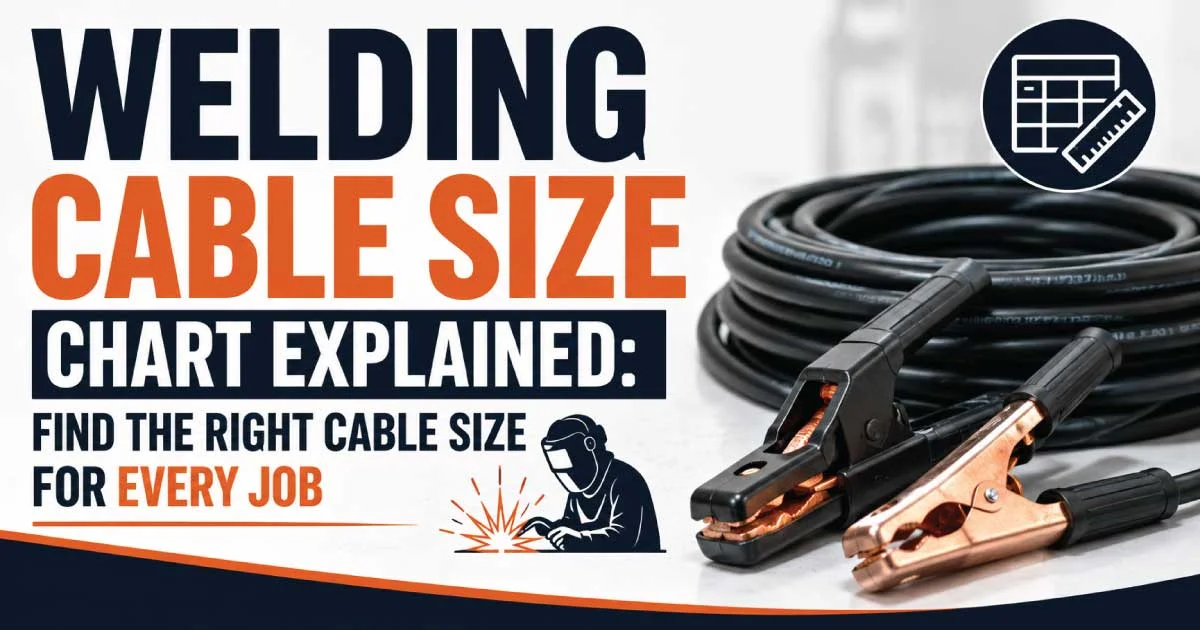
Selecting the correct welding cable size is one of the most important decisions for achieving safe, efficient, and high-quality welding performance.
A cable that is too small can overheat, reduce welding output, and create safety hazards, while an oversized cable increases unnecessary costs. Understanding the welding cable size chart helps welders choose the right cable based on amperage, cable length, and duty cycle.
Whether you are a professional fabricator or a DIY enthusiast, this guide explains everything you need to know about welding cable sizes and how to select the ideal option for your welding machine.
What Is a Welding Cable Size Chart?
A welding cable size chart is a reference guide that matches cable gauge with welding amperage and cable length. It helps users determine the proper cable thickness needed to safely carry electrical current while minimizing voltage drop, preventing overheating, and maintaining consistent welding performance during every project.
Why a Welding Cable Size Chart Matters
Using a welding cable size chart ensures your welding machine delivers the correct power to the electrode or torch. Incorrect cable sizing may reduce arc stability, waste energy, and shorten equipment lifespan. Proper sizing also improves operator safety by reducing excessive heat buildup within the cable insulation.
- Prevents voltage drop
- Improves welding efficiency
- Reduces cable overheating
- Extends equipment lifespan
- Enhances workplace safety
How Welding Cable Sizes Are Measured
Welding cables are commonly measured using the American Wire Gauge (AWG) system. In this system, smaller AWG numbers indicate thicker cables capable of carrying higher electrical currents. Larger cables have lower resistance, making them suitable for high-amperage welding applications over longer cable distances.
Understanding AWG Numbers
AWG sizing can be confusing because lower numbers represent larger conductors. For example, a 1 AWG cable is thicker than a 4 AWG cable. When current demands become extremely high, sizes progress to 1/0, 2/0, 3/0, and 4/0 welding cables for industrial applications.
- 6 AWG – Light-duty welding
- 4 AWG – Medium-duty work
- 2 AWG – Heavy-duty applications
- 1 AWG – High-amperage welding
- 1/0 to 4/0 – Industrial welding operations
Factors That Determine the Correct Welding Cable Size
Choosing the right welding cable involves more than simply checking the amperage. Cable length, duty cycle, welding process, and environmental conditions all influence the correct cable size. Evaluating these factors ensures reliable electrical performance and helps avoid unnecessary power losses during welding operations.
1. Welding Amperage
The welding current is the primary factor when selecting cable size. Higher amperage requires thicker cables because they carry more electrical current safely. Exceeding the cable’s rated capacity can cause overheating, insulation damage, and inconsistent arc performance throughout the welding process.
2. Total Cable Length
Cable length significantly impacts voltage drop. As the cable becomes longer, electrical resistance increases. Longer cable runs require thicker conductors to compensate for resistance and maintain sufficient voltage at the welding arc, ensuring consistent weld quality across the entire project.
3. Duty Cycle
Duty cycle refers to the percentage of time a welding machine operates continuously within a ten-minute period. Machines with higher duty cycles generate sustained electrical loads, requiring larger welding cables capable of handling prolonged heat without performance degradation or insulation failure.
4. Welding Process
Different welding methods consume varying amounts of electrical current. Stick welding often requires higher amperage than TIG welding, while MIG welding commonly falls between the two. Selecting cable size based on the specific welding process ensures optimal efficiency and reliable arc stability.
Standard Welding Cable Size Chart
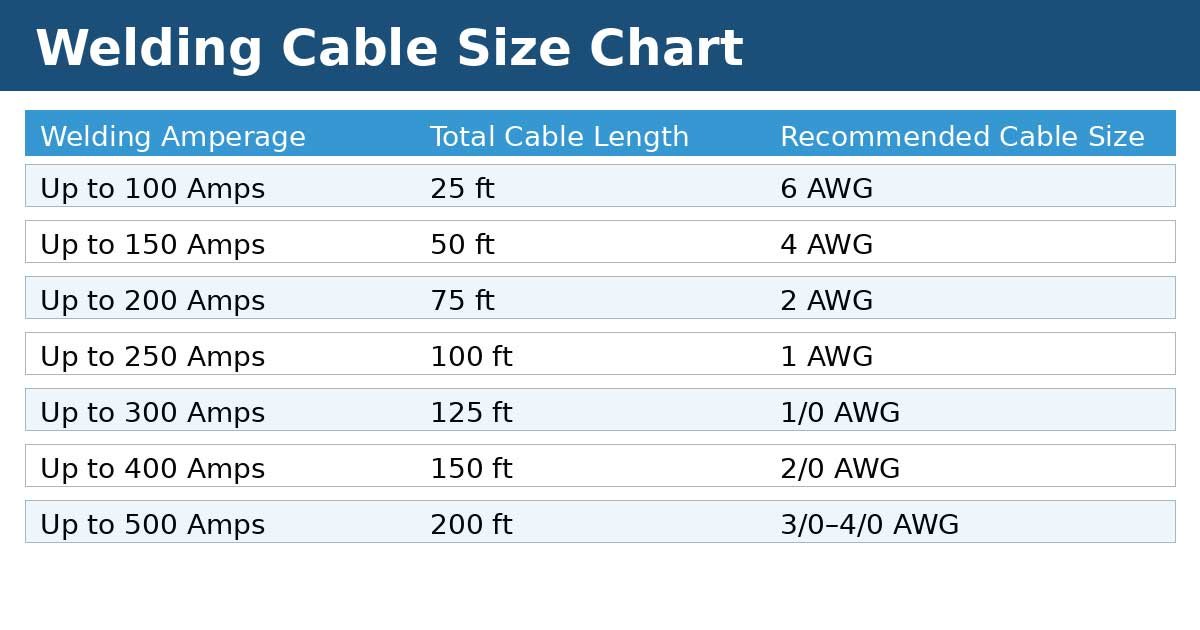
The following welding cable size chart provides general recommendations for selecting cable sizes based on welding amperage and total cable length. Always verify your welding machine manufacturer’s recommendations before final installation for maximum safety and equipment performance.
| Welding Amperage | Total Cable Length | Recommended Cable Size |
|---|---|---|
| Up to 100 Amps | 25 ft | 6 AWG |
| Up to 150 Amps | 50 ft | 4 AWG |
| Up to 200 Amps | 75 ft | 2 AWG |
| Up to 250 Amps | 100 ft | 1 AWG |
| Up to 300 Amps | 125 ft | 1/0 AWG |
| Up to 400 Amps | 150 ft | 2/0 AWG |
| Up to 500 Amps | 200 ft | 3/0–4/0 AWG |
Welding Cable Size PDF
Choosing the correct welding cable size helps maintain safe current flow, reduce voltage drop, and improve overall welding performance. This chart provides recommended welding cable sizes based on welding amperage and total cable length, making it easier to select the appropriate cable for efficient, reliable, and consistent welding operations.
How Voltage Drop Affects Welding Performance
Voltage drop occurs when electrical energy decreases while traveling through a cable. Excessive voltage drop weakens the welding arc, creates unstable performance, and reduces weld quality. Selecting an appropriate cable size minimizes resistance and ensures consistent electrical delivery throughout the welding operation.
Signs of Excessive Voltage Drop
Recognizing voltage drop early helps prevent welding defects and equipment damage. If the cable is undersized, several performance issues become noticeable during operation. Addressing these symptoms by upgrading cable size improves productivity and weld consistency.
- Weak welding arc
- Inconsistent penetration
- Cable overheating
- Reduced machine efficiency
- Frequent arc interruptions
Common Welding Cable Sizes and Their Applications
Different cable sizes are designed for different welding workloads. Understanding where each size performs best simplifies cable selection and prevents overloading, helping welders maintain safety while maximizing equipment performance across residential, commercial, and industrial welding applications.
6 AWG Welding Cable
A 6 AWG welding cable is suitable for light-duty welding projects involving lower amperage. It is commonly used with portable welders, maintenance work, hobby projects, automotive repairs, and small fabrication tasks where cable runs remain relatively short.
4 AWG Welding Cable
The 4 AWG cable supports moderate welding currents and is widely used in repair shops, construction sites, and medium-sized fabrication projects. It provides an excellent balance between flexibility, durability, and electrical capacity for everyday professional welding applications.
2 AWG Welding Cable
A 2 AWG welding cable handles higher current loads while maintaining excellent flexibility. It is frequently selected for heavy fabrication, farm equipment repairs, structural steel welding, and industrial maintenance requiring reliable performance over medium-length cable runs.
1/0 and Larger Welding Cables
Large welding cables, including 1/0, 2/0, 3/0, and 4/0 sizes, are intended for industrial welding operations involving extremely high amperage. These cables are commonly found in shipbuilding, pipeline welding, manufacturing plants, and heavy equipment fabrication facilities.
Benefits of Using the Correct Welding Cable Size
Using the proper welding cable size delivers better welding performance while reducing operational risks. Correct cable selection improves electrical efficiency, enhances arc stability, extends equipment life, and lowers long-term maintenance costs by minimizing heat-related cable deterioration.
- Stable welding arc
- Improved weld penetration
- Lower energy loss
- Increased cable lifespan
- Better operator safety
- Reduced maintenance expenses
Mistakes to Avoid When Choosing Welding Cable Size
Many welders make sizing mistakes by focusing only on amperage while ignoring cable length and duty cycle. These oversights often result in overheating, voltage drop, inconsistent weld quality, and premature cable failure, increasing both repair costs and workplace safety risks.
Avoid These Common Errors
Choosing the right welding cable requires evaluating every operating condition instead of relying solely on general recommendations. Avoiding common sizing mistakes helps maximize welding efficiency while protecting expensive welding equipment from unnecessary electrical stress.
- Ignoring total cable length
- Choosing cables based only on price
- Overlooking duty cycle requirements
- Using damaged or worn cables
- Exceeding cable current ratings