
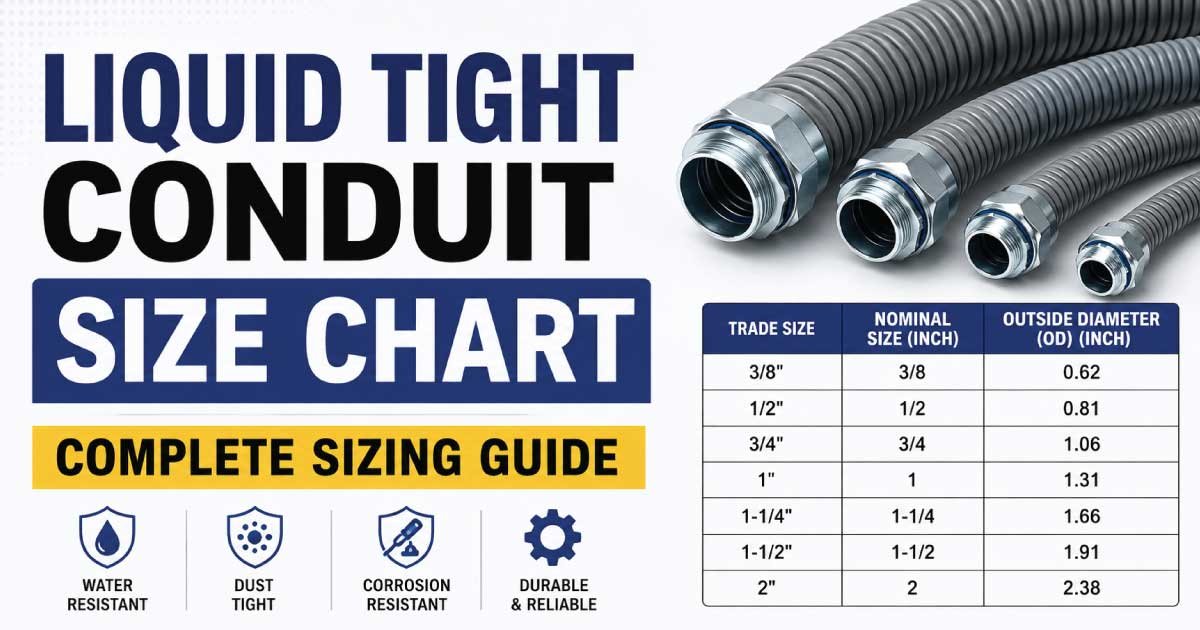
Liquid tight conduit is an important part of electrical installations where wires and cables need protection from water, moisture, oil, dust, vibration, and mechanical damage. It is commonly installed with motors, pumps, HVAC equipment, outdoor machinery, industrial equipment, control panels, and other electrical systems exposed to harsh environments.
Selecting the correct liquid tight conduit size is important because the conduit must provide enough internal space for the conductors while maintaining proper protection. A conduit that is too small can make wire pulling difficult, increase the possibility of insulation damage, and create installation problems. A properly sized conduit allows conductors to be installed safely and makes maintenance easier.
Liquid tight conduit is available in several trade sizes, materials, and constructions. The most common sizes include 3/8 inch, 1/2 inch, 3/4 inch, 1 inch, 1-1/4 inch, 1-1/2 inch, 2 inch, 2-1/2 inch, 3 inch, and 4 inch.
This complete guide explains liquid tight conduit dimensions, types, conduit fill, wire capacity, applications, fittings, sizing methods, and the factors to consider when selecting the right conduit.
What Is Liquid Tight Conduit?
Liquid tight conduit is a flexible electrical raceway designed to protect conductors from moisture and other environmental hazards. Unlike ordinary flexible conduit, liquid tight products are specifically designed for applications where water, oil, or other liquids may come into contact with the wiring system.
A typical liquid tight conduit system consists of:
- Flexible conduit.
- Inner metallic or nonmetallic construction.
- Protective outer jacket.
- Liquid tight connectors.
- Electrical conductors or cables.
The flexible construction allows the conduit to be routed around equipment and through areas where rigid conduit would be difficult to install.
Liquid tight conduit is particularly useful where electrical equipment experiences vibration or movement.
Why Liquid Tight Conduit Size Matters
Choosing the correct size affects both electrical installation and mechanical protection.
An undersized conduit can cause:
- Difficult wire pulling.
- Excessive pulling tension.
- Damaged conductor insulation.
- Overcrowding.
- Difficult maintenance.
- Excessive bending stress.
- Reduced installation flexibility.
An oversized conduit usually provides additional working space but may increase material cost and require larger fittings and supports.
The goal is to select a conduit that provides sufficient internal capacity without unnecessarily increasing the installation size.
Liquid Tight Conduit Size Chart
The following chart provides a general reference for common liquid tight conduit trade sizes. Actual inside diameter and conductor capacity vary according to conduit type, wall construction, manufacturer, and applicable electrical requirements.
| Liquid Tight Conduit Size | Approx. Inside Diameter* | Common Applications |
|---|---|---|
| 3/8 inch | 0.35–0.40 in | Small control wiring |
| 1/2 inch | 0.45–0.55 in | Lighting and small equipment |
| 3/4 inch | 0.70–0.80 in | Branch circuits and equipment |
| 1 inch | 0.95–1.05 in | Multiple conductors |
| 1-1/4 inch | 1.20–1.35 in | Larger power circuits |
| 1-1/2 inch | 1.45–1.60 in | Industrial equipment |
| 2 inch | 1.90–2.10 in | Large cable groups |
| 2-1/2 inch | 2.35–2.65 in | Heavy-duty wiring |
| 3 inch | 2.85–3.15 in | Large industrial installations |
| 4 inch | 3.80–4.15 in | Major cable runs |
*Approximate dimensions only. Always check the manufacturer’s specification for the exact internal diameter and allowable conductor fill.
Liquid Tight Conduit Trade Sizes
Liquid tight conduit is normally identified using trade sizes rather than its exact measured inside diameter.
Common trade sizes include:
- 3/8 inch
- 1/2 inch
- 3/4 inch
- 1 inch
- 1-1/4 inch
- 1-1/2 inch
- 2 inch
- 2-1/2 inch
- 3 inch
- 4 inch
Larger sizes are also available for specialized industrial applications.
It is important to understand that a 1-inch liquid tight conduit does not necessarily have a 1-inch inside diameter. The actual internal diameter depends on the product construction and manufacturer.
Liquid Tight Conduit Types
Several types of liquid tight flexible conduit are used in electrical installations.
Liquid Tight Flexible Metal Conduit
Liquid tight flexible metal conduit, commonly called LFMC, combines a flexible metallic core with a liquid-resistant outer jacket.
It is commonly used where:
- Mechanical protection is important.
- Moisture resistance is required.
- Equipment vibration is present.
- Electrical continuity or grounding requirements apply.
Typical applications include motors, pumps, outdoor equipment, HVAC units, and industrial machinery.
Liquid Tight Flexible Nonmetallic Conduit
Liquid tight flexible nonmetallic conduit uses a flexible nonmetallic construction.
It may provide advantages such as:
- Lightweight installation.
- Corrosion resistance.
- Flexibility.
- Moisture protection.
- Resistance to certain chemicals.
The exact performance depends on the product’s listing and manufacturer’s specifications.
Liquid Tight Conduit Size for Electrical Wiring
The required conduit size depends primarily on the number and physical size of the conductors.
For example, a small control circuit may require only a few small conductors. A motor circuit may contain larger conductors that require substantially more internal space.
When selecting conduit, consider:
- Wire gauge.
- Number of wires.
- Insulation thickness.
- Overall cable diameter.
- Conduit inside diameter.
- Conduit-fill requirements.
- Circuit length.
- Number of bends.
The same conduit size can therefore accommodate different numbers of wires depending on the actual conductor dimensions.
Liquid Tight Conduit Fill
Conduit fill refers to the amount of internal raceway space occupied by conductors.
Electrical standards establish limits on conductor fill to help ensure that wires can be installed without excessive crowding.
The allowable fill depends on factors such as:
- Number of conductors.
- Conductor dimensions.
- Conduit type.
- Applicable electrical code.
For this reason, there is no universal statement such as “one-inch conduit always holds X wires.”
The actual capacity should be calculated using the conductor dimensions and the applicable conduit-fill tables.
Also Read: MCB Size Chart: Complete MCB Sizes Guide
How to Calculate Liquid Tight Conduit Size
Selecting the right conduit size can be approached systematically.
Step 1: Count the Conductors
Determine how many wires or cables will be installed.
For example:
- 3 power conductors.
- 1 grounding conductor.
- 2 control conductors.
The total number and physical size must be considered.
Step 2: Determine Wire Dimensions
Identify the outside diameter of each conductor.
Do not rely solely on AWG because two conductors with the same gauge can have different overall diameters depending on insulation construction.
Step 3: Calculate Conductor Area
The approximate cross-sectional area of a round conductor can be calculated using:
Area = π × D² ÷ 4
where D represents the outside diameter.
Step 4: Add the Conductor Areas
Calculate the total occupied area of all conductors.
Total Area = Area 1 + Area 2 + Area 3 + …
Step 5: Compare With Allowable Fill
Compare the total conductor area with the permitted conduit-fill area.
If the conductors exceed the permitted fill, choose the next larger conduit size.
Liquid Tight Conduit Size for 12 AWG Wire
12 AWG wire is commonly used for electrical branch circuits and equipment wiring.
A small number of 12 AWG conductors may fit within 1/2-inch or 3/4-inch liquid tight conduit, depending on the specific wire construction and applicable fill requirements.
When more conductors are installed, a larger conduit such as 3/4 inch or 1 inch may be necessary.
Always calculate the actual conductor fill rather than assuming that all 12 AWG wires have identical dimensions.
Liquid Tight Conduit Size for 10 AWG Wire
10 AWG conductors are larger than 12 AWG and require more internal space.
They are often used for:
- Motors.
- Heating equipment.
- Larger branch circuits.
- Pumps.
- Industrial machinery.
- High-current equipment.
Depending on the number of conductors, 3/4-inch, 1-inch, or larger liquid tight conduit may be required.
Long runs with multiple bends may justify selecting a larger conduit to simplify wire pulling.
Liquid Tight Conduit Size for 8 AWG Wire
8 AWG conductors are used in higher-current electrical applications.
Examples include:
- Large equipment.
- Motors.
- Industrial machinery.
- Power distribution.
- High-current accessories.
Multiple 8 AWG conductors require significantly more internal space than smaller branch-circuit wiring.
The final conduit size should be selected using the actual outside diameter of the conductor and the applicable fill calculation.
Also Read: MCCB Size Chart: Complete Sizing Guide
Liquid Tight Conduit Size for 6 AWG and Larger Wire
Large conductors such as 6 AWG, 4 AWG, 2 AWG, and larger sizes require careful conduit sizing.
These conductors may be used for:
- Large motors.
- Industrial equipment.
- Service equipment.
- High-current power distribution.
- Battery systems.
- Large machinery.
When large conductors are installed in liquid tight conduit, also consider the minimum bending radius and pulling tension.
A conduit that meets fill requirements may still be difficult to install if the routing contains tight bends.
Liquid Tight Conduit for Motors
Motors are one of the most common applications for liquid tight conduit.
A motor can create vibration during operation, making a flexible connection useful between the fixed electrical raceway and the motor terminal box.
Liquid tight conduit can be used between:
- Motor and disconnect.
- Motor and junction box.
- Pump and electrical panel.
- HVAC equipment and disconnect.
- Industrial machine and control panel.
The conduit should be sized according to the motor conductors and selected for the temperature, moisture, oil, and mechanical conditions surrounding the motor.
Liquid Tight Conduit for HVAC Systems
HVAC installations often require flexible electrical connections because equipment can vibrate and may be exposed to moisture or condensation.
Liquid tight conduit is commonly used for:
- Air-conditioning units.
- Heat pumps.
- Condensers.
- Air handlers.
- Outdoor HVAC equipment.
- Ventilation equipment.
The conduit must be appropriately rated for the location and installed with compatible liquid tight fittings.
Liquid Tight Conduit for Outdoor Applications
Outdoor electrical equipment can be exposed to:
- Rain.
- Snow.
- Condensation.
- UV radiation.
- Dirt.
- Temperature changes.
- Chemicals.
Liquid tight conduit can provide additional environmental protection when the product is properly rated for the application.
Outdoor installations should use compatible conduit, connectors, fittings, and cable systems.
Simply using a flexible conduit outdoors does not automatically make an electrical installation liquid tight.
Liquid Tight Conduit for Pumps
Pumps often operate in locations where water or other liquids are present.
Applications include:
- Water pumps.
- Sump pumps.
- Industrial pumps.
- Pool equipment.
- Irrigation systems.
- Wastewater equipment.
Liquid tight conduit can help protect electrical conductors where moisture exposure is expected.
The conduit and fittings should be selected according to the environmental rating of the installation.
Liquid Tight Conduit for Industrial Equipment
Industrial machinery can expose electrical wiring to vibration, oil, chemicals, heat, and mechanical movement.
Liquid tight conduit can provide a flexible connection between fixed electrical wiring and moving or vibrating machinery.
Typical applications include:
- CNC machines.
- Conveyor systems.
- Robotics.
- Packaging equipment.
- Manufacturing machinery.
- Pumps.
- Compressors.
- Production equipment.
For industrial installations, conduit selection should account for both electrical and mechanical requirements.
Liquid Tight Conduit Bend Radius
The ability to bend is one of the major benefits of flexible conduit, but liquid tight conduit still has a minimum bend radius.
Excessively tight bends can:
- Restrict the internal opening.
- Increase wire-pulling friction.
- Damage the conduit.
- Damage conductor insulation.
- Increase mechanical stress.
Always follow the manufacturer’s recommended minimum bend radius.
This is especially important when routing large conduit around motors, machinery, junction boxes, and electrical panels.
Liquid Tight Conduit Fittings
A liquid tight conduit installation depends on properly selected fittings.
Common fittings include:
- Straight liquid tight connectors.
- 90-degree connectors.
- 45-degree connectors.
- Compression fittings.
- Threaded fittings.
- Adapters.
- Couplings.
Fittings must match the conduit trade size and type.
A fitting that does not provide the required environmental seal can compromise the entire installation.
For wet or outdoor locations, use fittings specifically approved for the intended application.
Liquid Tight Conduit Connector Size
The connector size should correspond to the conduit trade size.
For example:
| Conduit Trade Size | Typical Connector Trade Size |
|---|---|
| 3/8 inch | 3/8 inch |
| 1/2 inch | 1/2 inch |
| 3/4 inch | 3/4 inch |
| 1 inch | 1 inch |
| 1-1/4 inch | 1-1/4 inch |
| 1-1/2 inch | 1-1/2 inch |
| 2 inch | 2 inch |
| 2-1/2 inch | 2-1/2 inch |
| 3 inch | 3 inch |
| 4 inch | 4 inch |
However, compatibility should always be verified with the specific manufacturer because fitting designs and dimensions can vary.
Also Read: Circuit Breaker Size Chart: Breaker Sizes Explained
Liquid Tight Conduit vs Flexible Conduit
Regular flexible conduit and liquid tight conduit are not necessarily interchangeable.
| Feature | Flexible Conduit | Liquid Tight Conduit |
|---|---|---|
| Flexibility | Yes | Yes |
| Moisture protection | Depends on type | Designed for liquid-tight applications |
| Outdoor suitability | Product dependent | Product dependent |
| Vibration protection | Yes | Yes |
| Oil resistance | Depends on product | Product dependent |
| Common use | General electrical routing | Wet, outdoor, industrial equipment |
The appropriate product should be selected based on the environment rather than flexibility alone.
Liquid Tight Conduit vs Rigid Conduit
Rigid conduit provides strong mechanical protection but has limited flexibility.
Liquid tight conduit offers greater flexibility and is particularly useful for equipment that moves or vibrates.
Liquid Tight Conduit Advantages
- Flexible.
- Easier to route around equipment.
- Useful for vibration.
- Available in moisture-resistant constructions.
- Convenient for equipment connections.
Rigid Conduit Advantages
- Strong mechanical protection.
- Suitable for fixed installations.
- Excellent structural support.
- Available in multiple materials.
Many electrical systems use both rigid and flexible conduit, with liquid tight conduit installed near equipment where flexibility and environmental protection are needed.
Liquid Tight Conduit for Control Wiring
Liquid tight conduit is also useful for protecting control and instrumentation wiring in industrial environments.
Applications can include:
- Sensors.
- Limit switches.
- Control panels.
- Solenoid valves.
- Machine controls.
- PLC equipment.
- Industrial instrumentation.
Small control conductors may allow the use of smaller conduit, but the final size depends on the number and dimensions of the conductors.
Power and control wiring may also be subject to separation requirements.
Liquid Tight Conduit and Grounding
Metallic liquid tight conduit may form part of an electrical grounding or bonding system when installed according to applicable requirements.
However, grounding requirements vary depending on the wiring method and electrical code.
Where required, an equipment grounding conductor may need to be installed inside the conduit.
Do not assume that the conduit itself automatically satisfies every grounding requirement. Verify the installation method against the applicable electrical standard.
Liquid Tight Conduit Temperature Rating
Temperature is an important consideration when selecting conduit.
Electrical equipment may generate significant heat, particularly around:
- Motors.
- Compressors.
- Industrial machinery.
- Furnaces.
- Engine-driven equipment.
- Outdoor equipment exposed to direct sunlight.
The conduit, insulation, and fittings should have suitable temperature ratings for the installation environment.
High ambient temperatures can also affect conductor ampacity.
Liquid Tight Conduit Material Selection
Different applications require different conduit constructions.
Metallic Construction
Useful when greater mechanical protection is needed.
Nonmetallic Construction
Useful where corrosion resistance and lightweight installation are priorities.
PVC-Coated Construction
Can provide additional resistance to certain environmental conditions.
The best choice depends on the specific application, environmental exposure, mechanical requirements, and electrical code.
How to Choose the Correct Liquid Tight Conduit Size
Follow these steps when selecting conduit:
- Identify the application.
- Determine whether metallic or nonmetallic conduit is required.
- Count all conductors or cables.
- Determine their actual outside diameters.
- Calculate the total conductor area.
- Check allowable conduit fill.
- Check the conduit manufacturer’s inside diameter.
- Consider the length of the run.
- Consider the number of bends.
- Check the minimum bend radius.
- Select compatible fittings.
- Verify temperature and environmental ratings.
- Confirm compliance with applicable electrical requirements.
This method provides a more accurate result than simply matching conduit size to wire gauge.
Common Liquid Tight Conduit Sizing Mistakes
Using Trade Size as Actual Inside Diameter
A trade size is not necessarily the exact internal diameter.
Ignoring Insulation
Wire insulation contributes to the overall conductor diameter and conduit fill.
Overfilling the Conduit
Too many conductors can make installation difficult and may violate electrical requirements.
Using Incorrect Fittings
A liquid tight conduit system requires fittings that are compatible with the conduit and environment.
Making Excessively Tight Bends
Tight bends can increase pulling tension and damage the wiring.
Ignoring Temperature
Conduit and conductors must be suitable for the environmental temperature.
Assuming Every Flexible Conduit Is Liquid Tight
Flexibility alone does not mean a conduit provides protection against liquids.
Liquid Tight Conduit Size Quick Reference
For general planning:
| Size | Typical Use |
|---|---|
| 3/8 inch | Small control and instrumentation wiring |
| 1/2 inch | Small equipment and lighting |
| 3/4 inch | Branch circuits and equipment |
| 1 inch | Multiple conductors |
| 1-1/4 inch | Larger equipment circuits |
| 1-1/2 inch | Industrial power and control |
| 2 inch | Large cable groups |
| 2-1/2 inch | Heavy-duty installations |
| 3 inch | Large industrial cable runs |
| 4 inch | Major power installations |
This is a preliminary reference only. Actual capacity depends on conductor dimensions, conduit construction, allowable fill, and applicable electrical requirements.
Final Thoughts
Choosing the correct liquid tight conduit size is essential for creating a safe, durable, and serviceable electrical installation. The conduit must provide enough internal room for the conductors while also meeting requirements for environmental protection, mechanical flexibility, bend radius, and conductor fill.
For many small and medium installations, 1/2-inch, 3/4-inch, and 1-inch liquid tight conduit are commonly encountered. Larger electrical equipment and industrial systems may require 1-1/4-inch, 1-1/2-inch, 2-inch, 3-inch, or 4-inch conduit depending on conductor quantity and size.
The most reliable sizing method is to determine the actual outside diameter and number of conductors, calculate the required conduit fill, check the manufacturer’s dimensions, and then select the appropriate trade size.
For professional installations, always follow the applicable electrical code, manufacturer instructions, product listings, and local requirements. Properly sized liquid tight conduit not only protects electrical conductors but also improves installation quality, reduces wire-pulling problems, and provides dependable protection in demanding environments.
Frequently Asked Questions
What is liquid tight conduit used for?
Liquid tight conduit is used to protect electrical wires and cables in environments where moisture, water, oil, vibration, dust, or mechanical movement may be present. Common applications include motors, pumps, HVAC equipment, outdoor electrical systems, industrial machinery, and equipment connections.
What is the most common liquid tight conduit size?
Common sizes include 1/2 inch, 3/4 inch, and 1 inch, but there is no universal best size. The required size depends on the number and physical dimensions of the conductors, conduit type, allowable fill, installation length, and environmental conditions.
Can liquid tight conduit be used outdoors?
Yes, products specifically rated for outdoor and wet-location applications can be used outdoors. The entire system must be suitable for the environment, including the conduit, connectors, fittings, and conductors. Always verify the product listing and installation requirements before use.
Does liquid tight conduit protect against water?
Liquid tight conduit is designed for applications requiring protection against liquids when the correct product and compatible fittings are properly installed. However, not every flexible conduit is liquid tight. The specific product must be listed or rated for the intended wet or outdoor location.
How many wires can fit in liquid tight conduit?
The number of wires depends on their outside diameter and the conduit’s usable internal area. A larger conduit can accommodate more or larger conductors. The exact number should be determined using conductor dimensions and the applicable conduit-fill requirements rather than a generic wire-count estimate.
Is liquid tight conduit better than regular flexible conduit?
Liquid tight conduit is better when protection from moisture or liquids is required. Regular flexible conduit may be adequate for dry environments. The correct choice depends on environmental conditions, mechanical requirements, temperature, chemical exposure, and applicable electrical installation requirements.