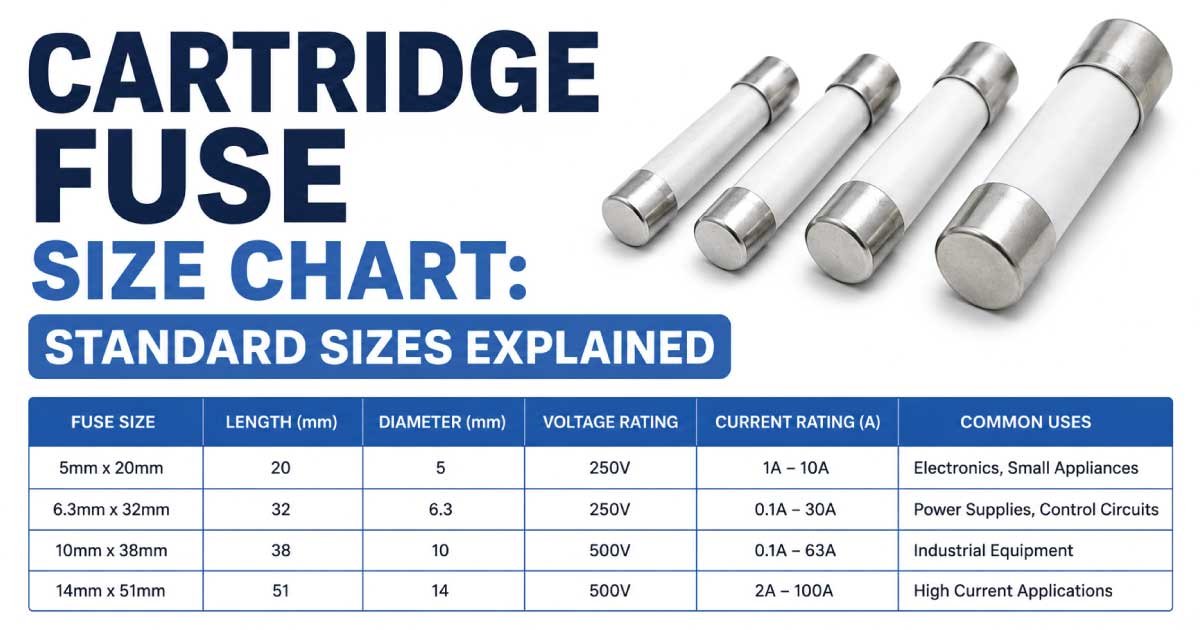
A cartridge fuse size chart helps electricians, technicians, engineers, and DIY users understand common fuse ratings, dimensions, voltage ratings, and electrical applications. Selecting the correct cartridge fuse is important because the fuse must provide suitable overcurrent protection for the circuit.
Cartridge fuses are widely used in electrical distribution, industrial equipment, control panels, appliances, automotive systems, and electronic equipment. Their size, current rating, voltage rating, breaking capacity, and fuse characteristic all affect proper selection.
What Is a Cartridge Fuse?
A cartridge fuse is an electrical protection device containing a fusible element enclosed inside a cylindrical body. When excessive current flows through the fuse, the element heats up and melts, interrupting the circuit.
Cartridge fuses are commonly used for:
- Electrical distribution systems
- Control panels
- Industrial machinery
- Motors
- Transformers
- Appliances
- Electronic equipment
- Lighting circuits
- Power supplies
Once a conventional cartridge fuse operates, it normally needs to be replaced with a suitable fuse of the correct rating.
How Does a Cartridge Fuse Work?
A cartridge fuse protects an electrical circuit by interrupting excessive current. Under normal operating conditions, current passes through the fusible element. During an overload or short circuit, the element heats up and eventually melts.
The basic operating process is:
- Normal current flows through the fuse.
- Excessive current increases heat.
- The fusible element reaches its operating temperature.
- The element melts or separates.
- Current flow is interrupted.
- The protected circuit is disconnected.
This simple operating principle makes cartridge fuses useful for many electrical protection applications.
Cartridge Fuse Size Chart
Cartridge fuses are available in many current ratings and physical dimensions. The correct fuse depends on the circuit’s operating current, voltage, fault level, fuse characteristic, and equipment requirements.
| Fuse Rating | Common Application | Typical Voltage Range |
|---|---|---|
| 1A | Electronics/control | Low voltage |
| 2A | Control circuits | Low voltage |
| 3A | Small equipment | 230V |
| 5A | Lighting/control | 230V |
| 6A | Small circuits | 230V |
| 10A | Lighting/equipment | 230–500V |
| 13A | Appliances | 230V |
| 16A | Small equipment | 230–500V |
| 20A | Equipment circuits | 230–500V |
| 25A | Appliances/equipment | 230–500V |
| 32A | Power circuits | 230–500V |
| 40A | Industrial equipment | 400–690V |
| 50A | Distribution/equipment | 400–690V |
| 63A | Industrial circuits | 400–690V |
| 80A | Larger equipment | 400–690V |
| 100A | Distribution systems | 400–690V |
| 125A+ | Industrial systems | Application dependent |
The actual voltage rating, dimensions, and available current ratings depend on the fuse type, standard, manufacturer, and application.
Cartridge Fuse Current Rating
The current rating of a cartridge fuse indicates the current it is designed to carry under specified conditions without operating. The fuse rating must be appropriate for the normal circuit load and conductor protection requirements.
Common cartridge fuse ratings include:
- 1A
- 2A
- 3A
- 5A
- 6A
- 10A
- 13A
- 16A
- 20A
- 25A
- 32A
- 40A
- 50A
- 63A
- 80A
- 100A
- 125A
A fuse should not be selected simply because its current rating is close to the expected load.
Cartridge Fuse Dimensions
Physical dimensions are an important part of cartridge fuse selection because the replacement fuse must fit the appropriate fuse holder or equipment.
Common cylindrical cartridge fuse dimensions include:
| Approx. Diameter | Approx. Length | Common Fuse Family |
|---|---|---|
| 5 mm | 20 mm | Small cartridge fuses |
| 6.3 mm | 32 mm | Electronic/equipment fuses |
| 10 mm | 38 mm | General equipment |
| 10 mm | 50 mm | Industrial/equipment |
| 14 mm | 51 mm | Larger cartridge types |
| 22 mm | 58 mm | Industrial cartridge types |
| 22 mm | 65 mm | Larger industrial fuses |
| 22 mm | 75 mm | Specialized applications |
Dimensions vary significantly between fuse standards and product families. Always verify the exact manufacturer’s dimensions before purchasing a replacement fuse.
Common Cartridge Fuse Types
Cartridge fuses are manufactured in different designs for different applications. The physical construction, fuse element, filling material, terminals, and operating characteristics can vary depending on the required protection.
Common types include:
- Ceramic cartridge fuses
- Glass cartridge fuses
- Fast-acting cartridge fuses
- Time-delay cartridge fuses
- Industrial cartridge fuses
- High-breaking-capacity fuses
- Electronic equipment fuses
- Automotive cartridge fuses
Selecting the correct type is just as important as selecting the correct amp rating.
Glass Cartridge Fuse
A glass cartridge fuse uses a transparent glass body that allows the internal fusible element to be visually inspected. These fuses are commonly found in electronic equipment, appliances, power supplies, and low-current circuits.
Advantages can include:
- Visible fuse element
- Easy identification
- Compact construction
- Wide range of current ratings
- Convenient inspection
Glass fuses are not automatically interchangeable with ceramic fuses because voltage, breaking capacity, dimensions, and application requirements can differ.
Ceramic Cartridge Fuse
A ceramic cartridge fuse uses a ceramic body instead of transparent glass. Ceramic construction can provide suitable thermal and mechanical properties for many electrical applications, including circuits where higher fault levels may be present.
Ceramic cartridge fuses are commonly used in:
- Industrial equipment
- Power supplies
- Control panels
- Appliances
- Electrical distribution
- High-current applications
The specific fuse specification should always be checked before replacement.
Fast-Blow Cartridge Fuse
A fast-blow cartridge fuse is designed to respond quickly when current rises significantly above its rated operating conditions. This makes fast-acting fuses useful for circuits containing components that require rapid protection from overcurrent.
Typical applications include:
- Electronic circuits
- Semiconductor protection
- Power supplies
- Sensitive control equipment
- Instrumentation
A fast-acting fuse should only be replaced with another fuse having an appropriate operating characteristic.
Slow-Blow Cartridge Fuse
A slow-blow or time-delay cartridge fuse is designed to tolerate certain temporary current surges without immediately opening the circuit. This can be useful for equipment that produces higher inrush current when starting.
Common applications include:
- Motors
- Transformers
- Compressors
- Power supplies
- Certain appliances
- Equipment with startup surges
Using a time-delay fuse can help prevent nuisance fuse operation during normal equipment startup.
Cartridge Fuse Voltage Rating
Voltage rating specifies the maximum system voltage at which a fuse is designed to safely interrupt current under specified conditions. The fuse voltage rating should never be treated as interchangeable simply because the amp rating is identical.
Common ratings include:
- 32V
- 125V
- 250V
- 300V
- 400V
- 500V
- 600V
- 690V
- Higher ratings for specialized systems
The fuse voltage rating must be suitable for the circuit in which it is installed.
Cartridge Fuse Breaking Capacity
Breaking capacity is the maximum fault current that a fuse can safely interrupt at a specified voltage and under specified conditions. This is particularly important in circuits where high short-circuit currents may occur.
Breaking capacity may be specified in:
- Amperes
- Kiloamperes (kA)
For example, an industrial fuse may have a substantially higher breaking capacity than a small electronic fuse. The selected fuse must be capable of safely interrupting the prospective fault current.
Cartridge Fuse Size and Wire Size
Fuse and conductor selection should be coordinated so that the fuse provides suitable overcurrent protection for the wiring. The appropriate fuse rating depends on the conductor’s permitted ampacity and the specific installation conditions.
Important factors include:
- Conductor size
- Conductor material
- Insulation rating
- Installation method
- Ambient temperature
- Number of loaded conductors
- Continuous load
- Voltage drop
- Applicable electrical standards
Never increase fuse size simply because a fuse repeatedly blows.
Cartridge Fuse Size for 12V Systems
Low-voltage 12V systems commonly use cartridge fuses for automotive, battery, electronic, and control applications. The fuse must be rated for both the circuit’s current and its operating voltage.
Typical considerations include:
- Load current
- Cable capacity
- Fuse voltage rating
- Short-circuit current
- Fuse dimensions
- Fuse holder rating
A fuse suitable for a 12V application should not automatically be assumed suitable for a higher-voltage AC circuit.
Cartridge Fuse Size for 24V Systems
24V systems are widely used in industrial controls, automation equipment, vehicles, instrumentation, and other low-voltage applications. Fuse selection should account for the operating current and fault characteristics of the system.
Before selecting a fuse, verify:
- System voltage
- Maximum operating current
- Cable ampacity
- Fuse rating
- Fuse characteristic
- Breaking capacity
- Fuse-holder compatibility
The fuse should provide adequate protection without opening during normal equipment operation.
Cartridge Fuse Size for 120V Systems
120V circuits commonly use cartridge fuses in appliances, control equipment, industrial systems, and electrical panels. The appropriate fuse rating depends on the connected load and conductor protection requirements.
Consider:
- Operating current
- Load type
- Inrush current
- Fuse voltage rating
- Breaking capacity
- Cable size
- Equipment specifications
Always use the fuse type specified by the equipment manufacturer where a particular fuse is required.
Cartridge Fuse Size for 230V Systems
230V systems are widely used for residential, commercial, and industrial electrical applications in many countries. Cartridge fuses may protect appliances, lighting circuits, control systems, and equipment.
When selecting a fuse, verify:
- Rated current
- Operating voltage
- Fuse characteristic
- Breaking capacity
- Physical dimensions
- Fuse holder compatibility
- Equipment requirements
The fuse must be suitable for both the circuit voltage and the prospective fault conditions.
Cartridge Fuse Size for 400V Systems
400V three-phase systems are common in commercial and industrial electrical installations. Cartridge fuses used in these systems must have suitable voltage and interrupting ratings for the installation.
Important factors include:
- Three-phase system voltage
- Full-load current
- Cable ampacity
- Fault current
- Fuse category
- Breaking capacity
- Equipment requirements
Higher-voltage industrial circuits require careful fuse selection because fault energy can be substantial.
Fuse Class and Application
Different fuse standards and classes are designed for specific electrical applications. The class identifies important characteristics such as construction, current range, voltage rating, and intended use.
Depending on the electrical system, you may encounter:
- General-purpose fuses
- Motor protection fuses
- Semiconductor fuses
- Control-circuit fuses
- Automotive fuses
- Electronic equipment fuses
- High-breaking-capacity industrial fuses
The exact designation should be matched to the equipment and applicable standard.
How to Choose the Correct Cartridge Fuse
Choosing a cartridge fuse requires more than matching the amp rating to the load. The fuse must be compatible with the circuit voltage, fault current, equipment requirements, physical holder, and required operating characteristic.
Follow these steps:
- Determine the normal operating current.
- Identify the circuit voltage.
- Check conductor ampacity.
- Determine whether inrush current exists.
- Select fast-acting or time-delay operation.
- Verify breaking capacity.
- Check physical dimensions.
- Confirm fuse-holder compatibility.
- Check manufacturer specifications.
- Follow applicable electrical standards.
Common Cartridge Fuse Sizing Mistakes
Incorrect fuse selection can reduce circuit protection or cause unnecessary fuse failures. One of the most common mistakes is installing a larger fuse simply because the original fuse repeatedly opens.
Avoid these mistakes:
- Installing a higher-rated fuse
- Ignoring voltage rating
- Ignoring breaking capacity
- Using the wrong physical size
- Selecting the wrong time characteristic
- Using a fuse unsuitable for DC
- Ignoring conductor ampacity
- Using an incompatible fuse holder
- Replacing a specialized fuse with a generic type
A replacement fuse should match the original electrical specifications whenever possible.
Key Points to Remember
A cartridge fuse size chart provides a useful reference for understanding fuse ratings, dimensions, voltage, and applications. However, the correct fuse must be selected according to the complete electrical requirements of the circuit.
Remember these important points:
- Check the fuse amp rating.
- Verify the voltage rating.
- Confirm the breaking capacity.
- Match the physical dimensions.
- Select the correct fuse characteristic.
- Consider inrush current.
- Check conductor ampacity.
- Use the correct fuse category.
- Verify fuse-holder compatibility.
- Never replace a fuse with a higher rating without proper evaluation.
- Follow manufacturer instructions and applicable electrical standards.
Also Read: How to Measure Wire Size – Complete Guide
Cartridge Fuse Size for Different Electrical Loads
The correct cartridge fuse rating depends on the equipment’s normal operating current, starting current, voltage, conductor capacity, and required protection characteristics. Different electrical loads may require fast-acting or time-delay fuses depending on how they operate.
| Electrical Load | Common Fuse Range* | Typical Fuse Type |
|---|---|---|
| LED Lighting | 1–5A | Fast-acting |
| Control Circuit | 1–5A | Fast-acting |
| Small Electronics | 1–10A | Fast-acting |
| Power Supply | 2–15A | Fast/time-delay |
| Household Appliance | 3–16A | Time-delay |
| Small Motor | 5–20A | Time-delay |
| Pump | 5–32A | Time-delay |
| Transformer | 5–50A+ | Time-delay |
| Industrial Equipment | 10–100A+ | Application dependent |
| Large Motor | 20–200A+ | Motor-rated fuse |
These are general reference ranges only. The actual fuse rating must be determined from equipment specifications, circuit design, conductor ampacity, voltage, inrush current, and applicable standards.
Cartridge Fuse for Lighting Circuits
Lighting circuits generally operate at relatively low current, so smaller cartridge fuses are commonly used. However, LED drivers, fluorescent ballasts, and other lighting equipment can produce temporary startup or inrush currents.
When selecting a lighting fuse, consider:
- Total lighting load
- Operating voltage
- Driver inrush current
- Cable capacity
- Fuse characteristic
- Breaking capacity
- Manufacturer requirements
The fuse should provide suitable protection without opening during normal operation.
Cartridge Fuse for Motors
Electric motors can draw several times their normal operating current during startup. A standard fast-acting fuse may therefore open unnecessarily when the motor starts.
Motor circuits often require a suitable time-delay or motor-protection fuse.
Consider:
- Motor full-load current
- Starting current
- Motor voltage
- Starting method
- Cable ampacity
- Overload protection
- Short-circuit protection
- Fuse breaking capacity
The fuse should be coordinated with the motor’s overload protection system.
Also Read: Marine Wire Size Chart: Choose the Right AWG Size
Cartridge Fuse for Transformers
Transformers can generate a temporary inrush current when energized. This makes fuse selection particularly important because the fuse must tolerate normal magnetizing inrush while still providing short-circuit protection.
Before selecting a transformer fuse, check:
- Transformer kVA
- Primary voltage
- Secondary voltage
- Full-load current
- Inrush current
- Available fault current
- Fuse voltage rating
- Breaking capacity
The manufacturer’s recommended protection should be followed where specified.
Cartridge Fuse for Power Supplies
Power supplies can contain capacitors that create a temporary current surge when the equipment is switched on. Depending on the design, either fast-acting or time-delay cartridge fuses may be suitable.
Check:
- Input voltage
- Normal input current
- Startup current
- Power supply type
- Fuse characteristic
- Breaking capacity
- Manufacturer recommendation
A fuse should protect the equipment without unnecessarily interrupting normal startup.
Cartridge Fuse for Control Circuits
Control circuits generally operate at lower current than power circuits, so small cartridge fuses are frequently used. The fuse protects control wiring and components from short circuits or excessive current.
Applications can include:
- Contactors
- Relays
- PLC circuits
- Sensors
- Control transformers
- Industrial control panels
- Instrumentation
The fuse rating should be coordinated with the control-circuit wiring and connected components.
Fast-Acting vs Time-Delay Cartridge Fuse
The operating characteristic is one of the most important factors when replacing a cartridge fuse. Fast-acting fuses respond quickly to excessive current, while time-delay fuses tolerate certain temporary surges.
| Characteristic | Fast-Acting | Time-Delay |
|---|---|---|
| Response to overload | Faster | Slower |
| Inrush tolerance | Lower | Higher |
| Common Use | Electronics | Motors/equipment |
| Startup surge | Limited | Better tolerance |
| Sensitive components | Often suitable | Application dependent |
Always use the fuse characteristic specified by the equipment manufacturer when available.
Also Read: Speaker Wire Size Chart: Complete AWG Size Guide
Cartridge Fuse AC vs DC
AC and DC circuits can require different fuse considerations because the electrical arc behaves differently when a fuse opens. A fuse designed for AC should not automatically be assumed suitable for DC.
For DC applications, verify:
- DC voltage rating
- DC interrupting capacity
- Fuse construction
- Circuit current
- Fuse holder rating
- Manufacturer approval
Always select a fuse specifically rated for the intended electrical system.
Cartridge Fuse Voltage and Current
Both voltage and current ratings must be considered when selecting a cartridge fuse. The current rating determines the approximate load level the fuse can carry, while the voltage rating relates to safe circuit interruption.
For example, a fuse marked:
10A 250V
has a 10A current rating and a specified maximum voltage rating of 250V under its applicable conditions.
However, these markings alone do not indicate whether the fuse is suitable for every 250V application.
Cartridge Fuse Breaking Capacity
Breaking capacity becomes especially important in circuits supplied by transformers, generators, or strong utility sources where available short-circuit current can be high.
A fuse with insufficient breaking capacity may not safely interrupt a severe fault.
Before selecting the fuse, determine:
- Prospective short-circuit current
- System voltage
- Fuse interrupting rating
- Installation location
- Equipment requirements
The fuse’s breaking capacity should meet or exceed the applicable prospective fault current.
Cartridge Fuse Holder Size
A cartridge fuse must fit the correct fuse holder. Physical compatibility involves more than simply checking whether the fuse fits into the holder.
Check:
- Fuse diameter
- Fuse length
- Terminal style
- Current rating
- Voltage rating
- Holder capacity
- Mounting arrangement
Using a fuse in an incompatible holder can create poor electrical connections, overheating, or unsafe operating conditions.
Cartridge Fuse Size by Diameter
Physical dimensions can help identify cartridge fuse families, but dimensions alone are not enough to select a replacement. Different fuse types can have similar dimensions while having very different electrical characteristics.
Common cylindrical dimensions include:
| Approx. Size | Possible Application |
|---|---|
| 5 × 20 mm | Electronics/control |
| 6.3 × 32 mm | Equipment |
| 10 × 38 mm | General/industrial |
| 10 × 50 mm | Equipment |
| 14 × 51 mm | Industrial |
| 22 × 58 mm | Industrial distribution |
| 22 × 65 mm | Higher-current applications |
Always confirm the complete fuse specification before replacement.
5 × 20 mm Cartridge Fuse
The 5 × 20 mm cartridge fuse is a common small cylindrical fuse format used in electronic equipment, power supplies, appliances, and control circuits.
Typical characteristics include:
- Compact dimensions
- Glass or ceramic body
- Low to moderate current ratings
- Fast or time-delay options
- Various voltage ratings
The exact current and voltage rating must be selected according to the equipment requirements.
6.3 × 32 mm Cartridge Fuse
The 6.3 × 32 mm cartridge fuse is another commonly encountered cylindrical fuse format. It can be used in appliances, electronic equipment, power supplies, and control applications.
When selecting this fuse, verify:
- Current rating
- Voltage rating
- Fuse characteristic
- Breaking capacity
- Body material
- End-cap construction
A physically identical fuse may have different electrical characteristics.
10 × 38 mm Cartridge Fuse
The 10 × 38 mm fuse is widely associated with electrical and industrial applications. Depending on the fuse family, it can be available in various current ratings and operating characteristics.
Applications may include:
- Control panels
- Solar equipment
- Industrial circuits
- Distribution equipment
- Electrical machinery
The exact fuse class and voltage rating should always be checked before installation.
14 × 51 mm Cartridge Fuse
The 14 × 51 mm cartridge fuse is commonly found in larger electrical protection applications. It provides a larger physical format than many electronic cartridge fuses and is available in various current and voltage ratings.
Potential applications include:
- Industrial equipment
- Distribution circuits
- Motor protection
- Commercial systems
- Electrical panels
Always match the fuse with its designated holder and protection category.
22 × 58 mm Cartridge Fuse
The 22 × 58 mm cartridge fuse is a larger cylindrical fuse format used in higher-current electrical systems. Depending on its class and design, it can provide substantial current-carrying and interrupting capability.
Applications can include:
- Industrial distribution
- Motor circuits
- Large equipment
- Commercial electrical systems
- Feeder protection
The fuse class, current rating, voltage rating, and breaking capacity must all be verified.
Cartridge Fuse Color Coding
Some cartridge fuse systems use color coding to help identify current ratings or fuse categories. However, color conventions are not universal across all fuse manufacturers and standards.
Therefore:
- Do not rely on color alone.
- Read the fuse marking.
- Check the current rating.
- Verify voltage rating.
- Confirm the fuse type.
- Compare manufacturer specifications.
The printed markings on the fuse and equipment documentation provide more reliable identification.
How to Read Cartridge Fuse Markings
Cartridge fuses often contain markings that identify important electrical specifications. Reading these markings helps prevent incorrect replacement.
Markings may identify:
- Current rating
- Voltage rating
- Fuse class
- Operating characteristic
- Breaking capacity
- Manufacturer
- Certification
- Product series
For example, a marking such as 10A 250V indicates the rated current and voltage, but additional markings may be necessary to identify the correct fuse type.
How to Test a Cartridge Fuse
A cartridge fuse can often be checked using a suitable electrical test instrument. A continuity test can indicate whether the fusible element remains electrically continuous.
A basic inspection may include:
- Disconnect the power safely.
- Remove the fuse according to equipment instructions.
- Inspect the fuse for visible damage.
- Use an appropriate meter if required.
- Check continuity.
- Compare the fuse specifications with the equipment requirements.
Never test or replace a fuse on an energized circuit unless the procedure and equipment are specifically designed for that purpose.
Signs of a Blown Cartridge Fuse
A cartridge fuse may open because of an overload, short circuit, component failure, or another electrical fault. Some glass fuses allow visual inspection, while ceramic fuses may require electrical testing.
Possible signs include:
- Broken internal element
- Darkened glass
- Burn marks
- Discoloration
- Loss of continuity
- Equipment suddenly losing power
- Repeated fuse operation
Replacing the fuse without identifying the underlying fault may result in another fuse opening.
Why Does a Cartridge Fuse Keep Blowing?
A cartridge fuse that repeatedly opens is usually indicating an underlying electrical problem. Installing a larger fuse is not an appropriate solution unless the circuit has been properly evaluated and the protection requirements have changed.
Possible causes include:
- Circuit overload
- Short circuit
- Faulty appliance
- Damaged wiring
- Motor startup problems
- Transformer faults
- Component failure
- Incorrect fuse characteristic
- Incorrect fuse rating
The cause should be investigated before replacing the fuse again.
How to Choose the Correct Cartridge Fuse
Selecting the correct cartridge fuse requires matching several electrical and physical specifications. The fuse should protect the circuit while allowing the equipment to operate normally.
Use this checklist:
- Determine normal operating current.
- Check circuit voltage.
- Check conductor ampacity.
- Identify load type.
- Determine inrush current.
- Select fast or time-delay operation.
- Verify breaking capacity.
- Check fuse dimensions.
- Confirm holder compatibility.
- Match the fuse class.
- Follow equipment specifications.
Cartridge Fuse Maintenance
Cartridge fuses themselves generally require little routine maintenance, but fuse holders and surrounding electrical connections should be inspected as part of electrical system maintenance.
Check for:
- Loose connections
- Overheating
- Discoloration
- Damaged holders
- Corrosion
- Incorrect fuse ratings
- Physical damage
- Signs of arcing
Maintenance should be performed by appropriately qualified personnel using safe electrical work practices.
Common Cartridge Fuse Replacement Mistakes
Replacing a fuse incorrectly can compromise the protection system. The replacement must match the required electrical characteristics rather than simply fitting physically into the holder.
Avoid these mistakes:
- Installing a higher amp-rated fuse
- Ignoring voltage rating
- Using the wrong fuse characteristic
- Ignoring breaking capacity
- Using the wrong physical dimensions
- Replacing a DC-rated fuse with an AC-only type
- Bypassing the fuse
- Using damaged fuse holders
- Selecting a generic fuse without checking specifications
FAQs:
What is a cartridge fuse used for?
A cartridge fuse protects electrical circuits from excessive current caused by overloads and short circuits. Cartridge fuses are used in appliances, control panels, electronic equipment, industrial machinery, lighting systems, power supplies, and electrical distribution applications.
What are common cartridge fuse sizes?
Common cartridge fuse dimensions include 5 × 20 mm, 6.3 × 32 mm, 10 × 38 mm, 14 × 51 mm, and 22 × 58 mm. However, physical size does not determine the fuse’s electrical rating, so complete specifications must be checked.
What is the difference between glass and ceramic cartridge fuses?
Glass cartridge fuses have a transparent body that can allow visual inspection, while ceramic fuses use a non-transparent ceramic body. Ceramic designs are available for many applications requiring different thermal, mechanical, and interrupting characteristics.
Can I replace a cartridge fuse with a higher amp fuse?
No, you should not replace a cartridge fuse with a higher-rated fuse simply because the original fuse keeps blowing. A higher rating can reduce circuit protection and potentially allow wiring or equipment to overheat.
What does 10A 250V mean on a cartridge fuse?
A marking of 10A 250V generally indicates a rated current of 10 amperes and a voltage rating of 250 volts. Additional markings may identify the fuse class, operating characteristic, breaking capacity, and manufacturer.
Final Thoughts
A cartridge fuse size chart makes it easier to compare common fuse ratings, dimensions, applications, and characteristics. However, selecting a cartridge fuse requires more than matching the amp rating or physical size.
Before installing a replacement fuse:
- Check current rating.
- Verify voltage rating.
- Confirm breaking capacity.
- Match the fuse characteristic.
- Check physical dimensions.
- Verify fuse-holder compatibility.
- Consider circuit inrush current.
- Check conductor ampacity.
- Use the correct fuse category.
- Follow manufacturer instructions and applicable electrical standards.
Using the correct cartridge fuse helps provide reliable overcurrent protection and reduces the risk of damage caused by electrical overloads and short circuits.