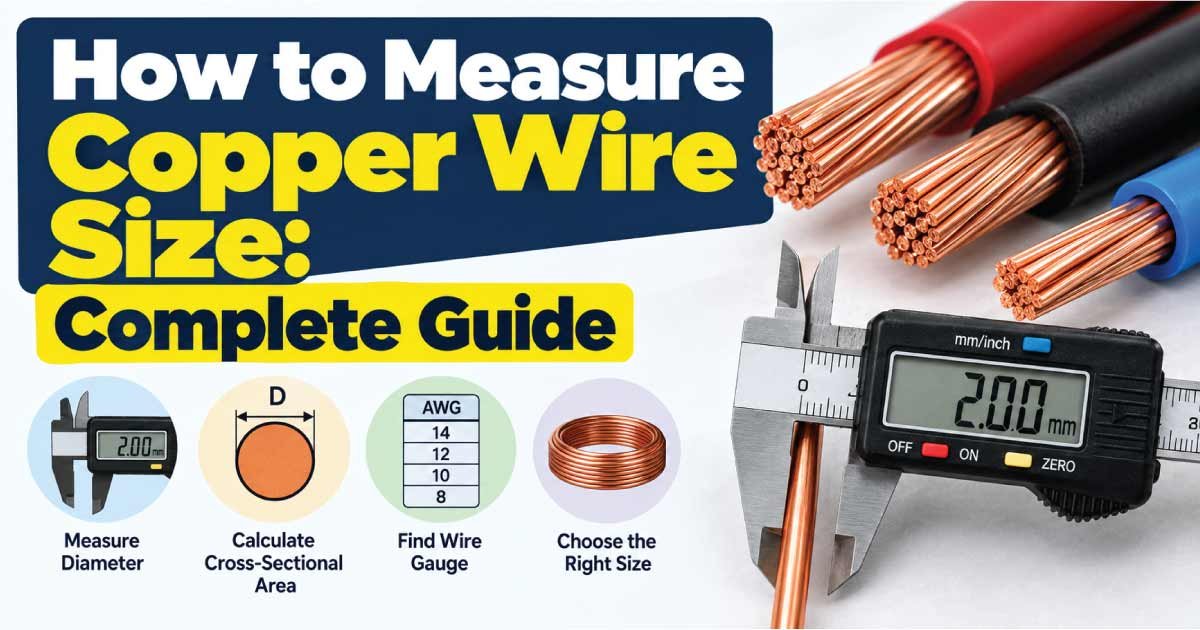
Measuring copper wire size correctly is important when selecting wire for electrical circuits, motors, appliances, automotive systems, and other applications. The wire size affects how much current a conductor can carry, how much voltage is lost, and whether the conductor is suitable for the intended installation.
The challenge is that copper wire size can be described in several ways. In North America, AWG (American Wire Gauge) is commonly used, while many other applications specify the conductor by its cross-sectional area in square millimeters (mm²). You can also measure the physical diameter of the bare copper conductor and convert that measurement into a wire size.
This guide explains how to measure copper wire size using a ruler, caliper, micrometer, and other practical methods. You will also learn how to measure stranded wire, calculate cross-sectional area, identify AWG sizes, avoid common mistakes, and understand when physical measurement alone is not enough.
What Does Copper Wire Size Mean?
Copper wire size describes the dimensions of the conductive copper portion of a wire. It does not normally refer to the outside diameter of the complete insulated cable.
For example, a wire may have a relatively thick insulation jacket while containing a comparatively small copper conductor. Measuring the outside of the insulation therefore does not tell you the actual conductor size.
Three measurements are particularly useful:
- Conductor diameter: The diameter of the bare copper conductor.
- Cross-sectional area: The copper area measured in mm².
- AWG size: A standardized wire-gauge designation commonly used for copper conductors.
For solid wire, measuring diameter is relatively straightforward. Stranded wire requires more care because the conductor consists of multiple individual copper strands.
Why Wire Size Matters
Correct conductor sizing helps ensure that the wire is appropriate for the electrical load and installation conditions.
Wire size can influence:
- Current-carrying capacity
- Voltage drop
- Electrical resistance
- Heating
- Mechanical strength
- Connection compatibility
- Terminal and connector selection
- Overall circuit performance
A measurement can tell you the physical size of the conductor, but it does not by itself determine the allowable ampacity. Ampacity depends on factors such as insulation temperature rating, installation method, ambient temperature, number of loaded conductors, and applicable electrical codes.
Tools You Can Use to Measure Copper Wire Size
You do not always need specialized equipment to determine wire size. The appropriate tool depends on the accuracy you need and whether the conductor is solid or stranded.
Digital Caliper
A digital caliper is one of the most useful tools for measuring the diameter of a bare copper conductor.
It can provide measurements in millimeters or inches and is generally more precise than a ruler.
For the best result:
- Remove enough insulation to expose the conductor.
- Clean the copper if necessary.
- Place the caliper jaws gently around the conductor.
- Avoid squeezing the copper.
- Record the diameter.
Micrometer
A micrometer can provide greater precision than a standard caliper, especially for small solid conductors.
It is useful when the difference between nearby wire sizes is difficult to distinguish with a caliper.
Wire Gauge Tool
A wire gauge tool contains openings corresponding to different AWG sizes. You insert the conductor into the openings until you find the closest matching size.
This can be convenient for identifying common wire gauges, although the conductor should be measured without insulation.
Ruler
A ruler can sometimes help with larger conductors, but it is not the preferred method for small electrical wires.
A ruler generally does not provide enough precision to reliably distinguish between neighboring wire sizes.
Wire Stripper with Gauge Markings
Some quality wire strippers have holes marked for common AWG sizes. These can help identify wire size, but markings should not automatically be treated as a precise measurement of an unknown conductor.
How to Measure Copper Wire Size Step by Step
The basic process is simple: expose the copper, measure the conductor, and compare the measurement with a recognized wire-size chart.
Step 1: Turn Off and Isolate the Circuit
If the wire is part of an electrical installation, de-energize the circuit before handling or stripping the conductor.
Do not assume a wire is safe simply because a switch is turned off. Follow appropriate electrical safety procedures and verify that the circuit is actually de-energized.
Step 2: Remove the Insulation
Carefully strip a small section of insulation from the wire.
Use an appropriate wire stripper rather than cutting deeply with a knife, because nicking or cutting copper strands can reduce the conductor’s integrity.
For an already disconnected wire, expose enough copper to obtain a reliable measurement.
Step 3: Identify Solid or Stranded Construction
Look closely at the exposed conductor.
A solid conductor consists of one piece of copper.
A stranded conductor consists of multiple small copper wires twisted together.
This distinction matters because measuring the overall outside diameter of stranded wire does not directly give you the same result as measuring a solid conductor of equivalent copper area.
Step 4: Measure the Copper Diameter
For solid copper wire, place the caliper across the conductor at approximately a right angle.
Do not include the insulation.
Record the measurement in millimeters or inches.
For example, suppose a solid conductor measures approximately 1.63 mm in diameter. That diameter is close to the nominal diameter associated with 14 AWG copper wire.
The measurement should be treated as an identification aid rather than proof of the manufacturer’s exact designation.
Step 5: Compare the Measurement with a Wire Gauge Chart
Once you have the conductor diameter, compare it with a recognized AWG chart.
A simplified reference for common solid AWG sizes is shown below.
| AWG Size | Nominal Diameter (mm) | Approx. Area (mm²) |
|---|---|---|
| 20 | 0.812 | 0.518 |
| 18 | 1.024 | 0.823 |
| 16 | 1.291 | 1.31 |
| 14 | 1.628 | 2.08 |
| 12 | 2.053 | 3.31 |
| 10 | 2.588 | 5.26 |
| 8 | 3.264 | 8.37 |
| 6 | 4.115 | 13.3 |
| 4 | 5.189 | 21.2 |
| 2 | 6.544 | 33.6 |
| 1 | 7.348 | 42.4 |
| 1/0 | 8.251 | 53.5 |
| 2/0 | 9.266 | 67.4 |
| 3/0 | 10.40 | 85.0 |
| 4/0 | 11.68 | 107 |
Values are nominal conductor dimensions based on the AWG system; actual manufactured dimensions can vary within applicable specifications.
How to Measure Stranded Copper Wire
Measuring stranded copper wire is slightly more complicated than measuring solid wire.
If you place caliper jaws around a stranded conductor, you are measuring the overall bundle diameter, including spaces between individual strands. That measurement cannot simply be treated as the diameter of an equivalent solid copper conductor.
A better approach is to determine the number and diameter of the individual strands.
Method 1: Count and Measure Individual Strands
If the construction is accessible, determine:
- Number of copper strands
- Diameter of each strand
- Whether all strands have the same diameter
Then calculate the total copper cross-sectional area.
The area of one round strand is:
A = π × d² ÷ 4
Where:
- A = area of one strand
- d = diameter of one strand
For multiple identical strands:
Total copper area = number of strands × π × d² ÷ 4
For example, a conductor containing 19 strands can be evaluated by measuring one strand and multiplying its cross-sectional area by 19.
Method 2: Use Manufacturer Markings
If the cable jacket has a printed designation, this is usually preferable to estimating size from the outside diameter.
Look for information such as:
- AWG designation
- mm² conductor area
- Number of conductors
- Conductor material
- Temperature rating
- Cable type
The manufacturer’s documentation should take precedence when exact conductor construction matters.
How to Calculate Copper Wire Size from Diameter
If you know the diameter of a solid round copper conductor, you can calculate its cross-sectional area.
The formula is:
A = πd² ÷ 4
Where:
- A is cross-sectional area
- d is conductor diameter
Suppose the measured copper diameter is 2.05 mm.
The calculation is approximately:
A = 3.1416 × (2.05²) ÷ 4
This produces approximately 3.30 mm², which corresponds closely to the nominal area of 12 AWG.
This method is particularly useful when your wire is specified in mm² rather than AWG.
AWG and mm² Are Not the Same Naming System
AWG numbers work differently from metric conductor areas.
With AWG:
- A smaller AWG number means a larger conductor.
- A larger AWG number means a smaller conductor.
For example, 10 AWG is larger than 14 AWG.
Metric wire sizing is more intuitive because the number represents approximate conductor cross-sectional area:
- 1.5 mm² is smaller than 2.5 mm².
- 6 mm² is smaller than 10 mm².
- 16 mm² is smaller than 25 mm².
When converting between AWG and mm², use a recognized conversion chart rather than assuming the numbers correspond exactly.
How to Measure Copper Wire Without Removing the Insulation
Sometimes you cannot easily strip the wire because it is installed, terminated, or otherwise difficult to access.
In that situation, measuring the outside diameter can provide useful information, but it has an important limitation: the insulation is included in the measurement.
Cable manufacturers can use different insulation thicknesses and constructions, so two wires with the same copper conductor size may have different overall outside diameters.
Check the Cable Markings First
Before attempting to estimate conductor size from outside diameter, inspect the jacket.
Cable markings may identify:
- Wire gauge
- Conductor count
- Voltage rating
- Insulation type
- Temperature rating
- Manufacturer information
- Cable classification
For installed wiring, these markings can be more useful than measuring the outside diameter.
Copper Wire Diameter vs. Cable Diameter
One of the most common mistakes is confusing conductor diameter with overall cable diameter.
Consider a typical insulated wire:
Copper conductor → insulation → outer jacket
When measuring wire size, you generally want the copper conductor rather than the complete insulated cable.
| Measurement | What It Represents | Useful for Identifying Conductor Size? |
|---|---|---|
| Bare copper diameter | Copper conductor only | Yes |
| Individual strand diameter | One strand in stranded wire | Yes, when used with strand count |
| Stranded bundle diameter | Overall copper strand bundle | Limited |
| Insulated wire diameter | Copper plus insulation | Usually not directly |
| Multi-conductor cable diameter | Entire cable | No, not by itself |
This distinction becomes especially important when selecting connectors, terminals, lugs, conduit, or replacement conductors.
Common Copper Wire Sizes and Typical Uses
Wire selection depends on the electrical application, installation conditions, and applicable requirements. The following table provides a general size reference rather than an ampacity chart.
| AWG | Approx. Area (mm²) | Common Examples of Use |
|---|---|---|
| 18 | 0.823 | Low-power control and electronic wiring |
| 16 | 1.31 | Control circuits and lighter electrical loads |
| 14 | 2.08 | General branch-circuit applications where permitted |
| 12 | 3.31 | General-purpose higher-load branch circuits |
| 10 | 5.26 | Higher-current circuits and equipment |
| 8 | 8.37 | Larger equipment and feeders |
| 6 | 13.3 | High-current equipment and distribution |
| 4 | 21.2 | Larger feeders and high-current applications |
| 2 | 33.6 | Heavy-duty feeders and distribution |
These examples are intentionally general. Do not select a wire solely because a particular AWG size is commonly used for an application. Verify ampacity, voltage drop, insulation rating, installation conditions, and local electrical requirements.
How to Measure Copper Wire for Automotive Applications
Automotive wiring often uses stranded copper conductors and may have flexible insulation.
When checking automotive wire:
- Identify any printed size marking.
- Determine whether the stated size is AWG or another system.
- Strip a small section if safe and practical.
- Count and measure strands when necessary.
- Avoid using overall insulated diameter as the conductor-size measurement.
Automotive cables can also use different terminology and construction standards from building wire. Therefore, a wire described by a particular automotive cable specification should be evaluated according to that specification rather than assumed to be equivalent to household wiring of the same apparent gauge.
Common Mistakes When Measuring Copper Wire Size
Accurate measurement depends as much on avoiding mistakes as it does on using a good tool.
Measuring the Insulation
The insulation is not the copper conductor.
Always distinguish between conductor diameter and overall cable diameter.
Squeezing Stranded Wire with Calipers
Excessive pressure can compress the strands and produce a misleading reading.
Measure gently.
Treating Stranded Bundle Diameter as Solid Copper
The spaces between strands mean the outside diameter of the bundle does not directly equal the diameter of an equivalent solid conductor.
Assuming AWG Numbers Work Like Millimeters
They do not.
A lower AWG number represents a larger conductor, while a higher AWG number represents a smaller conductor.
Using Diameter Alone to Determine Ampacity
Physical size does not tell you the complete allowable current rating.
The correct ampacity depends on the wire’s construction and installation conditions.
Ignoring Manufacturer Markings
If the wire jacket clearly identifies the conductor size, that information can be more reliable than estimating size from an imperfect physical measurement.
Tips for Getting a More Accurate Measurement
Use these practices when measuring copper conductors:
- Use a digital caliper for small solid conductors.
- Measure several times and compare the readings.
- Measure the bare copper, not the insulation.
- Avoid compressing stranded conductors.
- Check the cable’s printed markings before stripping it.
- Use a recognized AWG or mm² reference chart.
- For stranded wire, consider strand count and individual strand diameter.
- Confirm the manufacturer’s specifications when the size is critical.
- Do not use conductor diameter alone to determine safe ampacity.
- Consider voltage drop for long cable runs and demanding loads.
When You Should Not Rely on Physical Measurement
Physical measurement is useful for identification, but some applications require more information than diameter or cross-sectional area.
Do not rely solely on measurement when:
- The wire is part of a safety-critical installation.
- The conductor’s insulation rating is unknown.
- The cable has unusual construction.
- The conductor is plated or alloyed rather than standard copper.
- The cable contains multiple different conductor types.
- Ampacity must be established for an electrical installation.
- The wire is required to meet a specific product or installation standard.
In these situations, identify the cable using its markings and consult the relevant manufacturer documentation, electrical code, or applicable standard.
Copper Wire Size Measurement: Quick Reference
The measurement process can be summarized in a few steps:
| Step | Action | Purpose |
|---|---|---|
| 1 | De-energize the circuit | Improve safety |
| 2 | Inspect cable markings | Find existing size information |
| 3 | Expose copper if appropriate | Remove insulation from the measurement |
| 4 | Identify solid or stranded construction | Choose the correct measurement method |
| 5 | Measure conductor diameter | Obtain physical dimension |
| 6 | Calculate area if needed | Determine approximate mm² area |
| 7 | Compare with an AWG/mm² chart | Identify likely nominal size |
| 8 | Verify manufacturer or standard data | Confirm critical applications |
Frequently Asked Questions About Measuring Copper Wire Size
How do I measure copper wire size with a caliper?
Strip the insulation carefully, identify the conductor construction, and place the caliper around the bare copper. For solid wire, measure the conductor diameter directly. Compare the result with an AWG chart or calculate its cross-sectional area. For stranded wire, use strand count and individual strand diameter for greater accuracy.
Can I measure copper wire size without stripping it?
You can measure the overall outside diameter, but this does not directly identify the copper conductor size because insulation contributes to the measurement. If possible, inspect the cable markings first. For accurate conductor identification, measure the bare copper or use manufacturer documentation.
How do I measure stranded copper wire size?
Count the individual strands and measure the diameter of one strand. Calculate the area of one strand using A = πd²/4, then multiply by the number of equivalent strands. This gives the approximate total copper cross-sectional area when all strands have the same diameter.
Is copper wire size measured by diameter or area?
It can be described using either measurement, depending on the sizing system. AWG is based on a standardized gauge system and corresponds to conductor diameter and area, while metric cable specifications commonly use cross-sectional area in mm². Always check which sizing system applies.
Does measuring wire size tell me how many amps it can carry?
No. Measuring the conductor identifies its physical size, but allowable current depends on insulation, installation conditions, temperature, conductor construction, voltage-drop requirements, and applicable electrical codes. Use the appropriate ampacity tables and manufacturer information when determining whether a wire is suitable for a circuit.
Conclusion
Learning how to measure copper wire size starts with one important distinction: measure the copper conductor, not simply the outside of the insulated cable. A caliper or micrometer can provide an accurate diameter for solid wire, while stranded wire often requires counting and measuring individual strands.
Once the conductor diameter is known, you can compare it with an AWG chart or calculate its approximate cross-sectional area in mm². However, physical size should not be confused with allowable ampacity. For electrical installations, always consider conductor construction, insulation, installation conditions, voltage drop, manufacturer specifications, and applicable requirements.
With the right measurement method and a reliable wire-size reference, identifying an unknown copper conductor becomes much easier and more consistent.