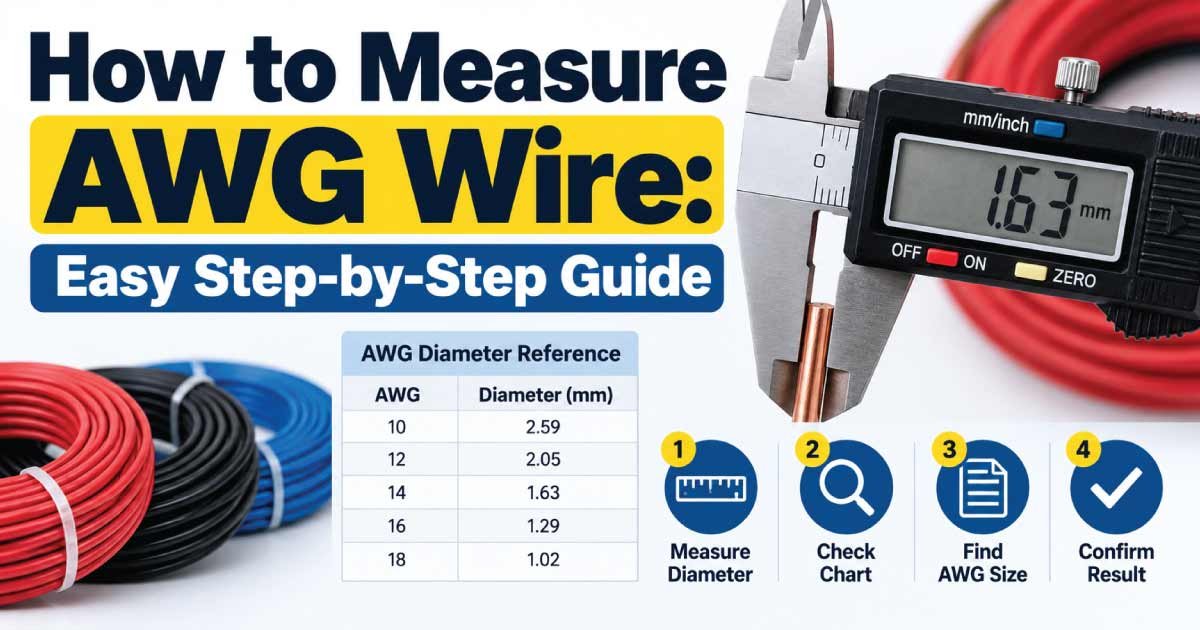
Knowing how to measure AWG wire is important when you need to identify an unknown electrical wire, replace an existing conductor, verify a labeled cable, or determine whether a wire is suitable for a particular application. American Wire Gauge (AWG) identifies wire size primarily by its conductor diameter, but measuring it correctly requires more than simply placing a ruler against the cable.
The insulation surrounding a wire is not included in the AWG size. You need to determine the diameter of the actual conductor, then compare that measurement with an AWG chart or calculate the corresponding gauge.
This guide explains how to measure AWG wire using calipers, a micrometer, a wire gauge tool, and basic measurement techniques. It also covers stranded wire, conversion formulas, common mistakes, and how to identify wire size when markings are unavailable.
What Is AWG Wire Size?
AWG, or American Wire Gauge, is a standardized system used to describe the diameter of electrical conductors. It is commonly used for copper, aluminum, and other electrically conductive wires, particularly in North America.
One important feature of AWG is that smaller gauge numbers represent larger wires. For example, 10 AWG is considerably larger than 18 AWG.
AWG is based on the conductor rather than the insulation. Therefore, two wires with the same AWG size may have different overall outside diameters because their insulation types and thicknesses can differ.
The AWG system is logarithmic rather than linear. Each increase of three gauge numbers approximately corresponds to a doubling or halving of conductor cross-sectional area, while a change of 10 gauge numbers represents approximately a tenfold change in area.
Wire size affects important electrical characteristics such as:
- Conductor resistance
- Current-carrying capability
- Voltage drop
- Physical flexibility
- Weight
- Compatibility with terminals and connectors
For this reason, correctly identifying an unknown wire is important before using it in an electrical installation.
Why You May Need to Measure AWG Wire
There are several situations where measuring wire size is useful. You may have a piece of wire without readable markings, or the printing may have faded due to age, heat, chemicals, or abrasion.
Common reasons include:
- Identifying an unmarked electrical wire
- Confirming the size printed on insulation
- Selecting a replacement wire
- Checking whether a wire matches a project specification
- Comparing an existing conductor with an AWG size chart
- Identifying wire recovered from old equipment
- Determining approximate conductor size before further research
- Checking whether stranded and solid conductors are comparable
However, a diameter measurement alone does not establish every property of a cable. Insulation temperature rating, conductor material, stranding, installation conditions, and applicable electrical codes also matter when selecting a replacement or designing a circuit.
Tools Needed to Measure AWG Wire
The best measurement method depends on how accurately you need to identify the conductor.
Digital Caliper
A digital caliper is one of the most practical tools for measuring conductor diameter. It can measure small dimensions with much greater precision than a standard ruler.
A caliper is particularly useful when:
- The wire is accessible
- The conductor can be exposed safely
- You need to distinguish between nearby AWG sizes
- You want a quick measurement
Make sure the jaws contact the conductor without crushing or deforming it.
Micrometer
A micrometer can provide greater precision than a basic caliper and is useful when the difference between possible wire sizes is small.
Because AWG conductor diameters can differ by relatively small amounts, a quality micrometer can be helpful when identifying an unknown conductor accurately.
Wire Gauge Tool
A dedicated wire gauge measuring tool contains holes or slots corresponding to different wire sizes. The stripped conductor is inserted into the openings until the correct fit is found.
This is convenient because it eliminates the need to convert diameter into an AWG number manually.
Ruler or Measuring Scale
A ruler is generally not precise enough for identifying many AWG sizes. It can provide a rough estimate for relatively large conductors, but it should not be the preferred method when accurate wire identification is important.
How to Measure AWG Wire Step by Step
The most reliable approach is to measure the bare conductor, not the insulated cable.
1. Disconnect and Isolate the Wire
Before measuring an electrical wire, make sure it is de-energized and safely isolated.
Do not attempt to strip or handle a conductor that may be connected to a live circuit.
For installed electrical systems, appropriate electrical safety procedures should be followed. If you are uncertain whether a conductor is energized, do not rely on appearance alone.
2. Inspect the Wire Markings
Before cutting or stripping the insulation, inspect the wire carefully.
Many manufactured wires have markings printed or embossed on the insulation. These may identify information such as:
- AWG size
- Conductor material
- Voltage rating
- Temperature rating
- Cable type
- Manufacturer information
- Number of conductors
If the AWG designation is clearly readable, measurement may only be necessary as a verification step.
3. Expose a Small Section of Conductor
If the wire marking is unavailable, carefully expose a small section of conductor.
Remove only enough insulation to make a reliable measurement. Avoid nicking, cutting, or deforming the metal strands.
For a solid conductor, expose enough metal to obtain a stable diameter measurement.
For stranded wire, the procedure requires additional care because the overall bundle diameter is not directly equivalent to the diameter of one solid AWG conductor.
4. Measure the Conductor Diameter
Place the caliper or micrometer across the conductor.
For a solid wire, measure across the widest part of the circular conductor.
Take care not to compress the conductor. Excessive pressure can produce a measurement that is smaller than the actual diameter.
For greater reliability, take several measurements at slightly different points and compare the results.
5. Compare the Result With an AWG Chart
Once you have the conductor diameter, compare it with a standard AWG reference.
The following values are nominal conductor diameters for common solid AWG sizes:
| AWG Size | Nominal Diameter (mm) | Nominal Diameter (in) | Approx. Area (mm²) |
|---|---|---|---|
| 6 | 4.115 | 0.1620 | 13.30 |
| 8 | 3.264 | 0.1285 | 8.37 |
| 10 | 2.588 | 0.1019 | 5.26 |
| 12 | 2.053 | 0.0808 | 3.31 |
| 14 | 1.628 | 0.0641 | 2.08 |
| 16 | 1.291 | 0.0508 | 1.31 |
| 18 | 1.024 | 0.0403 | 0.823 |
| 20 | 0.812 | 0.0320 | 0.519 |
| 22 | 0.644 | 0.0253 | 0.326 |
| 24 | 0.511 | 0.0201 | 0.205 |
| 26 | 0.405 | 0.0159 | 0.129 |
| 28 | 0.321 | 0.0126 | 0.0810 |
| 30 | 0.255 | 0.0100 | 0.0509 |
These figures describe the nominal conductor size. Actual finished wire dimensions can vary depending on construction, manufacturing tolerances, plating, stranding, and insulation.
6. Confirm the Wire Type
Do not stop after identifying the approximate AWG number.
Check whether the conductor is:
- Solid or stranded
- Copper or aluminum
- Bare, tinned, plated, or otherwise treated
- Single-conductor or part of a cable
- Intended for a specific temperature or installation environment
The AWG number tells you about conductor size, but it does not tell you everything necessary to select a safe electrical cable.
How to Measure Stranded AWG Wire
Measuring stranded wire is more complicated than measuring solid wire.
A stranded conductor consists of multiple smaller wires twisted together. If you measure the entire bundle with a caliper, the result can be misleading because the spaces between individual strands and the geometry of the bundle affect the outside measurement.
Best Method for Stranded Wire
First, look for markings on the cable or wire insulation. Manufacturer markings are often the easiest way to identify stranded wire.
If markings are unavailable, a dedicated wire gauge tool designed for the applicable wire construction may be useful.
You can also determine the conductor’s approximate cross-sectional area by identifying:
- Number of strands
- Diameter of each strand
- Strand construction
For a simple stranded conductor, the approximate metallic cross-sectional area can be calculated from the individual strand area multiplied by the number of strands:
Total area ≈ number of strands × area of one strand
The result can then be compared with AWG or metric conductor-area references.
However, stranded wire should not automatically be treated as the same diameter as a solid conductor of the same nominal AWG. Stranding changes the physical geometry of the conductor.
How to Calculate AWG From Wire Diameter
If you have an accurate conductor diameter measurement, you can use the AWG relationship to estimate the gauge.
For a conductor diameter measured in inches, a commonly used AWG relationship is:
AWG = 36 − 39.933 × log₁₀(d / 0.005)
where:
- AWG = approximate American Wire Gauge number
- d = conductor diameter in inches
The equation reflects the logarithmic nature of the AWG system.
For most practical identification tasks, however, comparing the measured diameter against a reliable AWG wire size chart is easier and less prone to calculation errors.
Example: Measuring a Wire
Suppose you measure a solid conductor and obtain a diameter close to 2.05 mm.
Comparing that value with an AWG chart shows that it is close to the nominal diameter of 12 AWG, which is approximately 2.053 mm.
That does not mean every conductor measuring approximately 2.05 mm can automatically be installed as 12 AWG. The measurement identifies the approximate conductor size; the complete wire specification must still be verified.
How to Measure AWG Wire Without Stripping It
If you cannot expose the conductor, identifying the exact AWG size becomes more difficult.
The outside diameter of an insulated wire cannot reliably determine AWG size because insulation thickness varies.
For example, two wires may contain conductors of the same AWG size but have different insulation materials or thicknesses. Conversely, cables with similar outside diameters can contain conductors of different sizes.
If stripping the wire is not possible, try these approaches:
- Inspect the insulation for printed markings.
- Look for manufacturer identification.
- Check the cable’s original packaging or documentation.
- Identify the wire type and construction.
- Compare manufacturer specifications.
- Use a suitable wire identification tool where appropriate.
A visual estimate should be treated as an approximation rather than a definitive measurement.
AWG Wire Diameter vs Cross-Sectional Area
Wire diameter and cross-sectional area are related, but they are not the same measurement.
Diameter describes the distance across the conductor. Cross-sectional area describes the amount of conductive material visible in a cut-through section.
For a round solid conductor:
Area = π × diameter² ÷ 4
This relationship is important because doubling conductor diameter does not simply double the conductive area. Area increases with the square of diameter.
For example, a larger conductor can have substantially more metal cross-sectional area than a slightly smaller one.
This is one reason AWG numbers should not be interpreted as a simple linear scale.
AWG and Metric Wire Sizes
AWG is widely used in North America, while metric conductor areas are commonly specified in square millimeters in many other regions.
A wire identified as 2.5 mm², for example, is not simply a different way of writing a particular AWG number with perfect one-to-one equivalence.
The systems are based on different sizing conventions, so conversions should be treated as approximate unless a specific standard or manufacturer specification provides the applicable equivalence.
| AWG | Nominal Area (mm²) | Nominal Diameter (mm) |
|---|---|---|
| 14 | 2.08 | 1.628 |
| 12 | 3.31 | 2.053 |
| 10 | 5.26 | 2.588 |
| 8 | 8.37 | 3.264 |
| 6 | 13.30 | 4.115 |
When purchasing wire, use the sizing system specified by the applicable electrical standard, project documentation, or manufacturer rather than assuming an approximate conversion is interchangeable for every application.
Common Mistakes When Measuring AWG Wire
Incorrect wire measurements often result from measuring the wrong part of the cable or using insufficiently precise tools.
Measuring the Insulation
This is one of the most common mistakes.
AWG refers to conductor size, not the overall outside diameter of the insulated wire.
Always distinguish between:
- Conductor diameter
- Insulation diameter
- Overall cable diameter
Using a Ruler for Small Wire
A ruler may provide a rough estimate, but small differences between AWG sizes can be difficult to see accurately.
A caliper or wire gauge tool is generally more appropriate.
Compressing the Conductor
Applying excessive pressure with a caliper can deform a soft conductor and produce an artificially small reading.
Use enough pressure to make contact without crushing the metal.
Measuring a Stranded Bundle as Solid Wire
The outside diameter of stranded wire should not automatically be compared directly with a solid-wire AWG diameter chart.
Strand construction affects the geometry.
Ignoring Wire Markings
If the insulation has a clear AWG marking, use it as an important identification source. Measurement can serve as confirmation rather than replacing reliable manufacturer information.
How to Choose the Right Tool for Measuring AWG
The appropriate tool depends on the accuracy you need.
| Tool | Best Use | Accuracy Consideration |
|---|---|---|
| Ruler | Rough identification of large wire | Low |
| Digital Caliper | General conductor diameter measurement | Good |
| Micrometer | Precise diameter measurement | Very good |
| Wire Gauge Tool | Quick AWG identification | Good when properly matched |
| Manufacturer Marking | Direct identification | Preferred when readable |
For everyday wire identification, a digital caliper is often a practical choice. For close measurements or quality-control work, a micrometer may provide better precision.
Important Factors Beyond AWG Size
Measuring AWG wire answers only one part of the wire-selection question.
Before using a conductor in an electrical installation, consider:
- Conductor material: Copper and aluminum have different electrical characteristics.
- Insulation type: Different insulation systems have different temperature and environmental ratings.
- Temperature rating: The permitted operating temperature depends on the wire construction and application.
- Voltage rating: The wire must be appropriate for the circuit voltage.
- Installation method: Raceway, cable, conduit, direct burial, and other installations can have different requirements.
- Number of current-carrying conductors: Conductor grouping can affect allowable ampacity.
- Ambient temperature: Environmental conditions can affect permissible current.
- Voltage drop: Long circuits may require consideration of conductor size beyond basic ampacity.
- Local electrical requirements: Applicable codes and standards should be followed.
Therefore, AWG measurement should not be used by itself to determine safe circuit ampacity.
Tips for Accurate AWG Wire Measurement
Use these practices when identifying an unknown conductor:
- Measure the metal conductor, not the insulation.
- Use a caliper or micrometer for better precision.
- Take more than one measurement when possible.
- Avoid squeezing or deforming the conductor.
- Check whether the wire is solid or stranded.
- Look for insulation markings before stripping the wire.
- Compare the measurement with a reliable AWG chart.
- Verify the conductor material.
- Check manufacturer documentation when available.
- Do not use AWG size alone to determine permissible current.
- Follow applicable electrical codes and installation requirements.
These steps can significantly reduce the chance of confusing nearby wire sizes.
Frequently Asked Questions About Measuring AWG Wire
Can I measure AWG wire with a ruler?
A ruler can provide a rough estimate, but it is not the best tool for accurately identifying small AWG sizes. A digital caliper, micrometer, or dedicated wire gauge tool provides a more reliable measurement because AWG conductor diameters can differ by relatively small amounts.
Do I measure the insulation when measuring AWG wire?
No. AWG identifies the conductor size, so you should measure the actual metal conductor rather than the insulation. Insulation thickness varies between wire types and manufacturers, meaning the outside diameter of an insulated cable cannot reliably identify its AWG size.
How do I measure stranded wire?
Stranded wire should not automatically be measured like solid wire. Check the manufacturer’s marking first. If unavailable, identify the number and size of individual strands and calculate their combined cross-sectional area, or use an appropriate wire gauge tool.
Does a smaller AWG number mean a bigger wire?
Yes. AWG numbers work in the opposite direction from physical conductor size. A lower AWG number represents a larger conductor, while a higher AWG number represents a smaller conductor. For example, 10 AWG is physically larger than 14 AWG.
Can wire diameter determine its ampacity?
No. Diameter can help identify the approximate AWG conductor size, but ampacity depends on additional factors such as conductor material, insulation temperature rating, installation conditions, ambient temperature, and applicable electrical requirements. Always verify the complete wire specification before selecting it for a circuit.
Conclusion
Learning how to measure AWG wire starts with one essential rule: measure the conductor rather than the insulation. For solid wire, a digital caliper or micrometer can provide a useful diameter measurement that can then be compared with an AWG chart.
Stranded wire requires more care because its bundle diameter does not directly correspond to the diameter of an equivalent solid conductor. Whenever possible, use manufacturer markings and documentation to verify the wire size and construction.
Most importantly, identifying AWG is only one part of selecting electrical wire. Material, insulation, temperature rating, installation conditions, voltage, ampacity, and applicable electrical requirements must also be considered before a wire is used in an electrical installation.