Choosing the correct automotive wire size is essential for safe, reliable, and efficient vehicle electrical systems. Automotive wiring carries electrical current between the battery, alternator, fuse box, switches, lights, motors, sensors, and accessories. If a wire is too small for the electrical load, it can overheat, cause voltage drop, damage electrical components, or create a fire hazard.
An automotive wire size chart makes it easier to select the appropriate wire gauge based on amperage, circuit length, voltage, and installation conditions. Most automotive wiring uses the American Wire Gauge (AWG) system, where a smaller AWG number represents a thicker wire with greater current-carrying capacity.
This guide explains automotive wire sizes, AWG ratings, ampacity, voltage drop, wire length, common automotive applications, and how to select the right wire for 12V and 24V vehicle electrical systems.
What Is Automotive Wire Gauge?
Automotive wire gauge describes the physical size of the conductor inside an electrical wire. The most common measurement system is AWG, or American Wire Gauge.
AWG sizing works differently from many other measurements. As the gauge number decreases, the conductor becomes larger.
For example:
- 22 AWG is relatively thin.
- 18 AWG is thicker than 22 AWG.
- 14 AWG is thicker than 18 AWG.
- 10 AWG is significantly thicker than 14 AWG.
- 4 AWG is suitable for much higher-current circuits.
Thicker wire generally has lower electrical resistance and can carry more current with less voltage loss. However, choosing wire based only on amperage is not enough. Circuit length and voltage drop are also important factors.
Why Automotive Wire Size Matters
Correct automotive wire sizing protects both the electrical system and the vehicle.
A properly sized wire helps:
- Carry the required current safely.
- Reduce excessive voltage drop.
- Prevent conductor overheating.
- Improve electrical component performance.
- Reduce power loss.
- Protect wiring insulation.
- Improve reliability.
- Minimize the risk of electrical faults and fires.
An undersized wire may become excessively hot when current flows through it. On the other hand, using a substantially larger wire is generally electrically acceptable when properly terminated and protected, although it may increase cost, weight, and installation difficulty.
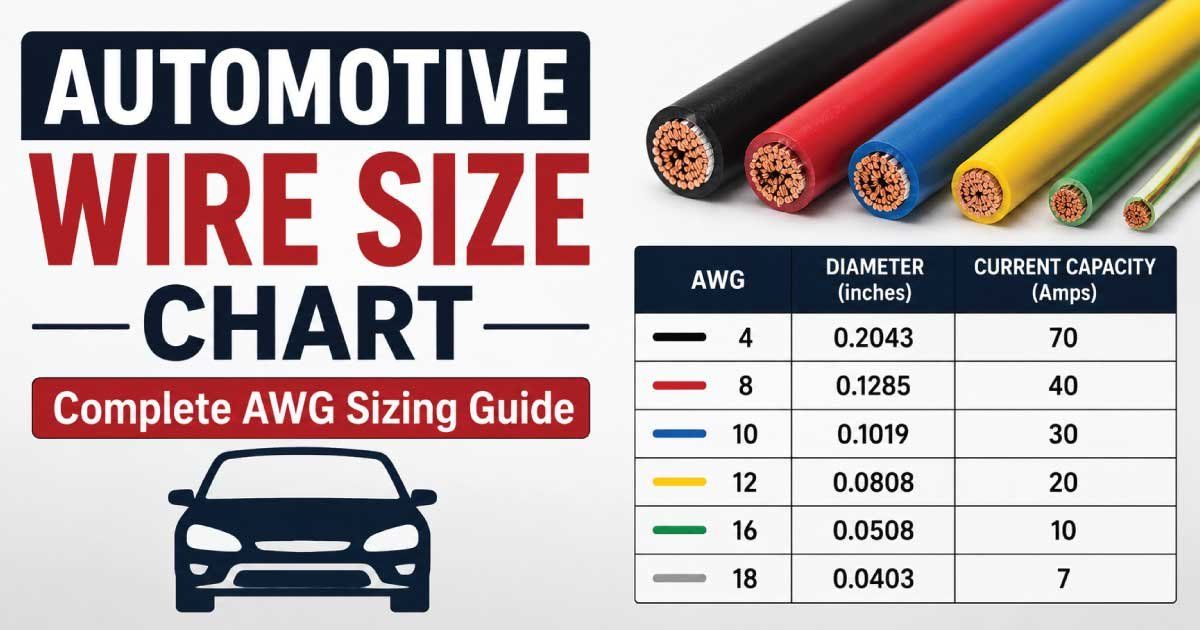
Automotive Wire Size Chart
The following chart provides practical starting points for selecting copper automotive wire based on approximate current capacity and circuit length. Actual capacity can vary according to insulation type, ambient temperature, bundling, installation method, and acceptable voltage drop.
| Automotive Wire Gauge | Approx. Diameter | Typical Current Range* | Common Applications |
|---|---|---|---|
| 2 AWG | 6.54 mm | 100–150 A | High-output starter, battery cables |
| 4 AWG | 5.19 mm | 80–120 A | Battery, alternator, large inverters |
| 6 AWG | 4.11 mm | 60–90 A | High-current accessories |
| 8 AWG | 3.26 mm | 40–60 A | Amplifiers, winches, power distribution |
| 10 AWG | 2.59 mm | 30–40 A | Large motors, heaters, auxiliary circuits |
| 12 AWG | 2.05 mm | 20–30 A | Fans, lighting, medium accessories |
| 14 AWG | 1.63 mm | 15–20 A | Lights, relays, small motors |
| 16 AWG | 1.29 mm | 10–15 A | Sensors, small lighting circuits |
| 18 AWG | 1.02 mm | 5–10 A | Low-current electronics |
| 20 AWG | 0.81 mm | 3–7 A | Sensors and control circuits |
| 22 AWG | 0.64 mm | 1–5 A | Signal and low-current circuits |
| 24 AWG | 0.51 mm | 1–3 A | Electronics and signal wiring |
*Current ratings are general reference ranges, not universal installation limits. Always verify the wire manufacturer’s specifications and applicable automotive wiring requirements.
Automotive Wire Size and Ampacity
Ampacity refers to the amount of current a conductor can safely carry under specified conditions.
For automotive applications, ampacity depends on several factors rather than wire gauge alone. Important variables include:
- Conductor material.
- Wire insulation.
- Ambient temperature.
- Wire length.
- Installation location.
- Number of wires bundled together.
- Continuous versus intermittent current.
- Acceptable voltage drop.
- Electrical system voltage.
A wire installed in a hot engine compartment may have a different practical capacity from the same wire installed inside the vehicle cabin.
This is why an automotive wire size chart should be treated as a selection guide rather than a substitute for manufacturer specifications.
12 Volt Automotive Wire Size Chart
Most passenger vehicles use a nominal 12V electrical system, although charging voltage is higher while the engine is running.
For a 12V circuit, voltage drop can become significant because even a small loss represents a relatively large percentage of the system voltage.
| Wire Size | Typical Low-to-Moderate Current Uses |
|---|---|
| 18 AWG | Sensors, small electronics, control circuits |
| 16 AWG | Small lights, relays, electronics |
| 14 AWG | Lighting, accessories, small motors |
| 12 AWG | Fans, pumps, medium accessories |
| 10 AWG | High-current accessories and larger motors |
| 8 AWG | Amplifiers, winches, power distribution |
| 6 AWG | High-current auxiliary circuits |
| 4 AWG | Battery and high-output charging connections |
| 2 AWG | Heavy-duty battery and starter applications |
For longer 12V circuits, a larger conductor may be required even when the current is relatively modest.
24 Volt Automotive Wire Size Chart
Commercial vehicles, buses, trucks, specialized equipment, and some industrial vehicles may use 24V electrical systems.
Because a 24V system operates at approximately twice the voltage of a 12V system, the same power requirement generally requires less current.
For example, ignoring losses:
Power = Voltage × Current
Therefore:
Current = Power ÷ Voltage
A 240W load requires approximately 20A at 12V but approximately 10A at 24V.
| Wire Size | Typical 24V Applications |
|---|---|
| 18 AWG | Sensors and control wiring |
| 16 AWG | Lighting and electronics |
| 14 AWG | Small motors and accessories |
| 12 AWG | Fans, pumps, and moderate loads |
| 10 AWG | Larger motors and accessories |
| 8 AWG | High-current auxiliary equipment |
| 6 AWG | Heavy-duty accessory circuits |
| 4 AWG | High-current power distribution |
The correct gauge must still be calculated according to current, circuit length, voltage-drop requirements, and installation conditions.
Automotive Wire Size Chart by Amperage
Amperage is one of the most important factors when selecting automotive wire.
A general reference is:
| Current | Common Starting Point |
|---|---|
| 1–3 A | 22–24 AWG |
| 3–5 A | 20–22 AWG |
| 5–10 A | 18–20 AWG |
| 10–15 A | 16–18 AWG |
| 15–20 A | 14–16 AWG |
| 20–30 A | 12–14 AWG |
| 30–40 A | 10–12 AWG |
| 40–60 A | 8–10 AWG |
| 60–90 A | 6–8 AWG |
| 90–120 A | 4–6 AWG |
| 120–150 A | 2–4 AWG |
These values are intended for preliminary sizing. Final wire selection should use the applicable wire manufacturer’s ampacity information and account for voltage drop and environmental conditions.
Also Read: Ring Terminal Size Chart: Complete Sizing Guide
How to Calculate Automotive Wire Size
Selecting the correct wire gauge involves more than finding the amperage in a chart.
1. Determine the Load Current
Start by finding the electrical load in amps.
If the component is rated in watts, use:
Current = Power ÷ Voltage
For example, a 120W accessory on a nominal 12V system draws approximately:
120 ÷ 12 = 10A
The actual operating current may vary, so use the manufacturer’s specifications whenever available.
2. Measure the Circuit Length
Measure the complete electrical path.
For many automotive voltage-drop calculations, you need to consider the round-trip length, meaning the distance from the power source to the load and back through the return path.
For example, if the power wire travels 10 feet to an accessory and the return path is another 10 feet:
Total circuit length = 20 feet
Ignoring the return path can result in selecting wire that is too small.
3. Consider Voltage Drop
Voltage drop occurs because electrical wire has resistance.
The longer the wire, the greater the resistance. As current increases, voltage drop also increases.
This is especially important in:
- 12V automotive systems.
- Headlight circuits.
- Fuel pumps.
- Electric fans.
- Audio amplifiers.
- Winches.
- Inverters.
- Long accessory circuits.
A larger wire has lower resistance and therefore generally produces less voltage drop.
4. Select the Wire Gauge
Use the calculated current and circuit length to determine an appropriate conductor size.
If the circuit is close to the maximum capacity of a particular gauge, selecting the next larger wire size can provide additional margin and reduce voltage drop.
Automotive Wire Size for Car Audio
Car audio systems often require larger wire than ordinary vehicle electronics because amplifiers can draw substantial current.
Common sizes include:
- 18–16 AWG: Low-power signal or accessory circuits.
- 14–12 AWG: Small audio equipment.
- 10 AWG: Moderate amplifier installations.
- 8 AWG: Larger amplifiers.
- 4 AWG: High-power audio systems.
- 2 AWG or larger: Very high-current installations.
The amplifier manufacturer’s recommended power-wire size should take priority.
For high-current audio installations, the main power cable should also be properly fused close to the battery. The fuse protects the wiring from excessive current and should be selected according to the wiring and system requirements.
Automotive Wire Size for LED Lights
LED lighting usually consumes less power than traditional incandescent lighting, but correct wire sizing is still important.
For small LED accessories, 18 AWG or 16 AWG may be sufficient. Larger lighting systems may require 14 AWG, 12 AWG, or larger depending on total current and circuit length.
When multiple LED lights share one circuit, add their current requirements together.
For example:
- LED light 1 = 2A
- LED light 2 = 2A
- LED light 3 = 3A
- LED light 4 = 3A
Total load:
2 + 2 + 3 + 3 = 10A
The wire and fuse should then be selected for the total circuit load rather than the current of an individual lamp.
Automotive Wire Size for Fuel Pumps
Fuel pumps can be sensitive to voltage drop. A pump may require significant current, and excessive voltage loss can affect its performance.
When wiring an electric fuel pump:
- Check the manufacturer’s current requirement.
- Measure the complete circuit length.
- Account for voltage drop.
- Use an appropriate fuse.
- Use a properly rated relay when required.
- Use automotive-grade wire.
- Make secure, corrosion-resistant connections.
For longer fuel-pump circuits, moving up one or more wire gauges can reduce resistance and help maintain the required voltage at the pump.
Automotive Wire Size for Electric Fans
Electric cooling fans can draw substantial current, particularly when starting.
A fan circuit should be sized according to:
- Fan running current.
- Startup or inrush current.
- Circuit length.
- Vehicle voltage.
- Relay specifications.
- Fuse rating.
Large electric fans commonly require 10 AWG, 8 AWG, or larger wiring, depending on the manufacturer’s specifications and installation.
Never size the wire only according to the normal running current if the manufacturer specifies a higher startup requirement.
Automotive Battery Cable Size Chart
Battery cables carry some of the highest currents in a vehicle. Starter motors can require hundreds of amps for short periods.
| Application | Common Cable Size Range |
|---|---|
| Small accessory battery connection | 8–10 AWG |
| Moderate auxiliary battery connection | 4–8 AWG |
| High-current auxiliary systems | 2–4 AWG |
| Large battery connections | 1–2 AWG |
| Heavy-duty starting systems | 1/0–4/0 AWG |
Battery cable sizing depends heavily on engine size, starter current, cable length, temperature, and vehicle design.
For starter circuits, always follow the vehicle or cable manufacturer’s specifications rather than relying solely on a generic chart.
Also Read: Crimp Connector Size Chart: Standard Sizes Explained
Automotive Wire Size for Alternators
High-output alternators can produce significantly more current than standard factory alternators.
The charging cable between the alternator and battery must be capable of carrying the expected current without excessive voltage drop.
For example, a high-output alternator may require:
- 6 AWG for moderate output.
- 4 AWG for higher output.
- 2 AWG or larger for very high-current systems.
The exact size depends on alternator output and cable length.
An upgraded alternator may also require an upgraded charging cable and appropriate fuse or fusible-link protection.
Primary Wire vs Battery Cable
Not all automotive wire is the same.
Automotive primary wire is commonly used for lighting, sensors, relays, switches, accessories, and other vehicle circuits.
Battery cable is designed for high-current applications such as:
- Starter motors.
- Battery connections.
- Alternator charging.
- Ground cables.
- High-current power distribution.
Battery cable is generally much larger and constructed for high-current service.
Using a small primary wire where a heavy battery cable is required can create excessive voltage drop and overheating.
Automotive Wire Types
Several types of automotive wire and cable are available.
GPT Automotive Wire
GPT is commonly used for general-purpose automotive wiring. It is suitable for many low- and medium-current circuits.
TXL Automotive Wire
TXL wire uses thin-wall insulation and is popular where reduced diameter and weight are desirable. It is commonly used in modern automotive wiring harnesses.
GXL Automotive Wire
GXL is another automotive-grade wire designed for demanding vehicle environments and higher-temperature applications.
SXL Automotive Wire
SXL typically has thicker insulation and is commonly selected where additional durability and temperature resistance are needed.
The wire type should be selected according to the vehicle environment and manufacturer’s requirements.
Copper vs Aluminum Automotive Wire
Copper is widely used for automotive electrical wiring because it has relatively low electrical resistance and good conductivity.
Aluminum conductors are lighter and may be used in certain specialized applications, but equivalent current capacity generally requires consideration of conductor size, connections, and material properties.
When replacing existing wiring, use the same conductor material and an appropriate automotive-grade replacement unless the system has been specifically engineered for an alternative.
How Wire Length Affects Automotive Wire Size
Wire length is one of the most frequently overlooked factors in automotive electrical installations.
A short circuit may work correctly with a particular gauge, while the same wire gauge can cause excessive voltage drop when used over a much longer distance.
For example, a small accessory located close to the fuse panel may require relatively small wire. If the same accessory is mounted at the rear of a large vehicle, the longer circuit may require a larger conductor.
Therefore, longer automotive circuits often require thicker wire even when the load current remains unchanged.
Automotive Wire Size and Fuse Selection
The fuse protects the wiring from excessive current.
A common mistake is choosing the fuse according to the electrical device without considering the wire’s capacity.
The basic protection concept is:
Load → Wire → Fuse → Power Source
The fuse should protect the conductor and circuit from excessive current while allowing normal operation of the equipment.
Never install a substantially larger fuse simply because the original fuse keeps blowing. Repeated fuse failures should be investigated to identify an overload, short circuit, damaged component, or wiring problem.
Also Read: Glass Fuse Size Chart: Complete Size Guide
Common Automotive Wire Gauge Applications
The following examples provide a quick reference:
22–20 AWG
Often used for:
- Sensors.
- Signal circuits.
- Small electronic controls.
- Low-current indicators.
18–16 AWG
Commonly used for:
- Small lighting.
- Relays.
- Sensors.
- Interior electronics.
- Small accessories.
14–12 AWG
Suitable for many:
- Lighting circuits.
- Fans.
- Pumps.
- Medium accessories.
- Motors.
10–8 AWG
Common in:
- Amplifiers.
- High-current accessories.
- Winches.
- Larger motors.
- Power distribution.
6–2 AWG
Used for:
- High-current battery connections.
- Alternator charging.
- Large inverters.
- Heavy-duty accessories.
- High-power electrical systems.
Common Automotive Wire Sizing Mistakes
Avoid these common errors when installing or repairing vehicle wiring.
Using Wire That Is Too Small
Undersized conductors can overheat and produce excessive voltage drop.
Ignoring Circuit Length
A wire may be adequate for a short circuit but inadequate for a long circuit.
Choosing a Fuse That Is Too Large
An oversized fuse can allow excessive current through a wire before the fuse opens.
Ignoring Temperature
Engine compartments can become extremely hot. Wire insulation must be rated for the environment.
Using Household Wire
Automotive applications require wire designed for vibration, temperature changes, abrasion, chemicals, and vehicle electrical systems. Ordinary household cable is not automatically suitable.
Poor Connections
Loose terminals, weak crimps, corrosion, and inadequate grounds can create resistance and heat even when the wire gauge is correct.
How to Choose the Correct Automotive Wire Size
Use this simple process:
- Identify the electrical device.
- Find its rated current.
- Determine the vehicle system voltage.
- Measure the complete circuit length.
- Determine an acceptable voltage drop.
- Select an appropriate automotive-grade wire.
- Check its ampacity for the installation conditions.
- Select a suitable fuse or circuit protection.
- Use properly rated terminals and connectors.
- Inspect the completed circuit for secure connections and adequate protection.
This approach is more reliable than choosing wire based only on the device’s amperage.
Automotive Wire Size Chart: Quick Reference
For quick selection, remember the basic relationship:
Higher current = larger wire
Longer circuit = larger wire
Lower voltage = greater concern about voltage drop
Higher temperature = potentially lower allowable ampacity
The AWG system follows:
Smaller AWG number = larger conductor
For example, 10 AWG is larger than 14 AWG, while 4 AWG is larger than 8 AWG.
Frequently Asked Questions About Automotive Wire Size
What is the best wire size for automotive wiring?
There is no single best automotive wire size. The correct gauge depends on current, circuit length, voltage, temperature, installation conditions, and allowable voltage drop. Small electronics may use 18–22 AWG, while high-current battery and starter circuits require substantially larger cables.
How do I know what gauge automotive wire I need?
Determine the load’s current, measure the complete circuit length, identify the vehicle’s voltage, and calculate the acceptable voltage drop. Then compare those requirements with an automotive wire size chart and the manufacturer’s ampacity specifications. When in doubt, selecting a larger appropriate conductor can reduce voltage drop.
Is thicker automotive wire better?
A thicker wire has lower resistance and can generally carry more current, but bigger is not automatically necessary for every circuit. Oversized wire costs more, takes up more space, and can be harder to terminate. The best wire is one correctly matched to the electrical load and installation.
What wire gauge is used for car battery cables?
Car battery cables commonly use much larger conductors than ordinary accessory wiring. Depending on the vehicle and cable length, sizes can range from several AWG sizes to 1/0, 2/0, or larger. Starter current, cable length, engine requirements, and manufacturer specifications determine the appropriate cable size.
Does wire length affect automotive wire size?
Yes. Longer wire creates more electrical resistance and therefore more voltage drop. This is particularly important in 12V systems. A circuit carrying the same current over a longer distance may require a larger conductor to maintain acceptable voltage at the electrical device.
Can I use household wire in a car?
Household wire is generally not an appropriate substitute for automotive-grade wire. Vehicle wiring experiences vibration, heat, moisture, chemicals, abrasion, and movement. Automotive wire is designed for these conditions and should be selected according to the application’s temperature, voltage, current, and mechanical requirements.
Final Thoughts on Automotive Wire Size
An automotive wire size chart is a useful starting point for selecting electrical conductors, but safe wire sizing requires more than matching amperage to AWG. Current, circuit length, voltage drop, temperature, insulation type, installation conditions, and circuit protection all influence the final selection.
For small vehicle electronics, gauges such as 18 AWG, 20 AWG, or 22 AWG may be appropriate. Medium accessories commonly use 12–16 AWG, while high-current systems may require 2–10 AWG or larger. Battery, starter, and high-output alternator circuits require especially careful sizing because of their high current requirements.
Always use automotive-grade wire, properly sized fuses, suitable connectors, secure grounds, and manufacturer specifications whenever available. When a circuit is close to the limits of a particular wire size, moving to the next larger appropriate gauge can help reduce voltage drop and provide additional capacity.
Correct wire sizing improves electrical performance, protects components, and contributes to a safer and more dependable automotive electrical system.