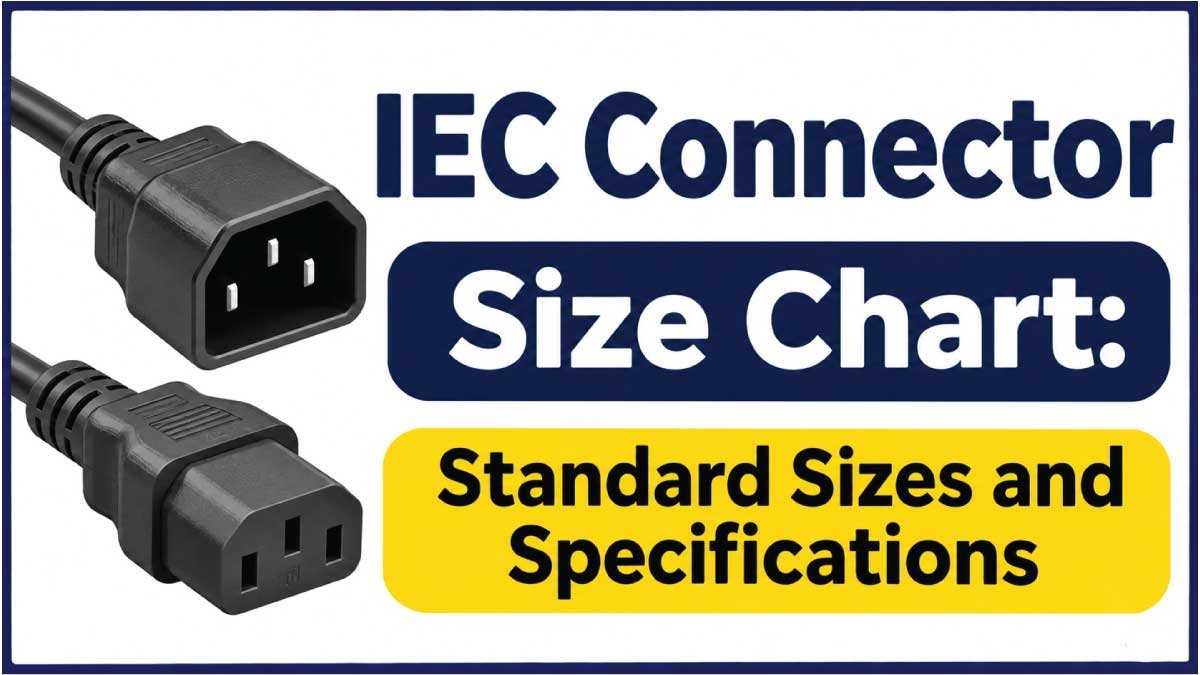
IEC connectors are widely used in computers, monitors, servers, televisions, printers, kitchen appliances, and industrial electrical equipment. They provide standardized connections between power cords and electronic devices, making it easier to use compatible cables across different countries and equipment brands.
The term IEC connector usually refers to appliance couplers covered by the IEC 60320 standard. These connectors come in different shapes, sizes, current ratings, temperature ratings, and grounding configurations.
Choosing the correct IEC connector requires checking its type number, physical dimensions, electrical rating, pin arrangement, and compatibility with the equipment inlet.
This guide covers common IEC connector sizes, including C5, C7, C13, C14, C15, C19, and C20, along with their dimensions, specifications, applications, and selection considerations.
IEC Connector Size Chart
IEC 60320 includes several connector families designed for different electrical loads and operating temperatures. The most familiar types are C5, C7, C13, and C19.
The following chart provides a quick overview of common connector types.
| Connector Type | Common Name | Contacts | International Current Rating | Typical Application |
|---|---|---|---|---|
| C1/C2 | Small appliance connector | 2 | 0.2 A | Small electrical devices |
| C5/C6 | Cloverleaf or Mickey Mouse | 3 | 2.5 A | Laptop power supplies |
| C7/C8 | Figure-8 connector | 2 | 2.5 A | TVs and small electronics |
| C13/C14 | Standard computer connector | 3 | 10 A | Computers and monitors |
| C15/C16 | Hot-condition connector | 3 | 10 A | High-temperature equipment |
| C15A/C16A | Very-hot-condition connector | 3 | 10 A | Specialized hot appliances |
| C17/C18 | Two-pole appliance connector | 2 | 10 A | Double-insulated equipment |
| C19/C20 | High-current connector | 3 | 16 A | Servers and power equipment |
| C21/C22 | Very-hot-condition connector | 3 | 16 A | High-temperature equipment |
| C23/C24 | Two-pole high-current connector | 2 | 16 A | Specialized appliances |
These are common international ratings. Certain North American configurations have higher ratings, such as 15 A for some 10 A international families and 20 A for some 16 A families. Always check the exact product certification and regional rating.
IEC Connector Dimensions Chart
Physical dimensions are important when replacing an existing power cable or designing an equipment inlet.
The following measurements are approximate reference dimensions for common connector pairs. Actual dimensions vary according to the manufacturer, housing design, and cable assembly.
| Connector Pair | Approx. Width | Approx. Height | Approx. Body Depth |
|---|---|---|---|
| C5/C6 | 18.6 mm | 18.6 mm | 30 mm |
| C7/C8 | 27.8 mm | 14.0 mm | 27 mm |
| C13/C14 | 29.0 mm | 20.8 mm | 35 mm |
| C19/C20 | 44.0 mm | 24.0 mm | 40 mm |
These are reference dimensions, not universal IEC standard measurements for every molded cable connector or panel-mounted inlet. Use the manufacturer’s dimensional drawing for accurate installation and replacement work.
C5 Connector Dimensions
The C5 connector is commonly called the cloverleaf or Mickey Mouse connector because of its three-lobed shape.
Its approximate reference dimensions are:
- Width: 18.6 mm
- Height: 18.6 mm
- Body depth: approximately 30 mm
- Contact arrangement: three contacts
It is commonly used with laptop power supplies and other compact electronic equipment.
C7 Connector Dimensions
The C7 connector is commonly called the figure-8 connector because of its two rounded contact sections.
Its approximate reference dimensions are:
- Width: 27.8 mm
- Height: 14.0 mm
- Body depth: approximately 27 mm
- Contact arrangement: two contacts
It is frequently used with televisions, radios, game consoles, and small electronic devices.
C13 Connector Dimensions
The C13 connector is one of the most recognizable IEC power connectors. It is commonly used with desktop computers, monitors, printers, and other electronic equipment.
Its approximate reference dimensions are:
- Width: 29.0 mm
- Height: 20.8 mm
- Body depth: approximately 35 mm
- Contact arrangement: three contacts
The C13 connector mates with a compatible C14 equipment inlet.
C19 Connector Dimensions
The C19 connector is larger than the C13 and is designed for higher-current equipment.
Its approximate reference dimensions are:
- Width: 44.0 mm
- Height: 24.0 mm
- Body depth: approximately 40 mm
- Contact arrangement: three contacts
It is commonly used with servers, data-center equipment, UPS systems, and high-power devices.
IEC Connector Specifications Chart
IEC connectors differ in current capacity, temperature classification, grounding, and physical configuration.
The following table summarizes common international ratings.
| Connector Pair | International Current Rating | Temperature Classification | Equipment Class |
|---|---|---|---|
| C1/C2 | 0.2 A | Cold | Class II |
| C5/C6 | 2.5 A | Cold | Class I |
| C7/C8 | 2.5 A | Cold | Class II |
| C9/C10 | 6 A | Cold | Class II |
| C11/C12 | 10 A | Cold | Class 0 |
| C13/C14 | 10 A | Cold | Class I |
| C15/C16 | 10 A | Hot | Class I |
| C15A/C16A | 10 A | Very hot | Class I |
| C17/C18 | 10 A | Cold | Class II |
| C19/C20 | 16 A | Cold | Class I |
| C21/C22 | 16 A | Very hot | Class I |
| C23/C24 | 16 A | Cold | Class II |
Temperature classifications generally refer to the maximum temperature conditions specified for the appliance inlet. They do not simply describe the surrounding room temperature.
Understanding IEC Connector Current Ratings
Current ratings determine how much electrical current a connector is designed to carry under specified conditions.
For example:
- C7 is commonly rated at 2.5 A internationally.
- C13 is commonly rated at 10 A internationally.
- C19 is commonly rated at 16 A internationally.
North American ratings can differ. A connector approved for 15 A or 20 A in North America should not automatically be assumed to have the same rating in every country.
Understanding IEC Voltage Ratings
IEC 60320 appliance couplers are generally intended for AC applications with a rated voltage not exceeding 250 V AC.
The actual voltage rating of a cord set or equipment inlet may be lower depending on its design and certification.
IEC 60320 connectors should not be confused with DC power connectors or industrial IEC 60309 plugs.
Common IEC Connector Types and Their Applications
1. C5 Connector – Cloverleaf
The C5 connector has three contacts arranged in a cloverleaf shape. It is commonly used with laptop power adapters and compact electronic equipment.
Its matching equipment inlet is C6.
Typical applications include:
- Laptop power supplies
- Compact projectors
- Some monitors
- Small electronic devices
The three-contact arrangement includes an earth connection.
2. C7 Connector – Figure-8
The C7 connector has two rounded contact sections that form a figure-8 shape.
Its matching equipment inlet is C8.
Typical applications include:
- Televisions
- Radios
- Game consoles
- Audio equipment
- Small household electronics
C7 is a two-pole connector and does not provide a protective earth connection.
3. C13 Connector – Standard Computer Power Connector
The C13 is one of the most widely used IEC power connectors. It has three contacts and mates with a C14 inlet.
Typical applications include:
- Desktop computers
- Computer monitors
- Printers
- Networking equipment
- Office electronics
It is commonly rated at 10 A internationally.
4. C15 Connector – Hot-Condition Connector
The C15 connector resembles the C13 but includes an additional notch that allows it to mate with the corresponding C16 inlet.
It is designed for equipment operating under higher-temperature conditions.
Typical applications include:
- Certain high-temperature appliances
- Network equipment
- Specialized industrial equipment
- Devices with hot-condition power inlets
The C15/C16 family has a 120°C temperature classification.
5. C19 Connector – High-Current Connector
The C19 connector has a larger rectangular housing and three contacts. It mates with a C20 equipment inlet.
Typical applications include:
- Servers
- Data-center equipment
- UPS systems
- Power distribution units
- High-power computing equipment
Its international current rating is commonly 16 A.
6. C17 Connector – Two-Pole Appliance Connector
The C17 connector is similar in general purpose to the C13 but has two contacts rather than three.
It mates with a C18 inlet and is intended for Class II equipment that does not require a protective earth connection.
Typical applications include suitable double-insulated appliances and electronic equipment.
IEC Connector C-Type and Inlet Compatibility Chart
IEC connector numbers can be confusing because the cable connector and equipment inlet use different numbers.
In the common IEC 60320 naming system, odd-numbered types generally identify cable connectors, while the corresponding even-numbered types identify equipment inlets.
| Cable Connector | Matching Equipment Inlet | Common Name |
|---|---|---|
| C5 | C6 | Cloverleaf |
| C7 | C8 | Figure-8 |
| C13 | C14 | Standard computer connector |
| C15 | C16 | Hot-condition connector |
| C15A | C16A | Very-hot-condition connector |
| C17 | C18 | Two-pole connector |
| C19 | C20 | High-current connector |
| C21 | C22 | Very-hot high-current connector |
| C23 | C24 | Two-pole high-current connector |
The matching inlet must have the correct shape, contact arrangement, and temperature classification.
Can a C13 Connector Fit a C14 Inlet?
Yes. C13 is designed to mate with a C14 inlet.
This is the standard connection used by many desktop computers, monitors, and other electronic devices.
Can a C13 Connector Fit a C16 Inlet?
No. The C16 inlet has a keying feature that prevents a standard C13 connector from being inserted.
A compatible C15 connector has the additional notch required for the hot-condition inlet.
Can a C19 Connector Fit a C20 Inlet?
Yes. C19 is designed to mate with C20.
However, C19 and C20 are physically larger than C13 and C14, so the two families are not interchangeable.
Also Read:
IEC C13 vs. C15 vs. C19 Connector Comparison
These three connectors are frequently confused because they are all used for AC power connections.
| Feature | C13 | C15 | C19 |
|---|---|---|---|
| Number of contacts | 3 | 3 | 3 |
| Matching inlet | C14 | C16 | C20 |
| International current rating | 10 A | 10 A | 16 A |
| Temperature classification | 70°C | 120°C | 70°C |
| Housing size | Medium | Medium | Large |
| Common application | Computers and monitors | Hot-condition equipment | Servers and UPS systems |
C13 vs. C15
C13 is designed for cold-condition equipment, while C15 is designed for hot-condition applications.
The C15 includes a notch that allows it to fit a compatible C16 inlet. A C13 connector cannot fit that keyed inlet.
C13 vs. C19
C19 is physically larger and has a higher international current rating than C13.
C13 is commonly used with desktop computers and monitors, while C19 is used with higher-power servers and equipment.
C15 vs. C19
C15 is designed for higher-temperature conditions, while C19 is designed for higher-current applications.
They serve different purposes and should not be selected based on physical size alone.
Also Read:
IEC Connector Temperature Classification Chart
IEC 60320 connectors are grouped according to the temperature conditions for which they are designed.
| Temperature Category | Temperature Classification | Common Connector |
|---|---|---|
| Cold condition | 70°C | C13/C14 |
| Hot condition | 120°C | C15/C16 |
| Very hot condition | 155°C | C15A/C16A |
| Very hot high-current condition | 155°C | C21/C22 |
These classifications relate to the specified operating temperature at the appliance inlet, not a general guarantee that the complete cable assembly can operate continuously at that temperature.
Always check the manufacturer’s temperature rating for the complete connector and cord set.
IEC Connector Equipment Classes
IEC appliance couplers are also designed for different equipment protection classes.
Class I Connectors
Class I equipment uses protective earthing. The connector and power cable must provide the required earth connection.
Common examples include:
- C5
- C13
- C15
- C19
Class II Connectors
Class II equipment uses double or reinforced insulation and does not rely on a protective earth connection.
Common examples include:
- C7
- C17
- C23
A two-contact connector should not be substituted for a three-contact grounded connector when the equipment requires protective earthing.
Also Read:
How to Measure an IEC Connector
Accurate measurements help identify an IEC connector and confirm whether it will fit an existing device.
1. Identify the Connector Shape
Start by checking the connector’s front profile. A cloverleaf shape usually indicates C5, a figure-8 shape indicates C7, and a rectangular three-contact shape may indicate C13 or C19.
2. Measure the Housing Width
Use a digital caliper to measure the widest part of the connector housing.
3. Measure the Housing Height
Measure the external height from the bottom to the top of the housing.
4. Measure the Overall Depth
Measure from the mating face to the rear of the connector body. Cable strain reliefs and molded backshells may increase the total assembly length.
5. Check the Number of Contacts
Identify whether the connector has two or three contacts. This helps distinguish grounded and ungrounded connector families.
6. Check the Inlet Compatibility
Compare the connector with the equipment inlet. Confirm the matching C-number, keying arrangement, current rating, and temperature classification.
Do not rely on appearance alone when choosing a replacement power cord.
How to Choose the Correct IEC Connector
Selecting the correct IEC connector involves checking the equipment requirements and the electrical rating of the complete cord assembly.
1. Identify the Equipment Inlet
Check the label or molded marking near the equipment’s power inlet. It may identify the inlet as C6, C8, C14, C16, or C20.
2. Match the Connector Type
Choose the cable connector designed for the inlet. For example, a C13 cable connector is used with a C14 inlet.
3. Check the Current Rating
Confirm that the connector and cord set support the equipment’s maximum current requirement.
Do not assume that every IEC cable has the same current capacity.
4. Verify the Voltage Rating
Check the voltage rating of the equipment, cord set, and connector. The complete assembly must be suitable for the electrical supply.
5. Check Grounding Requirements
Determine whether the equipment requires a protective earth connection.
Use a three-contact grounded connector where the equipment is designed for Class I protection.
6. Consider Temperature Conditions
For equipment operating at elevated inlet temperatures, select the correct hot-condition or very-hot-condition connector.
7. Check Cable and Certification Ratings
The cable conductor size, insulation, connector contacts, and product certification must all be suitable for the application.
Common IEC Connector Applications
Computers and Monitors
C13 and C14 connections are widely used for desktop computers, monitors, printers, and office electronics.
Laptop Power Supplies
C5 connectors are commonly found on compatible laptop power adapters and other compact electronic equipment.
Televisions and Audio Equipment
C7 connectors are frequently used with televisions, radios, speakers, and small consumer electronics.
Servers and Data Centers
C19 and C20 connectors are used in higher-current server systems, power distribution units, and UPS equipment.
Industrial Equipment
C15, C16, C21, and C22 connectors are used in applications where higher operating temperatures or specialized power requirements must be considered.
Common IEC Connector Sizing Mistakes
Confusing C13 With C15
Although they look similar, C15 is designed for hot-condition equipment and has a different keying profile.
Using a C7 Cable on Grounded Equipment
C7 has only two contacts and does not provide a protective earth connection. It must not replace a grounded cable where protective earthing is required.
Confusing C13 With C19
C19 is larger and has a higher international current rating. The two connector families are not interchangeable.
Ignoring Regional Current Ratings
International and North American ratings can differ. Always check the certification and rating of the actual product.
Choosing a Cable by Shape Alone
A connector may physically fit but still have an unsuitable current, voltage, grounding, or temperature rating.
Ignoring Temperature Requirements
A standard C13 connector should not be substituted for a C15 connector when the equipment requires a hot-condition connection.
Frequently Asked Questions
What is the most common IEC connector size?
C13 is one of the most common IEC connector types. It is widely used with desktop computers, monitors, printers, and other electronic equipment.
What is the difference between C13 and C14?
C13 is the cable connector, while C14 is the matching equipment inlet. They are designed to connect together.
What is the difference between C5 and C7 connectors?
C5 has a three-lobed cloverleaf shape and three contacts. C7 has a two-contact figure-8 shape. They are not interchangeable.
What is the current rating of a C13 connector?
A C13 connector is commonly rated at 10 A internationally. Some North American configurations have a 15 A rating under their applicable certification.
What is the difference between C13 and C19?
C13 is a medium-sized connector commonly rated at 10 A internationally. C19 is larger and commonly rated at 16 A internationally.
Can I use a C15 cable instead of a C13 cable?
A C15 connector can fit a compatible C14 inlet, but it should only be used when the cable assembly is suitable for the equipment and electrical requirements. A C13 connector cannot fit a keyed C16 inlet.
What is a C19 connector used for?
C19 connectors are commonly used with servers, UPS systems, data-center equipment, and other higher-current electrical devices.
Are IEC connectors universal?
IEC 60320 standardizes connector shapes and electrical requirements, allowing compatible products to be used across many regions. However, voltage, current, grounding, and regional cord-plug requirements must still be checked.
What is the difference between IEC 60320 and IEC 60309?
IEC 60320 covers appliance couplers commonly found on computers, appliances, and electronic equipment. IEC 60309 covers industrial plugs, socket-outlets, and couplers, often used for higher-power industrial connections.
Conclusion
IEC connectors are available in several standardized sizes and configurations to support different electrical loads, temperatures, and grounding requirements. C5, C7, C13, and C19 are among the most common types, while C15, C17, C21, and other variations serve more specialized applications.
Before selecting an IEC connector, identify the equipment inlet, matching C-type, physical dimensions, current rating, voltage rating, temperature classification, and grounding requirements. Always verify the complete connector and cable specifications to ensure a safe and compatible power connection.