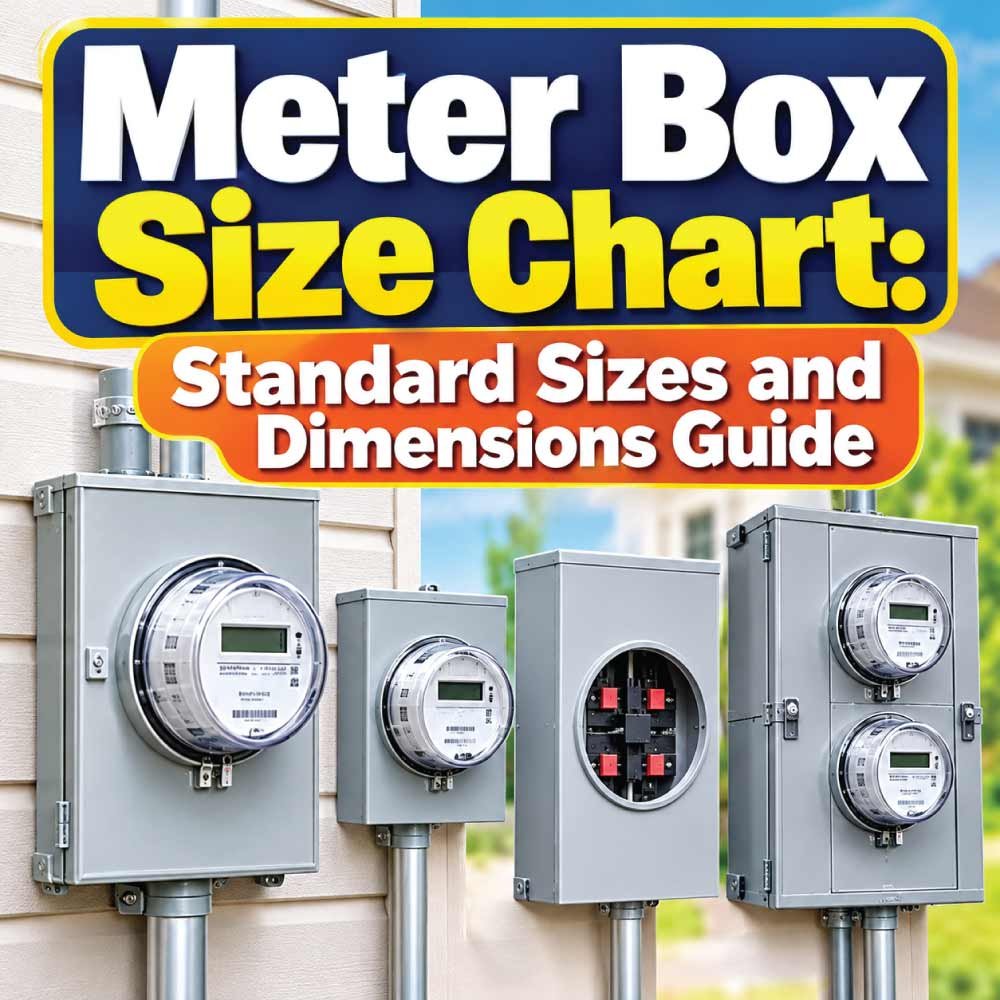
A meter box protects an electrical utility meter and provides an organized enclosure for the meter connections, service conductors, and associated equipment. Choosing the correct enclosure size is important because the box must provide enough room for the meter, wiring, terminals, fittings, and required working clearances.
This Meter Box Size Chart explains common meter box dimensions, enclosure types, capacity considerations, mounting requirements, and factors that affect the correct size. Because exact dimensions and installation requirements can vary by utility, manufacturer, meter type, and local electrical rules, the measurements below should be treated as general sizing guidance rather than universal specifications.
What Is a Meter Box?
A meter box, also called a meter enclosure or electric meter box, is a protective housing installed around an electrical energy meter. It is typically positioned where the utility can safely access and read the meter.
The enclosure protects electrical components from accidental contact, weather, physical damage, and environmental conditions. Depending on the installation, it may be designed for a single meter, multiple meters, indoor use, outdoor use, or specific utility requirements.
A meter box commonly accommodates:
- Electrical utility meter
- Service entrance conductors
- Meter socket or socket assembly
- Line and load terminals
- Grounding connections
- Conduit or cable entries
- Utility sealing provisions
- Mounting hardware
The box must not simply be large enough to physically hold the meter. Internal working space, conductor bending room, equipment arrangement, and utility requirements also influence the appropriate enclosure dimensions.
Meter Box Size Chart
Meter boxes are available in many configurations, so there is no single universal standard size. The following chart represents common general-purpose enclosure size ranges used as a starting point when comparing meter box dimensions.
| Meter Box Type | Typical Width | Typical Height | Typical Depth | Common Use |
|---|---|---|---|---|
| Small Single Meter | 8–12 in | 10–16 in | 4–6 in | Compact residential service |
| Standard Single Meter | 10–14 in | 14–20 in | 4–7 in | Residential installations |
| Large Single Meter | 12–18 in | 18–24 in | 5–8 in | Larger service equipment |
| Multi-Meter Box | 18–36+ in | 24–48+ in | 5–10+ in | Multi-unit buildings |
| Commercial Meter Enclosure | 18–36+ in | 24–48+ in | 6–12+ in | Commercial services |
| Outdoor Meter Cabinet | 12–36+ in | 18–48+ in | 6–12+ in | Weather-exposed installations |
These dimensions are general ranges rather than guaranteed standard measurements. The actual dimensions of a meter enclosure can differ substantially between manufacturers and utility service specifications.
When purchasing a replacement enclosure, always compare the actual meter socket, mounting pattern, service rating, conduit entries, and utility requirements, not just the external box dimensions.
Standard Meter Box Dimensions Explained
Understanding the three basic dimensions makes it easier to compare different enclosures.
Width
Width is the horizontal measurement across the front of the enclosure. A wider box can provide additional room for terminals, wiring routes, disconnect equipment, or multiple meter positions.
Single-meter residential boxes are generally narrower than multi-meter and commercial enclosures.
Height
Height is measured from the bottom to the top of the enclosure. Additional height can provide more space for conductor routing and equipment mounting.
Meter height and accessibility can also affect where the box is positioned on a wall or service structure.
Depth
Depth is the distance from the front cover to the back of the enclosure. This dimension is particularly important when the meter socket, terminals, conductors, or other components extend into the cabinet.
A box that is wide and tall enough can still be unsuitable if it does not provide adequate depth.
Common Types of Meter Boxes
Meter boxes differ according to the number of meters, installation environment, service arrangement, and equipment they are designed to accommodate.
Single Meter Box
A single-meter enclosure is intended for one utility meter. It is common in residential applications where one electrical service serves a home or individual building.
These boxes are generally compact but still need enough internal space for the meter socket, conductors, terminals, and service connections.
Multi-Meter Box
Multi-meter enclosures contain positions for two or more meters. They are frequently used in apartments, condominiums, duplexes, commercial properties, and buildings with separately metered units.
Because multiple meters require additional mounting and wiring space, these boxes can be substantially larger than single-meter enclosures.
Outdoor Meter Box
Outdoor meter boxes are designed for installation in exposed locations. Their construction may include weather-resistant materials, covers, gaskets, and provisions that help protect electrical components from moisture and environmental conditions.
The enclosure’s environmental rating should match the installation location.
Indoor Meter Enclosure
Indoor installations may use enclosures designed for protected environments. However, indoor placement still requires sufficient clearance, accessibility, and compliance with the applicable electrical requirements.
Commercial Meter Cabinet
Commercial meter cabinets are generally larger and may accommodate higher-capacity service equipment or more complex meter arrangements. Their dimensions can vary considerably depending on the service configuration.
Meter Box Size by Number of Meters
The number of meters is one of the most obvious factors affecting enclosure dimensions.
| Meter Capacity | Typical Configuration | Relative Enclosure Size | Common Application |
|---|---|---|---|
| 1 Meter | Single position | Small to medium | House or small building |
| 2 Meters | Two positions | Medium to large | Duplex or separate units |
| 3–4 Meters | Multiple positions | Large | Small multi-unit property |
| 5–8 Meters | Multi-position | Extra large | Apartment or commercial building |
| 9+ Meters | Modular/custom arrangement | Project-specific | Larger developments |
The table is intended for general comparison only. Actual dimensions depend on how the meter sockets are arranged, the service equipment used, conductor requirements, and the manufacturer’s design.
For larger installations, it is particularly important to select an enclosure based on the approved equipment configuration rather than assuming that a larger box will automatically be suitable.
What Determines the Correct Meter Box Size?
The correct meter box size depends on more than the physical size of the meter.
Meter Socket Dimensions
The meter socket or socket assembly must physically fit inside the enclosure. Its mounting points and required clearances must also match the cabinet design.
Service Rating
The electrical service rating affects the equipment and conductors installed inside the enclosure. Higher-capacity services can require larger conductors, terminals, or service equipment.
A box designed for a small residential installation should not automatically be used for a larger service simply because the meter itself fits.
Conductor Size
Large service conductors can require additional space for routing and bending. This can make a deeper or larger enclosure necessary.
Conduit and Cable Entry
The location and size of conduit openings can affect how efficiently conductors enter the box. Side, top, bottom, and rear entries may require different internal arrangements.
Number of Meters
More meters generally mean more sockets, terminals, conductors, and mounting space. Multi-meter applications therefore require larger purpose-built equipment.
Utility Requirements
Utility companies can specify approved meter sockets, enclosure designs, dimensions, mounting arrangements, and service configurations. These requirements can vary significantly by region.
For that reason, utility approval should be checked before selecting a meter box for a new service installation.
How to Measure a Meter Box
Measuring an existing enclosure can help identify a replacement, but external measurements alone are not enough.
Step 1: Measure the Width
Measure the outside width of the cabinet from one side to the other. Record the measurement in inches or millimeters and use the same unit throughout your comparison.
Step 2: Measure the Height
Measure the overall exterior height from the bottom edge to the top edge.
If the box includes a separate cover or trim, record the enclosure dimensions separately where appropriate.
Step 3: Measure the Depth
Measure from the rear mounting surface to the furthest point of the enclosure. Depth is important when comparing replacement cabinets.
Step 4: Check the Meter Socket
Identify the meter socket arrangement and measure its mounting dimensions. Look for the number and position of mounting holes, terminal locations, and service connections.
Step 5: Check Entry Locations
Record where conduits or cables enter the existing enclosure. A replacement box with different entry locations may require changes to the installation.
Step 6: Record the Service Information
Before ordering a replacement, identify relevant information such as:
- Meter capacity
- Number of meters
- Service configuration
- Enclosure type
- Existing socket arrangement
- Conductor entry method
- Indoor or outdoor location
- Manufacturer and model information
If the enclosure contains energized equipment, measurements and identification should be performed safely by a qualified person.
Also Read:
Meter Box Dimensions: Inches vs. Millimeters
Meter enclosures are commonly described using either inches or millimeters, depending on the market and manufacturer.
| Dimension | Inches | Approximate Millimeters |
|---|---|---|
| 8 in | 8 in | 203 mm |
| 10 in | 10 in | 254 mm |
| 12 in | 12 in | 305 mm |
| 16 in | 16 in | 406 mm |
| 18 in | 18 in | 457 mm |
| 20 in | 20 in | 508 mm |
| 24 in | 24 in | 610 mm |
| 30 in | 30 in | 762 mm |
| 36 in | 36 in | 914 mm |
| 48 in | 48 in | 1,219 mm |
These are unit conversions rather than recommended meter box sizes. When comparing products, use the manufacturer’s published dimensions and avoid assuming that two enclosures with similar outside dimensions have identical internal capacity.
Meter Box Material and Construction
The enclosure material can affect durability, weight, corrosion resistance, and suitability for a particular environment.
Metal Meter Boxes
Metal enclosures are widely used where mechanical strength and durability are important. Common construction materials can include steel or aluminum, depending on the application.
A metal enclosure may be appropriate for demanding service environments, but the material and finish should be suitable for the installation conditions.
Plastic or Nonmetallic Enclosures
Nonmetallic meter enclosures can offer corrosion resistance and reduced weight. Their suitability depends on the specific utility requirements, environmental conditions, meter equipment, and installation design.
The material should never be selected solely on appearance or price.
Also Read:
Indoor and Outdoor Meter Box Selection
The installation environment is an important part of choosing a meter enclosure.
For outdoor applications, consider:
- Weather exposure
- Moisture protection
- Corrosion resistance
- Sun exposure
- Physical impact
- Environmental enclosure rating
- Utility accessibility
For indoor installations, focus more heavily on the available wall space, accessibility, equipment arrangement, and applicable electrical requirements.
An enclosure intended for an indoor environment should not automatically be installed outdoors simply because its dimensions are suitable.
How to Choose the Right Meter Box Size
Choosing a meter enclosure becomes easier when the selection process follows a logical order.
1. Identify the Meter Configuration
Determine whether the installation requires a single meter, multiple meters, or a specialized metering arrangement.
2. Confirm the Service Requirements
Check the service rating and equipment requirements before selecting the enclosure.
3. Check Physical Dimensions
Compare the required internal and external dimensions with the available installation space.
4. Verify Conductor Space
Make sure the enclosure provides appropriate space for the service conductors and connections.
5. Check Environmental Suitability
Select an enclosure designed for its actual location and environmental conditions.
6. Confirm Utility Compatibility
This is one of the most important steps. A physically compatible box may still be unacceptable if it does not meet the local utility’s approved equipment requirements.
7. Review Manufacturer Specifications
Use the manufacturer’s dimensional drawings and installation documentation to verify the exact model before purchasing.
Also Read:
Common Meter Box Sizing Mistakes
Several mistakes can lead to installation problems.
Choosing Only by External Dimensions
Two boxes can have similar outside dimensions but very different internal layouts. Always check internal working space and mounting arrangements.
Ignoring Depth
Depth is often overlooked when replacing an enclosure. Conductors, terminals, and meter socket components can make depth just as important as width and height.
Assuming Bigger Is Always Better
A larger cabinet is not automatically a suitable replacement. The equipment must be designed and approved for the intended service arrangement.
Ignoring Utility Specifications
Utility requirements can determine which meter socket or enclosure configuration is acceptable. This should be confirmed before installation.
Forgetting Conduit Locations
A replacement enclosure may not line up with existing conduit entries. Always compare entry locations before purchasing.
Mixing Meter and Socket Requirements
The meter itself is only one component. The socket, terminals, conductors, mounting system, and enclosure all need to work together.
Meter Box vs. Meter Socket
The terms meter box and meter socket are sometimes used interchangeably, but they can describe different components.
A meter box generally refers to the protective enclosure or cabinet surrounding the metering equipment. A meter socket is the component that physically receives and connects the utility meter.
Depending on the product, the socket may be integrated into the enclosure or supplied as part of a larger assembly.
This distinction matters when ordering replacement equipment because a cabinet with the correct external dimensions may not contain the correct socket configuration.
Frequently Asked Questions
What is the standard size of an electric meter box?
There is no single universal meter box size. Common residential enclosures can range from compact boxes around 8–12 inches wide to larger cabinets exceeding 18 inches in width, depending on the equipment and service configuration.
How deep should a meter box be?
The required depth depends on the meter socket, conductors, terminals, conduit arrangement, and enclosure design. Common products may have depths of several inches, while larger service cabinets can be considerably deeper.
Are all meter boxes the same size?
No. Meter boxes vary by meter capacity, service rating, number of meters, manufacturer, installation environment, and utility requirements.
Can I replace a meter box with a larger one?
A larger enclosure is not automatically an acceptable replacement. The new enclosure must be compatible with the meter socket, service equipment, conductors, mounting arrangement, and applicable utility requirements.
What size meter box do I need for a house?
Many residential properties use a single-meter enclosure, but the correct size depends on the service arrangement and equipment. The meter socket and utility requirements should be confirmed before selecting a specific enclosure.
How do I know what size meter box I have?
Measure its width, height, and depth, then identify the meter socket, manufacturer, model, service rating, and conduit arrangement. Manufacturer markings can make identification much easier.
Does meter box depth matter?
Yes. Depth provides room for the socket, terminals, service conductors, and internal connections. A box with insufficient depth can create installation and wiring problems even when its width and height appear adequate.
Final Meter Box Size Selection Tips
A good meter box should provide the correct combination of physical dimensions, electrical capacity, equipment compatibility, environmental protection, and accessibility.
Before purchasing, verify:
- Meter quantity and configuration
- Meter socket dimensions
- Service rating
- Width, height, and depth
- Internal equipment space
- Conduit and cable entry locations
- Indoor or outdoor application
- Enclosure material and environmental suitability
- Manufacturer specifications
- Local utility requirements
- Applicable electrical installation requirements
The most important point is that meter box dimensions are not universal. A size chart can help narrow down the appropriate enclosure, but the final selection should always be based on the actual equipment and installation requirements.
Conclusion
A Meter Box Size Chart is useful for comparing enclosure dimensions and understanding the space required for different electrical metering applications. Single-meter residential boxes are typically more compact, while multi-meter and commercial cabinets require considerably more room.
When selecting a meter box, look beyond width and height. Depth, socket configuration, service rating, conductor space, environmental conditions, and utility approval are equally important. Always verify the manufacturer’s specifications and applicable local requirements before purchasing or installing an enclosure.