Choosing the correct battery cable size is essential for safe and reliable electrical performance. A cable that is too small can create excessive voltage drop, heat, poor starting performance, and potentially unsafe operating conditions. A cable that is unnecessarily large, however, adds cost, weight, and installation difficulty.
The good news is that measuring battery cable size does not have to be complicated. You can identify an existing cable by measuring its conductor diameter, determine its AWG (American Wire Gauge) size, or select a new cable based on current, cable length, and allowable voltage drop.
This guide explains how to measure battery cable size accurately, how AWG relates to conductor diameter and cross-sectional area, how cable length affects sizing, and how to avoid common mistakes when selecting battery cables for cars, trucks, boats, RVs, solar systems, and other equipment.
What Is Battery Cable Size?
Battery cable size refers primarily to the cross-sectional size of the conductive material inside the cable. Copper is commonly used because of its good electrical conductivity and flexibility.
Battery cables are often identified using AWG sizes, such as 1/0 AWG, 2/0 AWG, 4 AWG, 6 AWG, or 8 AWG. Unlike ordinary measurements where a larger number generally means a larger object, AWG works in reverse: a smaller AWG number represents a larger conductor.
For example, 4 AWG cable has a larger conductor than 8 AWG cable.
Battery cable sizing is important because the conductor must carry the required electrical current without excessive voltage loss or overheating.
The correct size depends on several factors:
- Maximum current the cable must carry
- Total cable length
- System voltage
- Acceptable voltage drop
- Conductor material
- Cable insulation and temperature rating
- Installation environment
- Type of electrical load
For high-current applications such as engine starting, inverters, winches, and battery banks, these factors become particularly important.
Battery Cable Size vs. Cable Diameter
One common source of confusion is the difference between cable size and overall cable diameter.
The overall diameter includes more than the conductor. It can include:
- Copper or aluminum conductor
- Insulation
- Protective jacket
- Additional shielding or covering
Therefore, measuring the outside diameter of a battery cable does not always tell you its exact AWG size.
If you need to identify an existing cable, the most reliable approach is to inspect its markings first. Many battery cables have the wire gauge printed, stamped, or marked on the insulation.
If there is no readable marking, you can measure the conductor itself.
How to Measure Battery Cable Size Step by Step
There are several ways to determine battery cable size. The best method depends on whether you can access the conductor and whether the cable has markings.
1. Check the Cable Markings
Before measuring anything, inspect the cable insulation.
Look for markings such as:
- 2 AWG
- 4 AWG
- 6 AWG
- 1/0 AWG
- 2/0 AWG
- Copper
- Welding cable specifications
- Manufacturer identification
If the gauge is clearly printed on the cable, this is usually the easiest way to identify the nominal conductor size.
Do not assume that the outside diameter alone confirms the gauge. Different insulation thicknesses and cable constructions can produce different overall diameters.
2. Disconnect the Battery Safely
If you need to expose or remove the cable for measurement, disconnect the electrical system safely first.
For a typical vehicle, turn off electrical equipment and follow the manufacturer’s recommended battery-disconnection procedure. Avoid allowing a metal measuring tool to bridge the battery terminals or other energized conductors.
For high-current battery systems, additional isolation procedures may be required.
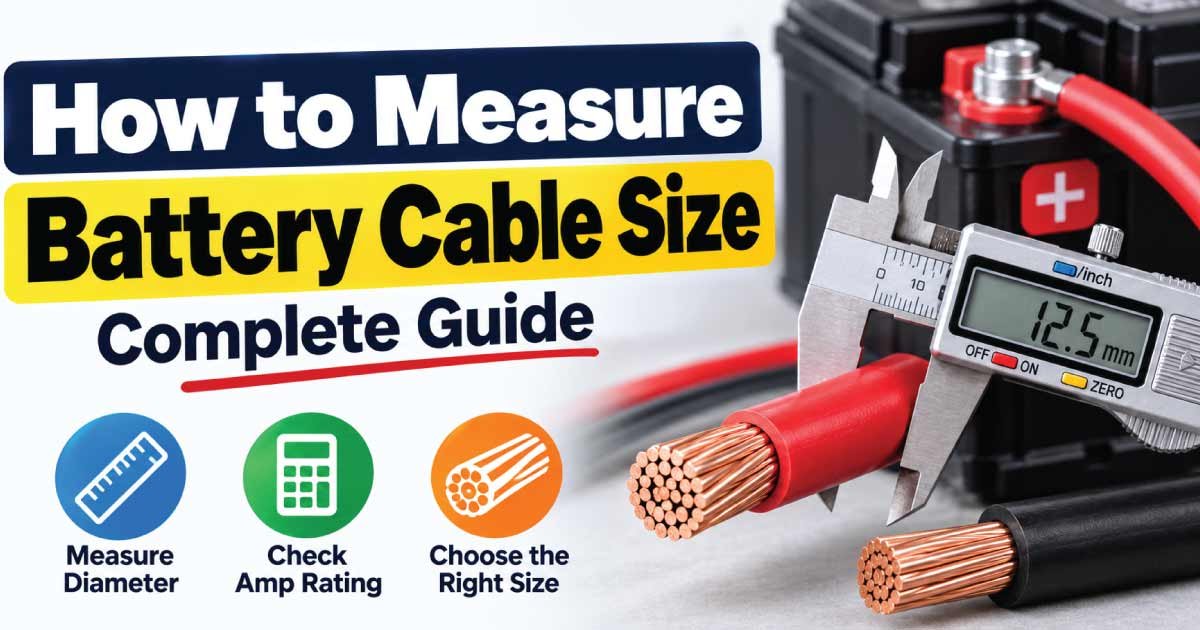
3. Measure the Conductor Diameter
If the cable can be disconnected and the conductor is accessible, measure the bare conductor diameter, not the insulated outside diameter.
A digital caliper provides a much better measurement than an ordinary ruler.
Place the caliper across the conductor at a right angle and measure its diameter.
For stranded cable, the measurement is more difficult because the individual strands do not form a perfectly solid circular surface. Avoid crushing the strands while measuring.
4. Determine the Approximate AWG Size
Once you have the conductor diameter, compare the measurement with an AWG reference chart.
Common AWG conductor dimensions include:
| AWG Size | Nominal Conductor Diameter (mm) | Approx. Area (mm²) |
|---|---|---|
| 8 AWG | 3.26 | 8.37 |
| 6 AWG | 4.11 | 13.3 |
| 4 AWG | 5.19 | 21.2 |
| 2 AWG | 6.54 | 33.6 |
| 1 AWG | 7.35 | 42.4 |
| 1/0 AWG | 8.25 | 53.5 |
| 2/0 AWG | 9.27 | 67.4 |
| 3/0 AWG | 10.4 | 85.0 |
| 4/0 AWG | 11.7 | 107 |
These values represent nominal AWG conductor dimensions. Actual finished cables can vary because of strand construction, manufacturing tolerances, insulation, and cable design.
5. Measure the Cable Length
Cable length is just as important as conductor size when selecting a replacement cable.
Measure the actual electrical path between the battery and the equipment rather than simply estimating the distance.
For a circuit, remember that current normally travels from the battery to the load and back again. Therefore, voltage-drop calculations commonly use the total circuit length.
For example, if the positive cable is 6 feet long and the negative return path is another 6 feet, the circuit length is approximately 12 feet.
6. Confirm the Current Requirement
Finally, determine how much current the cable needs to carry.
This may come from:
- Equipment specifications
- Starter requirements
- Inverter specifications
- Winch specifications
- Motor data
- Fuse or circuit-protection requirements
- Manufacturer documentation
Do not select cable size based only on the battery’s physical size. A battery’s capacity in amp-hours is not the same thing as the current carried by a particular cable.
How to Measure Battery Cable Diameter Correctly
If your main goal is to determine cable size from physical dimensions, measuring diameter requires care.
For a solid conductor, diameter is straightforward: measure straight across the circular conductor.
For a stranded conductor, the individual strands create gaps between them. Simply measuring the outside of the strand bundle can therefore produce an approximation rather than an exact conductor area.
A better method is to identify:
- Number of strands
- Diameter of each strand
- Conductor construction
- Manufacturer specification, if available
For a uniform stranded conductor, the approximate metallic cross-sectional area can be calculated from the number and diameter of the individual strands.
The basic relationship is:
Area = number of strands × π × (strand diameter ÷ 2)²
This can help when identifying an unmarked cable, but manufacturer specifications are preferable when available.
AWG Battery Cable Size Chart
AWG is widely used for identifying wire and cable conductor size in North America. The following reference compares several commonly encountered sizes.
| AWG Size | Diameter (mm) | Area (mm²) | Relative Size |
|---|---|---|---|
| 10 AWG | 2.59 | 5.26 | Small |
| 8 AWG | 3.26 | 8.37 | Small |
| 6 AWG | 4.11 | 13.3 | Medium |
| 4 AWG | 5.19 | 21.2 | Medium |
| 2 AWG | 6.54 | 33.6 | Large |
| 1/0 AWG | 8.25 | 53.5 | Very large |
| 2/0 AWG | 9.27 | 67.4 | Very large |
| 3/0 AWG | 10.4 | 85.0 | Heavy-duty |
| 4/0 AWG | 11.7 | 107 | Heavy-duty |
This is an identification reference, not an ampacity chart. The correct current capacity depends on installation conditions, insulation, temperature, allowable voltage drop, and applicable electrical requirements.
Why Battery Cable Length Matters
A common battery-cable sizing mistake is ignoring cable length.
Every conductor has electrical resistance. As conductor length increases, resistance increases. When current flows through that resistance, some voltage is lost along the cable.
This is known as voltage drop.
Long cable runs therefore may require a larger conductor even when the current remains unchanged.
For example, a short cable supplying a high-current device may perform adequately at one conductor size, while the same current traveling through a much longer cable may require a larger conductor to maintain acceptable voltage at the load.
This is particularly important in:
- RV battery systems
- Marine electrical systems
- Solar battery banks
- Remote equipment
- Inverter installations
- Winches
- Auxiliary vehicle batteries
Always consider the complete circuit length, not only the positive cable.
How to Choose Battery Cable Size
Measuring an existing cable and choosing the correct cable for a new installation are two different tasks.
If you are replacing an existing cable, you can identify the original conductor size and then verify whether it is appropriate for the application.
For a new installation, use a systematic approach.
Consider Maximum Current
Determine the highest continuous or expected current.
Starting systems can involve very high currents for short periods, while inverters and other equipment may draw substantial current continuously.
Do not rely on a generic current chart when the equipment manufacturer provides a specific cable-sizing requirement.
Consider Voltage Drop
Voltage drop becomes especially important in low-voltage systems.
A small voltage loss may represent a significant percentage of the available voltage in a 12 V system.
For example, a 0.5 V drop represents a much larger percentage of a 12 V system than it would of a 48 V system.
The commonly used voltage-drop relationship is:
Voltage Drop = Current × Resistance
Because cable resistance depends on conductor material, cross-sectional area, and length, increasing cable size reduces resistance and generally reduces voltage drop.
Consider the Installation Environment
Battery cables may be installed in locations exposed to:
- Heat
- Moisture
- Oil
- Chemicals
- Vibration
- Abrasion
- Saltwater
- Engine compartments
Choose cable insulation and construction suitable for the environment.
A cable that is electrically adequate may still be unsuitable if its insulation is not designed for the installation conditions.
Battery Cable Size for Common Applications
There is no single battery cable size that works for every vehicle or electrical system.
Different applications have different current and length requirements.
| Application | Important Sizing Factors |
|---|---|
| Car starting cable | Starter current, cable length, voltage drop |
| Truck battery cable | Starting current, length, environmental conditions |
| RV battery cable | Continuous load, inverter current, circuit length |
| Marine battery cable | Current, length, marine-rated construction |
| Solar battery connection | Maximum current, system voltage, cable length |
| Inverter cable | Maximum input current, cable length, voltage drop |
| Winch cable | Peak current, cable length, manufacturer requirements |
| Auxiliary battery | Load current, charging current, cable routing |
These applications should be sized individually rather than using a one-size-fits-all recommendation.
How to Calculate Battery Cable Size
Cable sizing calculations generally involve current, resistance, conductor area, and allowable voltage drop.
A useful relationship for a conductor is:
R = ρL/A
Where:
- R = resistance
- ρ = resistivity of the conductor material
- L = conductor length
- A = conductor cross-sectional area
Once resistance is known, voltage drop can be estimated using:
Vd = I × R
Where:
- Vd = voltage drop
- I = current
- R = circuit resistance
For a complete circuit, the length used in the calculation should generally include both the outgoing and return conductors.
In practical installations, cable-sizing tables supplied by reputable cable manufacturers are often easier and safer to use than calculating conductor size from scratch.
Copper vs. Aluminum Battery Cable
Battery cables can use different conductor materials, with copper being especially common because of its electrical conductivity and practical flexibility.
Aluminum conductors can provide a lower-weight alternative, but conductor size, termination methods, connectors, corrosion considerations, and manufacturer specifications must all be considered.
Do not assume that a copper cable and aluminum cable with identical physical dimensions will have identical electrical performance.
When changing conductor material, follow the cable manufacturer’s specifications and applicable electrical requirements.
Common Battery Cable Sizing Mistakes
Incorrect cable selection can lead to performance problems. Some of the most common mistakes include:
Measuring the Insulation Instead of the Conductor
The outside diameter includes insulation, so it cannot reliably identify the AWG conductor size.
Ignoring Total Circuit Length
Measuring only the positive cable can underestimate voltage-drop effects.
Choosing Cable by Battery Size
Battery physical dimensions or amp-hour capacity do not directly determine the required cable gauge.
Using Ampacity Alone
A cable may have sufficient current-carrying capacity but still produce excessive voltage drop over a long distance.
Assuming Bigger Is Always Better
A larger cable generally has lower resistance, but it may be more expensive, heavier, harder to route, and more difficult to terminate. The goal is the appropriate cable size, not simply the largest available cable.
Ignoring Terminations
Cable performance depends on the entire connection. Poorly crimped lugs, loose terminals, corrosion, or unsuitable connectors can introduce resistance and heat.
Tools for Measuring Battery Cable Size
You do not need a large collection of tools to identify most battery cables.
Useful tools include:
- Digital caliper: For measuring conductor diameter accurately
- Ruler or tape measure: For measuring cable length
- Wire gauge tool: For identifying conductor gauge
- Cable stripping tool: For safely exposing a conductor when appropriate
- Manufacturer cable chart: For confirming construction and specifications
- Multimeter: For electrical testing, although it does not directly determine cable gauge
A digital caliper is particularly useful when the cable marking is missing or unreadable.
When You Should Not Rely on Measurement Alone
Physical measurement can identify the approximate conductor size, but it cannot tell you whether that cable is actually appropriate for a specific application.
Before installing a battery cable, verify:
- Required current
- Cable length
- Allowable voltage drop
- Conductor material
- Insulation temperature rating
- Environmental requirements
- Terminal compatibility
- Applicable electrical standards
- Manufacturer recommendations
For critical or high-current systems, use the equipment manufacturer’s cable-sizing instructions or consult a qualified electrical professional.
Quick Battery Cable Measurement Checklist
Use this checklist when identifying or replacing a battery cable:
- Read the cable marking before cutting or removing anything.
- Disconnect power safely before exposing the conductor.
- Measure the conductor, not just the insulation.
- Use a caliper for better diameter measurements.
- Identify the AWG size or cross-sectional area.
- Measure the complete circuit length.
- Determine the equipment’s maximum current requirement.
- Check the required voltage-drop limit.
- Confirm the cable’s temperature and environmental rating.
- Check terminals, lugs, crimps, and connection points.
- Follow the manufacturer’s specifications whenever available.
Frequently Asked Questions
How do I know what size battery cable I have?
Start by checking the cable insulation for an AWG marking. If no marking is available, disconnect the cable safely and measure the bare conductor diameter with a caliper. Compare the measurement with an AWG chart, while remembering that stranded construction can make diameter-based identification approximate.
Can I measure battery cable size without removing the cable?
You can measure the overall outside diameter without removing the cable, but this does not reliably identify the conductor’s AWG size because insulation thickness varies. If possible, use existing cable markings or manufacturer information. For accurate conductor identification, measure the exposed conductor rather than the insulated cable.
What is the difference between 2 AWG and 2/0 AWG battery cable?
2/0 AWG is substantially larger than 2 AWG. In the AWG system, the “/0” sizes are larger conductors, with 1/0, 2/0, 3/0, and 4/0 increasing in size. Therefore, 2/0 cable has a larger conductor and cross-sectional area than 2 AWG.
Does a longer battery cable need to be larger?
Often, yes. Longer cable runs have greater electrical resistance, which can increase voltage drop. If the current and acceptable voltage drop remain the same, a longer circuit may require a larger conductor. Always consider the total circuit path and use the equipment or cable manufacturer’s sizing recommendations.
Is battery cable size based only on amps?
No. Current is important, but it is not the only factor. Cable length, system voltage, allowable voltage drop, conductor material, insulation, temperature, installation conditions, and applicable requirements also affect the appropriate cable size.
Conclusion
Learning how to measure battery cable size starts with identifying the conductor rather than simply measuring the cable’s outside diameter. Check the cable marking first, and when necessary, measure the conductor with a caliper and compare it with an AWG or cross-sectional-area reference.
For selecting a new cable, measurement alone is not enough. Consider current, total circuit length, voltage drop, conductor material, insulation, operating temperature, and installation environment.
The best battery cable is not necessarily the largest one. It is the cable that meets the electrical and physical requirements of the application with appropriate safety and performance margins. When exact requirements are critical, always verify the cable manufacturer’s specifications and the applicable electrical standard before installation.