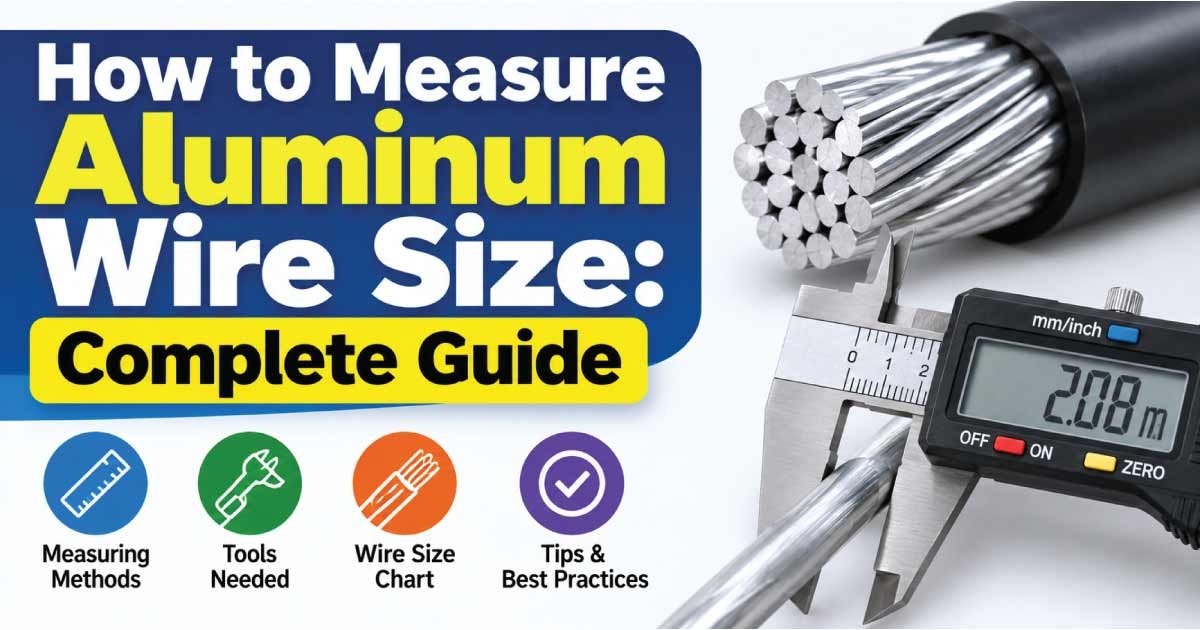
Measuring aluminum wire size correctly is important when replacing conductors, identifying existing wiring, checking electrical specifications, or selecting the right wire for an installation. The wire’s outside appearance can be misleading because insulation adds thickness, while aluminum conductors can have different strand arrangements.
The most reliable approach is to identify the conductor diameter, American Wire Gauge (AWG), or cross-sectional area rather than judging the wire by its insulation or overall cable diameter.
In this guide, you will learn how to measure aluminum wire size using common tools, how to measure solid and stranded aluminum wire, how diameter relates to AWG, how to calculate cross-sectional area, and what to check before selecting a replacement.
What Does Aluminum Wire Size Mean?
Aluminum wire size normally refers to the size of the conductive aluminum portion, not the complete outside diameter of the insulated wire. In North American wiring, conductor sizes are commonly identified using AWG (American Wire Gauge).
For larger conductors, sizes may also be expressed in kcmil, where one circular mil is a unit based on conductor diameter.
Wire size affects important electrical characteristics such as:
- Current-carrying capacity
- Electrical resistance
- Voltage drop
- Physical strength
- Heat generation
- Compatibility with terminals and connectors
- Suitable application and installation method
A larger conductor generally has a greater cross-sectional area and lower resistance. However, wire size alone does not determine whether a conductor is suitable for a particular circuit. Conductor material, insulation rating, ambient temperature, installation conditions, and applicable electrical codes must also be considered.
Tools Needed to Measure Aluminum Wire Size
You do not need specialized equipment for every measurement. The best tool depends on whether the conductor is accessible and whether you need an approximate identification or a precise measurement.
Digital or Vernier Caliper
A caliper is one of the most useful tools for measuring conductor diameter. It can provide a precise diameter measurement in millimeters or inches.
Use the caliper on the bare aluminum conductor, not on the insulation.
Micrometer
A micrometer can provide more precise diameter measurements than many basic calipers. It is particularly useful when measuring smaller solid conductors.
Wire Gauge Tool
A wire gauge tool has openings corresponding to different wire sizes. You insert the bare conductor into the appropriate opening to identify its approximate gauge.
For accurate identification, the conductor should fit the gauge opening properly without being forced.
Ruler or Measuring Scale
A ruler can help with rough measurements, but it is generally less suitable for determining an exact wire gauge because small diameter differences can correspond to different AWG sizes.
Calculator
A calculator is useful when converting a measured diameter into cross-sectional area.
For a round solid conductor:
Area = π × (diameter ÷ 2)²
The result can be expressed in square millimeters when the diameter is measured in millimeters.
How to Measure Aluminum Wire Size Step by Step
The basic process is straightforward, but preparation is important because measuring the wrong part of the wire can produce an incorrect result.
1. Disconnect and De-Energize the Circuit
Before exposing a conductor, make sure the circuit is properly de-energized.
Do not rely only on turning off a switch. Electrical work should be performed according to appropriate safety procedures, and energized conductors should be handled only by qualified personnel using suitable equipment.
2. Expose a Section of the Conductor
Remove enough insulation to expose the aluminum conductor if it is safe and appropriate to do so.
Avoid damaging or cutting into the conductor because reducing its cross-sectional area can affect its condition and usefulness.
3. Identify Whether the Conductor Is Solid or Stranded
Look closely at the exposed aluminum.
A solid conductor consists of one continuous metal piece. A stranded conductor consists of multiple smaller aluminum strands.
This distinction matters because the measurement method is different.
4. Measure the Conductor Diameter
For a solid aluminum conductor, place the caliper across the conductor and measure its diameter.
Take the measurement approximately perpendicular to the conductor’s length. Do not measure diagonally because this can produce an artificially large reading.
Record the measurement in millimeters or inches.
5. Compare the Measurement With an AWG Chart
Once you have the conductor diameter, compare it with a reliable AWG reference.
The closer the measured diameter is to a standard AWG diameter, the easier it is to identify the nominal wire size.
Remember that measurement tolerances, conductor condition, surface irregularities, and manufacturing variations can affect the result.
6. Check the Printed Markings
If the insulation has printing, inspect it carefully before relying solely on physical measurement.
Wire markings may identify information such as:
- Conductor size
- Conductor material
- Insulation type
- Voltage rating
- Temperature rating
- Manufacturer information
- Certification markings
The printed marking can provide more information than diameter measurement alone.
Common Aluminum Wire Sizes and Diameters
The following table provides commonly encountered AWG nominal conductor diameters for reference. Actual wire identification should be verified against the applicable standard and manufacturer information.
| AWG Size | Nominal Diameter (mm) | Nominal Diameter (in.) |
|---|---|---|
| 14 AWG | 1.628 mm | 0.0641 in. |
| 12 AWG | 2.053 mm | 0.0808 in. |
| 10 AWG | 2.588 mm | 0.1019 in. |
| 8 AWG | 3.264 mm | 0.1285 in. |
| 6 AWG | 4.115 mm | 0.1620 in. |
| 4 AWG | 5.189 mm | 0.2043 in. |
| 2 AWG | 6.544 mm | 0.2576 in. |
| 1 AWG | 7.348 mm | 0.2893 in. |
| 1/0 AWG | 8.251 mm | 0.3249 in. |
| 2/0 AWG | 9.266 mm | 0.3648 in. |
| 3/0 AWG | 10.405 mm | 0.4096 in. |
| 4/0 AWG | 11.684 mm | 0.4600 in. |
These figures describe the nominal AWG conductor diameter, not the outside diameter of insulated cable.
How to Measure Stranded Aluminum Wire
Stranded aluminum wire requires more care because the conductor contains multiple individual strands.
Measuring the entire bundle with a caliper does not directly give the same diameter as a solid conductor of equal metal area. Spaces between strands affect the overall bundle measurement.
Method 1: Identify the Strand Configuration
If the wire marking provides the strand count and individual strand size, use that information.
For example, a conductor might be described by its number of strands and the diameter or gauge of each strand. This information can be used to determine the approximate total metallic cross-sectional area.
Method 2: Measure an Individual Strand
If the strands can be separated without damaging the conductor, measure one strand with a suitable precision instrument.
You can then calculate the area of an individual round strand and multiply it by the number of strands:
Total metallic area ≈ number of strands × area of one strand
For a round strand:
Area = π × (d ÷ 2)²
where d is the diameter of the individual strand.
Method 3: Use Manufacturer Markings
For larger stranded aluminum conductors, the best method is often to identify the printed conductor designation.
Large electrical conductors may use cross-sectional-area or kcmil designations rather than relying only on AWG.
Do not assume that measuring the outside bundle diameter and treating it as a solid conductor will give an accurate wire size.
How to Calculate Aluminum Wire Cross-Sectional Area
Cross-sectional area provides another way to describe conductor size.
For a solid round conductor, use:
A = πd² ÷ 4
Where:
- A = cross-sectional area
- d = conductor diameter
- π ≈ 3.14159
If the diameter is measured in millimeters, the resulting area is in mm².
Example Calculation
Suppose you measure a solid aluminum conductor and obtain a diameter of approximately 4.12 mm.
The calculation is:
A = π × (4.12²) ÷ 4
The result is approximately 13.3 mm².
This value can then be compared with standardized conductor sizes.
The calculation is useful for understanding conductor dimensions, but it should not be used by itself to determine the safe ampacity of an electrical circuit.
AWG vs. Metric Aluminum Wire Size
AWG and metric sizing systems describe conductor size differently.
AWG is widely used in the United States and other applications influenced by North American electrical standards. Metric systems generally specify the conductor’s cross-sectional area in mm².
Some common approximate relationships are shown below.
| Approx. AWG | Approx. Area (mm²) | Typical Nominal Diameter |
|---|---|---|
| 14 AWG | 2.08 mm² | 1.63 mm |
| 12 AWG | 3.31 mm² | 2.05 mm |
| 10 AWG | 5.26 mm² | 2.59 mm |
| 8 AWG | 8.37 mm² | 3.26 mm |
| 6 AWG | 13.3 mm² | 4.12 mm |
| 4 AWG | 21.2 mm² | 5.19 mm |
| 2 AWG | 33.6 mm² | 6.54 mm |
| 1/0 AWG | 53.5 mm² | 8.25 mm |
| 2/0 AWG | 67.4 mm² | 9.27 mm |
| 3/0 AWG | 85.0 mm² | 10.41 mm |
| 4/0 AWG | 107.2 mm² | 11.68 mm |
These are nominal size relationships rather than a recommendation for a particular electrical installation.
How to Measure Aluminum Wire Without Removing the Insulation
Sometimes you cannot remove insulation simply to measure the conductor. In that situation, measuring the outside diameter of the insulated wire can be useful for physical planning, but it does not directly identify conductor size.
The overall diameter includes:
- Aluminum conductor
- Insulation
- Jackets or coverings
- Possible shielding
- Other construction layers
Two wires with the same conductor size can have different overall diameters because their insulation and construction differ.
If the wire has clear manufacturer markings, use those markings instead of trying to estimate conductor size from the outside diameter.
For an existing installation, conductor identification should also consider the wire type, insulation, terminal requirements, and installation conditions.
How to Tell Aluminum Wire From Copper Wire
Correctly identifying the conductor material is important because aluminum and copper have different electrical and mechanical characteristics.
Aluminum typically has a silvery or light gray metallic appearance, while copper normally has a reddish or orange-brown appearance.
However, appearance alone should not be treated as definitive if the conductor is oxidized, coated, dirty, or otherwise difficult to identify.
Check the cable markings whenever possible. The manufacturer’s designation can identify the conductor material more reliably than visual inspection alone.
Do not select a replacement conductor based only on matching diameter. The replacement must be appropriate for the electrical system and the terminals or connectors being used.
Why Aluminum Wire Size Is Important
Correct conductor sizing helps ensure that an electrical installation is designed appropriately for its intended load and conditions.
Current-Carrying Capacity
A conductor’s allowable current depends on more than physical diameter. Conductor material, insulation temperature rating, installation conditions, ambient temperature, number of conductors, and applicable code requirements can all affect ampacity.
Voltage Drop
Long conductor runs can experience voltage drop. Larger conductors generally reduce resistance, which can help reduce voltage drop.
The actual design should account for circuit length, load current, conductor properties, and system voltage.
Connections and Terminations
Aluminum conductors require compatible terminals and connectors designed for aluminum conductors or the specific conductor combination being used.
A wire that has the correct physical size is not automatically compatible with every terminal.
Common Mistakes When Measuring Aluminum Wire
Several simple mistakes can lead to incorrect wire identification.
Measuring the Insulation
The insulation is not the conductor. Measuring the complete outside diameter can significantly overstate the apparent wire size.
Using a Ruler for Precision Measurement
A standard ruler is difficult to use accurately for small conductor diameters. A caliper or appropriate wire gauge tool is better.
Ignoring Stranding
A stranded conductor should not automatically be treated as one solid conductor when calculating area from diameter.
Confusing AWG With Ampacity
AWG identifies conductor size. It does not provide a universal ampacity value.
The allowable current depends on installation and applicable electrical requirements.
Choosing a Replacement by Diameter Alone
Two conductors can have similar physical dimensions but different construction, insulation, material, or ratings.
Always verify the complete conductor specification.
Tips for Getting a More Accurate Measurement
For better results when measuring aluminum wire:
- Clean the exposed conductor before measuring it.
- Use a caliper or micrometer when precision matters.
- Measure a straight section of conductor.
- Take measurements at more than one point if the conductor appears irregular.
- For stranded wire, identify the strand count and individual strand size when possible.
- Check manufacturer markings before making assumptions.
- Record measurements in both millimeters and inches when comparing different references.
- Do not use conductor diameter alone to determine circuit ampacity.
- Verify the replacement wire against applicable electrical requirements.
How to Choose the Correct Aluminum Wire Size
Measuring an existing wire tells you its physical size, but selecting a suitable wire for a new installation requires additional information.
Consider:
- Electrical load
- Circuit voltage
- Circuit length
- Conductor material
- Ambient temperature
- Installation method
- Number of current-carrying conductors
- Insulation temperature rating
- Terminal and connector ratings
- Applicable electrical code
- Manufacturer requirements
For an existing circuit, the original wire size should not automatically be copied when replacing or modifying the circuit. The correct size depends on the actual application and design requirements.
When working with service conductors, feeders, branch circuits, or other significant electrical installations, use the applicable electrical code and qualified electrical expertise.
Aluminum Wire Measurement: Quick Reference
The following checklist provides a simple process to follow:
- De-energize the circuit safely.
- Expose the conductor if appropriate.
- Determine whether the wire is solid or stranded.
- Measure the bare conductor, not the insulation.
- Use a caliper, micrometer, or suitable wire gauge.
- Record the conductor diameter.
- Compare the measurement with a reliable AWG or metric size reference.
- Check the wire’s printed markings.
- For stranded conductors, consider strand count and individual strand dimensions.
- Verify the complete electrical specification before selecting a replacement.
Frequently Asked Questions About Measuring Aluminum Wire
How do I measure aluminum wire size with a caliper?
First, safely expose the aluminum conductor. Place the caliper across a straight section of the conductor and measure its diameter without squeezing it excessively. Compare the result with a reliable AWG chart. For stranded wire, measure individual strands or use manufacturer markings rather than treating the bundle as a solid conductor.
Can I measure aluminum wire size without stripping it?
You can measure the overall outside diameter without stripping the insulation, but this does not directly identify the conductor size. Insulation thickness varies between wire types. If available, use printed cable markings or manufacturer information. For accurate physical sizing, the conductor itself must be measured appropriately.
Is aluminum wire size the same as copper wire size?
The AWG designation describes conductor dimensions, so the same AWG number corresponds to the same nominal conductor diameter regardless of whether the conductor is aluminum or copper. However, aluminum and copper have different electrical properties, so their allowable applications and ampacity requirements are not necessarily interchangeable.
How do I measure stranded aluminum wire?
Do not simply measure the outside bundle and treat it as a solid conductor. If possible, identify the strand count and individual strand diameter, then calculate the combined metallic area. For large conductors, manufacturer markings and documentation are generally more reliable than estimating size from the bundle diameter.
Does a larger aluminum wire carry more current?
A larger conductor generally provides greater cross-sectional area and can have lower electrical resistance, but conductor size alone does not establish allowable current. Ampacity depends on conductor material, insulation, installation conditions, temperature, and applicable electrical requirements. Always use the appropriate code or manufacturer data for circuit sizing.
Conclusion
Learning how to measure aluminum wire size starts with one important principle: measure or identify the actual conductor, not simply the outside of the insulated cable. A caliper, micrometer, or wire gauge can help identify solid conductor diameter, while stranded aluminum wire requires additional attention to strand construction.
AWG, millimeters, and cross-sectional area provide useful ways to describe conductor size, but physical measurement is only one part of electrical wire selection. Before replacing or installing aluminum wire, verify the conductor material, insulation, ratings, installation conditions, terminals, and applicable electrical requirements.
For accurate work, use the measured dimensions together with manufacturer markings and recognized electrical standards rather than relying on appearance or diameter alone.