
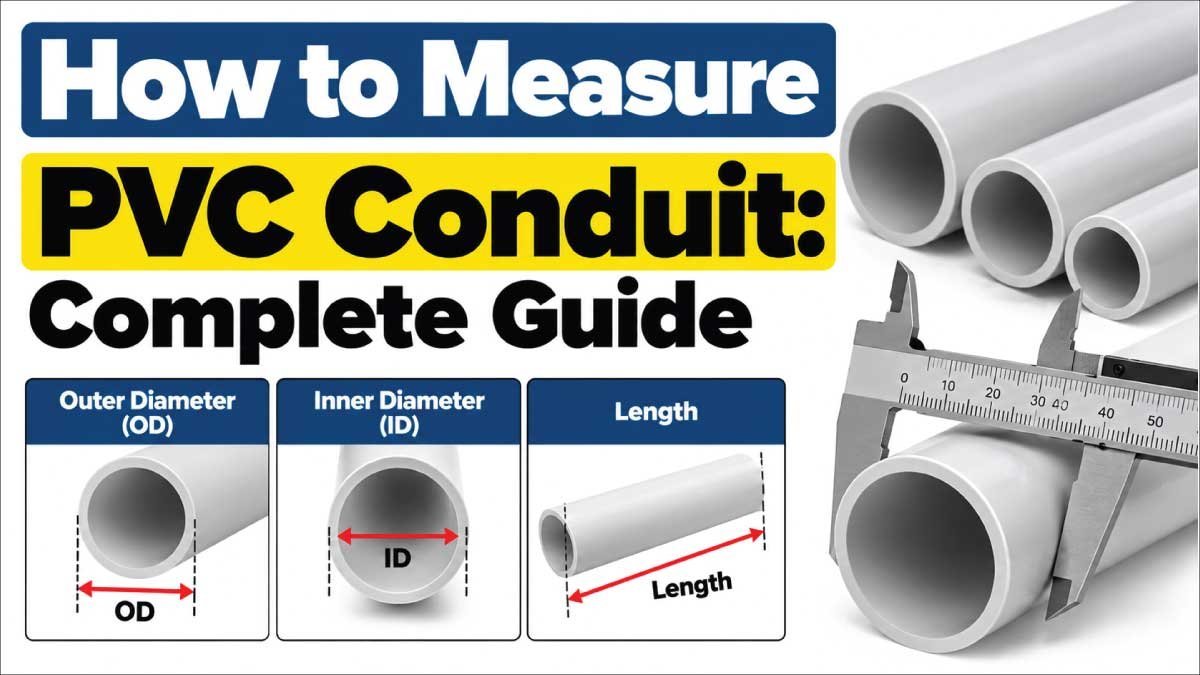
PVC conduit is commonly used to protect electrical wires and cables from physical damage, moisture, chemicals, and environmental exposure. However, measuring PVC conduit correctly is important because the outside diameter, inside diameter, wall thickness, trade size, and length can all affect whether a conduit is suitable for an installation.
If you are replacing an existing section, identifying an unknown conduit, planning a new run, or checking whether wires will fit, the measurement process is slightly different. A tape measure may be enough for length, while a caliper or ruler can help determine diameter. For electrical sizing, you also need to consider conductor fill, bends, fittings, and the conduit type.
This guide explains how to measure PVC conduit step by step, how to identify its size, how inside and outside diameter differ, and how to select the appropriate conduit for wiring.
What Is PVC Conduit?
PVC conduit is a rigid plastic raceway designed to route and protect electrical conductors. It is lightweight, corrosion-resistant, and available in different wall thicknesses and trade sizes.
Unlike ordinary plastic pipe, electrical PVC conduit is manufactured for electrical raceway applications. Common types include Schedule 40 PVC conduit and Schedule 80 PVC conduit, along with other electrical raceway systems depending on the installation.
The same nominal or trade size can have different inside dimensions depending on the conduit type and wall thickness. That is why measuring only the outside diameter does not always tell you the exact usable space inside.
PVC conduit is used for applications such as:
- Residential electrical wiring
- Commercial installations
- Outdoor electrical runs
- Underground raceways
- Industrial wiring
- Branch circuits
- Low-voltage installations
- Equipment connections
Why Measure PVC Conduit?
Measuring PVC conduit helps you identify what you already have and determine whether a new conduit will work for a particular wiring installation.
You may need to measure conduit when:
- Replacing damaged conduit
- Extending an existing electrical run
- Identifying an unmarked conduit
- Checking conduit dimensions
- Planning a new installation
- Determining available interior space
- Selecting compatible fittings
- Estimating the amount of conduit required
The most important point is that conduit measurement and electrical conduit sizing are not exactly the same thing. Physical measurement tells you the dimensions of the raceway, while electrical sizing determines whether the raceway is suitable for the conductors and installation.
What Measurements Matter for PVC Conduit?
Before measuring, understand the main dimensions involved. PVC conduit can be described by its trade size, outside diameter, inside diameter, wall thickness, and length.
| Measurement | What It Means | Why It Matters |
|---|---|---|
| Trade size | Nominal conduit designation | Used to identify conduit size |
| Outside diameter | Measurement across the exterior | Useful for identification and fittings |
| Inside diameter | Usable internal opening | Important for conductor space |
| Wall thickness | Thickness of the PVC wall | Helps distinguish conduit types |
| Length | End-to-end measurement | Needed for installation planning |
These measurements should not automatically be treated as interchangeable. A conduit labeled with a particular trade size does not necessarily have an inside or outside diameter equal to that number.
Tools Needed to Measure PVC Conduit
The tools you need depend on what you are trying to measure.
For Conduit Length
A tape measure is normally sufficient. Measure the actual route or exposed section from one end to the other.
For Outside Diameter
You can use:
- Digital calipers
- Vernier calipers
- Outside micrometer
- Steel ruler
- Measuring tape for larger conduit
A caliper provides a more precise measurement than a ruler.
For Inside Diameter
If the conduit is accessible and empty, use:
- Inside caliper jaws
- Digital caliper
- Telescoping gauge
- Ruler for a rough measurement
Do not force a measuring tool into an occupied conduit or disturb installed electrical conductors.
For Wall Thickness
If you have an accessible cut end, a caliper can measure the wall thickness directly. You can also determine it by comparing the outside and inside dimensions when both are known.
How to Measure PVC Conduit Step by Step
The following process works well when you need to measure an exposed piece of PVC conduit.
Step 1: Identify the Type of Conduit
Start by determining whether the raceway is actually electrical PVC conduit.
Look for markings printed along the conduit. Depending on the product, markings may identify the manufacturer, conduit type, size, standard, or other product information.
This is often more reliable than measuring alone because different conduit products can have different dimensions.
If the conduit is marked, record everything that is readable before taking physical measurements.
Step 2: Measure the Conduit Length
Place the end of a tape measure at one end of the conduit and measure to the other end.
For a loose section, measure directly from end to end. For an installed run, determine the length of the actual raceway path.
When planning a new installation, do not assume that the straight-line distance between two electrical boxes is the required conduit length. The raceway may follow walls, ceilings, trenches, or other routes.
Also account for fittings and changes in direction.
Step 3: Measure the Outside Diameter
The outside diameter (OD) is the distance across the outside of the conduit.
For an exposed round conduit:
- Place the caliper across the outside surface.
- Position the jaws approximately perpendicular to the conduit.
- Apply light pressure.
- Record the measurement.
- Repeat the measurement at another point to confirm consistency.
If a caliper is unavailable, place a ruler across the widest point and read the approximate diameter.
Do not assume the measured outside diameter is the trade size. Use the measurement together with conduit markings, wall thickness, and manufacturer information.
Step 4: Measure the Inside Diameter
The inside diameter (ID) represents the opening available inside the raceway.
If the conduit is empty and the end is accessible, measure across the internal opening.
With a digital caliper, use the smaller inside jaws and expand them until they touch opposite inside walls. Keep the tool straight across the opening rather than at an angle.
Inside diameter is particularly useful when evaluating available physical space, but electrical installations should still be checked using the applicable conductor-fill requirements rather than simply comparing the wire bundle to the measured opening.
Step 5: Check the Wall Thickness
Wall thickness is the distance between the outside wall and inside wall.
If you know both diameters, a simplified relationship is:
Wall thickness = (Outside diameter − Inside diameter) ÷ 2
For example, if you were measuring a cut piece and obtained reliable OD and ID measurements, the difference between those dimensions can help estimate the wall thickness.
However, use manufacturer specifications when the exact wall thickness matters. Measurement errors, rounded dimensions, and product variations can affect the calculation.
Step 6: Determine the Trade Size
Once you have the physical measurements, compare them with the manufacturer’s dimensional information or markings on the conduit.
PVC electrical conduit is generally identified by trade size, not simply by its measured outside or inside diameter.
For example, a conduit identified as 1-inch trade size should not be expected to measure exactly 1 inch across the outside or inside. The actual dimensions depend on the product and wall thickness.
Therefore, the best identification process is:
- Check printed markings.
- Determine the conduit type.
- Measure the outside diameter.
- Measure the inside diameter when accessible.
- Check wall thickness if necessary.
- Compare the results with the manufacturer’s dimensions.
Also Read:
PVC Conduit Size and Diameter
PVC conduit sizes are normally specified using a trade-size designation. The physical diameter associated with that designation depends on the particular conduit system.
The following table illustrates the measurements you should consider rather than presenting one universal diameter for every PVC product.
| Dimension | Measurement Method | Use |
|---|---|---|
| Trade size | Read marking or product documentation | Identifies nominal size |
| OD | Measure across exterior | Fittings and physical clearance |
| ID | Measure across interior | Raceway space |
| Wall thickness | Measure cut edge or calculate from OD/ID | Product identification |
| Length | Measure end to end | Material planning |
Important: Exact PVC conduit dimensions can vary by conduit type, schedule, manufacturer, and applicable standard. Use the manufacturer’s dimensional data when a precise specification is required.
How to Choose the Correct PVC Conduit Size
Measuring an existing conduit and choosing conduit for a new installation are two different tasks.
For a new installation, begin with the conductors you intend to install. Then determine the appropriate raceway based on the applicable electrical requirements.
Important factors include:
Number of Conductors
More conductors generally require more internal raceway space. Count the conductors that will occupy the conduit and account for their sizes.
Conductor Size
Large conductors occupy more space than small conductors. Wire insulation type can also affect the overall dimensions.
Conductor Fill
The available internal area must be sufficient for the conductors under the applicable electrical code or standard.
Do not select conduit simply because the wires physically appear to fit. Conductor-fill requirements are part of proper conduit sizing.
Number of Bends
A conduit run with several bends can be more difficult to install and pull conductors through than a straight run.
The applicable electrical requirements may also place limits on the total bend between accessible points.
Fittings
Couplings, elbows, adapters, boxes, and other fittings must be compatible with the conduit type and trade size.
Installation Environment
Consider whether the conduit is:
- Indoors
- Outdoors
- Underground
- Exposed to sunlight
- Subject to physical damage
- Installed in a wet location
- Installed in a corrosive environment
The appropriate PVC conduit product depends on the installation conditions.
Also Read:
Inside Diameter vs. Outside Diameter
One of the most common mistakes when measuring PVC conduit is confusing inside diameter with outside diameter.
Outside diameter measures the entire conduit across its exterior. It is useful when checking physical clearance and fitting compatibility.
Inside diameter measures only the opening. It is more relevant when considering the physical space available for conductors.
The wall between these two dimensions is the conduit material.
A thicker-wall conduit can have the same nominal trade size while providing a different internal opening than a thinner-wall product. Consequently, two conduits with the same trade-size designation should not automatically be assumed to have identical internal dimensions.
How to Measure PVC Conduit Without Removing It
Sometimes the conduit is already installed and cannot be removed. You can still gather useful measurements.
Use Existing Markings
Inspect the visible surface for printed size and product information. This may provide the most reliable identification.
Measure an Accessible End
If an end of the conduit is exposed, measure the OD and ID at that location.
Measure Around the Conduit
If you cannot place a ruler across the conduit, measuring the circumference can provide an approximate outside diameter.
The relationship is:
Outside diameter ≈ Circumference ÷ 3.1416
For example, if the measured circumference is approximately 6.28 inches:
6.28 ÷ 3.1416 ≈ 2 inches
This provides an approximate outside diameter, not a direct identification of trade size.
Compare With Product Data
Use the measured dimension alongside the conduit markings and manufacturer specifications before selecting replacement material.
Also Read:
Common Mistakes When Measuring PVC Conduit
Small measurement errors can lead to incorrect identification or an unsuitable replacement.
Mistake 1: Assuming Trade Size Equals Actual Diameter
A trade-size number is a nominal designation. It should not automatically be interpreted as the measured OD or ID.
Mistake 2: Measuring Only the Outside
OD alone may not distinguish products with different wall thicknesses.
Mistake 3: Ignoring Conduit Type
Different PVC conduit products can have different dimensional characteristics. Identify the product before comparing measurements.
Mistake 4: Choosing Conduit Based Only on Wire Appearance
Conductors must satisfy applicable fill requirements. A bundle that looks like it will fit may still be unsuitable.
Mistake 5: Forgetting Fittings
A conduit measurement does not guarantee that a particular elbow, coupling, adapter, or box will fit. Fittings must match the conduit system.
Mistake 6: Using an Approximate Measurement for Critical Work
A ruler can provide a quick estimate, but use accurate tools and manufacturer documentation when exact dimensions matter.
Tips for More Accurate PVC Conduit Measurements
Follow these practices when measuring:
- Clean the conduit surface before measuring.
- Measure at a straight, undamaged section.
- Use a caliper when precision is important.
- Take more than one measurement.
- Record measurements in consistent units.
- Check markings before relying on physical dimensions.
- Measure both OD and ID when possible.
- Consider wall thickness when identifying the product.
- Verify dimensions against manufacturer documentation.
- Check applicable electrical requirements before selecting conduit for conductors.
If the conduit is damaged, deformed, heat-affected, or crushed, measurements may no longer represent its original dimensions.
PVC Conduit Measurement Example
Suppose you find an unmarked PVC raceway in an existing installation and want to identify it.
Start by measuring the exposed section. You record its length, then use a caliper to measure the outside diameter. If the end is accessible and empty, you also measure the inside diameter.
You now have several useful pieces of information:
| Measurement | Purpose |
|---|---|
| Length | Determines the physical section length |
| Outside diameter | Helps identify the conduit and check clearance |
| Inside diameter | Shows the internal opening |
| Wall thickness | Helps distinguish conduit characteristics |
| Markings | May directly identify trade size and product type |
Next, compare these measurements with the manufacturer’s dimensional information. If the conduit is going to be reused for electrical conductors, separately verify conductor fill and other installation requirements.
This approach is more dependable than guessing the trade size from a single measurement.
When You Should Not Rely on Measurement Alone
Physical measurements are useful, but they are not always sufficient for electrical work.
Do not rely solely on a ruler or caliper when:
- The conduit has no accessible end
- The conduit is damaged or distorted
- The product type is unknown
- Exact dimensions are required
- Conductors are being added
- The installation has many bends
- The raceway is part of a regulated electrical installation
For these situations, identify the conduit from its markings or manufacturer information whenever possible. For electrical sizing and installation requirements, follow the applicable electrical code, standard, and local requirements.
Frequently Asked Questions
How do I measure the size of PVC conduit?
Start by checking the markings on the conduit. Then measure the outside diameter and, if accessible, the inside diameter. Compare the measurements with the manufacturer’s dimensions to determine the trade size.
Is PVC conduit size based on inside or outside diameter?
PVC electrical conduit is normally identified by trade size, rather than simply by its measured inside or outside diameter. Actual dimensions depend on the conduit product and wall thickness.
Can I measure PVC conduit with a tape measure?
Yes, a tape measure works well for measuring conduit length and can provide an approximate diameter. For more accurate diameter measurements, a digital or vernier caliper is preferable.
Why should I measure inside diameter?
Inside diameter tells you the size of the internal opening. This can help with physical assessment of the raceway, although conductor fill must be evaluated according to applicable electrical requirements.
Does thicker PVC conduit have a smaller inside diameter?
For products with the same nominal trade size, a thicker wall can result in less internal space. Always use the dimensional specifications for the particular conduit product when exact ID matters.
How do I identify PVC conduit without markings?
Measure the outside diameter and, if possible, the inside diameter and wall thickness. Then compare those measurements with reliable manufacturer dimensional information. Do not identify trade size from OD alone.
How much conduit do I need?
Measure the actual planned route, including changes in direction and the locations of fittings and boxes. Add an appropriate allowance for cutting and installation rather than relying only on the straight-line distance.
Final Takeaway
Learning how to measure PVC conduit starts with understanding the difference between trade size, outside diameter, inside diameter, wall thickness, and length. For an existing conduit, check its markings first, then verify the physical dimensions with appropriate measuring tools.
For a new electrical installation, physical dimensions are only part of the process. Conductor size, conductor count, fill requirements, bends, fittings, installation environment, and applicable electrical requirements must also be considered.
When exact dimensions or compliance are important, use the manufacturer’s specifications and applicable electrical requirements rather than relying on approximate measurements. This approach makes conduit identification and sizing more accurate and helps ensure the selected raceway is appropriate for the intended installation.