
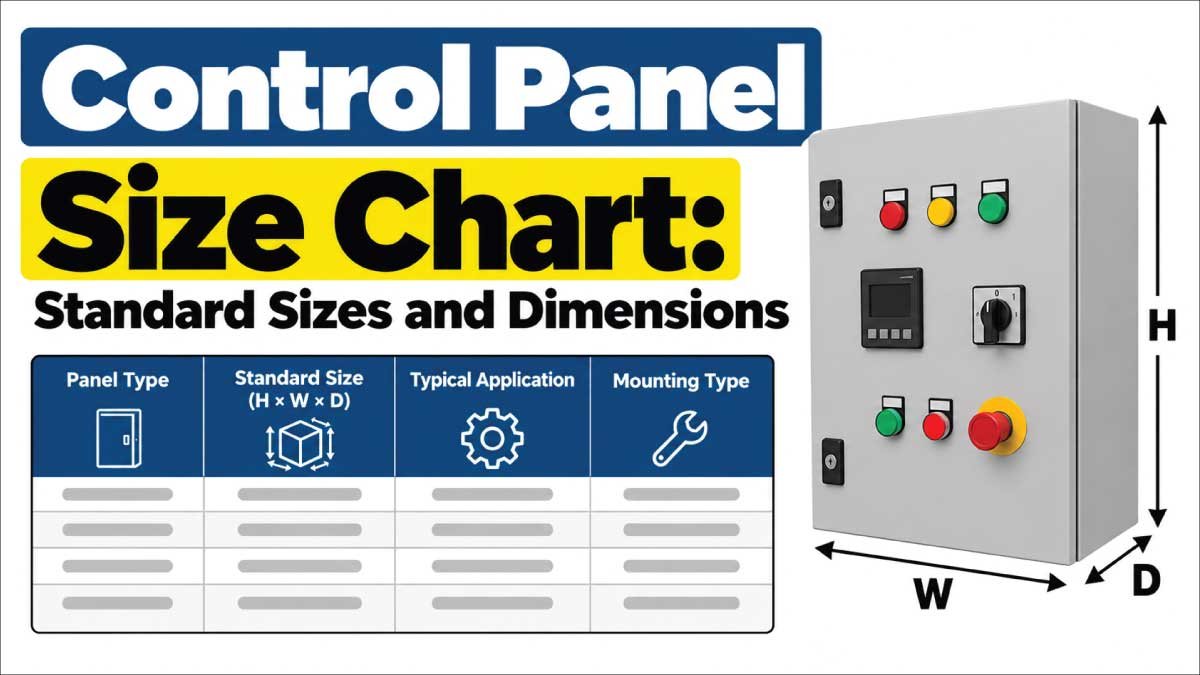
A control panel must provide enough space for electrical components, wiring, terminals, ventilation, and future maintenance without becoming unnecessarily large. Choosing the right enclosure size is therefore an important part of electrical panel design.
This control panel size chart explains common panel dimensions, enclosure depths, component space, mounting considerations, and practical selection factors. Because control panels are built for different applications, there is no single universal size. Actual dimensions depend on the equipment installed, wiring requirements, environmental conditions, and applicable electrical standards.
What Is a Control Panel?
A control panel is an enclosure that houses electrical and control equipment used to operate, monitor, protect, or automate machinery and electrical systems. Depending on the application, a panel may contain circuit breakers, contactors, relays, terminal blocks, PLCs, power supplies, motor starters, switches, meters, and other components.
The enclosure protects internal equipment from accidental contact, dust, moisture, mechanical damage, and other environmental conditions when properly selected.
A control panel may be designed for:
- Industrial machinery
- Motor control systems
- HVAC equipment
- Pumps and water systems
- Manufacturing equipment
- Automation systems
- Building electrical systems
- Process-control applications
- Generator systems
- Distribution and monitoring equipment
The required enclosure dimensions are primarily determined by the components and wiring inside rather than by the panel’s external appearance alone.
Control Panel Size Chart
The following chart provides commonly encountered control panel enclosure dimensions as practical size categories. These are not universal mandatory dimensions; manufacturers offer many variations.
| Panel Size Category | Width | Height | Depth | Typical Use |
|---|---|---|---|---|
| Small | 300–500 mm | 400–600 mm | 150–250 mm | Small control circuits |
| Medium | 500–800 mm | 600–1000 mm | 200–300 mm | General machine control |
| Large | 800–1200 mm | 1000–1600 mm | 250–400 mm | Automation and motor control |
| Extra Large | 1200+ mm | 1600+ mm | 300–600+ mm | Complex industrial systems |
These ranges should be treated as planning categories rather than fixed standards. A panel measuring 600 × 800 mm may be suitable for one application but too small for another containing more components, larger cable bends, or greater heat dissipation requirements.
When selecting an enclosure, always compare the actual manufacturer’s dimensions, usable mounting area, door clearance, gland-plate arrangement, and internal accessories.
Standard Control Panel Dimensions
Control panel dimensions are commonly expressed as width × height × depth. For example, a panel listed as 600 × 800 × 250 mm is approximately 600 mm wide, 800 mm high, and 250 mm deep.
Some manufacturers use inches instead of millimeters, particularly for North American equipment.
Common Widths
Control panel widths vary significantly depending on the number of components installed. Common planning dimensions include approximately:
- 300 mm
- 400 mm
- 500 mm
- 600 mm
- 800 mm
- 1000 mm
- 1200 mm
- 1600 mm and larger
Wider enclosures can make component arrangement and wiring easier, particularly when multiple rows of devices are required.
Common Heights
Panel heights may range from compact wall-mounted enclosures to tall floor-standing cabinets.
Common dimensions include:
- 400 mm
- 500 mm
- 600 mm
- 800 mm
- 1000 mm
- 1200 mm
- 1400 mm
- 1600 mm
- 1800 mm
- 2000 mm and larger
Tall panels are useful when equipment must be arranged vertically or when multiple DIN rails and wiring ducts are required.
Common Depths
Depth is equally important because some electrical equipment extends farther into the enclosure than expected.
Typical control panel depths include:
- 150 mm
- 200 mm
- 250 mm
- 300 mm
- 400 mm
- 500 mm
- 600 mm or more
A deep enclosure may be necessary for variable-frequency drives, transformers, contactors, power supplies, large terminal arrangements, or cable-routing requirements.
How to Choose the Correct Control Panel Size
The correct control panel size should be selected from the equipment layout rather than simply choosing the smallest enclosure that can physically contain the components.
1. List All Internal Components
Start by identifying every device that will be installed. Include both major equipment and smaller accessories.
The list may include:
- Circuit breakers
- Contactors
- Overload relays
- PLCs
- I/O modules
- Relays
- Terminal blocks
- Power supplies
- Transformers
- Disconnects
- VFDs
- Motor starters
- Fuses
- Surge protection
- Meters
- Cooling equipment
This inventory establishes the basic mounting-space requirement.
2. Allow Space for Wiring
Components do not occupy the only usable space inside a control panel. Wiring needs room to enter, exit, bend, terminate, and be routed safely.
Cable ducts and wireways can occupy substantial portions of the mounting area. Large conductors also require adequate bending and termination space.
A panel that technically fits all components may still be unsuitable if wiring becomes crowded.
3. Consider Future Expansion
A panel designed with no spare space can become difficult to modify later.
Where the project permits it, leave reasonable spare mounting and wiring capacity for future equipment. The appropriate amount depends on the project requirements rather than a universal percentage.
Planning for expansion can reduce the need to replace the enclosure when additional circuits or control equipment are added.
Control Panel Enclosure Depth Guide
Depth is often overlooked when choosing a panel. However, a component may fit within the width and height while still requiring more front-to-back clearance.
| Depth Category | Approximate Depth | Suitable For |
|---|---|---|
| Shallow | 100–150 mm | Terminals, small relays, compact controls |
| Standard | 200–300 mm | General control equipment |
| Deep | 300–400 mm | Drives, starters, larger components |
| Extra Deep | 400–600+ mm | Complex industrial equipment |
The actual usable depth can be less than the enclosure’s external depth because of mounting plates, doors, cable-entry arrangements, internal hardware, and other accessories.
Always check the equipment manufacturer’s required clearances before finalizing enclosure depth.
Wall-Mounted vs Floor-Standing Control Panels
Control panels are generally available in wall-mounted and floor-standing configurations.
Wall-Mounted Control Panels
Wall-mounted enclosures are useful where the equipment load and physical dimensions are manageable.
They are commonly used for:
- Small machinery
- Building automation
- HVAC controls
- Pump controls
- Compact PLC systems
- Local operator controls
Their main advantage is efficient use of wall space. However, very large or heavy assemblies may be more difficult to install and service when mounted on a wall.
Floor-Standing Control Panels
Floor-standing cabinets are better suited to larger electrical and automation systems.
They can provide substantial room for:
- Multiple equipment sections
- Large cable-entry areas
- Several DIN rails
- Extensive terminal blocks
- Drives and motor controls
- Power distribution
- Automation equipment
Floor-standing designs can also be combined into multi-section assemblies when a single enclosure is not sufficient.
Control Panel Size by Application
The required panel size changes considerably according to the application.
| Application | Typical Panel Requirement | Important Considerations |
|---|---|---|
| Small machine | Compact | Controls, relays, terminals |
| Pump control | Small to medium | Starters, protection, terminals |
| HVAC control | Small to medium | Controllers, relays, contactors |
| PLC automation | Medium to large | PLC, I/O, power supply, wiring |
| Motor control | Medium to large | Starters, overloads, drives |
| VFD system | Medium to large | Drive clearance and heat |
| Industrial process | Large | Extensive controls and terminals |
| Complex automation | Large or modular | Multiple devices and expansion |
These categories describe general planning needs. The actual enclosure should be determined from the equipment schedule, layout, environmental requirements, and manufacturer’s installation instructions.
Also Read:
Important Control Panel Dimensions to Measure
When comparing control panel sizes, external dimensions are only one part of the specification.
External Dimensions
Measure or verify:
- Overall width
- Overall height
- Overall depth
- Door projection
- Mounting footprint
External dimensions determine whether the enclosure can physically fit into the intended location.
Usable Internal Space
The internal mounting area is more important for equipment layout.
Check:
- Mounting plate dimensions
- DIN rail space
- Available wiring area
- Door-mounted equipment space
- Cable-entry space
- Internal obstructions
- Component clearances
A large external enclosure does not necessarily provide an equally large usable mounting area.
Cable Entry Area
Cable glands, conduits, and terminal connections require dedicated space. Cable entry can be positioned at the top, bottom, side, or another location depending on the enclosure design.
The entry arrangement should be considered before selecting the final dimensions.
Also Read:
Control Panel Material and Environmental Requirements
Panel size should not be considered separately from enclosure construction.
Control panels may be manufactured from materials such as:
- Painted or coated steel
- Stainless steel
- Aluminum
- Polycarbonate
- Other engineered enclosure materials
The appropriate material depends on the environment, mechanical requirements, corrosion exposure, cleaning conditions, temperature, and installation location.
Indoor Applications
Indoor control panels may face relatively controlled conditions, although dust, humidity, chemicals, and temperature can still affect enclosure selection.
Outdoor Applications
Outdoor installations may require stronger protection against:
- Rain
- Sunlight
- Dust
- Condensation
- Corrosion
- Temperature changes
An outdoor panel may also require a suitable enclosure rating and environmental accessories.
Also Read:
Control Panel Size and Heat Dissipation
Electrical components generate heat during operation. As equipment density increases, thermal management becomes increasingly important.
A compact enclosure can have limited natural heat dissipation, particularly when high-power devices are installed.
Heat-producing equipment can include:
- Variable-frequency drives
- Transformers
- Power supplies
- Contactors
- Motor-control equipment
- Power electronics
Depending on the application, thermal management may involve enclosure ventilation, filtered fans, heat exchangers, air conditioning, or other methods.
The required approach should be based on the equipment’s heat output, ambient conditions, enclosure construction, and manufacturer’s requirements.
Control Panel Layout Best Practices
A correctly sized enclosure can still be difficult to use if the internal layout is poorly planned.
A practical layout should provide clear organization between power, control, and field wiring where appropriate.
Useful considerations include:
- Group related components together.
- Keep wiring routes organized.
- Provide adequate terminal space.
- Maintain required equipment clearances.
- Avoid blocking ventilation paths.
- Leave practical access for maintenance.
- Position frequently serviced components conveniently.
- Separate sensitive equipment from sources of electrical interference when required.
- Keep cable entry points aligned with their corresponding wiring routes.
Good layout planning can make troubleshooting, testing, replacement, and future modification much easier.
How to Measure an Existing Control Panel
If you are replacing an existing enclosure, measure more than its outside dimensions.
Step 1: Measure Width
Measure the external width from side to side.
Step 2: Measure Height
Measure the external height, including the enclosure body but distinguishing external accessories where necessary.
Step 3: Measure Depth
Measure the enclosure’s front-to-back dimension.
Step 4: Measure the Mounting Plate
Record the usable mounting plate width and height. This is especially important when transferring existing equipment.
Step 5: Record Component Positions
Document the locations of DIN rails, wiring ducts, terminals, breakers, drives, and other equipment.
Step 6: Check Cable Entry Locations
Note whether cables enter through the top, bottom, sides, or a removable gland plate.
A replacement panel should accommodate not only the components but also their wiring and connection requirements.
Control Panel Size Selection Mistakes to Avoid
Several common mistakes can result in an enclosure that is difficult or impossible to use effectively.
Choosing Only by External Size
Two enclosures with similar external dimensions can have different usable internal areas. Always check mounting dimensions.
Ignoring Component Depth
A shallow cabinet may not provide adequate space for deeper devices or their connections.
Forgetting Cable Bending Space
Cable termination often requires more room than the component itself. This is particularly important for larger conductors.
Packing Components Too Closely
Crowded equipment can complicate installation, maintenance, ventilation, and heat management.
Ignoring Environmental Conditions
A panel suitable for a clean indoor room may not be appropriate for a dusty, wet, corrosive, or outdoor location.
Failing to Plan Expansion
A panel with no practical spare capacity can make future modifications unnecessarily difficult.
Control Panel Size Chart in Inches
Some projects specify enclosure dimensions in inches rather than millimeters. The following are common nominal dimensions used as convenient reference points, not universal standard sizes.
| Nominal Width | Nominal Height | Approx. Millimeter Equivalent |
|---|---|---|
| 12 in | 16 in | 305 × 406 mm |
| 16 in | 20 in | 406 × 508 mm |
| 20 in | 24 in | 508 × 610 mm |
| 24 in | 32 in | 610 × 813 mm |
| 24 in | 36 in | 610 × 914 mm |
| 30 in | 36 in | 762 × 914 mm |
| 36 in | 48 in | 914 × 1219 mm |
| 48 in | 72 in | 1219 × 1829 mm |
Actual manufacturer dimensions can differ from these nominal reference values. Always verify the enclosure’s published dimensional drawing before ordering or fabricating mounting arrangements.
What Size Control Panel Do I Need?
There is no single control panel size that works for every electrical installation. The correct choice depends on the equipment, wiring, environment, access requirements, and available installation space.
For a small control system containing a few relays and terminals, a compact enclosure may be sufficient. A PLC system with multiple I/O modules may require a medium enclosure, while a motor-control or industrial automation system may need a large or floor-standing cabinet.
Before choosing, evaluate:
- Component count
- Component dimensions
- Equipment depth
- Wiring and cable-entry requirements
- Heat generation
- Required clearances
- Environmental conditions
- Maintenance access
- Future expansion
- Mounting location
- Applicable standards and manufacturer instructions
The best enclosure is not necessarily the largest one. It should provide adequate usable space, safe equipment arrangement, practical wiring access, and appropriate environmental protection.
Frequently Asked Questions
What are standard control panel sizes?
Control panels are available in many dimensions, from compact enclosures around a few hundred millimeters to large floor-standing cabinets several meters tall or wide when assembled into systems. There is no single universal standard size for every application.
How is control panel size measured?
Control panel size is generally described by width × height × depth. For equipment installation, the internal mounting area and usable depth are also important.
How much space should be left inside a control panel?
The required spare space depends on the design and project requirements. Space should account for wiring, cable routing, heat management, maintenance access, and any planned expansion rather than relying on an arbitrary percentage.
Does a deeper control panel provide more usable space?
Greater depth can accommodate deeper components and wiring, but it does not automatically solve width or height limitations. The enclosure must provide sufficient space in all three dimensions.
Can a control panel be too large?
Yes. An unnecessarily large enclosure can increase cost, installation space, and material requirements without providing a practical benefit. Size should be based on the actual equipment and installation requirements.
Should control panels have ventilation?
Ventilation or thermal-management equipment may be necessary when internal heat generation exceeds the enclosure’s ability to dissipate it naturally. The decision should consider component heat output, ambient temperature, enclosure construction, and manufacturer’s requirements.
Conclusion
A control panel size chart is useful for comparing enclosure dimensions and planning an electrical installation, but there is no universal panel size suitable for every system. Width, height, depth, mounting area, cable space, heat dissipation, environmental protection, and maintenance access all influence the correct choice.
Start by listing the components, creating a practical internal layout, allowing room for wiring and service access, and checking the enclosure’s actual usable dimensions. For the final selection, verify manufacturer drawings and the requirements applicable to the specific electrical installation.