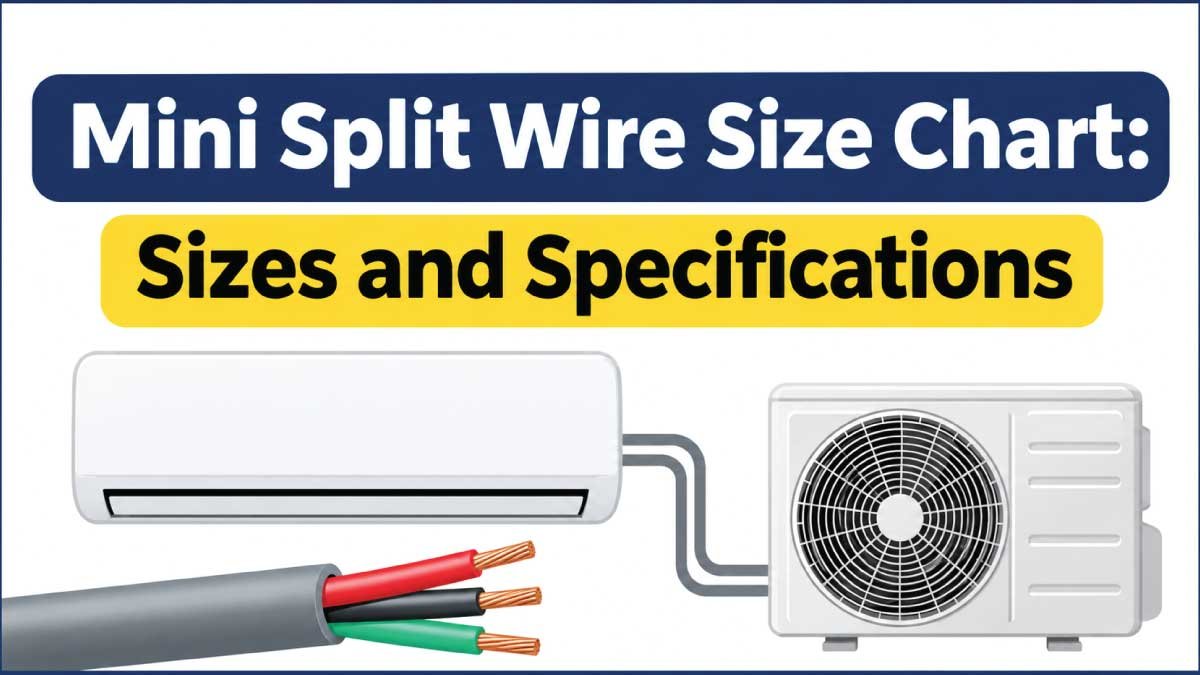
Choosing the correct wire size for a mini split air conditioner is essential for safe operation, reliable performance, and compliance with electrical codes. A wire that is too small can overheat, cause voltage drop, damage equipment, or create a fire hazard. A wire that is unnecessarily large can increase installation costs without providing a meaningful benefit.
Mini split systems are available in different capacities, including 9,000, 12,000, 18,000, 24,000, 36,000, and 48,000 BTU. However, the required wire size is not determined by BTU capacity alone. Voltage, minimum circuit ampacity (MCA), maximum overcurrent protection (MOCP), installation distance, conductor material, and manufacturer specifications all affect the final selection.
This guide explains common mini split wire sizes, standard AWG measurements, electrical ratings, wiring types, and the factors to consider before installing a dedicated circuit.
Mini Split Wire Size Chart
The following chart provides general copper-wire reference sizes for common residential mini split capacities. These are planning estimates, not universal installation requirements. Always check the outdoor unit’s nameplate and installation manual before selecting a conductor or circuit breaker.
| Mini Split Capacity | Common Supply Voltage | Typical Copper Wire Reference | Common Breaker Range |
|---|---|---|---|
| 9,000 BTU | 115V or 230V | 14–12 AWG | 15–20A |
| 12,000 BTU | 115V or 230V | 14–12 AWG | 15–20A |
| 18,000 BTU | 208–230V | 12–10 AWG | 20–30A |
| 24,000 BTU | 208–230V | 10–8 AWG | 25–35A |
| 30,000 BTU | 208–230V | 10–8 AWG | 30–40A |
| 36,000 BTU | 208–230V | 8–6 AWG | 30–45A |
| 48,000 BTU | 208–230V | 8–6 AWG | 40–60A |
| 60,000 BTU | 208–230V | 6–4 AWG | 50–70A |
Important: The breaker ranges and wire sizes above are broad reference values. Actual equipment may require a different combination. For example, two 24,000 BTU mini splits from different manufacturers can have different MCA and maximum breaker ratings. Do not use this chart as the final basis for electrical installation.
Understanding Mini Split Wire Sizes
Mini split wire sizes are commonly identified using the American Wire Gauge (AWG) system. AWG numbers indicate conductor thickness. A smaller AWG number represents a thicker wire, while a larger number represents a thinner wire.
For example, 10 AWG copper wire is thicker than 12 AWG copper wire. Thicker conductors generally have lower electrical resistance and can carry more current under comparable installation conditions.
Common AWG Wire Sizes
| Wire Gauge | Approximate Conductor Diameter | Typical Uses |
|---|---|---|
| 14 AWG | 1.63 mm | Smaller electrical circuits |
| 12 AWG | 2.05 mm | Small and medium mini split circuits |
| 10 AWG | 2.59 mm | Medium-capacity equipment |
| 8 AWG | 3.26 mm | Larger air-conditioning circuits |
| 6 AWG | 4.11 mm | Higher-capacity equipment |
| 4 AWG | 5.19 mm | Large electrical loads |
The diameters shown are approximate bare-conductor dimensions, not the outside diameter of insulated cable.
Why Wire Gauge Matters
The correct wire gauge helps maintain acceptable voltage at the equipment and prevents excessive conductor heating. When a mini split operates, its compressor, fan motors, and electronic components require a stable electrical supply.
An undersized conductor may experience excessive voltage drop, particularly over long cable runs. This can contribute to operating problems and equipment damage.
A properly selected conductor should meet the equipment’s MCA requirement after applicable ampacity adjustments and corrections.
Mini Split Wire Size by BTU Capacity
Different mini split capacities have different electrical requirements. The following sections explain common wire-size considerations for individual system sizes.
9,000 BTU Mini Split Wire Size
A 9,000 BTU mini split is commonly used in bedrooms, small offices, and compact living spaces. Some models operate at 115V, while others use 208–230V.
A 14 AWG or 12 AWG copper conductor may be specified for certain models. However, some 115V systems have higher circuit requirements than similarly sized 230V equipment.
Check the nameplate for MCA and maximum fuse or breaker ratings before selecting the circuit.
12,000 BTU Mini Split Wire Size
A 12,000 BTU mini split is a common choice for small rooms and residential spaces. Depending on the model, it may operate at 115V or 208–230V.
Typical installations may use 14 AWG or 12 AWG copper wire. The actual requirement depends on the manufacturer’s electrical specifications and installation conditions.
Do not assume that every 12,000 BTU unit can use the same wire size or breaker.
18,000 BTU Mini Split Wire Size
An 18,000 BTU system is generally designed for medium-sized rooms or open living areas. Many models use a 208–230V supply.
Common wire-size references include 12 AWG and 10 AWG copper conductors. The correct option depends on the equipment’s MCA, circuit protection requirements, and cable installation conditions.
Longer distances between the electrical panel and outdoor unit may require a larger conductor to control voltage drop.
24,000 BTU Mini Split Wire Size
A 24,000 BTU mini split is used in larger rooms and residential areas. Many models operate on a 208–230V supply.
Some equipment specifies 10 AWG copper wire, while other models may require a different size. The manufacturer’s MCA and maximum overcurrent protection rating should determine the final selection.
Pay particular attention to the specified breaker size. It is not always possible to select a breaker using a general household circuit rule.
30,000 BTU Mini Split Wire Size
A 30,000 BTU system may be used in larger residential spaces or commercial applications. Electrical requirements vary considerably between manufacturers.
Depending on the model, installation may require 10 AWG or 8 AWG copper conductors. Verify the rated voltage, MCA, MOCP, and terminal requirements before installation.
36,000 BTU Mini Split Wire Size
A 36,000 BTU mini split may serve a large living area or multiple indoor zones. Many systems operate at 208–230V.
Common reference sizes include 8 AWG and 6 AWG copper wire. However, the exact conductor must be selected according to the outdoor unit’s electrical data and the installation environment.
48,000 BTU Mini Split Wire Size
A 48,000 BTU system typically has greater electrical requirements than a small single-zone unit. It may be used in large homes, commercial spaces, or multi-zone applications.
Depending on the condenser design, 8 AWG or 6 AWG copper conductors may be specified. Confirm the actual MCA and maximum permitted overcurrent protection rather than relying on nominal capacity.
Understanding MCA and MOCP
Two important electrical specifications appear on most mini split outdoor-unit nameplates: Minimum Circuit Ampacity (MCA) and Maximum Overcurrent Protection (MOCP).
These values help determine the correct conductor and circuit protection.
Minimum Circuit Ampacity (MCA)
MCA identifies the minimum ampacity required for the branch-circuit conductors supplying the equipment.
The selected conductor must have sufficient allowable ampacity after considering the applicable electrical-code requirements, including temperature ratings, correction factors, and installation conditions.
For example, if an outdoor unit lists an MCA of 19A, the selected conductor must meet or exceed that requirement under the actual installation conditions.
Maximum Overcurrent Protection (MOCP)
MOCP identifies the maximum permitted rating of the fuse or circuit breaker protecting the equipment.
For example, if the nameplate specifies a maximum breaker of 30A, the selected overcurrent device must not exceed that limit. The installation manual may also specify an approved breaker or fuse type.
MCA vs. MOCP Comparison
| Specification | Meaning | Main Purpose |
|---|---|---|
| MCA | Minimum Circuit Ampacity | Determines minimum conductor ampacity |
| MOCP | Maximum Overcurrent Protection | Limits the fuse or breaker rating |
| Rated Voltage | Required supply voltage | Determines compatible electrical supply |
| Phase | Single-phase or three-phase | Identifies the power configuration |
| Frequency | Usually 50Hz or 60Hz | Confirms supply compatibility |
The wire and breaker are selected using different nameplate values. Do not assume that the MCA and MOCP should be identical.
Mini Split Wire Types and Their Applications
Selecting the correct conductor size is only part of the installation process. The wire insulation, conductor material, cable construction, and approved installation method also matter.
Copper Wire
Copper is widely used for mini split electrical circuits because it has good conductivity and is commonly supported by equipment manufacturers.
Copper conductors are available in several gauges, including 14, 12, 10, 8, and 6 AWG.
Always use the conductor material and wire type permitted by the equipment instructions and local electrical code.
THHN and THWN-2 Wire
THHN and THWN-2 are common insulation designations for building wire used in approved raceway installations.
- THHN: Thermoplastic high-heat-resistant nylon-coated wire.
- THWN-2: Thermoplastic heat- and water-resistant wire rated for wet or dry locations.
The suitability of either type depends on its listing, temperature rating, installation method, and applicable local requirements. Individual conductors generally need an approved raceway or wiring method.
NM-B Cable
NM-B cable is commonly used for certain indoor residential branch circuits. It contains insulated conductors and a grounding conductor within an outer jacket.
However, NM-B is not suitable for every mini split installation. Outdoor exposure, wet locations, local code requirements, and manufacturer instructions must be considered.
Outdoor-Rated Cable
Outdoor wiring must use a cable or wiring method approved for its location and exposure conditions.
The cable must be suitable for sunlight, moisture, temperature, and physical protection requirements where applicable. Do not assume that an indoor cable can be installed outdoors simply because it has the correct AWG size.
Also Read:
Mini Split Power Wiring vs. Communication Wiring
Mini split systems may require more than one type of electrical connection. The main power circuit and the indoor-to-outdoor interconnecting cable serve different purposes.
Main Power Wiring
The main power wiring supplies electricity to the equipment, commonly through a dedicated branch circuit connected to the outdoor condenser.
Depending on the model, the system may use:
- 115V single-phase power
- 208–230V single-phase power
- A different voltage or phase arrangement specified by the manufacturer
The supply cable must meet the equipment’s MCA and installation requirements.
Communication or Interconnecting Wiring
Many mini splits use a cable between the indoor and outdoor units for communication and, in some designs, power to the indoor unit.
The required conductor count and gauge vary by manufacturer and model. Some systems use a four-conductor cable, while others use different terminal arrangements.
Follow the wiring diagram supplied with the equipment. Do not substitute a generic communication cable or assume that terminal labels are interchangeable between brands.
Grounding Wire
A grounding conductor provides a fault-current path and helps protect people and equipment if an electrical fault occurs.
The grounding conductor must be sized and installed according to the applicable electrical code and equipment instructions. Never use the grounding conductor as a normal current-carrying conductor.
Also Read:
Factors That Affect Mini Split Wire Selection
Several installation conditions can change the conductor size required for a mini split system.
1. Equipment Voltage
A 115V system and a 230V system of similar cooling capacity may have different current requirements.
The supply voltage must match the unit’s nameplate rating. Using the wrong voltage can damage the equipment or prevent it from operating correctly.
2. Cable Length
Long cable runs increase conductor resistance and can create voltage drop.
For longer distances, a larger conductor may be necessary to maintain voltage within the equipment manufacturer’s permitted range.
The calculation should consider the actual one-way circuit distance, conductor material, load current, and operating voltage.
3. Ambient Temperature
High surrounding temperatures can reduce a conductor’s allowable ampacity.
Outdoor installations, hot mechanical spaces, and locations exposed to direct sunlight may require additional consideration. Apply the appropriate electrical-code correction factors.
4. Conduit and Installation Conditions
The number of current-carrying conductors in a raceway, the wiring method, and the surrounding environment can affect allowable conductor ampacity.
A wire size that is suitable in one installation may not be suitable in another.
5. Manufacturer Requirements
Manufacturers may specify minimum wire sizes, preferred wire sizes, breaker ratings, and approved wiring methods.
These instructions are especially important because two systems with the same BTU rating can have different electrical designs.
Also Read:
How to Choose the Correct Wire Size for a Mini Split
Use the following process to identify the correct conductor and circuit protection for a specific unit.
Step 1: Read the Outdoor Unit Nameplate
Locate the electrical data plate on the outdoor condenser. Record the following information:
- Rated voltage
- Phase and frequency
- Minimum circuit ampacity
- Maximum fuse or breaker rating
- Any specified conductor or wiring requirements
Do not select the wire using BTU capacity alone.
Step 2: Check the Installation Manual
Find the manufacturer’s electrical installation section. Confirm the required conductor material, minimum wire size, terminal temperature rating, and approved wiring method.
If the manual gives a specific wire size for the exact model, use that information along with applicable code requirements.
Step 3: Calculate the Circuit Distance
Measure the route from the electrical panel to the outdoor unit.
Consider voltage drop when the run is long. The required conductor may need to be larger than the minimum size suggested by the equipment nameplate.
Step 4: Verify Conductor Ampacity
Check the applicable ampacity table and account for:
- Conductor material
- Insulation and temperature rating
- Terminal temperature limitations
- Ambient-temperature correction
- Conductor-count adjustment
- Installation method
The final allowable ampacity must satisfy the equipment’s MCA.
Step 5: Select the Correct Breaker
Use the equipment’s MOCP as the maximum permitted overcurrent protection rating. Also follow the manufacturer’s instructions and local electrical code.
Do not increase the breaker size to compensate for an undersized wire.
Step 6: Confirm Grounding and Connections
Verify the grounding conductor, disconnecting means, terminal connections, and wiring diagram.
All electrical connections should be completed and inspected by a qualified electrician.
Common Mini Split Wiring Mistakes
Incorrect electrical installation can cause equipment failure, poor performance, or serious safety hazards.
Choosing Wire by BTU Rating Alone
BTU capacity does not provide enough information to determine conductor size. Always use the unit’s MCA and manufacturer specifications.
Installing an Undersized Wire
A conductor with insufficient ampacity can overheat and create a fire hazard. Long cable runs can make the problem worse because of voltage drop.
Using an Oversized Breaker
A breaker that exceeds the unit’s maximum permitted rating may fail to provide the required protection. Always check the MOCP.
Ignoring Cable Distance
A conductor that meets the minimum ampacity requirement may still experience excessive voltage drop over a long run.
Using the Wrong Interconnecting Cable
Indoor-to-outdoor communication wiring must match the manufacturer’s terminal layout, conductor count, and cable specifications.
Skipping Grounding
Proper grounding is an essential part of electrical safety. Never omit the grounding connection or use it as a substitute for a current-carrying conductor.
Frequently Asked Questions
What size wire is needed for a 12,000 BTU mini split?
A 12,000 BTU mini split may use 14 AWG or 12 AWG copper wire, depending on its voltage and electrical specifications. Check the outdoor unit’s MCA and installation manual before choosing a conductor.
What size wire does a 24,000 BTU mini split need?
Some 24,000 BTU systems specify 10 AWG copper wire, while others may require a different size. The correct conductor depends on the MCA, cable length, installation conditions, and manufacturer instructions.
Can I use 12 AWG wire for a mini split?
Yes, 12 AWG copper wire is suitable for some mini split systems when its allowable ampacity meets the equipment’s MCA and all other installation requirements. It is not appropriate for every capacity or model.
Does a mini split need a dedicated circuit?
Many mini split manufacturers require a dedicated branch circuit for the outdoor unit. Follow the installation manual and applicable electrical code rather than connecting the equipment to an unrelated general-purpose circuit.
Does a mini split need a neutral wire?
Not every mini split requires a neutral conductor. Some 208–230V systems use two ungrounded conductors and a grounding conductor, while other configurations may require a neutral. Follow the unit’s wiring diagram.
What breaker size is required for a mini split?
The breaker size depends on the unit’s MOCP and manufacturer requirements. Common systems may use 15A, 20A, 30A, or larger protection, but the exact rating must come from the equipment documentation.
Is thicker wire better for a mini split?
A larger conductor can reduce voltage drop and may be appropriate for long cable runs. However, the conductor must still be compatible with the equipment terminals, wiring method, and local code. Larger wire does not justify using a breaker above the unit’s permitted maximum.
Can aluminum wire be used for a mini split?
Only if the equipment terminals, conductor type, and installation instructions specifically permit it. Copper is commonly specified for mini split circuits. Never connect aluminum wire to terminals that are not approved for aluminum conductors.
Conclusion
Choosing the correct mini split wire size requires more than knowing the air conditioner’s BTU capacity. Voltage, minimum circuit ampacity, maximum overcurrent protection, conductor material, cable distance, and installation conditions all influence the final selection.
Smaller systems may use 14 AWG or 12 AWG copper conductors, while larger equipment may require 10 AWG, 8 AWG, or thicker wire. These sizes are only general references, not universal requirements.
For a safe and reliable installation, check the outdoor unit’s nameplate and manufacturer’s wiring instructions, verify conductor ampacity and voltage drop, and select circuit protection within the specified limits. Have the electrical work completed by a qualified professional in accordance with local electrical codes.