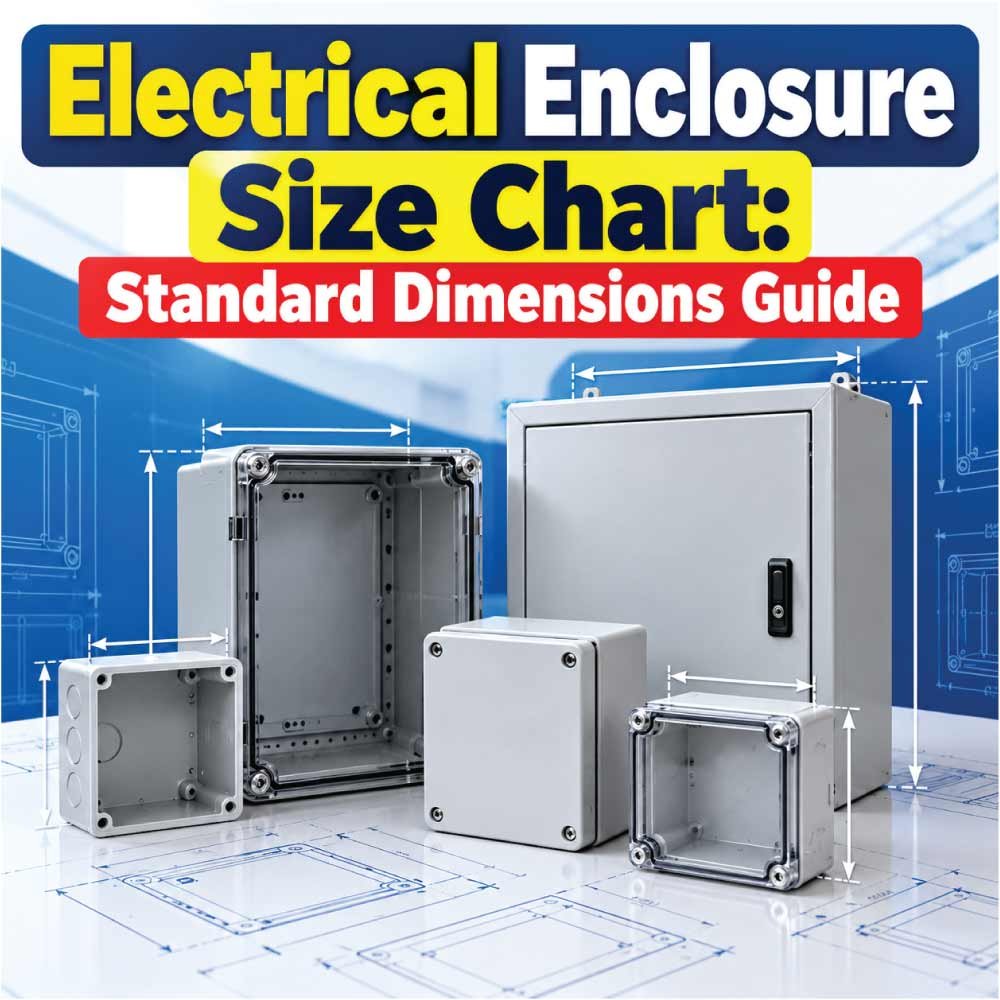
Electrical enclosures protect electrical components from dust, moisture, accidental contact, impact, and other environmental conditions. Choosing the correct enclosure size is important because the cabinet must provide enough room for equipment, wiring, ventilation, cable entry, and future maintenance.
This electrical enclosure size chart explains common enclosure dimensions, enclosure types, mounting considerations, internal space requirements, and the factors that influence size selection. Because manufacturers offer many custom and standard configurations, dimensions should always be checked against the actual equipment and enclosure documentation before installation.
What Is an Electrical Enclosure?
An electrical enclosure is a protective housing designed to contain electrical equipment such as circuit breakers, terminal blocks, relays, contactors, switches, control components, power supplies, and wiring.
The enclosure may be made from materials such as painted steel, stainless steel, aluminum, polycarbonate, or other engineered plastics. The appropriate material depends on the environment, mechanical requirements, corrosion exposure, and electrical application.
An enclosure’s overall dimensions usually include its external height, width, and depth. However, the usable internal space can be smaller because of the door, mounting plate, rails, cable glands, hinges, wiring channels, and other internal components.
Electrical Enclosure Size Chart
The following chart provides common enclosure dimensions that are useful for planning and comparison. These are general dimensional examples rather than universal product standards, because manufacturers use different dimension series and configurations.
| Enclosure Size | Approx. Height | Approx. Width | Approx. Depth | Typical Use |
|---|---|---|---|---|
| Small | 200 mm | 150 mm | 100 mm | Small control components |
| Compact | 300 mm | 200 mm | 150 mm | Terminal and control equipment |
| Medium | 400 mm | 300 mm | 200 mm | Control panels and distribution |
| Large | 600 mm | 400 mm | 250 mm | Larger control equipment |
| Extra Large | 800 mm | 600 mm | 300 mm | Complex electrical assemblies |
| Floor Standing | 1200 mm | 800 mm | 300–400 mm | Large control systems |
| Large Cabinet | 1600 mm | 800 mm | 400–600 mm | Industrial control equipment |
| Industrial Cabinet | 2000 mm | 1000 mm | 500–800 mm | Large electrical installations |
These dimensions should be treated as a planning reference, not as a replacement for a manufacturer’s dimensional drawing. The available internal mounting area can differ significantly from the external enclosure dimensions.
Standard Electrical Enclosure Dimensions
Electrical enclosure dimensions are normally described using three primary measurements: height, width, and depth.
Height
Height determines how much vertical space is available for components, DIN rails, mounting plates, wiring ducts, and cable routing.
A taller enclosure may be appropriate when equipment is arranged in several vertical rows. It can also make future expansion easier when sufficient internal space is available.
Width
Width affects the horizontal arrangement of breakers, contactors, terminal blocks, controllers, and other components.
A wider enclosure can simplify wiring and provide more separation between groups of equipment. However, excessive width can increase cabinet size without providing a practical benefit.
Depth
Depth is particularly important when the enclosure contains large components, wiring bends, terminal connections, or equipment mounted on the door.
Before selecting a shallow enclosure, check the depth of the deepest component and allow sufficient room for conductors and connections.
Common Electrical Enclosure Sizes in Inches
Electrical enclosures are also commonly specified using inch dimensions, particularly in equipment and industrial applications designed around imperial measurements.
| Approx. Size | Height | Width | Depth | General Application |
|---|---|---|---|---|
| Small | 8 in | 6 in | 4 in | Compact controls |
| Small-Medium | 12 in | 8 in | 6 in | Terminals and small equipment |
| Medium | 16 in | 12 in | 8 in | Control assemblies |
| Large | 24 in | 16 in | 10 in | Larger electrical systems |
| Extra Large | 32 in | 24 in | 12 in | Industrial controls |
| Cabinet | 48 in | 32 in | 16 in | Large equipment |
| Floor Cabinet | 60 in | 32 in | 20 in | Large control assemblies |
| Industrial Cabinet | 72 in | 40 in | 24 in | Complex installations |
These values illustrate common size ranges rather than a single universal enclosure series. Exact dimensions vary by manufacturer, enclosure family, mounting arrangement, and application.
Electrical Enclosure Types and Their Size Requirements
Different enclosure designs require different approaches to size selection.
Junction Box Enclosures
Junction boxes are generally used to contain electrical connections, terminals, splices, or cable transitions.
They may be relatively small, but adequate internal volume is still necessary to prevent excessive crowding. The number and size of conductors should be considered before choosing the box.
Control Panel Enclosures
Control panel enclosures house components such as relays, contactors, PLC equipment, power supplies, terminal blocks, and control devices.
These applications often require larger dimensions because components must be arranged with sufficient wiring space and separation.
Electrical Cabinets
Electrical cabinets are typically larger than compact boxes and may contain multiple groups of equipment.
A cabinet may be wall mounted or floor standing. Size selection should consider the complete assembly rather than only the largest individual component.
Outdoor Electrical Enclosures
Outdoor enclosures must account for environmental exposure in addition to internal equipment requirements.
Depending on the application, considerations can include:
- Rain and water exposure
- Dust and dirt
- Solar heat
- Corrosion
- Temperature changes
- Condensation
- Mechanical impact
The enclosure’s environmental protection rating and construction should be appropriate for the installation conditions.
Stainless Steel Enclosures
Stainless steel enclosures are commonly selected where corrosion resistance, cleanliness, or durability is important.
The size requirements are similar to other enclosure types, but material and construction can influence weight, mounting, and installation considerations.
How to Choose the Correct Electrical Enclosure Size
Selecting an enclosure should begin with the components that need to fit inside it.
1. List the Components
Create a list of all equipment that will be installed inside the enclosure.
This may include:
- Circuit breakers
- Contactors
- Relays
- Terminal blocks
- PLC modules
- Power supplies
- Transformers
- Fuses
- Disconnect devices
- Wiring terminals
- Control equipment
Do not select an enclosure based only on one large component.
2. Measure the Equipment
Record the height, width, and depth of each major component.
Also identify components that require special mounting arrangements, such as DIN rails, mounting plates, or door-mounted controls.
3. Plan the Component Layout
Arrange the equipment before finalizing the enclosure size.
Consider where incoming power enters, where outgoing conductors leave, and how wiring will move between components. A logical layout can reduce unnecessary wiring and make maintenance easier.
4. Allow Wiring Space
The equipment itself is not the only space requirement.
Conductors need room to enter terminals, bend, route through wiring ducts, and connect to components. Cable glands and other entry hardware can also consume valuable internal space.
5. Consider Future Expansion
If additional equipment may be installed later, a very tightly packed enclosure may become unsuitable.
Leaving reasonable spare mounting and wiring space can make future modifications easier.
Also Read:
Internal Space vs. External Enclosure Dimensions
One of the most important points when reading an electrical enclosure size chart is that external dimensions are not the same as usable internal dimensions.
For example, an enclosure measuring 600 × 400 × 250 mm externally may have less usable space because of:
- Wall thickness
- Door construction
- Mounting plates
- Rails
- Hinges
- Door hardware
- Cable entry components
- Internal brackets
- Wiring ducts
Always check the manufacturer’s internal mounting dimensions when equipment must fit precisely.
Electrical Enclosure Mounting Dimensions
Mounting dimensions determine whether the enclosure can be physically installed in its intended location.
Wall-Mounted Enclosures
Wall-mounted cabinets require enough wall area for the enclosure and sufficient clearance for installation and maintenance.
Check:
- Mounting hole locations
- Hole spacing
- Overall height
- Overall width
- Cabinet depth
- Door opening
- Cable entry position
Floor-Standing Enclosures
Floor-standing cabinets require a stable installation surface and sufficient surrounding space.
The enclosure should be selected according to both the equipment inside and the physical installation area.
Door-Mounted Equipment
Controls, meters, switches, and indicators may be mounted on the enclosure door.
When this occurs, account for the equipment cutouts, internal clearances, wiring connections, and door movement.
Electrical Enclosure Size for Control Panels
Control panels often require more planning than simple junction boxes because they contain multiple electrical devices.
A control panel layout may include separate areas for:
- Incoming power
- Protection devices
- Control components
- PLC equipment
- Terminal blocks
- Power supplies
- Communication equipment
- Cable routing
The enclosure should provide enough space for organized installation rather than simply fitting every component inside.
A crowded panel can make troubleshooting, maintenance, heat management, and future modifications more difficult.
Also Read:
Electrical Enclosure Size for Circuit Breakers
Circuit breakers can be mounted in different arrangements depending on the enclosure and panel design.
When determining enclosure size, consider the physical breaker dimensions, number of poles, mounting arrangement, wiring space, terminals, and adjacent equipment.
If several breakers are installed together, measure the complete row or group rather than estimating space from a single breaker.
Electrical Enclosure Size for Wiring and Cable Entry
Cable entry can significantly influence enclosure selection.
Large cables require suitable entry points and sufficient bending space. Multiple cable entries may also require additional room for glands, connectors, strain relief, and routing.
Before choosing an enclosure, identify:
- Number of cables
- Cable diameter
- Entry direction
- Gland size
- Required cable bend space
- Internal routing path
- Grounding or bonding requirements
A cabinet that fits the electrical components but does not provide adequate cable-entry space is not a practical selection.
How Much Extra Space Should an Electrical Enclosure Have?
There is no single extra-space percentage that applies to every electrical enclosure.
The appropriate amount depends on component arrangement, wiring requirements, heat generation, maintenance access, and the possibility of future additions.
Instead of relying on one universal percentage, evaluate the actual installation.
A useful planning approach is to ensure that:
- Components are not unnecessarily crowded.
- Wiring can be routed cleanly.
- Terminals remain accessible.
- Door-mounted components have adequate clearance.
- Cable entries can be installed properly.
- Heat-producing equipment has suitable space.
- Future modifications can be accommodated when required.
The final enclosure should be based on the complete engineering layout and applicable requirements.
Also Read:
Electrical Enclosure Material Comparison
Material selection can be as important as enclosure size.
| Material | Typical Characteristics | Common Applications |
|---|---|---|
| Painted Steel | Strong and durable | Indoor industrial panels |
| Stainless Steel | Corrosion resistant | Harsh or clean environments |
| Aluminum | Lightweight and corrosion resistant | Industrial and equipment applications |
| Polycarbonate | Lightweight and electrically insulating | Control and instrumentation |
| ABS Plastic | Lightweight and economical | General-purpose applications |
The correct material depends on environmental conditions, mechanical demands, temperature, chemical exposure, installation location, and the equipment being housed.
Electrical Enclosure Size and Environmental Protection
A larger enclosure is not automatically a better enclosure.
The enclosure must also provide an appropriate level of protection for the environment. Consider exposure to water, dust, chemicals, outdoor weather, impact, and other hazards.
The required protection depends on the installation. When a specific ingress or enclosure classification is required, verify the exact rating and conditions with the applicable product documentation.
Do not assume that two enclosures with identical dimensions provide the same environmental protection.
Common Mistakes When Selecting Enclosure Size
Several mistakes can result in an enclosure that technically fits the equipment but performs poorly in practice.
Choosing Based Only on Height and Width
Depth and internal mounting space can be just as important as the first two dimensions.
Ignoring Cable Space
Cable entry and conductor routing can consume significant space.
Using External Dimensions as Internal Dimensions
Wall thickness and internal hardware reduce usable space.
Packing Components Too Closely
Crowded layouts can complicate wiring and maintenance.
Ignoring the Door
Door-mounted equipment needs clearance from internal components and wiring.
Forgetting the Installation Location
A cabinet may fit the components but fail to fit the available wall, floor, or equipment space.
Selecting a Rating Without Checking the Environment
The required environmental protection should match the actual installation conditions.
Electrical Enclosure Size Selection Checklist
Before purchasing or installing an enclosure, review the following points:
- Measure all major components.
- Confirm enclosure height, width, and depth.
- Check usable internal mounting dimensions.
- Plan the equipment layout.
- Allow room for wiring and cable bends.
- Check cable entry locations.
- Consider door-mounted components.
- Evaluate heat-producing equipment.
- Consider future expansion.
- Confirm the mounting method.
- Check environmental exposure.
- Verify the required enclosure classification.
- Compare the final dimensions with the manufacturer’s drawing.
This process reduces the risk of selecting an enclosure that is too small or unsuitable for the application.
Frequently Asked Questions
What are standard electrical enclosure sizes?
There is no single universal list of standard electrical enclosure sizes. Manufacturers produce many dimensional series, from compact junction boxes to large floor-standing cabinets. Common dimensions are typically selected according to the equipment, mounting arrangement, wiring requirements, and installation space.
How do I measure an electrical enclosure?
Measure the external height, width, and depth for overall cabinet dimensions. If equipment must fit inside, also check the usable internal space, mounting plate dimensions, door clearance, and cable-entry area.
Should an electrical enclosure be bigger than the equipment inside?
Yes, the enclosure normally needs additional usable space for wiring, terminals, mounting hardware, cable routing, maintenance, and other installation requirements. The exact amount depends on the application.
What is the most important enclosure dimension?
There is no single most important dimension. Height, width, and depth should all be evaluated together. Depth becomes particularly important when large components, terminals, cables, or door-mounted devices are involved.
Can I use an outdoor enclosure indoors?
An enclosure designed for outdoor use may be suitable indoors, but suitability depends on its construction, dimensions, environmental classification, and application. The enclosure should still meet the requirements of the intended installation.
How do I choose an enclosure for a control panel?
Start by listing and measuring every component. Create a layout, account for wiring and cable entry, check mounting requirements, consider heat and maintenance, and then select an enclosure with appropriate usable space and environmental protection.
Conclusion
Choosing the right electrical enclosure size requires more than comparing height and width. The complete installation must be considered, including internal mounting space, depth, wiring, cable entry, door clearance, component layout, environmental conditions, and future maintenance.
Use an electrical enclosure size chart as a planning reference, but verify the exact dimensions and specifications of the enclosure before installation. Manufacturer drawings and application requirements should take priority whenever precise fit, protection, or compliance is important.