
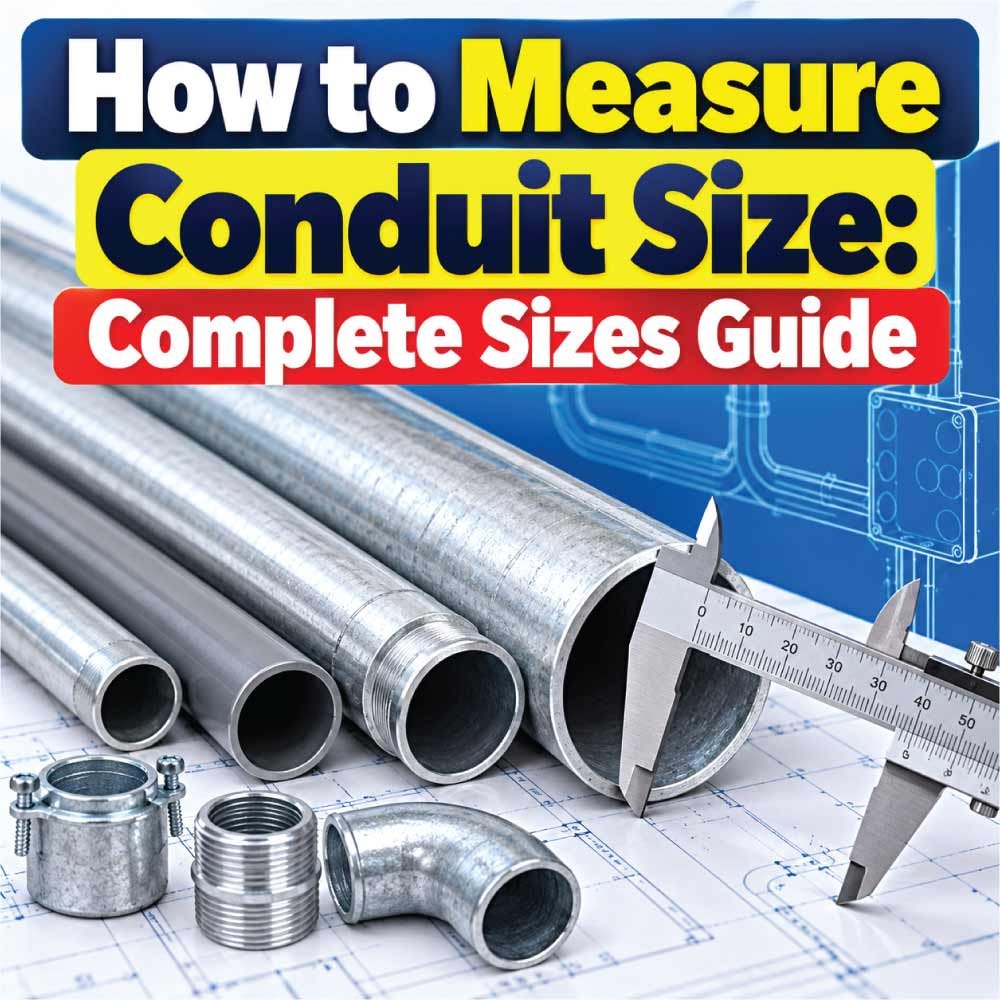
Choosing the correct conduit size is important for protecting electrical conductors, maintaining safe wire installation, and allowing enough room for pulling and future maintenance. Measuring conduit size involves more than checking its outside diameter. You need to consider the conduit’s trade size, inside diameter, number and size of conductors, conductor fill, bends, length, and installation conditions.
This guide explains how to measure conduit size, how conduit dimensions are identified, how to calculate conductor fill, and how to select a suitable raceway for an electrical installation.
What Is Conduit Size?
Conduit size refers to the designated size of an electrical raceway used to contain and protect wires or cables. Conduit may be made from PVC, EMT, IMC, RMC, flexible metal, or liquidtight materials, and each type can have different internal dimensions.
One important point is that conduit size is usually identified by trade size, not simply by its measured outside diameter. A conduit labeled 1 inch, for example, does not necessarily have an inside or outside diameter of exactly 1 inch.
The usable interior space matters most when determining whether conductors will fit.
Conduit Trade Size vs. Actual Diameter
Conduit has several dimensions that can be relevant:
- Trade size: The standard designation used to identify the conduit.
- Outside diameter (OD): The total diameter measured across the outside.
- Inside diameter (ID): The available internal diameter.
- Wall thickness: The material between the outside and inside surfaces.
- Length: The total raceway distance between termination points.
- Bend radius: The space required when the conduit changes direction.
For conductor installation, inside dimensions and allowable fill are generally more important than outside diameter.
Measurements You Need Before Sizing Conduit
Before selecting or measuring a conduit, collect the information that determines the required raceway capacity.
1. Conduit Inside Diameter
If you already have a piece of conduit, use a caliper or suitable measuring tool to determine its inside diameter. Measure across the internal opening rather than across the exterior.
Because conduit can have different wall thicknesses, measuring only the outside diameter does not reliably tell you how much room is available for wires.
2. Number of Conductors
Count the conductors that will occupy the raceway.
Include:
- Hot or ungrounded conductors
- Neutral conductors
- Grounding conductors
- Other conductors that share the raceway
The exact treatment of grounding and bonding conductors for fill calculations depends on the applicable electrical code.
3. Conductor Size
Record the size of every conductor. Wire size is commonly expressed using AWG for many North American applications, while metric conductor sizes may be specified by cross-sectional area.
The insulation type and conductor construction can also affect the actual outside dimensions of the conductor.
4. Conduit Length and Bends
A straight, short conduit run is easier to install than a long run containing several bends.
Record:
- Total conduit length
- Number of bends
- Bend angles
- Junctions or pull points
- Entry and exit locations
These factors may affect both installation difficulty and code requirements.
How to Measure Conduit Size Step by Step
The following process provides a practical way to determine the appropriate conduit size.
Step 1: Identify the Conduit Type
First determine whether the raceway is:
- EMT
- Rigid metal conduit
- Intermediate metal conduit
- PVC conduit
- Flexible metal conduit
- Liquidtight flexible conduit
- Another approved raceway type
The same nominal trade size can have different internal dimensions depending on the conduit type.
Step 2: Determine the Trade Size
Look for markings printed, stamped, or molded on the conduit. If the marking is unavailable, measure the conduit and compare the measured dimensions with the manufacturer’s dimensional information.
Do not assume that a measured outside diameter directly represents the trade size.
Step 3: Determine the Internal Area
For a circular conduit, the theoretical internal cross-sectional area can be calculated using:
Area = π × (D ÷ 2)²
where D represents the inside diameter.
For example, if a circular opening has an inside diameter of 1 inch:
Area = π × (1 ÷ 2)²
This gives approximately 0.785 square inches of total geometric interior area.
However, the entire area cannot necessarily be occupied by conductors. Electrical codes establish allowable raceway fill limits.
Step 4: Determine Conductor Areas
Each conductor occupies space inside the raceway. The conductor’s actual outside dimensions should be used when applicable rather than assuming that the nominal wire size alone represents its physical area.
Add the applicable conductor areas together.
A simplified calculation is:
Total conductor area = Area 1 + Area 2 + Area 3 + …
The result can then be compared with the permitted fill area for the selected raceway.
Step 5: Check the Allowable Fill
Conduit fill requirements vary according to the number of conductors and the applicable electrical code.
For installations governed by the National Electrical Code (NEC), raceway fill calculations generally use different allowable percentages depending on how many conductors are installed. The familiar limits for many raceway situations are 53% for one conductor, 31% for two conductors, and 40% for three or more conductors, subject to the applicable rules and exceptions.
Do not use these percentages as a substitute for checking the complete code requirements for a specific installation.
Step 6: Check Conductor Ampacity
A conductor may physically fit inside a conduit and still require a different installation arrangement.
When multiple current-carrying conductors are installed together, ampacity adjustment or derating may be required depending on the installation conditions.
Consider:
- Number of current-carrying conductors
- Ambient temperature
- Conductor insulation rating
- Terminal temperature limitations
- Raceway conditions
- Installation method
Conduit sizing and conductor ampacity are related, but they are not the same calculation.
Conduit Size Measurement Chart
The following table shows common conduit trade-size designations. Actual inside and outside dimensions vary by raceway type and manufacturer, so use the applicable product dimensions when performing a precise fill calculation.
| Trade Size | Nominal Designation | Typical Use |
|---|---|---|
| 1/2 in. | Small | Branch circuits and compact wiring |
| 3/4 in. | Small-medium | Residential and light commercial wiring |
| 1 in. | Medium | Larger branch circuits and equipment |
| 1-1/4 in. | Medium-large | Multiple conductors |
| 1-1/2 in. | Large | Larger conductor installations |
| 2 in. | Large | Feeders and larger raceways |
| 2-1/2 in. | Extra-large | High conductor capacity |
| 3 in. | Extra-large | Large commercial installations |
| 4 in. | Large raceway | Major feeder and distribution runs |
These are trade sizes rather than guaranteed internal diameters. Always use the dimensional information for the exact conduit type when calculating fill.
How to Calculate Conduit Fill
Conduit fill is the amount of the raceway’s usable interior capacity occupied by conductors.
For example, suppose an installation requires several insulated conductors and a grounding conductor. You would first determine the outside dimensions or cross-sectional areas of the applicable conductors.
Then:
Total conductor area = Sum of individual conductor areas
Next, compare that value with the maximum allowable conductor-fill area of the conduit.
The basic relationship can be expressed as:
Required raceway capacity ≥ Total conductor area ÷ Allowable fill percentage
The actual calculation must account for the specific code provisions governing the raceway and conductors.
Why Conduit Fill Matters
Correct fill provides enough space for conductors without overcrowding the raceway.
Oversized conductors or excessive fill can make installation difficult because:
- Wires become harder to pull.
- Insulation can be damaged during installation.
- Heat dissipation can become a concern.
- Future maintenance becomes more difficult.
- The installation may not comply with applicable requirements.
A conduit that is technically large enough on paper may still be inconvenient to install if the run is long or contains multiple bends.
Also Read:
How to Measure Conduit for Existing Wiring
If wires are already installed, measuring the existing conduit requires additional care.
Measure the Existing Raceway
If accessible, identify:
- Conduit type
- Trade size
- Inside diameter
- Approximate length
- Number of bends
- Number of conductors
- Conductor sizes
- Conductor insulation types
Avoid pulling or disturbing energized conductors merely to determine their dimensions.
Use Conduit Markings When Available
Manufacturers often place identification markings along conduit. These markings can provide more reliable information than estimating size from the outside diameter.
If markings cannot be read, compare the measured dimensions against manufacturer specifications for the particular conduit material.
Conduit Size by Conduit Type
Different raceway materials have different physical characteristics.
EMT Conduit
Electrical Metallic Tubing (EMT) is commonly used for exposed electrical wiring and commercial installations. It has a relatively thin wall compared with rigid raceways, so its internal dimensions differ from other conduit types with the same trade size.
PVC Conduit
PVC electrical conduit is nonmetallic and commonly used where corrosion resistance or certain installation conditions make it appropriate.
PVC schedules and product types can have different dimensions, so the specific product should be checked before calculating fill.
Rigid Metal Conduit
Rigid metal conduit has a thicker construction and provides substantial mechanical protection. Because wall thickness affects the internal opening, its actual ID should be taken from the applicable dimensional specifications.
Flexible Conduit
Flexible metal and liquidtight flexible raceways can be useful where wiring must accommodate movement, equipment vibration, or difficult routing.
Their construction can reduce usable interior space compared with a simple smooth-wall raceway, so manufacturer dimensions are particularly important.
Also Read:
How to Choose the Correct Conduit Size
Selecting conduit should not be based on conductor count alone.
Consider the Number and Size of Wires
Start with the conductors that must be installed. Larger conductors require more interior space, while additional conductors increase total fill.
Consider Future Expansion
If the installation is likely to be modified later, a larger raceway may make future work easier. However, the design should still follow applicable electrical and installation requirements rather than adding arbitrary excess capacity.
Consider the Installation Route
A conduit run with many bends can be considerably harder to pull conductors through than a short straight run.
Pay attention to:
- Total run length
- Number of bends
- Bend locations
- Pull points
- Accessibility
- Equipment connections
Consider the Environment
The installation environment can influence the appropriate raceway type.
Factors may include:
- Moisture
- Corrosion
- Physical damage
- Outdoor exposure
- Temperature
- Chemicals
- Underground installation
- Indoor or outdoor location
The correct conduit size must therefore be paired with a raceway type suitable for the environment.
Also Read:
Conduit Size and Wire Size Relationship
Wire size and conduit size should not be treated as interchangeable terms.
Wire size describes the electrical conductor, while conduit size describes the protective raceway containing it.
For example, two installations could use the same wire size but require different conduit sizes if one contains more conductors.
A useful sizing sequence is:
Determine conductors → identify conductor dimensions → calculate fill → select raceway → verify ampacity and installation requirements
This approach is more reliable than selecting conduit based solely on the wire’s AWG number.
Common Conduit Sizing Mistakes
Several mistakes can result in an undersized or unsuitable raceway.
Using Outside Diameter as the Conduit Size
The outside diameter does not necessarily equal the trade size. Always identify the conduit type and use its applicable dimensions.
Ignoring Conductor Insulation Dimensions
Two conductors with the same nominal electrical size may have different physical outside dimensions depending on construction and insulation.
Forgetting the Grounding Conductor
Conductors used for grounding and bonding must be considered according to the applicable fill rules.
Sizing Only for Physical Fit
A wire bundle that can technically be inserted into a conduit does not automatically satisfy electrical-code requirements.
Ignoring Bends
A long raceway with several bends may create substantially more pulling difficulty than a straight installation.
Confusing Fill With Ampacity
Conduit fill determines whether conductors have enough physical room. Ampacity determines how much current a conductor can safely carry under applicable conditions. Both need to be evaluated separately.
Practical Tips for Accurate Conduit Measurement
Use these practices when sizing or checking a raceway:
- Measure the inside diameter when the physical opening is being evaluated.
- Identify the raceway material and type before using dimensional data.
- Record every conductor that will occupy the raceway.
- Check the conductor’s actual outside dimensions when required.
- Calculate conductor fill using the applicable electrical code.
- Consider conductor ampacity and adjustment separately.
- Account for bends and long pulling distances.
- Use manufacturer data for exact conduit dimensions.
- Check local electrical requirements before beginning an installation.
- When working on existing electrical systems, use appropriate safety procedures and de-energize circuits when required.
For complex installations, a qualified electrician or electrical designer can verify the complete raceway and conductor selection.
Frequently Asked Questions About Measuring Conduit Size
Is conduit size measured by inside or outside diameter?
Conduit is normally identified by its trade size, while actual physical dimensions include both inside and outside diameter. For conductor capacity and fill, the inside dimensions are especially important.
How do I know what size conduit I have?
Check the markings on the conduit first. If they are unavailable or unreadable, identify the conduit type and measure its dimensions, then compare them with the manufacturer’s dimensional information.
Does a larger wire always require larger conduit?
Not necessarily by itself, but larger conductors generally occupy more physical space. The required conduit depends on the number, dimensions, and type of conductors, along with applicable fill requirements.
How many wires can fit in conduit?
There is no single answer for every conduit. The maximum depends on the raceway’s internal area, conductor dimensions, number of conductors, and applicable electrical-code fill rules.
Can I use the same conduit size for different wire sizes?
Yes, provided the selected raceway has sufficient capacity and the complete installation meets applicable requirements. A conduit suitable for one conductor arrangement may not be suitable for another with more or larger conductors.
Does conduit length affect sizing?
Length may not directly change the basic fill calculation, but a long raceway can make conductor pulling more difficult. Long runs and multiple bends should therefore be considered when designing the installation.
Is conduit fill the same as wire ampacity?
No. Conduit fill concerns physical space, while ampacity concerns the current-carrying capability of conductors. Both calculations may be necessary for a compliant installation.
Final Takeaway
Learning how to measure conduit size starts with identifying the raceway type and trade size, then evaluating its internal dimensions and the conductors that will occupy it. The correct selection depends on conductor size, conductor count, allowable fill, installation length, bends, environment, and electrical-code requirements.
For accurate work, do not rely on nominal conduit size alone. Use the dimensions for the specific raceway, calculate conductor fill correctly, and verify ampacity and other installation requirements before completing the wiring system.