Knowing how to measure electrical wire size is important when replacing a cable, checking an existing installation, selecting a conductor, or matching a wire to a circuit. Electrical wire size is commonly identified by AWG (American Wire Gauge) in North America, while other regions may use metric conductor area such as mm².
The challenge is that measuring the outside of an insulated wire does not tell you the actual conductor size. Insulation thickness varies by wire type, voltage rating, temperature rating, and manufacturer.
The most reliable approach is to identify the bare conductor diameter or cross-sectional area and then compare the measurement with an appropriate wire size chart. This guide explains how to measure electrical wire size using a ruler, caliper, wire gauge tool, and basic calculations.
What Is Electrical Wire Size?
Electrical wire size refers primarily to the size of the conductive metal inside a cable, rather than the overall outside diameter of the insulated wire.
For copper and aluminum conductors, wire size affects several important electrical characteristics, including:
- Current-carrying capacity
- Electrical resistance
- Voltage drop
- Heat generation
- Circuit performance
- Suitable breaker or fuse rating
- Physical flexibility
A larger conductor generally has a greater cross-sectional area and lower electrical resistance. A smaller conductor has less metal available to carry current and therefore can experience greater resistance and heating for a given load.
In the United States and many other applications, conductor sizes are often expressed using AWG. Metric systems generally describe conductor area in square millimeters (mm²).
AWG vs. Metric Wire Size
AWG numbers work differently from metric sizes. With AWG, a smaller gauge number represents a larger conductor.
For example, 10 AWG is larger than 14 AWG, while 14 AWG is larger than 18 AWG.
Metric sizing works more intuitively: a 6 mm² conductor has a greater cross-sectional area than a 2.5 mm² conductor.
| Wire Size | Approx. Solid Conductor Diameter | Approx. Conductor Area |
|---|---|---|
| 18 AWG | 1.02 mm | 0.823 mm² |
| 16 AWG | 1.29 mm | 1.31 mm² |
| 14 AWG | 1.63 mm | 2.08 mm² |
| 12 AWG | 2.05 mm | 3.31 mm² |
| 10 AWG | 2.59 mm | 5.26 mm² |
| 8 AWG | 3.26 mm | 8.37 mm² |
| 6 AWG | 4.12 mm | 13.3 mm² |
| 4 AWG | 5.19 mm | 21.2 mm² |
| 2 AWG | 6.54 mm | 33.6 mm² |
| 1 AWG | 7.35 mm | 42.4 mm² |
| 1/0 AWG | 8.25 mm | 53.5 mm² |
| 2/0 AWG | 9.27 mm | 67.4 mm² |
| 3/0 AWG | 10.4 mm | 85.0 mm² |
| 4/0 AWG | 11.7 mm | 107 mm² |
Values shown are approximate nominal dimensions for comparison. Stranded construction and insulation should not be measured as though they were solid conductors.
How to Measure Electrical Wire Size Step by Step
There are several ways to determine wire size. The best method depends on whether the conductor is accessible and whether the wire has readable markings.
Before measuring, de-energize the circuit and verify that the conductor is not live. Never remove insulation or handle an exposed conductor on an energized circuit.
Step 1: Check the Wire Markings
The easiest method is often to inspect the printing or markings on the cable jacket or insulation.
Many electrical wires have information printed along the insulation, such as:
- Conductor size
- AWG designation
- Number of conductors
- Copper or aluminum construction
- Insulation type
- Temperature rating
- Voltage rating
- Manufacturer information
For example, a marking may indicate 12 AWG, which immediately identifies the nominal conductor gauge.
If the marking is readable and trustworthy, there may be no reason to physically measure the conductor.
Step 2: Expose the Conductor Safely
If the wire marking is unavailable, the conductor may need to be inspected.
Only perform this on a wire that has been properly disconnected, isolated, and verified de-energized. Remove only enough insulation to expose a clean section of conductor.
Do not damage or nick the copper or aluminum strands because damage can weaken the conductor and create a poor termination.
Step 3: Measure the Conductor Diameter
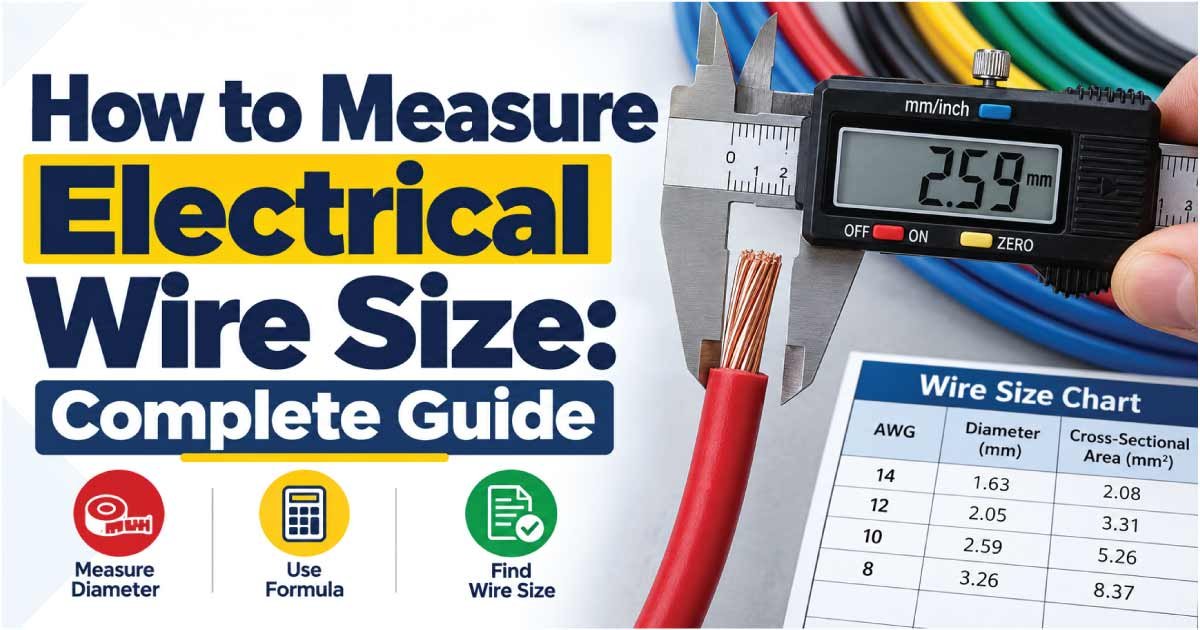
A digital caliper is one of the most useful tools for measuring conductor diameter.
Place the caliper across the bare conductor and measure its diameter without crushing or deforming it.
For a solid conductor, the measurement is relatively straightforward because the conductor has a continuous circular cross-section.
For example, if a solid conductor measures approximately 2.05 mm, it corresponds closely to 12 AWG.
Step 4: Compare the Measurement With an AWG Chart
After obtaining the conductor diameter, compare it with an AWG wire size chart.
Remember that the relationship is reversed:
Smaller AWG number = larger conductor
Larger AWG number = smaller conductor
For example:
- Approximately 2.59 mm → around 10 AWG
- Approximately 2.05 mm → around 12 AWG
- Approximately 1.63 mm → around 14 AWG
- Approximately 1.29 mm → around 16 AWG
The measured value does not need to match a chart value perfectly. Manufacturing tolerances, measurement technique, plating, strand construction, and conductor shape can affect the result.
How to Measure Stranded Wire Size
Measuring stranded wire is more complicated than measuring solid wire because a stranded conductor contains multiple individual wires.
A stranded cable may contain dozens or even hundreds of small strands. Measuring the outside diameter of the entire bundle does not directly give you the AWG size.
Method 1: Check the Cable Marking
For stranded wire, checking the manufacturer’s marking is usually preferable.
The jacket may identify the conductor as something such as:
- 10 AWG
- 12 AWG
- 6 mm²
- 16 mm²
The marking should be treated as the primary identification when available.
Method 2: Measure Individual Strands
If the construction is known, you can measure an individual strand with a precision caliper and determine its approximate area.
The area of one circular strand is:
A = π × d² ÷ 4
Where:
- A = cross-sectional area
- d = strand diameter
- π ≈ 3.1416
You then multiply the area of one strand by the number of strands to estimate the total metallic cross-sectional area.
For example, if a conductor contains 19 identical strands, you would calculate the area of one strand and multiply it by 19.
However, this method can become inaccurate if the strands differ in diameter, are compacted, or are difficult to measure precisely.
Why Stranded Wire Is Difficult to Measure
The outer diameter of a stranded conductor can include air gaps between strands. As a result, the measured bundle diameter is not equivalent to the diameter of a solid conductor containing the same amount of metal.
For this reason, do not simply measure across the outside of a stranded bundle and use a solid-wire AWG chart.
Using a Wire Gauge Tool to Identify Wire Size
A wire gauge or wire-sizing gauge can make identification much faster.
These tools contain openings designed to accept specific wire gauges. The conductor is inserted into the appropriate opening to determine which size fits correctly.
A wire gauge is especially convenient for:
- Workshop projects
- Electrical maintenance
- Automotive wiring
- DIY identification
- Sorting loose conductors
- Checking common copper wire sizes
How to Use a Wire Gauge
First, make sure the conductor is safely disconnected and stripped if necessary.
Then:
- Remove enough insulation to expose the conductor.
- Select the appropriate openings on the gauge.
- Insert the conductor into the opening.
- Check where the conductor fits correctly.
- Compare the result with the gauge marking.
- Confirm the result against the cable marking or manufacturer’s information when possible.
A wire gauge is convenient, but it should not replace proper electrical design calculations when circuit safety depends on the result.
How to Calculate Wire Size From Diameter
If you know the conductor diameter, you can calculate its approximate cross-sectional area.
For a round solid conductor, use:
A = πd² ÷ 4
Where:
- A is the conductor area in mm²
- d is conductor diameter in millimeters
Suppose a solid conductor has a diameter of approximately 2.05 mm.
The calculation is:
A = 3.1416 × (2.05²) ÷ 4
This gives an area of approximately 3.30 mm², which is close to the nominal area associated with 12 AWG.
This calculation is useful when converting between diameter and metric conductor area.
However, it is primarily appropriate for a round solid conductor. Stranded conductors require a different approach because the individual strands must be considered.
Discover More:
How to Measure Wire Size Without Stripping the Insulation
Sometimes you cannot strip the insulation because the wire is installed or because you need to preserve the cable.
In this situation, you can try the following methods.
Read the Printed Markings
Look closely along the cable jacket. Manufacturer markings often repeat at regular intervals.
A flashlight and magnification can help with faded printing.
Measure the Overall Cable Diameter
A caliper can measure the outside diameter of an insulated wire.
However, overall cable diameter should not normally be used to determine conductor AWG directly because insulation thickness varies.
For example, two wires with the same conductor size may have different outside diameters because one has thicker insulation or additional protective layers.
Use Manufacturer Information
If you know the cable type, manufacturer, part number, or construction, the manufacturer’s specification sheet can provide the conductor size and outside dimensions.
This is generally more reliable than estimating conductor size from the outside diameter.
Wire Size Measurement: Diameter vs. Cross-Sectional Area
Two measurements are particularly important when identifying electrical wire size: diameter and cross-sectional area.
Diameter is a linear measurement across the conductor. Cross-sectional area describes how much conductive material exists in the conductor.
For electrical calculations, conductor area is often more meaningful than physical diameter.
| Measurement | What It Tells You | Common Use |
|---|---|---|
| Diameter | Width across a round conductor | Identifying solid wire |
| Cross-sectional area | Amount of conductive material | Metric wire sizing |
| AWG | Standardized conductor gauge | North American wire identification |
| Overall cable diameter | Total outside size including insulation | Routing and physical installation |
A common mistake is assuming that the outside diameter of the insulated cable is the same thing as conductor diameter. It is not.
What Affects the Correct Electrical Wire Size?
Measuring wire size tells you what conductor you have. It does not automatically tell you whether that conductor is appropriate for a particular circuit.
Correct wire selection depends on several factors.
Current or Ampacity
The conductor must be suitable for the expected load and installation conditions.
Ampacity can depend on:
- Conductor material
- Insulation temperature rating
- Ambient temperature
- Number of current-carrying conductors
- Installation method
- Raceway or cable arrangement
- Applicable electrical code
Therefore, you should not select a breaker solely from the measured wire gauge.
Voltage Drop
Long wire runs can experience voltage drop because of conductor resistance.
A circuit with a long distance between the power source and load may require a larger conductor even when the basic ampacity calculation appears acceptable.
Voltage-sensitive equipment can be particularly affected by excessive voltage drop.
Copper vs. Aluminum
The conductor material also matters.
Copper and aluminum do not have identical electrical properties, so the same physical dimensions should not automatically be treated as electrically equivalent.
Always identify the conductor material before using wire-size information for circuit design.
Temperature Rating
The insulation and termination system have temperature ratings that can affect allowable ampacity.
A wire’s temperature rating should be considered together with the applicable code requirements and the ratings of connected equipment.
Discover More:
Common Electrical Wire Sizes and Typical Identification
The following table provides a quick reference to common AWG sizes and approximate solid-conductor dimensions.
| AWG Size | Approx. Diameter (mm) | Approx. Area (mm²) | Relative Size |
|---|---|---|---|
| 18 AWG | 1.02 | 0.823 | Small |
| 16 AWG | 1.29 | 1.31 | Small |
| 14 AWG | 1.63 | 2.08 | Medium-small |
| 12 AWG | 2.05 | 3.31 | Medium |
| 10 AWG | 2.59 | 5.26 | Medium-large |
| 8 AWG | 3.26 | 8.37 | Large |
| 6 AWG | 4.12 | 13.3 | Larger |
| 4 AWG | 5.19 | 21.2 | Very large |
| 2 AWG | 6.54 | 33.6 | Very large |
| 1/0 AWG | 8.25 | 53.5 | Extra large |
These dimensions are useful for identification, but they should not be interpreted as a complete ampacity chart. Wire ampacity must be determined using the applicable electrical code, conductor insulation rating, installation conditions, and circuit requirements.
Tools for Measuring Electrical Wire Size
You do not need expensive equipment for every wire-sizing task.
Digital Caliper
A digital caliper provides accurate diameter measurements and is particularly useful for solid conductors.
Wire Gauge
A wire gauge provides a quick physical comparison between a conductor and standard gauge openings.
Ruler
A ruler can provide a rough diameter measurement, but it is much less precise than a caliper.
Wire Strippers
Wire strippers are useful for safely removing insulation from a properly de-energized conductor.
Manufacturer Documentation
For installed cables, manufacturer documentation can be more useful than physical measurement, especially when the cable has multiple layers or specialized construction.
Common Mistakes When Measuring Electrical Wire
Incorrect measurement can lead to selecting the wrong wire size or misunderstanding the cable construction.
Avoid these common mistakes:
- Measuring the insulation instead of the conductor
- Measuring the entire cable and assuming it represents conductor diameter
- Using a solid-wire chart for a stranded bundle diameter
- Forgetting that AWG numbers decrease as conductor size increases
- Ignoring whether the conductor is copper or aluminum
- Assuming measured gauge automatically determines safe ampacity
- Removing insulation from an energized circuit
- Using a rough ruler measurement when high accuracy is required
- Ignoring voltage drop on long cable runs
- Assuming two cables with identical outside diameters have identical conductors
The most reliable identification combines visible cable markings, conductor construction, accurate measurement, and manufacturer or standard information.
How to Choose the Correct Wire Size After Measuring
Once you have identified the conductor size, the next question is whether it is suitable for the intended application.
Use this general process:
- Identify the conductor material.
- Determine the wire gauge or metric area.
- Determine the expected circuit load.
- Check the applicable ampacity requirements.
- Consider conductor temperature and insulation rating.
- Account for installation conditions and conductor grouping.
- Evaluate voltage drop for longer runs.
- Check terminal and equipment requirements.
- Select the appropriate overcurrent protection.
- Verify the final installation against the applicable electrical requirements.
The measurement step identifies the existing conductor. It should not be confused with the complete process of designing or approving an electrical circuit.
Frequently Asked Questions
How do I measure electrical wire size?
To measure electrical wire size, first identify any markings on the cable. If the conductor is accessible and safely de-energized, expose it and measure the bare conductor diameter with a caliper. Compare the measurement with an AWG chart or calculate its cross-sectional area for metric identification.
Can I measure wire size with a ruler?
Yes, a ruler can provide a rough conductor diameter, but it is not the preferred tool for accurate identification. A digital caliper or wire gauge provides better results. Avoid measuring the outside of insulated cable and assuming that dimension represents the conductor.
Is wire diameter the same as wire gauge?
No. Wire diameter is a physical measurement, while AWG is a standardized gauge system. AWG sizes have a defined relationship with conductor diameter and area. As the AWG number becomes smaller, the conductor becomes larger.
How do I measure stranded wire size?
Stranded wire should not normally be identified by measuring the outside diameter of the strand bundle. Check the cable marking first. If necessary, determine the number and diameter of individual strands and calculate their combined conductive area.
Does measuring wire size tell me the correct breaker size?
No. Measuring the conductor identifies its physical size, but breaker selection also depends on ampacity, conductor material, insulation rating, installation conditions, equipment ratings, and applicable electrical requirements. Always verify the complete circuit design rather than selecting protection from gauge alone.
Conclusion
Learning how to measure electrical wire size is useful for identifying existing conductors and checking whether a cable matches its labeling. The most reliable approach is to check the cable markings first, then use a wire gauge or caliper when physical measurement is necessary.
For solid conductors, diameter can be compared directly with an AWG chart or converted into cross-sectional area. Stranded conductors require more care because the outside bundle diameter does not directly represent the amount of conductive metal.
Most importantly, wire-size measurement and wire-size selection are not the same thing. After identifying the conductor, consider ampacity, voltage drop, conductor material, insulation rating, installation conditions, and applicable electrical requirements before using the wire in a circuit.