
Selecting the correct contactor is essential for safely switching electric motors and other electrical loads. A contactor must be capable of handling the load current, voltage, motor horsepower, starting current, switching frequency, and application duty.
For motor applications, choosing a contactor only by its ampere rating can lead to incorrect selection. The contactor’s utilization category, horsepower rating, coil voltage, number of poles, and manufacturer specifications also need to be considered.
A properly selected contactor provides reliable switching, reduces contact wear, and helps ensure that the motor-control system operates safely and efficiently.
What Is a Contactor?
A contactor is an electrically controlled switching device designed to repeatedly make and break an electrical circuit.
Contactors are commonly used for:
- Electric motors.
- Pumps.
- Compressors.
- Fans.
- HVAC equipment.
- Industrial machinery.
- Lighting systems.
- Heating equipment.
- Conveyor systems.
A contactor typically contains:
- Main contacts.
- Electromagnetic coil.
- Armature.
- Auxiliary contacts.
- Arc-suppression components.
When voltage is applied to the coil, the electromagnetic mechanism closes the main contacts and connects the load to the power supply.
Why Contactor Size Matters
The contactor must be able to withstand the electrical and mechanical demands of the connected load.
An undersized contactor may experience:
- Excessive contact heating.
- Contact welding.
- Premature contact failure.
- Arc damage.
- Nuisance operation.
- Reduced service life.
An oversized contactor may physically work, but it can increase equipment cost and may require a different control arrangement.
The best selection is based on the actual load characteristics and manufacturer’s ratings.
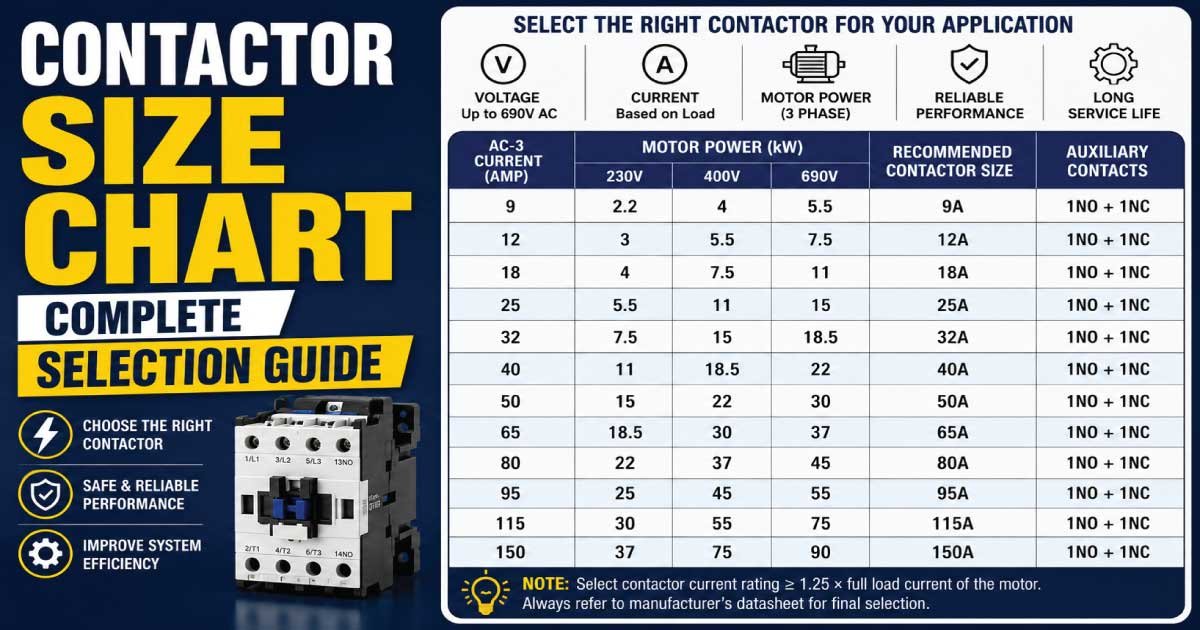
Contactor Size Chart
The following table provides general reference values for common IEC contactor sizes used with three-phase motors. Actual selection should always be based on the motor nameplate current and the manufacturer’s contactor ratings.
| Contactor Size | Approx. AC-3 Rating | Typical Motor Application at 400–460V |
|---|---|---|
| 6 A | 6 A | Up to 2 HP |
| 9 A | 9 A | Up to 3 HP |
| 12 A | 12 A | Up to 5 HP |
| 18 A | 18 A | Up to 7.5–10 HP |
| 25 A | 25 A | Up to 15 HP |
| 32 A | 32 A | Up to 20 HP |
| 40 A | 40 A | Up to 25–30 HP |
| 50 A | 50 A | Up to 30–40 HP |
| 65 A | 65 A | Up to 40–50 HP |
| 80 A | 80 A | Up to 50–60 HP |
| 95 A | 95 A | Up to 75 HP |
| 110 A | 110 A | Up to 75–100 HP |
| 150 A | 150 A | Up to 100–125 HP |
| 185 A | 185 A | Up to 125–150 HP |
| 225 A | 225 A | Up to 150–200 HP |
| 265 A | 265 A | Large industrial motors |
| 330 A | 330 A | Large industrial motors |
| 400 A | 400 A | Heavy industrial applications |
Horsepower values are general references. Actual motor horsepower ratings vary by voltage, motor efficiency, manufacturer, and contactor utilization category.
How to Select the Correct Contactor
A reliable contactor selection process includes:
- Identify the load type.
- Check the operating voltage.
- Determine the load current.
- Identify whether the load is single phase or three phase.
- Determine the motor horsepower or kW if applicable.
- Check the contactor utilization category.
- Select the appropriate contactor current rating.
- Check the coil voltage.
- Verify the number of poles.
- Check auxiliary-contact requirements.
- Consider switching frequency.
- Verify short-circuit coordination.
- Check environmental conditions.
- Confirm the manufacturer’s ratings.
For motors, the AC-3 rating is especially important.
Contactor Size and Amperage
Contactor size is commonly expressed by its rated operational current.
Common IEC contactor ratings include:
- 6A.
- 9A.
- 12A.
- 18A.
- 25A.
- 32A.
- 40A.
- 50A.
- 65A.
- 80A.
- 95A.
- 110A.
- 150A.
- 185A.
- 225A.
- 265A.
- 330A.
- 400A and larger.
However, the current rating should not be interpreted without considering the contactor’s utilization category.
AC-1 vs AC-3 Contactor Rating
One of the most important concepts in contactor selection is the difference between AC-1 and AC-3 ratings.
AC-1 Rating
AC-1 is generally associated with resistive or lightly inductive loads.
Examples include:
- Electric heaters.
- Resistive loads.
- Certain non-inductive applications.
A contactor may have a higher AC-1 rating than its AC-3 rating.
AC-3 Rating
AC-3 is commonly associated with squirrel-cage induction motor switching.
Motor applications include:
- Pumps.
- Fans.
- Compressors.
- Conveyors.
- Machine tools.
For motor control, use the manufacturer’s AC-3 motor rating, not simply the higher AC-1 current value.
Contactor Size for 1 HP Motor
A small three-phase motor may require a contactor in the 6A or 9A range, depending on its voltage and full-load current.
For a small motor, verify:
- Motor nameplate current.
- Voltage.
- AC-3 rating.
- Coil voltage.
- Overload relay range.
The contactor should be selected based on the actual motor current rather than horsepower alone.
Contactor Size for 5 HP Motor
A 5 HP motor at approximately 400–460V three phase may commonly use a contactor around the 9–12A class.
However, the actual motor full-load current should be checked.
A suitable overload relay should also be paired with the contactor to provide motor overload protection.
Contactor Size for 10 HP Motor
A typical 10 HP three-phase motor may require a contactor around the 18A class at 400–460V.
At lower voltages, motor current can be considerably higher, so the contactor selection may change.
Always check the motor’s nameplate current and manufacturer’s contactor selection table.
Contactor Size for 15 HP Motor
A 15 HP three-phase motor may commonly fall around the 25A contactor class at 400–460V.
The contactor should have an appropriate AC-3 rating for the motor.
For frequent motor starting and stopping, switching duty should also be considered.
Contactor Size for 20 HP Motor
A 20 HP three-phase motor may require a contactor around 32A at typical industrial voltages.
However, motor current can vary according to:
- Voltage.
- Efficiency.
- Power factor.
- Motor design.
- Manufacturer.
The nameplate current remains the preferred selection reference.
Contactor Size for 30 HP Motor
A 30 HP motor can commonly fall around the 40–50A contactor range at approximately 400–460V.
The final selection should consider:
- AC-3 current rating.
- Motor full-load current.
- Starting frequency.
- Motor duty.
- Ambient temperature.
- Enclosure.
Contactor Size for 50 HP Motor
A 50 HP industrial motor may commonly require a contactor around 65–80A, depending on the operating voltage and motor characteristics.
For larger motors, the contactor, overload relay, feeder conductors, and short-circuit protection should be properly coordinated.
Contactor Size for 100 HP Motor
A 100 HP motor can require a contactor around 110–150A at typical industrial voltages.
Large motor applications should be checked carefully because starting current and switching duty can be significant.
A soft starter or VFD may be considered if reduced starting current or controlled acceleration is required.
Also Read: Ring Terminal Size Chart: Complete Sizing Guide
Contactor Size for Three-Phase Motors
Three-phase motors are among the most common contactor applications.
For a three-phase motor:
I = P ÷ (√3 × V × Efficiency × Power Factor)
Where:
- I = motor current.
- P = motor output in watts.
- V = line voltage.
- Efficiency = motor efficiency.
- Power Factor = motor power factor.
In practice, the motor’s nameplate full-load current should normally be used instead of estimating current from horsepower.
Contactor Size for Single-Phase Motors
Single-phase motors can draw more current than three-phase motors with the same horsepower.
The contactor must be rated specifically for the single-phase motor load.
Important factors include:
- Motor voltage.
- Full-load current.
- Starting current.
- Motor horsepower.
- Contact configuration.
- Utilization category.
A contactor suitable for a three-phase motor should not automatically be assumed to have the same rating for a single-phase motor.
Contactor Coil Voltage
The coil voltage is separate from the main contact rating.
Common coil voltages include:
- 24V AC.
- 24V DC.
- 48V AC.
- 110V AC.
- 120V AC.
- 220V AC.
- 230V AC.
- 240V AC.
- 380V AC.
- 400V AC.
For example, a contactor could have a 40A AC-3 rating with a 24V DC coil.
The coil voltage must match the control circuit.
Contactor Poles
The number of poles determines how many circuits the contactor can switch.
Common configurations include:
- 1 pole.
- 2 pole.
- 3 pole.
- 4 pole.
Three-phase motor contactors commonly use three main poles.
Four-pole contactors may be used when the neutral also needs to be switched in applications where the system design requires it.
The number of poles should be selected according to the electrical system and applicable requirements.
Also Read: Cable Lug Size Chart: Find the Right Lug Size
Contactor Auxiliary Contacts
Auxiliary contacts are used for control and signaling functions.
They can be used for:
- Holding circuits.
- Interlocking.
- Status indication.
- Alarm circuits.
- PLC inputs.
- Control sequencing.
Common auxiliary contact arrangements include:
- Normally open (NO).
- Normally closed (NC).
Additional auxiliary blocks can often be added to a contactor if supported by the manufacturer.
NEMA Contactor Sizes
NEMA contactors are commonly identified by standardized size classifications.
Typical NEMA sizes include:
| NEMA Size | Typical Application |
|---|---|
| 00 | Very small motors |
| 0 | Small motors |
| 1 | Small to medium motors |
| 2 | Medium motors |
| 3 | Larger motors |
| 4 | Large motors |
| 5 | Heavy-duty motors |
| 6 | Very large motors |
The exact horsepower rating depends on voltage and the specific contactor.
NEMA sizes should therefore be checked using the manufacturer’s published ratings.
IEC Contactor Sizes
IEC contactors are frequently identified by their rated operational current.
Common sizes include:
| IEC Contactor | Typical AC-3 Current |
|---|---|
| 6 A | 6 A |
| 9 A | 9 A |
| 12 A | 12 A |
| 18 A | 18 A |
| 25 A | 25 A |
| 32 A | 32 A |
| 40 A | 40 A |
| 50 A | 50 A |
| 65 A | 65 A |
| 80 A | 80 A |
| 95 A | 95 A |
| 110 A | 110 A |
| 150 A | 150 A |
| 185 A | 185 A |
| 225 A | 225 A |
These ratings are useful for preliminary selection but should always be matched to the actual application.
Also Read: Cartridge Fuse Size Chart: Standard Sizes Explained
Contactor Size for Pumps
Pump motors are common contactor applications.
When selecting a contactor for a pump, consider:
- Motor horsepower.
- Full-load current.
- Starting current.
- Number of starts per hour.
- Pump load.
- Voltage.
- Phase.
- AC-3 rating.
For larger pumps, soft starters or VFDs may be used to reduce starting stress.
Contactor Size for Compressors
Compressors can impose significant electrical and mechanical loads during startup.
When selecting a compressor contactor, check:
- Motor full-load current.
- Starting current.
- Compressor design.
- Starting frequency.
- Motor duty.
- Contact utilization category.
A compressor should not be treated exactly like a resistive load when selecting a contactor.
Contactor Size for Fans and Blowers
Fan and blower motors are commonly switched using contactors.
For fan applications, check:
- Motor current.
- Motor horsepower.
- Voltage.
- Starting characteristics.
- Number of starts.
- AC-3 rating.
A contactor used for frequent switching may need a higher-duty rating than one used for occasional operation.
Contactor Size for Heaters
Electric heaters are generally resistive loads, so their contactor selection is different from motor applications.
For resistive loads, the AC-1 rating may be the relevant rating.
When selecting a heater contactor, consider:
- Heater current.
- Voltage.
- Number of phases.
- Switching frequency.
- Ambient temperature.
- Contact configuration.
Never use an AC-3 motor rating as the only basis for a high-current heating application.
Contactor and Overload Relay
A contactor controls the load, while an overload relay helps protect a motor from sustained excessive current.
A typical motor-control circuit may look like:
Power Supply → Protection → Contactor → Overload Relay → Motor
The overload relay should be selected with an adjustment range appropriate for the motor’s nameplate current.
The contactor and overload relay are often available as a coordinated motor starter combination.
Contactor and Circuit Breaker
A contactor should not be confused with a circuit breaker.
A contactor is primarily designed for frequent switching.
A circuit breaker is primarily intended to provide overcurrent and short-circuit protection while also allowing circuit isolation depending on its design.
A typical motor circuit can include both:
Breaker/Fuse → Contactor → Overload Relay → Motor
Each component performs a different function.
How to Read a Contactor Rating
A contactor nameplate may provide information such as:
- AC-1 current.
- AC-3 current.
- AC-4 current.
- Rated operational voltage.
- Coil voltage.
- Frequency.
- Auxiliary contacts.
- Short-circuit coordination information.
For motor applications, pay particular attention to the AC-3 rating.
For applications involving plugging, inching, or frequent reversing, the appropriate higher-duty utilization category may need to be considered.
Contactor AC-4 Applications
AC-4 applications can include demanding motor-control operations such as:
- Plugging.
- Inching.
- Jogging.
- Frequent reversing.
These operations can cause substantially more contact wear than normal motor switching.
A contactor selected only for a normal AC-3 application may not be suitable for heavy AC-4 duty.
Common Contactor Selection Mistakes
Choosing Only by Ampere Rating
The application and utilization category must also be considered.
Ignoring Motor Voltage
The same horsepower motor can draw different currents at different voltages.
Using AC-1 Rating for Motor Applications
Motor applications commonly require an appropriate AC-3 rating.
Ignoring Coil Voltage
A contactor with the wrong coil voltage will not operate correctly in the control circuit.
Ignoring Switching Frequency
Frequent starting and stopping can significantly increase contact wear.
Ignoring Auxiliary Contacts
Control circuits may require NO or NC auxiliary contacts.
Using the Wrong Number of Poles
The contactor must match the electrical system and switching requirements.
How to Choose the Correct Contactor Size
Use these steps:
- Identify whether the load is a motor, heater, lighting circuit, or another load.
- Check the operating voltage.
- Determine single-phase or three-phase operation.
- Read the load’s full-load current.
- Identify the motor horsepower if applicable.
- Determine the required utilization category.
- Select the contactor’s AC-1 or AC-3 rating as appropriate.
- Check the coil voltage.
- Verify the number of poles.
- Check auxiliary-contact requirements.
- Consider switching frequency.
- Check environmental conditions.
- Verify short-circuit coordination.
- Confirm the manufacturer’s specifications.
Contactor Quick Reference
| Motor Size at 400–460V | Approx. Contactor Class |
|---|---|
| 1 HP | 6–9 A |
| 2 HP | 6–9 A |
| 3 HP | 9 A |
| 5 HP | 9–12 A |
| 7.5 HP | 12–18 A |
| 10 HP | 18 A |
| 15 HP | 25 A |
| 20 HP | 32 A |
| 25 HP | 40 A |
| 30 HP | 40–50 A |
| 40 HP | 65 A |
| 50 HP | 65–80 A |
| 60 HP | 80–95 A |
| 75 HP | 95–110 A |
| 100 HP | 110–150 A |
These values are general references only. Always verify the actual motor current and manufacturer’s AC-3 horsepower/current rating before selecting a contactor.
Frequently Asked Questions
How do I choose the correct contactor size?
Choose a contactor based on the load type, operating voltage, full-load current, phase, utilization category, switching frequency, and application. For motors, use the motor nameplate current and select a contactor with an appropriate AC-3 rating rather than relying only on the contactor’s general ampere rating.
What size contactor do I need for a 10 HP motor?
A typical 10 HP, 400–460V three-phase motor may use an 18A-class contactor. However, the actual motor nameplate current and manufacturer’s AC-3 rating should be checked before selection. A motor operating at a lower voltage can require a higher-current contactor.
What is the difference between AC-1 and AC-3 contactor ratings?
AC-1 is generally used for resistive or lightly inductive loads, while AC-3 is commonly used for switching squirrel-cage induction motors. A contactor may have a higher AC-1 rating than its AC-3 rating, so motor applications should be selected using the appropriate AC-3 specification.
Does contactor size depend on voltage?
Yes. Voltage affects motor current and the contactor’s applicable horsepower rating. The same motor horsepower can require different contactor ratings at 230V, 400V, or 460V. Always check the manufacturer’s voltage-specific motor ratings.
What coil voltage should a contactor have?
The coil voltage must match the control circuit. Common options include 24V AC, 24V DC, 120V AC, 230V AC, and 240V AC. The coil voltage is independent of the main contactor current rating.
Can I use a larger contactor than required?
A larger contactor can sometimes be used if its ratings, coil, terminals, control circuit, and physical configuration are compatible. However, oversizing does not automatically provide better protection. The contactor must still be properly coordinated with the load and other control components.
What size contactor is needed for a 20 HP motor?
A typical 20 HP, 400–460V three-phase motor may use a contactor around the 32A class. The exact selection depends on the motor’s full-load current, contactor AC-3 rating, operating voltage, starting conditions, and manufacturer’s recommendations.
Final Thoughts
Choosing the correct contactor size requires more than looking at the motor’s horsepower. The most important factors are load current, operating voltage, phase, utilization category, coil voltage, switching frequency, and motor starting conditions.
For typical three-phase motors at 400–460V, contactors in the 9A, 12A, 18A, 25A, 32A, 40A, 50A, 65A, 80A, 95A, and 110A ranges cover many common applications.
For motor control, the AC-3 rating is particularly important. For resistive loads such as heaters, the AC-1 rating may be more relevant. Applications involving jogging, plugging, or frequent reversing may require consideration of AC-4 ratings.
Always check the motor nameplate and the contactor manufacturer’s technical data before making the final selection. A properly sized contactor, correctly matched overload relay, and suitable short-circuit protection provide a more reliable motor-control system.