
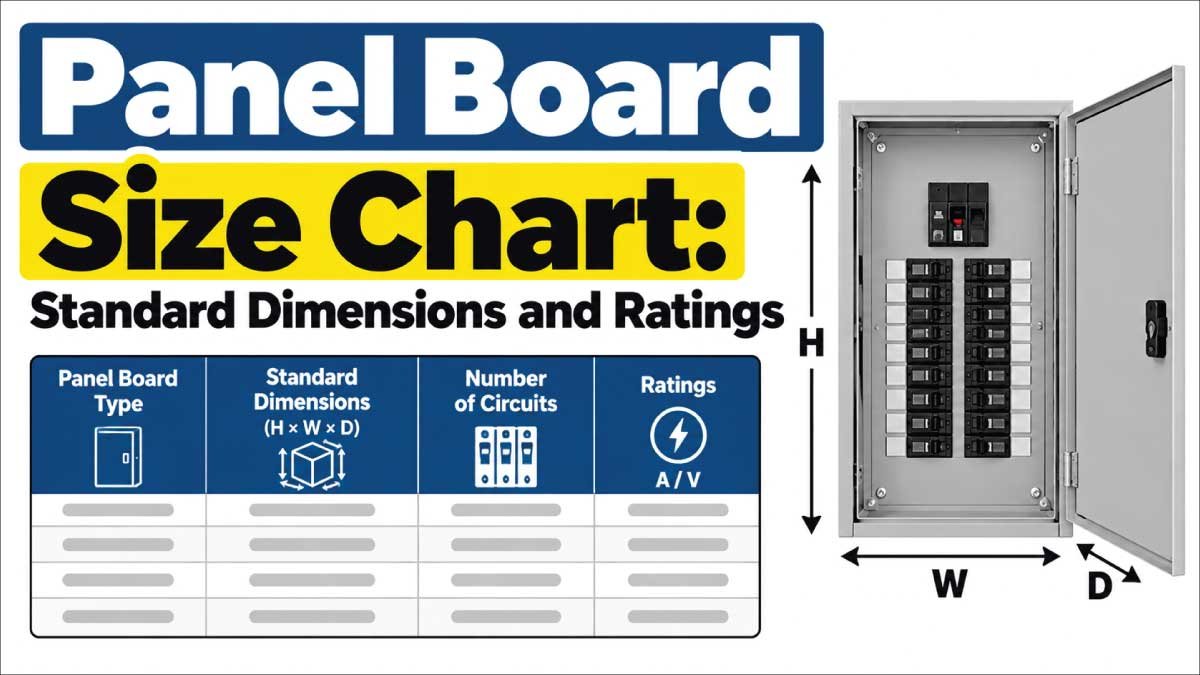
A panel board is a central part of many electrical distribution systems, and choosing the right size requires more than checking the enclosure dimensions. The board must provide enough space for circuit breakers, wiring, busbars, terminals, and future expansion while meeting the required voltage and current ratings.
This panel board size chart explains common panel board dimensions, breaker capacities, enclosure configurations, busbar ratings, and important selection factors. Because manufacturers use different designs and standards, the dimensions shown are practical reference ranges rather than universal specifications.
What Is a Panel Board?
A panel board is an electrical distribution assembly used to receive incoming power and distribute it through individual branch circuits. It typically contains circuit breakers, busbars, neutral terminals, grounding connections, and an enclosure.
Panel boards are commonly installed in:
- Residential buildings
- Commercial properties
- Industrial facilities
- Workshops
- Offices
- Retail buildings
- Utility rooms
- Mechanical rooms
- Electrical control areas
The appropriate panel board size depends on the number of circuits, breaker arrangement, incoming supply, load requirements, available installation space, and applicable electrical requirements.
Panel Board Size Chart
Panel boards are available in many physical configurations. The following chart provides general dimensional categories for comparison.
| Panel Board Size | Typical Width | Typical Height | Typical Depth | Common Application |
|---|---|---|---|---|
| Small | 200–300 mm | 300–500 mm | 90–120 mm | Small installations |
| Medium | 300–500 mm | 500–800 mm | 100–180 mm | Residential and light commercial |
| Large | 400–600 mm | 800–1200 mm | 150–250 mm | Commercial distribution |
| Extra Large | 500–800+ mm | 1200–1800+ mm | 200–350+ mm | Industrial applications |
These dimensions are general reference ranges, not standardized dimensions for every manufacturer. The actual panel board dimensions should be obtained from the product documentation for the selected model.
Panel Board Dimensions Explained
Panel board dimensions are normally described by width, height, and depth. Each measurement affects installation and maintenance.
Panel Board Width
Width determines how much horizontal space the enclosure occupies. It can also influence the available room for breaker arrangements, busbars, wiring gutters, and cable entry.
Panel Board Height
Height is strongly influenced by the number of circuits and breaker spaces. A board with more breaker positions generally requires more vertical space.
Panel Board Depth
Depth is particularly important when large conductors, terminals, breakers, or other components require additional wiring space.
A panel that fits the wall opening may still be unsuitable if its depth interferes with surrounding equipment or does not provide adequate conductor space.
Panel Board Size by Circuit Capacity
Circuit count is one of the most common ways to compare panel boards.
| Approx. Circuit Spaces | Typical Panel Size Category | General Use |
|---|---|---|
| 4–8 spaces | Small | Small electrical installations |
| 12–16 spaces | Compact | Residential applications |
| 20–24 spaces | Medium | Larger residential systems |
| 30–42 spaces | Large | Commercial applications |
| 48–60+ spaces | Extra large | Commercial and industrial distribution |
The actual number of circuits supported depends on the panel design and the breaker types approved for that panel.
A panel’s number of spaces should not be confused with its electrical current rating. A panel with many breaker spaces is not automatically capable of handling a higher total load.
Panel Board Amp Rating Chart
The main current rating indicates the maximum current for which the panel assembly is designed under its specified conditions.
| Panel Rating | Common Application Category | Selection Consideration |
|---|---|---|
| 60 A | Small electrical systems | Limited loads |
| 100 A | Residential and light commercial | General distribution |
| 125 A | Residential and commercial | Moderate demand |
| 150 A | Larger installations | Increased load capacity |
| 200 A | Commercial and residential | Higher electrical demand |
| 225 A | Commercial distribution | Larger branch loads |
| 400 A | Commercial/industrial | High-capacity distribution |
| 600 A+ | Industrial systems | Specialized distribution |
These are common rating categories rather than a universal panel board sizing standard. The correct rating depends on the electrical design and applicable requirements.
Panel Board Voltage Ratings
A panel board must be suitable for the voltage of the electrical system in which it is installed.
Depending on the design, panel boards may be rated for different system voltages and configurations. Common categories include:
- Low-voltage distribution
- Single-phase systems
- Three-phase systems
- Commercial distribution systems
- Industrial distribution systems
Voltage rating should be checked together with the interrupting rating, busbar rating, breaker compatibility, and system configuration.
Panel Board Busbar Size and Rating
The busbar distributes electrical power from the incoming supply to branch circuit breakers. Its rating is therefore an important part of panel board selection.
A panel may have different busbar configurations depending on:
- Main current rating
- Number of circuits
- Phase arrangement
- Manufacturer design
- Temperature conditions
- Available breaker types
- Distribution requirements
Busbar Current Rating
The busbar must be appropriately rated for the intended electrical distribution system. It should not be selected simply by counting the number of breaker spaces.
A panel with 24 spaces, for example, could have a different busbar rating from another 24-space panel because the two assemblies may be designed for different applications.
Main Breaker vs. Main Lug Panel
Panel boards commonly use different incoming supply arrangements.
Main Breaker Panel
A main breaker panel includes a primary circuit breaker that provides a means of disconnecting the panel’s supply.
It may be selected when the panel requires an integrated main disconnect arrangement.
Main Lug Only Panel
A main lug only, or MLO, panel receives its supply through incoming lugs without an integrated main breaker in the same manner.
This configuration may be used as a downstream distribution panel where the required disconnecting arrangement is located elsewhere.
The correct configuration depends on the electrical system design and applicable requirements.
Flush Mount vs. Surface Mount Panel Boards
Mounting method affects both the physical installation space and the finished appearance.
| Mounting Type | Installation | Typical Use |
|---|---|---|
| Flush Mount | Installed within a wall cavity | Finished interiors |
| Surface Mount | Mounted directly on a wall | Utility and equipment areas |
| Recessed | Set into a prepared opening | Architectural installations |
| Freestanding | Mounted as an independent assembly | Larger electrical systems |
The required dimensions can differ between mounting versions of otherwise similar panel boards.
Panel Board Enclosure Size
The enclosure must accommodate more than the breakers themselves. Internal space may be needed for conductors, terminals, busbars, grounding components, and cable routing.
When comparing enclosure dimensions, consider:
- Overall height
- Overall width
- Internal depth
- Door clearance
- Wiring space
- Cable entry
- Conduit connections
- Breaker arrangement
- Maintenance access
A compact enclosure can save wall space, but insufficient internal room can make installation and servicing more difficult.
Panel Board Breaker Size and Compatibility
Circuit breakers must be compatible with the specific panel board. Breakers should not be selected simply because their physical dimensions appear to fit.
Important factors include:
- Breaker manufacturer
- Approved breaker series
- Pole configuration
- Voltage rating
- Current rating
- Interrupting rating
- Panel listing or certification
- Mounting arrangement
The panel manufacturer’s documentation should be used to determine which breakers are approved for that particular panel.
How to Choose the Correct Panel Board Size
Selecting a panel board should begin with the electrical requirements and then consider physical installation constraints.
1. Determine the Electrical Load
Estimate or calculate the expected connected and demand loads according to the applicable electrical design requirements.
The panel rating should be appropriate for the intended load rather than selected simply because a larger rating is available.
2. Count Required Circuits
Determine how many branch circuits are needed.
Include space for:
- Lighting circuits
- Receptacle circuits
- HVAC equipment
- Motors
- Appliances
- Dedicated equipment
- Specialized loads
3. Allow for Future Expansion
If additional circuits are reasonably expected, selecting a panel with spare spaces can make future modifications easier.
However, unused spaces do not automatically mean the panel has additional electrical capacity.
4. Check the Main Rating
Verify that the panel’s main breaker or incoming arrangement is appropriate for the electrical system.
5. Check Voltage and Phase
Confirm whether the installation requires a single-phase or three-phase configuration and verify the required voltage rating.
6. Confirm Breaker Compatibility
Only use breakers and accessories approved for the selected panel.
7. Measure the Installation Space
Record the available:
- Width
- Height
- Depth
- Door clearance
- Conduit entry area
- Working space
Also Read:
Panel Board Size vs. Load Capacity
Physical size, circuit capacity, and electrical rating are separate specifications.
| Specification | What It Determines |
|---|---|
| Physical dimensions | Installation space |
| Number of spaces | Available breaker positions |
| Main rating | Rated incoming current |
| Busbar rating | Distribution capacity |
| Voltage rating | Suitable system voltage |
| Phase configuration | System compatibility |
| Breaker compatibility | Approved protective devices |
| Enclosure type | Installation environment |
| Interrupting rating | Required fault-current capability |
This distinction is important because a larger panel does not automatically mean that it can safely carry a larger electrical load.
Also Read:
Panel Board Selection for Residential Applications
Residential panel boards often prioritize compact dimensions, sufficient circuit spaces, appropriate current capacity, and convenient breaker access.
A typical selection process considers:
- Number of branch circuits
- Existing electrical load
- Future circuit requirements
- Available wall space
- Main service arrangement
- Required breaker types
- Voltage and phase
For a replacement panel, the existing installation should be carefully evaluated rather than choosing a new panel solely by matching the old enclosure dimensions.
Panel Board Selection for Commercial Applications
Commercial systems can require larger boards because they may supply numerous lighting, receptacle, HVAC, motor, and equipment circuits.
Important considerations include:
- Higher circuit counts
- Larger conductors
- Increased fault-current requirements
- Three-phase distribution
- Multiple feeder arrangements
- More extensive cable management
- Future expansion
- Equipment coordination
Commercial panel boards may also require more internal wiring space than smaller residential assemblies.
Also Read:
Panel Board Selection for Industrial Applications
Industrial installations can require substantially larger distribution equipment and more specialized configurations.
Depending on the application, designers may need to consider:
- High fault-current levels
- Large feeder conductors
- Motor loads
- Industrial environmental conditions
- Higher current ratings
- Specialized breakers
- Multiple distribution sections
- Temperature and ventilation
- Equipment accessibility
Industrial panel selection should follow the equipment manufacturer’s requirements and the applicable electrical design standards.
Common Panel Board Sizing Mistakes
Choosing by Physical Dimensions Alone
A panel may fit an existing opening but have an unsuitable voltage, current, breaker compatibility, or busbar configuration.
Ignoring Future Circuits
Selecting only enough spaces for today’s circuits can make future expansion unnecessarily difficult.
Confusing Spaces With Ampacity
The number of breaker spaces does not determine the panel’s total current capacity.
Using Incompatible Breakers
A breaker that physically appears to fit may not be approved for a particular panel.
Ignoring Wiring Space
Large conductors can require substantial room for bending, routing, and termination.
Ignoring Installation Clearance
The enclosure itself may fit while the required working and access space does not.
How to Measure an Existing Panel Board
If you are replacing an existing panel, take measurements before ordering a new unit.
Measure the Exterior
Record:
- Overall height
- Overall width
- Overall depth
- Door dimensions
- Trim dimensions, where applicable
Measure the Interior
If accessible and safe to do so, identify:
- Number of breaker spaces
- Main breaker arrangement
- Busbar configuration
- Neutral arrangement
- Grounding arrangement
- Cable entry locations
Electrical panels can contain hazardous voltages even when individual breakers appear to be switched off. Internal electrical work should be performed by a qualified person following appropriate safety procedures.
Panel Board Size Selection Checklist
Before selecting a panel board, verify:
Required number of circuit spaces
Main current rating
Busbar rating
System voltage
Phase configuration
Breaker compatibility
Interrupting rating
Enclosure dimensions
Mounting method
Available wiring space
Cable entry requirements
Future expansion needs
Environmental conditions
Applicable electrical requirements
For exact installation requirements, always use the manufacturer’s documentation and the electrical requirements applicable to the project location.
Frequently Asked Questions
What is the standard size of a panel board?
There is no single standard physical panel board size. Dimensions vary according to circuit count, breaker configuration, current rating, mounting method, enclosure design, and manufacturer.
How many circuits can a panel board hold?
Panel boards are available with different numbers of breaker spaces, from small units with only a few positions to large assemblies with many spaces. The approved breaker arrangement determines the usable circuit capacity.
Does a larger panel board have a higher amp rating?
Not necessarily. Physical dimensions and electrical ratings are separate specifications. A larger enclosure may provide more spaces without having a higher current rating.
How much spare space should a panel board have?
The appropriate amount of spare capacity depends on the project design and anticipated future requirements. Allowing reasonable expansion space can simplify later modifications.
What is the difference between a panel board and a breaker panel?
The terms are sometimes used interchangeably in everyday electrical work, although technical classifications can differ depending on the equipment and applicable standards. The exact equipment type should be identified from its manufacturer documentation.
Can I replace a panel board with one of the same size?
Matching physical dimensions alone is not sufficient. The replacement must also be compatible with the electrical service, breakers, busbar arrangement, voltage, current rating, mounting requirements, and applicable installation requirements.
Conclusion
A panel board size chart helps compare common enclosure dimensions, circuit capacities, current ratings, and mounting configurations, but physical size is only one part of panel selection. The correct board must also match the electrical load, voltage, phase arrangement, busbar rating, breaker compatibility, and installation environment.
Before purchasing a panel board, measure the available space, determine the required number of circuits, verify the electrical ratings, and confirm that all breakers and accessories are approved for the selected assembly. For exact requirements, rely on the manufacturer’s specifications and applicable electrical regulations.