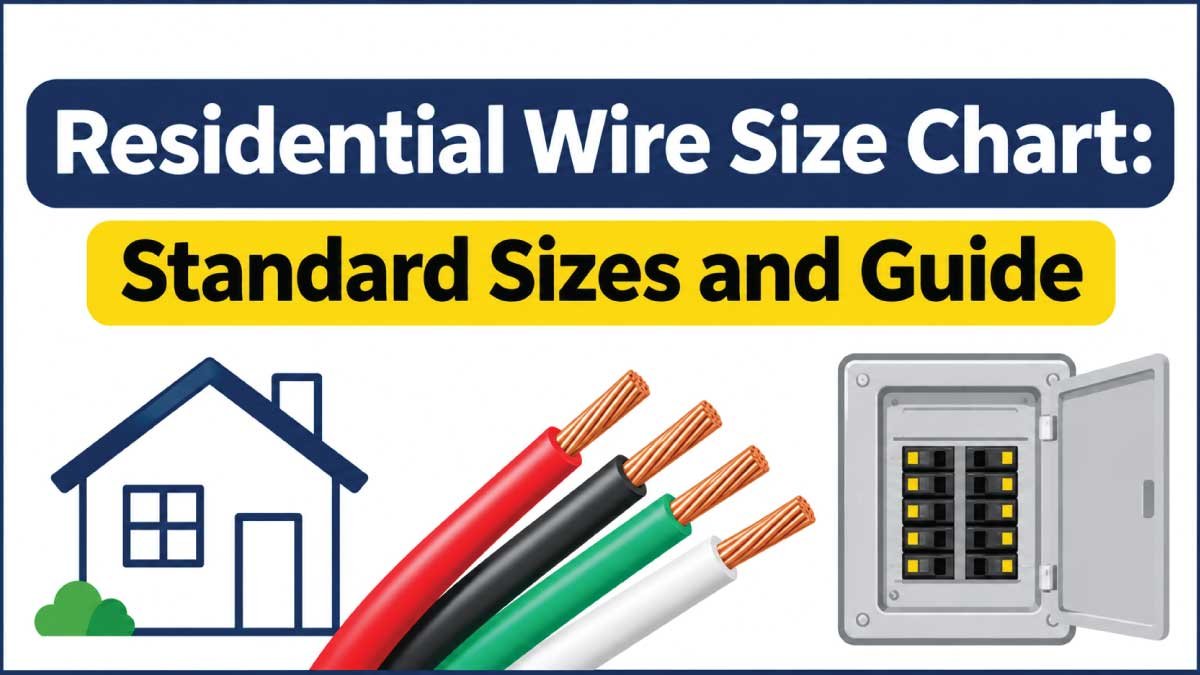
Choosing the correct wire size is one of the most important parts of a safe residential electrical installation. Electrical wires must carry the required current without excessive heating, voltage drop, or damage to their insulation. Using an undersized conductor can create serious electrical hazards, while selecting an inappropriate cable can cause installation and performance problems.
A residential wire size chart makes it easier to understand standard electrical wire sizes, conductor diameters, cross-sectional areas, and common household applications. Whether you are planning lighting circuits, installing electrical outlets, connecting household appliances, or understanding your home’s electrical distribution system, knowing the basics of wire sizing is essential.
Residential wiring uses different conductor sizes depending on electrical load, circuit protection, wire material, installation conditions, and local electrical regulations. This guide covers common AWG and metric wire sizes, their measurements, household applications, and the factors involved in selecting suitable electrical conductors.
What Is Residential Wire Size?
Residential wire size refers to the thickness or cross-sectional area of an electrical conductor used in a home’s electrical system. It determines how much electrical current a wire can safely carry under specified installation conditions.
Wire size is generally expressed using two measurement systems:
- American Wire Gauge (AWG): A standardized wire-sizing system commonly used in the United States and Canada.
- Metric sizing (mm²): A system that identifies conductors by their cross-sectional area in square millimeters.
The two systems use different measurement methods.
In the AWG system, a smaller gauge number represents a thicker conductor. For example, 10 AWG is thicker than 12 AWG, and 12 AWG is thicker than 14 AWG.
In the metric system, a larger number represents a larger conductor cross-sectional area. For example, 6 mm² wire has a greater conductor area than 2.5 mm² wire.
Selecting the correct size helps control conductor temperature, maintain electrical performance, and support safe operation of household equipment.
Residential Wire Size Chart
The following residential wire size chart provides common AWG conductor sizes, their approximate metric equivalents, and typical applications.
The measurements represent the bare metal conductor, excluding insulation.
| AWG Size | Diameter (mm) | Area (mm²) | Typical Application |
|---|---|---|---|
| 18 AWG | 1.02 | 0.82 | Low-voltage controls |
| 16 AWG | 1.29 | 1.31 | Low-voltage wiring |
| 14 AWG | 1.63 | 2.08 | Certain lighting circuits |
| 12 AWG | 2.05 | 3.31 | Certain outlet circuits |
| 10 AWG | 2.59 | 5.26 | Dedicated appliance circuits |
| 8 AWG | 3.26 | 8.37 | Larger electrical loads |
| 6 AWG | 4.12 | 13.30 | Larger equipment and feeders |
| 4 AWG | 5.19 | 21.15 | Electrical distribution |
| 3 AWG | 5.83 | 26.67 | Larger feeders |
| 2 AWG | 6.54 | 33.62 | Heavy-duty distribution |
| 1 AWG | 7.35 | 42.41 | Large electrical installations |
| 1/0 AWG | 8.25 | 53.49 | Service conductors |
| 2/0 AWG | 9.27 | 67.43 | Large electrical feeders |
| 3/0 AWG | 10.40 | 85.03 | Heavy electrical distribution |
| 4/0 AWG | 11.68 | 107.22 | Large service applications |
These are nominal conductor dimensions. Actual current-carrying capacity, known as ampacity, depends on conductor material, insulation temperature rating, ambient temperature, installation method, and applicable electrical codes.
Common Residential Wire Sizes and Their Uses
Different residential electrical circuits require different conductor sizes. Lighting, receptacles, heating equipment, and large household appliances do not necessarily have identical electrical requirements.
The following examples primarily describe common North American copper-wire applications.
14 AWG Residential Wire
14 AWG copper wire is commonly used in certain residential branch circuits protected at 15 amps.
Typical applications include:
- General lighting circuits.
- Some household switching circuits.
- Certain general-purpose electrical loads.
- Compatible residential branch-circuit installations.
Its relatively small conductor diameter makes it suitable for applications where the electrical load and circuit protection permit its use.
12 AWG Residential Wire
12 AWG copper wire is commonly associated with certain 20-amp residential branch circuits.
Common applications include:
- General-purpose receptacle circuits.
- Kitchen countertop receptacle circuits.
- Certain laundry-area circuits.
- Other appropriately protected household circuits.
It has a larger cross-sectional area than 14 AWG wire and can carry more current under comparable conditions.
10 AWG Residential Wire
10 AWG copper conductors are commonly used in certain 30-amp residential circuits.
Potential applications include:
- Some electric water heaters.
- Certain electric dryers.
- Dedicated equipment circuits.
- Selected heating applications.
The actual conductor requirements must be checked against the appliance nameplate, manufacturer instructions, and applicable electrical regulations.
8 AWG Residential Wire
8 AWG wire is used in some larger household electrical installations.
Possible applications include:
- Certain electric heating systems.
- Larger electrical equipment.
- Selected subpanel feeders.
- Equipment requiring higher-capacity conductors.
Its suitability depends on the calculated load, circuit protection, and installation conditions.
6 AWG and Larger Residential Wire
Larger conductors are generally used for electrical equipment and distribution systems with higher current requirements.
Common applications include:
- Certain electric ranges.
- Larger subpanel feeders.
- Electrical service installations.
- High-demand household equipment.
These applications require proper electrical calculations rather than selection based on conductor size alone.
Residential Wire Size Chart by Amperage
Wire size and circuit amperage are closely connected. The conductor must have sufficient ampacity for the electrical load and must be protected by an appropriately rated circuit breaker or fuse.
The following chart provides common North American copper-wire examples.
| Circuit Rating | Common Copper Wire Size | Typical Application Context |
|---|---|---|
| 15 Amps | 14 AWG | Certain lighting and branch circuits |
| 20 Amps | 12 AWG | Certain receptacle circuits |
| 30 Amps | 10 AWG | Some dedicated appliance circuits |
| 40 Amps | 8 AWG | Selected larger equipment circuits |
| 50 Amps | 6 AWG | Certain high-demand equipment |
| 60 Amps | 6 AWG or larger | Depends on installation conditions |
Important: This is a general reference, not a universal wire-sizing specification. The 40-amp, 50-amp, and 60-amp examples may require different conductor sizes depending on insulation ratings, terminal temperature limitations, cable type, conductor material, and installation conditions.
Never increase a circuit breaker rating without verifying that the complete circuit is designed for it.
Understanding Circuit Ampacity
Ampacity refers to the maximum current a conductor can carry continuously under specified conditions without exceeding its permitted temperature.
Several factors influence ampacity:
- Conductor material.
- Conductor cross-sectional area.
- Insulation temperature rating.
- Ambient temperature.
- Number of current-carrying conductors grouped together.
- Installation inside conduit or cable assemblies.
- Applicable electrical code requirements.
A wire’s physical thickness alone does not determine its permitted current rating.
Metric Residential Wire Size Chart
Many countries use metric conductor sizing instead of AWG. Metric residential wire sizes are identified by their cross-sectional area in square millimeters.
Common sizes include 1.0 mm², 1.5 mm², 2.5 mm², 4 mm², 6 mm², and 10 mm².
The following chart compares commonly encountered metric sizes with approximate AWG equivalents.
| Metric Size (mm²) | Approximate AWG Equivalent | Typical Application Context |
|---|---|---|
| 0.75 | 18 AWG | Certain low-load applications |
| 1.0 | 17 AWG | Small electrical loads |
| 1.5 | 15 AWG | Some lighting circuits |
| 2.5 | 13 AWG | Some socket circuits |
| 4.0 | 11 AWG | Selected higher-load circuits |
| 6.0 | 9 AWG | Larger appliance circuits |
| 10.0 | 7 AWG | Larger electrical loads |
| 16.0 | 5 AWG | Feeders and distribution |
| 25.0 | 3 AWG | Larger distribution systems |
| 35.0 | 2 AWG | Heavy electrical distribution |
Metric and AWG sizes are not always exact equivalents. These comparisons are based on approximate conductor cross-sectional areas.
Common Metric Wire Applications
1.5 mm² Wire
This size is commonly found in certain residential lighting circuits in metric-based electrical systems. Its permitted use depends on the installation method and applicable circuit protection.
2.5 mm² Wire
A frequently encountered size for residential socket circuits in some countries. It can also be used for other electrical applications where permitted.
4 mm² Wire
A larger conductor used in selected appliance circuits and other installations requiring greater current capacity.
6 mm² Wire
Commonly encountered in certain dedicated appliance circuits, larger electrical loads, and distribution applications.
10 mm² Wire
Used in some larger residential circuits, feeders, and electrical equipment installations.
The correct application for each size varies according to national wiring standards and installation conditions.
Types of Residential Electrical Wires
Residential electrical systems use different conductor materials, constructions, and cable types. Each has specific characteristics and suitable applications.
Copper Wire
Copper is one of the most widely used materials for residential electrical wiring.
Its main characteristics include:
- High electrical conductivity.
- Good mechanical properties.
- Reliable connections with compatible terminals.
- Availability in solid and stranded constructions.
- Good performance in properly installed electrical systems.
Copper conductors are commonly used in household branch circuits.
Aluminum Wire
Aluminum is lighter than copper and is used in certain residential service and feeder applications.
Important characteristics include:
- Lower weight.
- Different electrical resistance compared with copper.
- Generally larger conductor dimensions for comparable electrical performance.
- Specific connector and termination requirements.
Aluminum conductors must use connectors and installation methods approved for the particular conductor material.
Solid Electrical Wire
Solid wire consists of a single continuous metal conductor.
It is commonly used in fixed electrical installations.
Advantages include:
- Simple conductor construction.
- Good mechanical stability in fixed wiring.
- Compatibility with many residential wiring devices designed for solid conductors.
However, solid conductors are generally less flexible than stranded conductors.
Stranded Electrical Wire
Stranded wire contains multiple smaller metal strands twisted together.
It is often used where flexibility is important.
Common applications include:
- Equipment connections.
- Certain electrical feeders.
- Flexible wiring assemblies.
- Installations using compatible terminals.
The termination method must be suitable for the stranded conductor construction.
Residential Electrical Cable
Electrical cable generally contains one or more insulated conductors within a protective assembly or outer covering.
Common residential cable types include:
- Nonmetallic-sheathed cable.
- Armored cable.
- Individual insulated conductors installed in conduit.
- Other approved wiring assemblies.
The correct cable type depends on the environment, installation method, and local electrical regulations.
Also Read:
How to Choose the Correct Residential Wire Size
Selecting a suitable conductor requires evaluating the electrical requirements of the circuit and the conditions in which the wire will operate.
1. Determine the Electrical Load
First, identify the power requirements of the connected appliance or electrical equipment.
For a basic single-phase load, current can be estimated using:
[
I=\frac{P}{V}
]
Where:
- I = Current in amperes.
- P = Electrical power in watts.
- V = Supply voltage in volts.
For example, consider an appliance rated at 2,000 watts operating at 230 volts.
[
I=\frac{2000}{230}=8.7A
]
The appliance draws approximately 8.7 amps under these assumptions.
This calculation is only a starting point. Circuit design must also consider continuous loads, motor starting current, power factor where applicable, and electrical code requirements.
2. Identify the Conductor Material
Determine whether the installation uses copper or aluminum conductors.
These materials have different resistance and ampacity characteristics. The conductor size must be selected according to the material and applicable electrical standards.
3. Check Circuit Protection
Circuit breakers and fuses protect electrical circuits against excessive current.
The protective device must be properly coordinated with the conductor and connected equipment.
Never replace a smaller breaker with a larger one simply because the existing breaker trips.
4. Consider Cable Length
Longer wire runs generally experience greater voltage drop.
This can affect the operation of appliances, motors, and other electrical equipment.
A larger conductor may be necessary when the calculated voltage drop exceeds the permitted design limits.
5. Evaluate Installation Conditions
The installation environment can significantly affect the current-carrying capacity of electrical conductors.
Consider:
- Ambient temperature.
- Cable grouping.
- Number of loaded conductors.
- Conduit installation.
- Insulation temperature rating.
- Exposure to moisture or heat.
6. Follow Applicable Electrical Standards
Residential wiring requirements differ between countries.
For example, North American installations commonly use the National Electrical Code (NEC), while many other countries follow IEC-based or national wiring standards.
Always follow the regulations applicable to the installation location.
Also Read:
Residential Wire Diameter and Gauge Chart
Wire gauge and conductor diameter are related measurements used to identify electrical wire dimensions.
In the AWG system, the gauge number decreases as the conductor becomes thicker.
For example:
- 14 AWG is thinner than 12 AWG.
- 12 AWG is thinner than 10 AWG.
- 10 AWG is thinner than 8 AWG.
- 8 AWG is thinner than 6 AWG.
The following chart provides approximate bare conductor diameters.
| AWG Size | Diameter (mm) | Diameter (inches) |
|---|---|---|
| 18 AWG | 1.02 | 0.0403 |
| 16 AWG | 1.29 | 0.0508 |
| 14 AWG | 1.63 | 0.0641 |
| 12 AWG | 2.05 | 0.0808 |
| 10 AWG | 2.59 | 0.1019 |
| 8 AWG | 3.26 | 0.1285 |
| 6 AWG | 4.12 | 0.1620 |
| 4 AWG | 5.19 | 0.2043 |
| 2 AWG | 6.54 | 0.2576 |
| 1/0 AWG | 8.25 | 0.3249 |
| 2/0 AWG | 9.27 | 0.3648 |
| 3/0 AWG | 10.40 | 0.4096 |
| 4/0 AWG | 11.68 | 0.4600 |
These measurements exclude insulation. The overall diameter of an insulated wire or cable is larger and varies according to its construction.
Also Read:
Residential Wire Size for Common Household Applications
Different household appliances and electrical systems require different conductor sizes. The following table summarizes common wiring contexts and the factors that influence selection.
| Household Application | Common Wiring Context | Important Consideration |
|---|---|---|
| Lighting circuits | 14 AWG or 1.5 mm² in some systems | Circuit protection and local code |
| General outlets | 12 AWG or 2.5 mm² in some systems | Expected electrical load |
| Kitchen outlets | Dedicated or specially protected circuits | Local kitchen wiring requirements |
| Washing machines | Designated or dedicated circuits | Appliance specifications |
| Electric water heaters | Dedicated circuits | Rated current and manufacturer instructions |
| Electric dryers | Dedicated circuits | Voltage and equipment rating |
| Air conditioners | Dedicated circuits | Minimum circuit ampacity |
| Electric ranges | Dedicated circuits | Equipment load |
| Subpanels | Larger feeder conductors | Calculated feeder load |
| Main electrical service | Appropriately sized service conductors | Total calculated electrical demand |
These examples are not universal specifications. The required wire size must be determined using the actual equipment rating, installation conditions, and applicable electrical regulations.
What Is Voltage Drop in Residential Wiring?
Voltage drop is the reduction in electrical voltage that occurs as current travels through a conductor.
All electrical wires have some resistance. When current flows through a conductor, electrical energy is converted into heat, producing a voltage difference between the supply point and the connected equipment.
Voltage drop becomes more significant when:
- The cable run is long.
- The electrical load draws substantial current.
- The conductor is relatively small.
- The conductor material has higher resistance.
- Multiple loads operate simultaneously.
How to Reduce Voltage Drop
Several design measures can help control voltage drop:
- Select a conductor with an appropriate cross-sectional area.
- Avoid unnecessarily long cable runs.
- Use suitable conductor materials.
- Calculate the expected circuit load.
- Follow the voltage-drop recommendations of the applicable electrical standard.
Increasing conductor size generally reduces resistance and helps maintain voltage at the connected equipment.
Common Residential Wiring Mistakes to Avoid
Incorrect wire selection and installation can create electrical hazards and reduce system reliability.
Using Undersized Conductors
An undersized conductor may overheat when carrying more current than its permitted ampacity.
Always verify conductor size against the electrical load and installation conditions.
Installing an Oversized Circuit Breaker
A circuit breaker must be compatible with the wiring it protects.
Installing a breaker with a higher rating without checking the conductor can allow dangerous current to flow through an undersized wire.
Ignoring Wire Material
Copper and aluminum conductors have different electrical characteristics.
Always use appropriately rated connectors and approved termination methods.
Overlooking Voltage Drop
A conductor that is suitable for a short circuit may not provide acceptable performance over a much longer distance.
Calculate voltage drop when designing longer electrical runs.
Choosing the Wrong Cable Type
Not every cable is suitable for installation inside walls, underground, outdoors, or in wet locations.
Always select a cable approved for its intended environment.
Ignoring Grounding and Bonding
Grounding and bonding are essential safety components of residential electrical installations.
The required protective conductors and connections must be installed according to the applicable electrical standards.
Frequently Asked Questions About Residential Wire Sizes
What Is the Most Common Residential Wire Size?
In North American residential wiring, 14 AWG and 12 AWG copper conductors are commonly used for certain 15-amp and 20-amp branch circuits.
In metric-based systems, 1.5 mm² and 2.5 mm² conductors are commonly encountered in lighting and socket installations.
Is 12 AWG Wire Thicker Than 14 AWG?
Yes. 12 AWG wire is thicker than 14 AWG wire.
12 AWG has an approximate conductor diameter of 2.05 mm, while 14 AWG has an approximate diameter of 1.63 mm.
What Wire Size Is Used for a 20-Amp Residential Circuit?
12 AWG copper is commonly used for certain 20-amp branch circuits in North America.
However, the final conductor selection must follow applicable electrical regulations and installation requirements.
Can 2.5 mm² Wire Be Used for Residential Wiring?
Yes. A 2.5 mm² conductor is commonly used in some residential socket circuits and other household electrical applications.
Its suitability depends on the circuit design, protective device, installation method, and local regulations.
Does Residential Wire Size Depend on Voltage?
Voltage is one of the factors considered in electrical circuit design, but conductor sizing is not determined by voltage alone.
Current, electrical load, conductor material, circuit length, installation conditions, and protective-device ratings also matter.
Is Copper Better Than Aluminum for Residential Wiring?
Copper provides higher electrical conductivity for the same conductor dimensions and is widely used in household branch circuits.
Aluminum is lighter and can be suitable for certain service and feeder installations when correctly sized and terminated.
What Happens If Residential Wire Is Too Small?
An undersized wire can experience excessive heating, insulation damage, and increased fire risk.
It may also contribute to excessive voltage drop and unreliable equipment operation.
Can I Use a Residential Wire Size Chart for Actual Installation?
A wire size chart is useful for understanding standard conductor dimensions and common applications.
However, it should not replace electrical load calculations, ampacity tables, manufacturer instructions, or local electrical code requirements.
Conclusion
Selecting the correct residential wire size is essential for safe, efficient, and reliable household electrical installations.
Common North American sizes include 14 AWG, 12 AWG, 10 AWG, and larger conductors for higher-demand equipment and distribution systems. Metric-based installations commonly use 1.5 mm², 2.5 mm², 4 mm², 6 mm², and 10 mm² conductors.
The appropriate size depends on electrical load, circuit protection, conductor material, cable length, installation environment, and local wiring standards.
Use the residential wire size chart as a reference for understanding standard measurements, but always verify the actual installation requirements with applicable electrical codes and a qualified electrician.