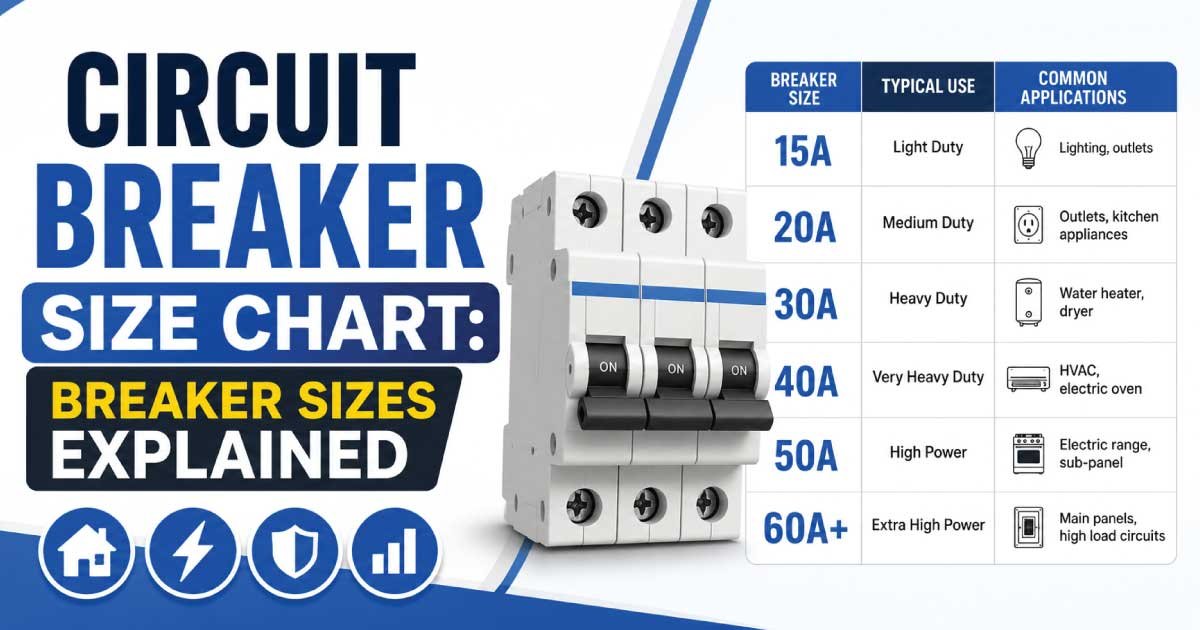
A circuit breaker size chart helps homeowners, electricians, and contractors understand the relationship between breaker ratings, wire sizes, circuit loads, and electrical protection. Choosing the correct breaker is important because the breaker must protect the conductors from excessive current.
Circuit breakers are available in different amp ratings and configurations. Understanding breaker size, wire gauge, voltage, circuit type, and electrical load makes it easier to select an appropriate breaker for a specific application.
What Is a Circuit Breaker?
A circuit breaker is an automatic electrical protection device designed to interrupt current when a circuit experiences an excessive electrical load or fault. Unlike a fuse, a breaker can generally be reset after it trips once the underlying problem is addressed.
Circuit breakers are commonly used in:
- Residential electrical panels
- Commercial buildings
- Industrial electrical systems
- Lighting circuits
- Appliance circuits
- HVAC systems
- Motor circuits
- Electrical distribution systems
Circuit Breaker Size Chart
Circuit breaker size is normally expressed in amperes (amps). Common ratings range from small branch-circuit breakers to larger breakers used for feeders and major electrical equipment.
| Breaker Size | Common Circuit Application | Typical Voltage |
|---|---|---|
| 10 Amp | Small dedicated circuits | 120V |
| 15 Amp | Lighting and general circuits | 120V |
| 20 Amp | Receptacle and appliance circuits | 120V |
| 25 Amp | Dedicated equipment | 120/240V |
| 30 Amp | Appliances and equipment | 120/240V |
| 40 Amp | Larger appliances | 120/240V |
| 50 Amp | Ranges and large equipment | 120/240V |
| 60 Amp | Larger feeders/equipment | 120/240V |
| 70 Amp | Larger electrical loads | 120/240V |
| 80 Amp | Equipment and subpanels | 120/240V |
| 90 Amp | Larger feeders | 120/240V |
| 100 Amp | Subpanels and feeders | 120/240V |
| 125 Amp | Larger feeders | 120/240V |
| 150 Amp | Service/feeders | 120/240V |
| 200 Amp | Main service/feeders | 120/240V |
Applications shown are general examples. The correct breaker rating must be determined from conductor ampacity, load calculation, equipment requirements, and the electrical code applicable to the installation.
How Circuit Breaker Sizes Work
A breaker rating indicates the approximate amount of continuous current the breaker is designed to carry before its protective function operates under specified conditions. The breaker must be coordinated with the circuit conductors and connected load.
For example:
- A 15-amp breaker is commonly associated with smaller branch circuits.
- A 20-amp breaker is commonly used for higher-load branch circuits.
- A 30-amp breaker is often used for dedicated equipment.
- Larger breakers are commonly used for feeders and major electrical loads.
The breaker should never simply be increased to stop nuisance tripping without determining why the circuit is overloaded.
Circuit Breaker Size and Wire Size
The relationship between breaker size and wire size is one of the most important parts of electrical circuit design. The breaker must provide appropriate overcurrent protection for the conductors installed in the circuit.
Common copper wire sizes include:
| Wire Size | General Use | Common Breaker Range* |
|---|---|---|
| 14 AWG | Small branch circuits | 15 A |
| 12 AWG | Branch circuits | 15–20 A |
| 10 AWG | Larger branch circuits | 20–30 A |
| 8 AWG | Larger loads | 30–50 A |
| 6 AWG | Equipment/feeders | 40–60 A |
| 4 AWG | Larger feeders | 60–85 A |
| 3 AWG | Feeders | 70–100 A |
| 2 AWG | Large feeders | 75–115 A |
| 1 AWG | Large feeders | 100–130 A |
| 1/0 AWG | Large feeders | 125–150 A |
| 2/0 AWG | Large feeders | 150–175 A |
| 4/0 AWG | Major feeders | 180–230 A |
These are general reference ranges, not a substitute for an electrical code calculation. The permitted ampacity depends on conductor material, insulation temperature rating, installation conditions, terminal limitations, and applicable code rules.
Also Read: Battery Cable Size Chart: Correct AWG Cable Guide
What Determines Circuit Breaker Size?
Several factors determine the correct breaker rating for an electrical circuit. The connected load is important, but breaker selection also depends on conductor ampacity, equipment ratings, voltage, continuous loads, and applicable electrical requirements.
Important factors include:
- Electrical load
- Wire ampacity
- Wire material
- Conductor size
- Circuit voltage
- Continuous loads
- Equipment rating
- Ambient temperature
- Number of conductors
- Breaker type
- Applicable electrical code
A proper load calculation should be completed before selecting the breaker.
How to Calculate Circuit Breaker Size
Circuit breaker sizing starts with determining the electrical load of the circuit. For a simple single-phase load, current can be estimated using the relationship between power and voltage.
For many basic loads:
Current (A) = Power (W) ÷ Voltage (V)
For example, a 2,400-watt load operating at 120 volts would draw approximately:
2,400 ÷ 120 = 20 amps
However, the breaker should not automatically be selected based only on this calculation. Continuous-load requirements, conductor ampacity, equipment specifications, and applicable electrical rules must also be considered.
Breaker Size for 120V Circuits
120-volt circuits are common in residential and light commercial electrical systems. Typical applications include lighting, receptacles, electronics, and smaller appliances.
Common breaker ratings for 120V circuits include:
- 15 amps
- 20 amps
- 25 amps
- 30 amps
- Higher ratings for specific equipment where permitted
The wire size and connected equipment must be compatible with the selected breaker. A higher-rated breaker should not be installed simply because the circuit trips.
Breaker Size for 240V Circuits
240-volt circuits are commonly used for larger residential appliances, HVAC equipment, water heaters, dryers, ranges, and other higher-power equipment.
Typical breaker ratings may include:
- 20 amps
- 30 amps
- 40 amps
- 50 amps
- 60 amps
- 100 amps or more for larger equipment and feeders
Many 240V circuits use a two-pole breaker because the circuit is supplied from two energized legs of the electrical system.
Single-Pole vs Double-Pole Breakers
The number of breaker poles depends on the circuit configuration and voltage requirements. Single-pole breakers are commonly used for standard branch circuits, while two-pole breakers are commonly used for many 240V loads.
| Breaker Type | Typical Application |
|---|---|
| Single-Pole | 120V branch circuits |
| Double-Pole | 240V equipment and larger circuits |
| Triple-Pole | Certain three-phase systems |
| Tandem | Two circuits in one panel space where permitted |
The panelboard must be compatible with the specific breaker type being installed.
Also Read: USB Cable Size Chart: Find the Right USB Cable Size
Circuit Breaker Amp Ratings
Circuit breakers are manufactured in standardized amp ratings. Smaller ratings are generally used for branch circuits, while larger ratings are used for feeders, subpanels, and major electrical equipment.
Common ratings include:
- 10 A
- 15 A
- 20 A
- 25 A
- 30 A
- 40 A
- 50 A
- 60 A
- 70 A
- 80 A
- 90 A
- 100 A
- 125 A
- 150 A
- 175 A
- 200 A
The correct rating depends on the circuit design rather than simply the available breaker size.
Breaker Size for Common Appliances
Different appliances can require different circuit ratings depending on their power consumption, voltage, manufacturer requirements, and installation configuration.
| Appliance | Common Circuit Range |
|---|---|
| Lighting | 15–20 A |
| Refrigerator | 15–20 A |
| Dishwasher | 15–20 A |
| Washing Machine | 15–20 A |
| Garbage Disposal | 15–20 A |
| Microwave | 15–20 A |
| Water Heater | 25–30 A+ |
| Clothes Dryer | 30 A |
| Electric Range | 40–50 A |
| Central AC | 20–60 A+ |
These are general examples only. Always check the equipment nameplate and manufacturer’s installation instructions for the actual circuit requirements.
Breaker Size for Air Conditioners
Air-conditioning equipment can have significant starting and running current, so the breaker cannot be selected simply from the unit’s wattage. The equipment nameplate and manufacturer instructions provide important electrical information.
Before selecting a breaker for an air conditioner, check:
- Minimum circuit ampacity
- Maximum overcurrent protection
- Rated voltage
- Compressor requirements
- Conductor ampacity
- Manufacturer specifications
The breaker and conductor must be properly coordinated with the specific HVAC equipment.
Also Read: Transformer Wire Gauge Chart: Choose the Right AWG
Breaker Size for Electric Water Heaters
Electric water heaters commonly operate on dedicated circuits because of their relatively high electrical load. The correct breaker depends on the heater’s rated power, voltage, conductor requirements, and applicable installation rules.
For water heaters, check:
- Heater wattage
- Rated voltage
- Required circuit amperage
- Manufacturer specifications
- Conductor size
- Breaker type
- Continuous-load requirements
Never choose a breaker based only on the physical size of the appliance.
Breaker Size for Electric Dryers
Electric clothes dryers commonly require a dedicated circuit because of their high electrical demand. Many residential dryers operate on 240 volts and use a two-pole breaker.
Before selecting the breaker, verify:
- Dryer nameplate rating
- Required voltage
- Circuit amperage
- Conductor size
- Breaker configuration
- Manufacturer instructions
- Applicable electrical code
The actual breaker size should be based on the specific dryer rather than a generic assumption.
Breaker Size for Electric Ranges
Electric ranges and ovens can require substantial electrical power and are commonly connected to dedicated circuits. Their breaker requirements vary according to the appliance rating and installation configuration.
Important information includes:
- Appliance nameplate
- Rated voltage
- Maximum current
- Required circuit size
- Conductor ampacity
- Breaker configuration
- Manufacturer instructions
A range requiring a dedicated circuit should not share that circuit with unrelated loads.
Why Breakers Trip
A circuit breaker trips when its protective mechanism detects a condition such as excessive current or a short circuit. Repeated tripping is a warning that the circuit should be investigated rather than solved by installing a larger breaker.
Common causes include:
- Circuit overload
- Short circuit
- Faulty appliance
- Damaged wiring
- Loose electrical connections
- Excessive electrical demand
- Ground-fault conditions where applicable
- Breaker malfunction
If a breaker repeatedly trips, identify the cause before resetting it again or changing its rating.
Important Circuit Breaker Safety Rules
Electrical panels and circuit breakers can involve dangerous voltages and fault currents. Breaker selection and installation should be performed according to applicable electrical requirements and, when necessary, by a qualified electrician.
Important safety principles include:
- Never install a breaker larger than the circuit permits.
- Do not replace a breaker simply to stop nuisance tripping.
- Match breakers to the panelboard.
- Verify conductor ampacity.
- Follow equipment instructions.
- De-energize equipment before servicing where appropriate.
- Investigate repeated breaker trips.
- Follow applicable electrical codes.
Correct breaker sizing protects both wiring and connected equipment.
Key Points to Remember
A circuit breaker size chart is useful for understanding common breaker ratings, but the correct breaker cannot be selected from amp rating alone. The load, conductor ampacity, equipment requirements, voltage, and installation conditions must all be considered.
Remember these points:
- Breaker size is measured in amps.
- Wire size and breaker size must be coordinated.
- Load calculations help determine circuit requirements.
- 120V and 240V circuits use different configurations.
- Equipment nameplates provide important sizing information.
- Repeated breaker trips should be investigated.
- Never increase breaker size without verifying conductor protection.
- Always follow applicable electrical codes and manufacturer instructions.
Circuit Breaker Size for Different Wire Gauges
The correct breaker rating depends on conductor ampacity, insulation, material, installation conditions, and applicable electrical requirements. Wire gauge provides an important starting point, but breaker selection should always be verified using the appropriate code tables.
| Wire Size | Common Copper Ampacity Range* | Common Breaker Reference* |
|---|---|---|
| 14 AWG | 15 A | 15 A |
| 12 AWG | 20 A | 20 A |
| 10 AWG | 30 A | 30 A |
| 8 AWG | 40–50 A | 40–50 A |
| 6 AWG | 55–65 A | 60 A |
| 4 AWG | 70–85 A | 70–80 A |
| 3 AWG | 85–100 A | 90–100 A |
| 2 AWG | 95–115 A | 100–110 A |
| 1 AWG | 110–130 A | 125 A |
| 1/0 AWG | 125–150 A | 125–150 A |
| 2/0 AWG | 145–175 A | 150–175 A |
| 3/0 AWG | 165–200 A | 175–200 A |
| 4/0 AWG | 195–230 A | 200–225 A |
Reference values only. Actual allowable ampacity depends on conductor material, insulation temperature rating, ambient temperature, number of current-carrying conductors, terminal limitations, and applicable code.
How Wire Size and Breaker Size Work Together
The primary purpose of a circuit breaker is to protect the conductors from excessive current. Therefore, the breaker must be selected so that the circuit wiring is adequately protected under the applicable electrical requirements.
For example:
- 14 AWG copper is commonly associated with 15-amp circuits.
- 12 AWG copper is commonly used with 20-amp circuits.
- 10 AWG copper is commonly associated with 30-amp circuits.
- Larger conductors can support larger breakers when permitted by their calculated ampacity.
Never increase a breaker rating simply because a circuit is tripping.
15 Amp Circuit Breaker
A 15-amp circuit breaker is commonly used for lighting and general-purpose branch circuits. It is frequently paired with 14 AWG copper conductors where permitted by the applicable electrical requirements.
Typical applications include:
- Lighting circuits
- General-purpose receptacles
- Small electrical loads
- Bedrooms
- Living areas
- Low-demand equipment
The actual circuit requirements should be verified before selecting the breaker and conductor.
20 Amp Circuit Breaker
A 20-amp circuit breaker is widely used for residential and commercial branch circuits. It is commonly associated with 12 AWG copper conductors and is frequently used for receptacles and dedicated appliances.
Typical applications include:
- Kitchen receptacles
- Bathroom receptacles
- Garage circuits
- Workshop outlets
- Small appliances
- Dedicated equipment
The conductor must have adequate ampacity for the selected breaker under the installation conditions.
30 Amp Circuit Breaker
A 30-amp breaker is commonly used for dedicated equipment and larger branch circuits. 10 AWG copper is frequently associated with 30-amp circuits, although the final conductor selection depends on the installation requirements.
Common applications include:
- Electric dryers
- Water heaters
- HVAC equipment
- Larger appliances
- Workshop equipment
- Dedicated machinery
Always check the equipment nameplate and manufacturer’s instructions before determining the final circuit size.
40 Amp Circuit Breaker
A 40-amp breaker is commonly used for larger electrical appliances and equipment. Depending on the installation, 8 AWG copper may be suitable, but actual conductor ampacity must be verified.
Potential applications include:
- Electric ranges
- Ovens
- HVAC equipment
- Large appliances
- Workshop equipment
- Dedicated machinery
The breaker rating should be coordinated with the equipment requirements and conductor ampacity.
50 Amp Circuit Breaker
A 50-amp breaker is often used for high-demand equipment and larger residential circuits. Conductor size must be determined from the calculated load and applicable ampacity rules rather than selecting wire based solely on the breaker label.
Common applications can include:
- Electric ranges
- Large cooking equipment
- RV circuits
- Workshop equipment
- Welding equipment
- Large electrical appliances
Check the equipment specifications before selecting the breaker and conductor.
60 Amp Circuit Breaker
A 60-amp circuit breaker is commonly used for larger equipment, feeders, and subpanel applications. The conductor size depends on material, insulation, installation conditions, terminal ratings, and the applicable electrical code.
Applications may include:
- Subpanels
- HVAC equipment
- Large appliances
- Electrical equipment
- Feeders
- Workshop systems
A proper load calculation should be completed before installing a 60-amp circuit.
100 Amp Circuit Breaker
A 100-amp breaker is commonly used for larger feeders, subpanels, and certain electrical distribution applications. The appropriate conductor must have sufficient ampacity under the actual installation conditions.
A 100-amp circuit may supply:
- Subpanels
- Workshops
- Garages
- Larger buildings
- Electrical distribution equipment
- Multiple branch circuits
The breaker, conductors, panelboard, and equipment must all be rated appropriately for the installation.
200 Amp Circuit Breaker
A 200-amp breaker is commonly associated with large residential services, feeders, and electrical distribution systems. The conductor and equipment requirements for a 200-amp installation are substantially greater than those for ordinary branch circuits.
Before installing a 200-amp system, consider:
- Calculated electrical load
- Service requirements
- Conductor ampacity
- Service equipment rating
- Panelboard rating
- Grounding and bonding
- Utility requirements
- Applicable electrical code
Service upgrades should generally be designed and installed by qualified electrical professionals.
Circuit Breaker Size for 120V Circuits
120V circuits are widely used for residential lighting, receptacles, electronics, and small appliances. The breaker rating depends on the conductor and connected load.
| Breaker | Common Circuit Type |
|---|---|
| 15 A | Lighting and general branch circuits |
| 20 A | Receptacles and small appliances |
| 25 A | Specialized equipment |
| 30 A | Dedicated equipment |
| 40 A+ | Specialized high-load equipment |
These are general references, not universal installation rules.
Circuit Breaker Size for 240V Circuits
240V circuits are frequently used for equipment requiring more power, including dryers, ranges, water heaters, HVAC equipment, and certain machinery.
Common ratings include:
- 20 amps
- 30 amps
- 40 amps
- 50 amps
- 60 amps
- 70 amps
- 100 amps or more
Many 240V circuits use two-pole breakers, but the exact configuration depends on the electrical system and equipment.
Circuit Breaker Size for Continuous Loads
Continuous electrical loads require special consideration because equipment operating for extended periods can place sustained current demand on the circuit. Breaker and conductor sizing should account for the applicable continuous-load requirements.
Examples may include:
- Electric heaters
- Lighting systems
- Certain HVAC equipment
- Commercial equipment
- Industrial machinery
- Long-running electrical loads
Do not size a circuit solely from the instantaneous operating current without checking the applicable requirements.
Circuit Breaker Size for Motors
Motor circuits can be more complicated than ordinary resistive loads because motors can draw significantly higher current during starting. The breaker, conductors, motor protection, and disconnecting means must be selected according to the motor’s characteristics and applicable requirements.
Check:
- Motor horsepower
- Rated voltage
- Full-load current
- Starting characteristics
- Conductor ampacity
- Overcurrent protection
- Manufacturer requirements
Motor circuits should be sized using the appropriate electrical rules rather than a simple wattage calculation.
Circuit Breaker Size for HVAC Equipment
HVAC equipment often has specific electrical requirements printed on its nameplate. For many air-conditioning and heat-pump systems, the nameplate can provide minimum circuit ampacity and maximum overcurrent protection information.
Before selecting the breaker, check:
- Rated voltage
- Minimum circuit ampacity
- Maximum overcurrent protection
- Compressor requirements
- Conductor size
- Manufacturer instructions
The equipment nameplate should take priority over generic breaker-size assumptions.
Circuit Breaker Size for Water Heaters
Electric water heaters are generally connected to dedicated circuits because they can consume substantial electrical power. The correct breaker depends on the heater’s rated wattage, voltage, conductor requirements, and applicable electrical rules.
For example, a heater’s electrical information may include:
- Wattage
- Voltage
- Rated current
- Required circuit size
- Recommended conductor
- Breaker requirements
Always use the manufacturer’s installation instructions and applicable code requirements.
Circuit Breaker Size for Electric Dryers
Electric dryers commonly use dedicated 240V circuits because of their relatively high electrical demand. The required breaker and conductor depend on the dryer rating and installation requirements.
Before installation, verify:
- Dryer nameplate
- Rated voltage
- Circuit rating
- Conductor requirements
- Breaker configuration
- Grounding requirements
- Manufacturer instructions
A generic dryer breaker chart should never replace the actual appliance specifications.
Circuit Breaker Size for Electric Ranges
Electric ranges can require substantial power and normally use dedicated circuits. Their circuit requirements vary depending on the appliance’s rated load and installation configuration.
Check:
- Range nameplate
- Rated voltage
- Maximum demand
- Required circuit rating
- Conductor ampacity
- Breaker configuration
- Manufacturer instructions
The final circuit size should be calculated and verified before installation.
Can You Use a Larger Breaker for the Same Wire?
In general, you should not install a larger breaker simply because the existing breaker trips. The breaker protects the conductors, so increasing its rating without confirming conductor ampacity can create a dangerous overheating condition.
If a breaker trips repeatedly:
- Reduce the connected load.
- Disconnect questionable equipment.
- Check for short circuits or faults.
- Inspect for damaged wiring.
- Determine whether the breaker is faulty.
- Have the circuit evaluated by a qualified electrician when necessary.
Finding the cause is safer than simply increasing the breaker rating.
What Happens If the Breaker Is Too Large?
An oversized breaker may allow a conductor to carry more current than it can safely handle before the breaker interrupts the circuit. This can cause excessive conductor heating and potentially damage insulation or surrounding components.
Potential problems include:
- Overheated conductors
- Damaged insulation
- Electrical equipment damage
- Increased fire risk
- Failure to provide proper overcurrent protection
- Code violations
The breaker should be properly matched to the protected circuit.
What Happens If the Breaker Is Too Small?
An undersized breaker generally causes nuisance tripping when the normal circuit load exceeds the breaker rating. Although frequent trips can be inconvenient, they can also indicate that the circuit is being overloaded.
Possible causes include:
- Too many connected loads
- Equipment with high electrical demand
- Starting current
- Faulty equipment
- Incorrect circuit design
- Inadequate circuit capacity
Do not replace the breaker with a larger one without checking the entire circuit.
How to Choose the Correct Circuit Breaker Size
Choosing the correct breaker requires evaluating the complete circuit rather than looking at the wire gauge alone. The connected equipment, conductor ampacity, voltage, continuous loads, and panel compatibility all matter.
A basic selection process is:
- Determine the electrical load.
- Calculate the expected current.
- Identify continuous loads.
- Select suitable conductors.
- Verify conductor ampacity.
- Select a compatible breaker.
- Check equipment requirements.
- Verify the panelboard compatibility.
- Confirm applicable code requirements.
This approach helps create a properly coordinated electrical circuit.
Common Circuit Breaker Sizing Mistakes
Many breaker problems result from selecting the breaker before calculating the actual circuit requirements. A breaker should protect the circuit conductors and equipment rather than simply accommodate the desired operating current.
Common mistakes include:
- Installing an oversized breaker
- Ignoring conductor ampacity
- Using the wrong breaker type
- Ignoring equipment nameplate requirements
- Forgetting continuous loads
- Mixing incompatible breakers and panels
- Increasing breaker size to stop tripping
- Failing to consider voltage
- Ignoring applicable electrical requirements
Correct sizing helps improve electrical safety and reliability.
FAQs:
What size breaker do I need for 12 AWG wire?
A 20-amp breaker is commonly associated with 12 AWG copper conductors, but the correct rating depends on conductor insulation, installation conditions, terminal limitations, and applicable electrical requirements. Always verify the circuit before selecting the breaker.
What size breaker do I need for 14 AWG wire?
14 AWG copper is commonly used on 15-amp branch circuits. The actual installation must still comply with the applicable electrical requirements, including conductor ampacity, equipment ratings, and any special rules affecting the circuit.
What size breaker do I need for 10 AWG wire?
10 AWG copper is commonly associated with 30-amp circuits, although actual ampacity depends on conductor material, insulation, temperature conditions, terminals, and applicable code requirements. Always verify the conductor’s permitted ampacity before selecting the breaker.
Can I replace a 15-amp breaker with a 20-amp breaker?
Not simply because the 15-amp breaker trips. The circuit conductors and equipment must be capable of being protected by the larger breaker. Increasing breaker size without verifying conductor ampacity can create an unsafe condition.
What breaker size is used for a 240V circuit?
240V circuits can use many different breaker sizes, including 20, 30, 40, 50, and 60 amps or larger. The correct rating depends on the connected equipment, calculated load, conductor ampacity, and applicable electrical requirements.
Final Thoughts
A circuit breaker size chart is a useful reference for understanding common breaker ratings, but breaker selection should never be based on amp rating alone. The circuit load, conductor size, conductor ampacity, equipment specifications, voltage, and installation conditions all matter.
Before selecting a breaker:
- Calculate the circuit load.
- Check conductor ampacity.
- Verify wire size and insulation.
- Check equipment nameplate information.
- Consider continuous loads.
- Match the breaker to the panel.
- Never oversize a breaker to stop nuisance tripping.
- Follow applicable electrical codes and manufacturer instructions.
Correct breaker sizing helps protect conductors, electrical equipment, and the overall electrical system from excessive current.