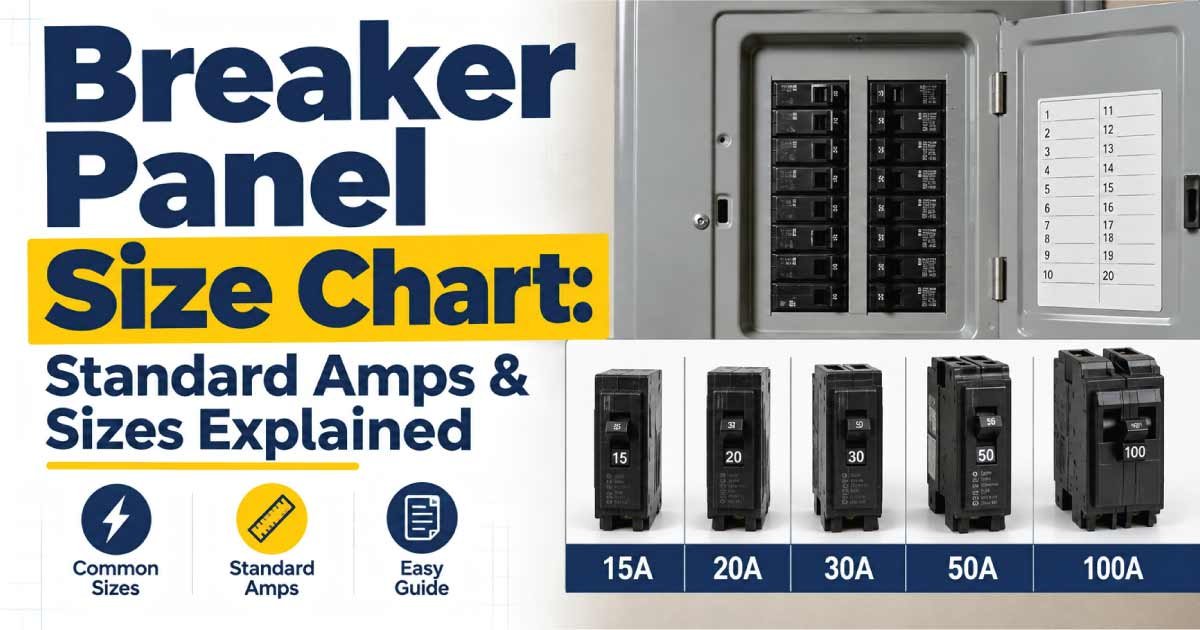
A breaker panel size chart helps homeowners, electricians, builders, and DIY users understand the common electrical panel sizes used in residential and light commercial installations. Electrical panels are available in different amp ratings, circuit capacities, physical sizes, and breaker configurations.
Common service and panel ratings include 60A, 100A, 125A, 150A, 200A, and 400A. However, choosing the correct breaker panel is not simply a matter of selecting the largest amp rating available. The panel must match the electrical service, feeder conductors, main breaker, load requirements, available fault current, and applicable electrical code.
A properly sized panel provides enough capacity for existing circuits while leaving reasonable room for future electrical expansion.
What Is a Breaker Panel?
A breaker panel, also called an electrical panel, distribution board, load center, or consumer unit depending on the electrical system, is the central point where electrical power is distributed to individual circuits.
The panel contains protective devices such as:
- Main breaker
- Branch circuit breakers
- Neutral busbar
- Grounding busbar
- Busbars
- Circuit terminals
- Panel enclosure
The main service conductors supply the panel, while individual breakers distribute electricity to lighting, receptacles, appliances, HVAC equipment, water heaters, and other circuits.
Panel selection involves both electrical capacity and physical circuit capacity.
Breaker Panel Size Chart
The following chart provides a general reference for common electrical panel amp ratings and their typical applications.
| Panel Rating | Typical Application | General Circuit Capacity |
|---|---|---|
| 60A | Small older homes, garages, small buildings | Limited |
| 100A | Small to medium homes | Moderate |
| 125A | Residential upgrades and medium loads | Moderate to high |
| 150A | Larger residential electrical systems | High |
| 200A | Modern larger homes | High |
| 225A | Larger residential/light commercial systems | Very high |
| 300A | High-demand electrical installations | Very high |
| 400A | Large homes and commercial applications | Extremely high |
The appropriate service rating depends on a load calculation, not simply the number of rooms or appliances.
Common Breaker Panel Sizes
60 Amp Breaker Panel
A 60A panel represents a relatively small electrical service compared with modern residential installations.
It may be found in:
- Older homes
- Small cabins
- Detached garages
- Workshops
- Small utility buildings
A 60A service can become restrictive when multiple high-power appliances are added.
100 Amp Breaker Panel
A 100A panel has historically been common in residential electrical systems.
It may provide adequate capacity for a smaller home depending on the electrical loads.
Typical circuits can include:
- Lighting
- General receptacles
- Kitchen circuits
- Water heater
- HVAC equipment
- Laundry
- Small appliances
Whether 100A is sufficient must be determined by a proper load calculation.
125 Amp Breaker Panel
A 125A panel provides more service capacity than a 100A panel and may be selected for residential installations with somewhat higher electrical demand.
It can be useful when the calculated load is above what a smaller service can reasonably support but does not require a 200A service.
150 Amp Breaker Panel
A 150A panel can provide additional capacity for larger homes and installations with several significant electrical loads.
Potential loads include:
- Central air conditioning
- Electric water heating
- Electric cooking
- Laundry equipment
- Workshop equipment
- Multiple large appliances
The service conductors and utility connection must also be suitable for the selected service rating.
200 Amp Breaker Panel
A 200A panel is a common choice for many modern residential electrical services.
It can provide substantial capacity for:
- Large homes
- Multiple HVAC systems
- Electric ranges
- Water heaters
- Laundry equipment
- Workshops
- EV charging
- Future electrical expansion
A 200A panel does not mean that every branch circuit can collectively operate at 200A continuously. The overall installation still requires proper load calculations and demand considerations.
400 Amp Breaker Panel
A 400A electrical service is generally associated with very high-demand residential, commercial, industrial, or multi-load installations.
A 400A system may use multiple service disconnects or specially configured equipment rather than simply one conventional residential panel.
Breaker Panel Size vs Number of Circuits
Amp rating and circuit count are two different panel specifications.
For example, a panel may be rated for 200A while having:
- 12 spaces
- 20 spaces
- 24 spaces
- 30 spaces
- 40 spaces
- 42 spaces
- More spaces depending on the panel design
The number of spaces determines how many breaker positions are physically available, while the amp rating relates to the panel’s electrical capacity.
Therefore:
More breaker spaces ≠ higher service amperage.
A 100A panel can have more breaker spaces than another 200A panel, depending on the manufacturer and configuration.
Breaker Panel Spaces Chart
Here is a general planning chart for common panel configurations.
| Panel Spaces | Typical Use | Expansion Potential |
|---|---|---|
| 8–12 spaces | Small installations | Low |
| 16 spaces | Small residential systems | Low to moderate |
| 20 spaces | Small to medium homes | Moderate |
| 24 spaces | Medium residential systems | Moderate |
| 30 spaces | Larger residential systems | High |
| 40 spaces | Large homes and equipment | High |
| 42+ spaces | Large or complex installations | Very high |
Actual breaker compatibility depends on the specific panelboard design.
Breaker Panel Size Chart by Home Size
Home floor area alone should not determine electrical service size. Electrical demand depends on the appliances and equipment installed.
Nevertheless, the following is a broad planning reference:
| Home Type | Possible Service Range to Evaluate |
|---|---|
| Small cabin or limited-load building | 60–100A |
| Small home | 100–125A |
| Medium home | 125–200A |
| Large home | 200A or more |
| High-electrical-demand home | 200–400A |
This table is only a general guide. A home with electric heating, multiple HVAC systems, an EV charger, electric cooking, and other high-demand equipment may require substantially more capacity than a similarly sized home using gas appliances.
How Many Breakers Can a Panel Have?
The number of breakers a panel can accommodate depends on its number of spaces, manufacturer’s instructions, breaker type, and approved configurations.
For example, a panel with 24 spaces does not necessarily accept 24 breakers of every possible type.
Some panels may allow specific tandem or space-saving breakers, while others may not.
Always use breakers specifically listed or identified as compatible with the panel.
Do not assume that a breaker will fit safely simply because it physically fits the busbar.
Breaker Panel Amp Rating Explained
The panel’s amp rating represents its designed current capacity under its specified conditions.
Common ratings include:
60A → 100A → 125A → 150A → 200A → 225A → 300A → 400A
The panel rating must be coordinated with the incoming service or feeder.
For example, installing a panel with a larger rating does not automatically increase the capacity of the utility service.
If an existing service is rated at 100A, simply installing a panel labeled 200A does not turn the electrical service into a 200A service.
A service upgrade may require changes to:
- Service conductors
- Meter equipment
- Main disconnect
- Service entrance equipment
- Grounding and bonding
- Utility connection
Breaker Panel Size and Main Breaker
The main breaker provides overcurrent protection and disconnecting functionality for the panel or service, depending on the system configuration.
Common residential main breaker ratings include:
- 60A
- 100A
- 125A
- 150A
- 175A
- 200A
Larger electrical systems may use higher ratings.
The main breaker rating must be appropriate for the panel, conductors, service equipment, and electrical system.
Breaker Panel Size and Wire Size
The panel rating must be coordinated with the feeder or service conductor size.
There is no single universal wire size for every 200A or 100A installation because conductor selection depends on factors such as:
- Copper or aluminum conductor
- Insulation temperature rating
- Installation method
- Ambient temperature
- Number of current-carrying conductors
- Terminal ratings
- Conductor length
- Voltage drop
- Applicable electrical code
For this reason, a simple “panel rating = wire size” chart can be misleading.
The conductor must be properly sized for the actual installation and protective device.
Breaker Panel Load Calculation
Before selecting a panel size, the electrical demand should be calculated.
A basic load assessment considers major loads such as:
- General lighting
- Receptacles
- Kitchen appliances
- Electric range
- Water heater
- HVAC
- Electric heating
- Clothes dryer
- EV charger
- Pool equipment
- Workshop machinery
The calculation may include demand factors permitted by the applicable electrical code rather than simply adding the nameplate ratings of every appliance.
This helps determine whether a 100A, 125A, 150A, 200A, or larger service is appropriate.
Breaker Panel Size for EV Chargers
Electric vehicle chargers can significantly increase electrical demand.
For example, a home with:
- Electric heating
- Electric water heating
- Electric cooking
- Central air conditioning
- An EV charger
may require a more detailed load assessment than a home with gas heating and cooking.
The EV charging equipment should be evaluated according to its required circuit rating, continuous-load characteristics, conductor size, and protective-device requirements.
A panel upgrade may be necessary in some installations, but it should not be assumed without performing the required calculations.
Discover More:
Breaker Panel Size for Electric Appliances
Large electric appliances can have a significant effect on service demand.
Common high-load equipment includes:
- Electric water heaters
- Electric dryers
- Electric ranges
- Ovens
- HVAC systems
- Heat pumps
- Electric furnaces
- EV chargers
- Welders
When several high-power appliances are installed together, the existing service capacity should be evaluated.
Main Panel vs Subpanel
A main panel is generally the primary distribution point for an electrical service or building.
A subpanel receives power from an upstream panel and distributes circuits to another area.
Subpanels are commonly installed for:
- Garages
- Workshops
- Home additions
- Detached buildings
- Basement renovations
- Large extensions
A subpanel’s feeder rating, breaker size, conductor size, grounding/bonding arrangement, and panel configuration must be designed correctly.
A 100A-rated subpanel does not necessarily require a 100A feeder if its actual calculated load is lower, but the feeder and protective device must be properly coordinated.
Breaker Panel Types
Main Breaker Panel
A main breaker panel contains a primary disconnecting means and branch circuit breakers.
Main Lug Only Panel
A main-lug-only panel typically does not have a main breaker in the same enclosure and is commonly used where an upstream disconnect provides the required protection.
Subpanel
A subpanel is supplied from another distribution point and provides additional branch circuits.
Meter Main Panel
A meter-main combination integrates electrical metering equipment with disconnecting and distribution equipment in a single assembly, where permitted.
Outdoor Electrical Panel
Outdoor-rated panels are designed for exposure conditions according to their enclosure rating.
Breaker Panel Size and Physical Dimensions
Electrical panel dimensions vary considerably by manufacturer and model.
A panel’s physical size may depend on:
- Number of breaker spaces
- Main breaker configuration
- Indoor or outdoor installation
- Enclosure type
- Wire-bending space
- Cable entry locations
- Required clearances
- Equipment configuration
Therefore, there is no universal physical dimension for a “200A panel.”
When replacing a panel, measure the available wall space and verify the new equipment’s dimensions before purchasing.
Discover More:
How to Choose the Right Breaker Panel Size
Follow these steps when selecting an electrical panel.
1. Calculate the Electrical Load
Determine the expected demand of the building and major electrical equipment.
2. Determine Service Capacity
Establish whether the existing electrical service can support the calculated load.
3. Choose the Amp Rating
Select an appropriate panel/service rating based on the calculated demand and applicable requirements.
4. Count Required Circuits
List existing and planned branch circuits.
5. Allow Room for Expansion
Consider future additions such as:
- EV chargers
- HVAC upgrades
- Workshop circuits
- Solar equipment
- Additional appliances
- Home additions
6. Verify Breaker Compatibility
Use only breakers approved for the specific panel.
7. Check Physical Requirements
Verify panel dimensions, enclosure rating, wiring space, mounting requirements, and required clearances.
Breaker Panel Size Chart Quick Reference
| Panel Rating | Typical General Application |
|---|---|
| 60A | Small or limited-load installations |
| 100A | Smaller residential systems |
| 125A | Medium residential loads |
| 150A | Larger residential systems |
| 200A | Modern residential systems |
| 225A | Larger residential/light commercial |
| 300A | High-demand systems |
| 400A | Very high-demand installations |
Remember that these ratings are reference values, not automatic recommendations.
Common Breaker Panel Sizing Mistakes
Choosing a Panel by House Size Alone
Square footage does not determine electrical demand by itself.
Confusing Panel Rating With Circuit Capacity
A 200A panel does not mean every branch circuit is rated at 200A.
Ignoring Future Loads
Installing a panel with very few spaces can make future expansion difficult.
Adding Breakers Without Checking Capacity
Unused breaker spaces do not necessarily mean additional service capacity is available.
Using Incompatible Breakers
Only breakers approved for the particular panel should be installed.
Ignoring Physical Clearance
Panels require appropriate working space and access around the equipment.
Assuming a Larger Panel Solves an Overloaded Service
A larger enclosure does not automatically increase the capacity of the incoming electrical service.
Discover More:
Frequently Asked Questions
What are the most common breaker panel sizes?
Common breaker panel ratings include 60A, 100A, 125A, 150A, and 200A, with larger systems using 225A, 300A, or 400A equipment. The correct size depends on the calculated electrical demand, service capacity, conductors, and applicable electrical requirements.
Is a 200 amp panel enough for a house?
A 200A panel can provide substantial capacity for many residential installations, but whether it is enough depends on the home’s electrical loads. Electric heating, HVAC systems, EV charging, water heating, cooking, and other major loads should be included in a proper load calculation.
How many breakers can a 200 amp panel hold?
A 200A panel can have different numbers of breaker spaces depending on its design. Common configurations include 20, 24, 30, 40, and 42 spaces. The number of spaces is separate from the panel’s 200A electrical rating.
Can I replace a 100 amp panel with a 200 amp panel?
A 200A panel may be installed as part of a service upgrade, but simply replacing the enclosure does not increase the existing service capacity. Service conductors, meter equipment, disconnects, utility requirements, and the overall installation must be evaluated.
What size breaker panel is best for a new home?
There is no universal best panel size. The correct choice should be based on a calculated electrical load, required circuits, available service capacity, major appliances, future expansion, and applicable electrical regulations. A qualified electrician can determine the appropriate configuration for the installation.
Conclusion
A breaker panel size chart provides a useful starting point for comparing common electrical panel ratings, from smaller 60A panels to larger 400A systems. However, panel selection involves much more than choosing an amp number.
The correct panel should provide adequate service capacity, breaker spaces, conductor compatibility, fault protection, physical working space, and room for future circuits.
For a residential or commercial installation, perform the required electrical load calculation before selecting the panel rating. The final equipment should also be compatible with the electrical system and installed according to applicable electrical requirements.