Knowing how to measure wire gauge is important when replacing electrical wire, checking an existing installation, selecting a conductor, or matching wire to a terminal or connector. Wire gauge describes the conductor’s size, but it is not always obvious from the outside of an insulated cable.
The most common system for smaller electrical conductors in North America is American Wire Gauge (AWG). AWG numbers work in reverse: a smaller AWG number means a larger conductor, while a larger AWG number means a smaller conductor.
You can determine wire gauge by measuring the conductor’s diameter, using an AWG wire gauge tool, or comparing the measured conductor with a reliable wire gauge chart. This guide explains each method, shows common AWG dimensions, and covers the mistakes that can lead to incorrect measurements.
What Is Wire Gauge?
Wire gauge is a standardized way of describing the physical size of a wire conductor. For AWG wire, the gauge number is related to the conductor’s diameter and cross-sectional area.
For example, 12 AWG wire is larger than 14 AWG wire, and 10 AWG is larger than 12 AWG. This reverse numbering system can be confusing when you first work with electrical wire.
Wire gauge is primarily concerned with the metal conductor, not the outside diameter of the complete insulated cable.
A cable can have thick insulation around a relatively small conductor, while another cable can have thinner insulation around a larger conductor. Therefore, measuring only the outside of the insulation does not normally tell you the actual AWG size.
Wire size matters because conductor dimensions influence:
- Electrical resistance
- Current-carrying capability
- Voltage drop
- Physical flexibility
- Terminal compatibility
- Connector selection
- Heating under load
The appropriate wire size also depends on factors beyond gauge, including conductor material, insulation temperature rating, installation conditions, circuit length, and applicable electrical requirements.
AWG Wire Gauge and Diameter
The easiest way to understand AWG is to compare gauge numbers with conductor diameter.
The following commonly used AWG dimensions provide useful reference points. Diameter values are approximate nominal conductor diameters.
| AWG Size | Nominal Diameter (mm) | Nominal Diameter (in) |
|---|---|---|
| 10 | 2.588 | 0.1019 |
| 12 | 2.053 | 0.0808 |
| 14 | 1.628 | 0.0641 |
| 16 | 1.291 | 0.0508 |
| 18 | 1.024 | 0.0403 |
| 20 | 0.812 | 0.0320 |
| 22 | 0.644 | 0.0253 |
| 24 | 0.511 | 0.0201 |
| 26 | 0.405 | 0.0159 |
| 28 | 0.321 | 0.0126 |
| 30 | 0.255 | 0.0100 |
The important relationship is that AWG diameter decreases as the gauge number increases.
This means you should not interpret a larger number as a physically larger wire.
How to Measure Wire Gauge Step by Step
There are several ways to determine wire gauge. The most reliable method depends on whether you have access to an AWG gauge tool, a digital caliper, or only the wire itself.
1. Disconnect and Prepare the Wire
Before measuring an electrical conductor, make sure it is safe to handle.
If the wire is installed in an energized circuit, do not strip or manipulate it simply to determine its size. Follow appropriate electrical safety procedures and verify that the circuit is de-energized before working on the conductor.
For loose wire, place it on a clean surface where you can examine the conductor without damaging it.
If the conductor is insulated, you may need to expose a short section to measure the metal conductor directly.
2. Remove Insulation From a Small Section
If the conductor is insulated and the gauge marking is unavailable, carefully remove enough insulation to expose the metal.
Use an appropriate wire-stripping tool rather than cutting deeply into the conductor.
A nicked or partially cut conductor can affect its physical condition and may make accurate measurement more difficult.
For stranded wire, avoid separating or damaging individual strands during preparation.
3. Identify the Conductor Type
Before measuring, determine whether you are dealing with:
- Solid wire
- Stranded wire
- Bare conductor
- Insulated conductor
- Single-conductor cable
- Multi-conductor cable
This distinction matters because solid and stranded conductors should not always be measured in exactly the same way.
A solid conductor has one continuous metal body, so measuring its diameter is relatively straightforward. A stranded conductor consists of multiple smaller wires and requires a different approach.
4. Measure the Conductor
For solid wire, measure the diameter of the exposed metal conductor using a digital caliper or micrometer.
Take the measurement across the conductor at approximately 90 degrees to its length.
Avoid measuring over insulation, surface contamination, or damaged sections.
If using a caliper, close the jaws gently until they contact the conductor. Do not compress the metal unnecessarily because excessive pressure can affect the measurement.
5. Compare the Diameter With an AWG Chart
Once you have the conductor diameter, compare it with a reliable AWG chart.
For example, if your measured diameter is close to 1.63 mm, it corresponds approximately to 14 AWG.
If it is close to 2.05 mm, it corresponds approximately to 12 AWG.
Because real wire can vary slightly due to manufacturing tolerances, surface condition, measurement technique, and conductor construction, do not assume that a tiny difference automatically means a different gauge.
6. Confirm the Result
If the measurement is important for electrical work, confirm the result using additional information.
Look for:
- Printing or markings on the insulation
- Manufacturer information
- Cable labeling
- Existing documentation
- Product specifications
- An AWG gauge tool
When the measured size and printed marking disagree, investigate the discrepancy rather than automatically choosing whichever value appears more convenient.
How to Measure Wire Gauge With a Caliper
A digital caliper is one of the most useful tools for measuring the diameter of a solid conductor.
Follow these steps:
- Expose a clean section of the conductor.
- Zero the caliper if necessary.
- Place the conductor between the measuring jaws.
- Position the jaws perpendicular to the wire.
- Close the jaws gently.
- Record the diameter.
- Compare the measurement with an AWG chart.
- Repeat the measurement at another point if the result appears uncertain.
A caliper is particularly useful when the wire has no visible gauge marking.
Why Measure More Than Once?
A single measurement can be misleading if the conductor is not perfectly round, if the caliper is tilted, or if the wire has been damaged.
For greater confidence, take several measurements and check whether they produce approximately the same result.
How to Measure Stranded Wire Gauge
Measuring stranded wire is more complicated than measuring solid wire because the conductor is made from multiple individual strands.
The outside diameter of a stranded bundle does not automatically provide a direct AWG designation in the same way as measuring a solid conductor.
A stranded wire may contain:
- A specific number of strands
- Individual strand diameters
- A particular stranding arrangement
- Different compacting or construction methods
If the wire is marked, the manufacturer’s identification should normally be preferred over estimating its gauge from the outside diameter.
For an unmarked stranded conductor, you can inspect the strand construction and use conductor information where available. Measuring one strand alone does not tell you the gauge of the complete conductor.
Can You Measure Stranded Wire With a Caliper?
You can measure the overall stranded bundle, but that measurement should not automatically be treated as an equivalent solid-wire diameter.
For accurate identification, use the conductor’s markings, manufacturer specifications, or an appropriate wire gauge method designed for the particular conductor construction.
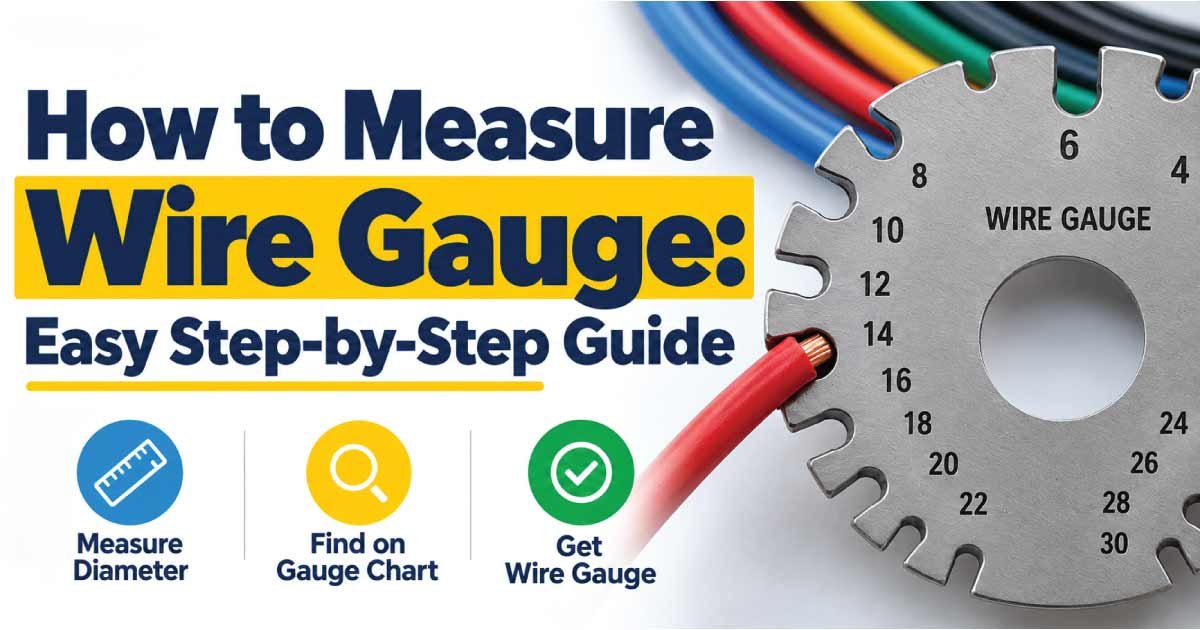
How to Use an AWG Wire Gauge Tool
An AWG wire gauge tool is designed to help identify wire size by matching a conductor to labeled openings or slots.
To use one:
- Strip a small section of insulation if necessary.
- Select an opening that appears close to the conductor.
- Insert the conductor into the gauge opening.
- Check how closely it fits.
- Compare adjacent sizes if necessary.
- Read the AWG number corresponding to the correct opening.
A gauge tool can be faster than measuring diameter and then looking up the result manually.
However, the tool must be appropriate for the type and size of wire being measured.
Discover More:
How to Measure Wire Gauge Without Stripping the Wire
If you cannot expose the conductor, you generally cannot determine the exact AWG size simply by measuring the outside diameter of the insulated wire.
The overall diameter includes:
Conductor + insulation + possible additional layers
Insulation thickness can vary significantly between wire types and manufacturers.
Instead, look for printed markings on the insulation. Wire and cable jackets may include information about:
- Conductor size
- Number of conductors
- Voltage rating
- Temperature rating
- Insulation type
- Manufacturer identification
- Applicable product designations
If markings are present and legible, they may provide a more reliable identification method than measuring the cable’s outside diameter.
AWG vs. Metric Wire Size
Not every country uses AWG as its primary wire-sizing system. Metric conductor sizes are commonly expressed using cross-sectional area in square millimeters (mm²).
AWG and mm² are related measurements, but they are not interchangeable labels.
For example, an AWG size may have a nominal cross-sectional area that is close to a particular metric size, but the values are not necessarily identical.
| AWG | Approx. Area (mm²) | Approx. Diameter (mm) |
|---|---|---|
| 10 | 5.26 | 2.588 |
| 12 | 3.31 | 2.053 |
| 14 | 2.08 | 1.628 |
| 16 | 1.31 | 1.291 |
| 18 | 0.823 | 1.024 |
| 20 | 0.519 | 0.812 |
| 22 | 0.326 | 0.644 |
| 24 | 0.205 | 0.511 |
When converting between AWG and metric sizes, use a proper conversion chart rather than assuming that every AWG size has an exact metric equivalent.
Wire Gauge, Diameter, and Cross-Sectional Area
Wire gauge can be described through several related measurements.
Diameter
Diameter measures the distance across a round conductor.
For solid round wire, diameter provides a practical way to identify AWG size.
Cross-Sectional Area
Cross-sectional area describes how much conductor material exists across the conductor’s cross-section.
It is normally expressed in mm² for metric wire sizing.
Resistance
Conductor resistance depends partly on conductor material, length, and cross-sectional area.
A smaller conductor generally has greater resistance per unit length than a larger conductor made from the same material.
However, wire gauge alone is not enough to determine whether a wire is suitable for a particular circuit.
Common Mistakes When Measuring Wire Gauge
Incorrect wire identification often comes from measuring the wrong part of the cable or interpreting AWG numbers incorrectly.
Measuring the Insulation
One of the most common mistakes is measuring the outside diameter of the insulated wire and treating that measurement as the conductor diameter.
The insulation is not part of the AWG conductor dimension.
Assuming a Larger Number Means a Larger Wire
AWG works in reverse.
For example:
10 AWG > 12 AWG > 14 AWG > 16 AWG
In this sequence, 10 AWG is physically the largest conductor.
Measuring a Stranded Bundle Like Solid Wire
A stranded conductor’s outside bundle diameter should not automatically be matched to a solid AWG diameter chart.
Use the appropriate identification method for stranded construction.
Using a Damaged Section
Crushed, flattened, nicked, or corroded conductor sections can produce inaccurate measurements.
Choose a clean and undamaged section whenever possible.
Relying on a Single Approximate Measurement
If a measurement falls between two expected values, repeat it and check the conductor’s markings or manufacturer information.
Discover More:
How to Choose the Correct Wire Size
Measuring the existing wire is only one part of selecting electrical wire.
The correct conductor size for an application can depend on:
- Expected current
- Circuit length
- Voltage
- Allowable voltage drop
- Conductor material
- Insulation temperature rating
- Ambient temperature
- Installation method
- Number of conductors
- Applicable electrical codes and standards
- Equipment and terminal requirements
For this reason, do not select replacement wire solely by measuring the old wire if the original installation may have been incorrectly designed or modified.
A properly selected conductor should satisfy the requirements of the complete electrical system.
Tools for Measuring Wire Gauge
You do not need expensive equipment for every wire-identification task.
| Tool | Best Use | Main Limitation |
|---|---|---|
| AWG Wire Gauge | Quick gauge identification | Must fit the conductor correctly |
| Digital Caliper | Measuring solid conductor diameter | Requires conductor access |
| Micrometer | High-precision diameter measurement | More specialized and slower |
| Wire Stripper | Safely exposing conductor | Does not identify gauge by itself |
| Manufacturer Documentation | Confirming exact wire construction | Only useful when documentation is available |
| Printed Cable Marking | Identifying labeled wire | Marking may be worn or incomplete |
For ordinary solid-wire identification, an AWG gauge and digital caliper are often the most practical options.
Why Wire Gauge Matters
The conductor size affects more than physical dimensions.
A conductor with inadequate capacity for its application can experience excessive heating and voltage drop. At the same time, selecting a larger conductor may affect cost, flexibility, termination, and installation requirements.
Correct sizing therefore requires both accurate measurement and proper electrical design considerations.
This is especially important when working with:
- Branch circuits
- Motors
- Battery systems
- Automotive wiring
- Control panels
- Extension cables
- Industrial equipment
- Low-voltage systems
Always follow the requirements applicable to the specific installation rather than relying on a generic ampacity assumption.
Frequently Asked Questions About Measuring Wire Gauge
How do I measure wire gauge accurately?
To measure wire gauge accurately, expose the conductor and measure its diameter with a caliper or use an appropriate AWG wire gauge tool. Compare the measurement with a reliable AWG chart, then confirm the result using wire markings or manufacturer information when available.
Can I measure wire gauge without stripping insulation?
You generally cannot determine the exact conductor gauge by measuring only the outside of insulated wire because insulation adds to the overall diameter. Check the cable jacket for printed markings or manufacturer information whenever possible.
Is 12 AWG bigger than 14 AWG?
Yes. 12 AWG is larger than 14 AWG. AWG numbers decrease as conductor diameter increases. Therefore, 10 AWG is larger than 12 AWG, and 12 AWG is larger than 14 AWG.
How do I measure stranded wire gauge?
Stranded wire should not automatically be identified by treating its bundle diameter like the diameter of solid wire. Check the conductor markings, manufacturer specifications, strand construction, or use a suitable wire-identification method for the particular stranded conductor.
Can a caliper measure wire gauge?
Yes. A caliper can measure the diameter of a solid conductor, after which the diameter can be compared with an AWG chart. The measurement should be taken carefully on a clean conductor and repeated if the result is uncertain.
Conclusion
Learning how to measure wire gauge makes it easier to identify unknown conductors and verify wire dimensions before selecting components or replacing existing wiring.
For solid wire, the most practical approach is to expose the conductor, measure its diameter with a caliper or AWG gauge tool, and compare the result with a reliable wire gauge chart. Remember that AWG numbering runs in reverse: a smaller gauge number represents a larger conductor.
For stranded wire, insulated cable, and critical electrical installations, rely on conductor markings and manufacturer documentation whenever available. Finally, remember that choosing the correct wire involves more than gauge alone. Current, length, voltage drop, insulation, installation conditions, and applicable requirements must all be considered.