
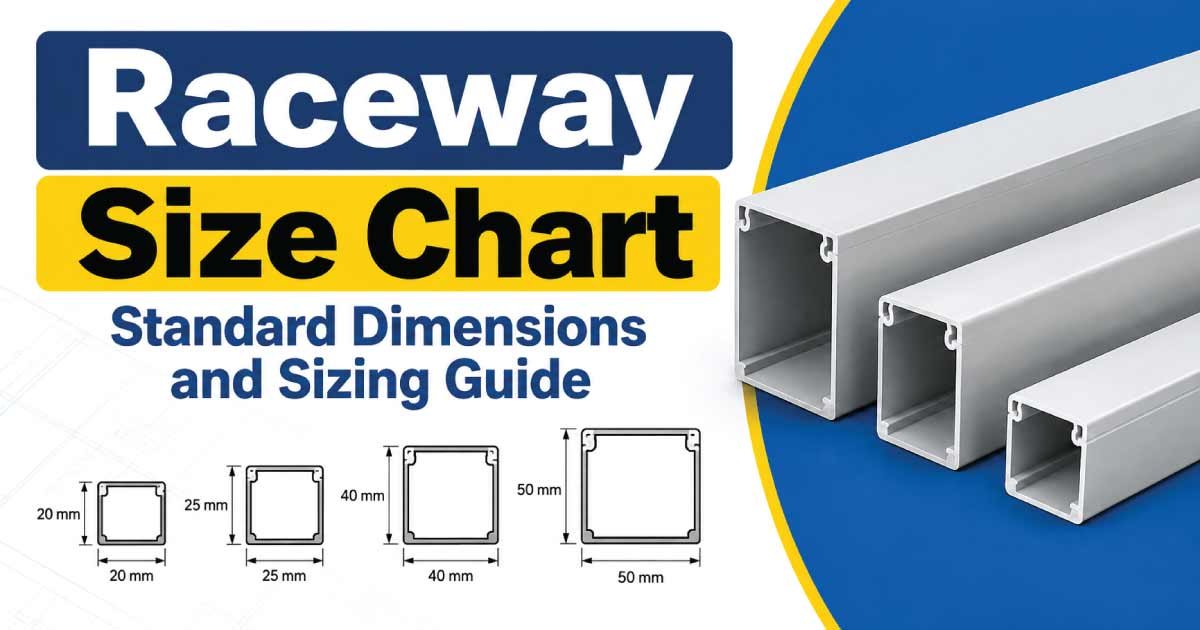
A raceway provides a protected pathway for electrical conductors and cables. It helps organize wiring, protect conductors from physical damage, and create a cleaner and more maintainable electrical installation. Choosing the correct raceway size is important because the raceway must provide sufficient space for the conductors while also meeting applicable fill and installation requirements.
A raceway size chart helps electricians, contractors, engineers, and DIY users compare common raceway sizes and understand how conductor quantity and wire size affect the required raceway.
Raceways are available in several forms, including conduit, tubing, wireways, cable trays, and surface raceways. The correct size depends on the type of wiring system, conductor dimensions, number of conductors, installation method, environmental conditions, and applicable electrical requirements.
What Is an Electrical Raceway?
An electrical raceway is an enclosed or partially enclosed pathway designed to contain, route, and protect electrical conductors.
Raceways can be made from:
- Steel
- Aluminum
- PVC
- Flexible metallic materials
- Nonmetallic materials
- Other approved electrical materials
Common raceway systems include:
- EMT
- RMC
- IMC
- PVC conduit
- Flexible conduit
- Liquidtight conduit
- Wireways
- Surface raceways
- Cable tray systems
The term raceway is therefore broader than the word conduit. Conduit is one type of raceway.
Raceway Size Chart
Raceway sizes are commonly identified by trade size for conduit-type systems or by width and height for rectangular raceways.
| Raceway Size | Approximate Internal Area | Common Application |
|---|---|---|
| 1/2 inch | ~0.30 in² | Small branch circuits |
| 3/4 inch | ~0.53 in² | General wiring |
| 1 inch | ~0.87 in² | Multiple conductors |
| 1-1/4 inch | ~1.50 in² | Feeders and larger circuits |
| 1-1/2 inch | ~2.04 in² | Larger feeders |
| 2 inch | ~3.36 in² | Commercial power distribution |
| 2-1/2 inch | ~4.79 in² | Large feeder systems |
| 3 inch | ~7.39 in² | Industrial wiring |
| 3-1/2 inch | ~9.90 in² | Large cable installations |
| 4 inch | ~12.76 in² | Major feeders and distribution |
These internal areas are representative values for common conduit dimensions and should not be treated as universal for every raceway type. Actual internal dimensions vary according to the raceway material, wall thickness, schedule, and manufacturer.
Understanding Raceway Trade Size
Raceway trade size is a standardized designation used to identify many conduit systems.
Common trade sizes include:
- 1/2 inch
- 3/4 inch
- 1 inch
- 1-1/4 inch
- 1-1/2 inch
- 2 inch
- 2-1/2 inch
- 3 inch
- 3-1/2 inch
- 4 inch
- 5 inch
- 6 inch
One important point is that trade size is not always the same as actual inside diameter.
For example, a 1-inch conduit does not necessarily have exactly 1 inch of usable internal diameter.
The wall thickness changes according to the raceway type, so conduit fill calculations should use the actual internal area for the specific raceway.
Raceway Fill Requirements
One of the most important parts of raceway sizing is conductor fill.
Fill describes how much of the raceway’s internal space is occupied by conductors.
For many conduit installations, commonly used maximum fill percentages are:
| Number of Conductors | Common Maximum Fill |
|---|---|
| 1 conductor | 53% |
| 2 conductors | 31% |
| 3 or more conductors | 40% |
These percentages are widely used as a reference for conduit fill calculations, but specific requirements depend on the applicable electrical code and raceway type.
The remaining space is important because overcrowding can make conductors difficult to install and remove.
How to Calculate Raceway Fill
Raceway fill is calculated by comparing the total cross-sectional area of the conductors with the internal area of the raceway.
The basic formula is:
Fill Percentage = Total Conductor Area ÷ Raceway Internal Area × 100
Example
Suppose the total area of the conductors is 0.25 in² and the raceway has an internal area of 1.00 in².
The fill is:
0.25 ÷ 1.00 × 100 = 25%
If the applicable maximum fill is 40%, this arrangement would be below that particular limit.
The actual calculation should use the published dimensions of the exact conductor and raceway being installed.
Raceway Size Based on Wire Size
The required raceway size depends heavily on conductor size.
Common wire sizes include:
- 14 AWG
- 12 AWG
- 10 AWG
- 8 AWG
- 6 AWG
- 4 AWG
- 2 AWG
- 1 AWG
- 1/0 AWG
- 2/0 AWG
- 3/0 AWG
- 4/0 AWG
Larger conductors occupy more internal raceway space.
However, the AWG number alone is not sufficient for an accurate fill calculation. The actual outside diameter of the insulated conductor must be considered.
Different insulation types can have different outside diameters even when the conductor cross-sectional area is identical.
Raceway Size Chart for Common Wires
The following table provides general planning guidance.
| Wire Size | Typical Raceway Size to Evaluate | Common Application |
|---|---|---|
| 14 AWG | 1/2 inch | Small branch circuits |
| 12 AWG | 1/2–3/4 inch | General branch circuits |
| 10 AWG | 1/2–3/4 inch | Higher-current circuits |
| 8 AWG | 3/4–1 inch | Larger circuits |
| 6 AWG | 3/4–1-1/4 inch | Large branch circuits |
| 4 AWG | 1–1-1/4 inch | Feeders |
| 2 AWG | 1-1/4–1-1/2 inch | Large feeders |
| 1/0 AWG | 1-1/2–2 inch | High-current feeders |
| 4/0 AWG | 2–3 inch | Large distribution systems |
These are general evaluation ranges, not guaranteed raceway requirements. The exact raceway size should be determined using conductor dimensions, conductor quantity, raceway type, and applicable fill requirements.
How Many Wires Can Fit in a Raceway?
There is no universal number of wires that can fit into a specific raceway.
The number depends on:
- Wire size
- Conductor insulation
- Conductor outside diameter
- Raceway internal area
- Number of conductors
- Raceway type
- Applicable fill percentage
For example, a 1/2-inch raceway may accommodate several small conductors, but considerably fewer large conductors.
Therefore, a statement such as “1/2-inch raceway holds 10 wires” is incomplete unless the wire size and conductor type are specified.
Raceway Types and Sizes
Different raceways are designed for different installation conditions.
EMT Raceway
Electrical Metallic Tubing (EMT) is a lightweight metallic raceway commonly used for commercial and industrial wiring.
It is often used for:
- Branch circuits
- Feeders
- Control wiring
- Exposed installations
- Electrical rooms
EMT is available in multiple trade sizes.
Rigid Metal Conduit
Rigid Metal Conduit (RMC) provides strong mechanical protection.
It can be useful in demanding environments where physical protection is important.
Applications may include:
- Industrial facilities
- Outdoor installations
- Exposed wiring
- Areas subject to physical damage
Intermediate Metal Conduit
IMC provides substantial mechanical protection while generally being lighter than RMC.
It is commonly used for commercial and industrial electrical installations.
PVC Raceway
PVC conduit is a nonmetallic raceway often used for underground and corrosion-resistant applications.
Common uses include:
- Underground wiring
- Outdoor electrical systems
- Wet-location applications where the specific product is approved
- Corrosive environments
Flexible Raceway
Flexible raceways are useful where wiring needs to accommodate movement, vibration, or difficult routing.
They are commonly used around:
- Motors
- Machinery
- Equipment
- Vibration-prone connections
Raceway vs Conduit
The terms raceway and conduit are sometimes used interchangeably, but they are not exactly the same.
A raceway is a broader category that can include several wiring pathways.
| Feature | Raceway | Conduit |
|---|---|---|
| Meaning | Broad wiring pathway category | Specific type of raceway |
| Forms | Conduit, wireway, tray, surface raceway, etc. | EMT, RMC, IMC, PVC, etc. |
| Shape | Round or rectangular | Usually tubular |
| Cable access | Depends on type | Generally through ends |
| Applications | Broad | Conductor protection and routing |
Understanding this distinction helps when selecting the correct wiring system.
Raceway Size for Electrical Panels
Raceways are frequently used to connect electrical panels, distribution boards, switchgear, and other equipment.
When selecting a raceway for a panel connection, consider:
- Number of conductors
- Conductor size
- Panel configuration
- Grounding conductors
- Neutral conductors
- Conductor bending space
- Raceway entry location
- Available working space
The raceway should be large enough to accommodate the conductors without exceeding the permitted fill.
Raceway Size for Branch Circuits
Small branch circuits commonly use smaller raceways.
For example, circuits using 14 AWG, 12 AWG, or 10 AWG conductors may be installed in smaller raceways depending on conductor quantity and type.
However, several circuits sharing one raceway can quickly increase the total conductor area.
When multiple circuits share a raceway, calculate the area of all applicable conductors together rather than sizing the raceway for only one circuit.
Raceway Size for Feeders
Feeder circuits typically use larger conductors and therefore require more raceway space.
Common feeder conductors can include:
- 6 AWG
- 4 AWG
- 2 AWG
- 1/0 AWG
- 2/0 AWG
- 3/0 AWG
- 4/0 AWG
Large feeders may require raceways such as 1-1/4, 1-1/2, 2, 2-1/2, or 3 inches, depending on the number and dimensions of the conductors.
For larger installations, multiple raceways may be more practical than placing every conductor in one raceway.
Discover More:
Raceway Fill and Ampacity
Raceway fill and conductor ampacity are separate considerations.
Raceway fill determines whether the conductors physically fit within the permitted area.
Ampacity determines how much current a conductor can safely carry under specific conditions.
A raceway can pass the fill calculation while the conductor system still requires an ampacity or derating review.
Important electrical factors include:
- Conductor ampacity
- Number of current-carrying conductors
- Ambient temperature
- Conductor insulation rating
- Raceway installation method
- Grouping
- Voltage drop
- Overcurrent protection
All applicable factors should be evaluated before finalizing conductor and raceway sizes.
Raceway Size and Voltage Drop
Voltage drop becomes increasingly important as circuit length increases.
A long electrical circuit can experience greater voltage loss because of conductor resistance and reactance.
If a larger conductor is selected to reduce voltage drop, its larger physical dimensions may require a larger raceway.
This creates a useful sizing relationship:
Long circuit → larger conductor → more conductor area → potentially larger raceway
Therefore, raceway sizing should be reviewed after completing the voltage-drop calculation.
Raceway Size for Multiple Circuits
Multiple circuits can share a raceway when the installation permits it.
Before combining circuits, consider:
- Total conductor area
- Number of current-carrying conductors
- Ampacity adjustment
- Circuit voltage
- Separation requirements
- Conductor insulation
- Raceway fill
- Heat dissipation
For example, combining several branch circuits into one raceway may increase both physical fill and conductor derating considerations.
A larger raceway may be required even when each individual circuit would fit easily in a smaller raceway.
How to Choose the Correct Raceway Size
Use the following process for preliminary raceway sizing.
Step 1: Determine the Conductors
List every conductor that will occupy the raceway.
Include:
- Phase conductors
- Neutral conductors where applicable
- Grounding conductors
- Control conductors
- Other permitted conductors
Step 2: Identify Conductor Dimensions
Determine the actual outside diameter or published area for each conductor.
Do not assume that all conductors of the same AWG size have identical dimensions.
Step 3: Calculate Total Area
Add the cross-sectional areas of the conductors.
Step 4: Determine Raceway Area
Use the actual internal area of the selected raceway.
Step 5: Apply the Appropriate Fill Limit
Compare total conductor area with the applicable maximum fill percentage.
Step 6: Check Ampacity
Verify conductor ampacity and any applicable adjustment or correction factors.
Step 7: Check Voltage Drop
For long circuits, calculate voltage drop and increase conductor size if necessary.
Step 8: Check Installation Requirements
Review:
- Bending radius
- Pulling requirements
- Raceway fittings
- Environmental conditions
- Working space
- Support requirements
- Local electrical requirements
Discover More:
Common Raceway Sizing Mistakes
Using the Raceway Trade Size as Its Inside Diameter
Trade size and actual inside diameter are not always identical.
Counting Wires Instead of Calculating Area
The number of wires alone does not determine raceway fill.
Ignoring Insulation Thickness
The same conductor size can have different outside diameters depending on insulation type.
Forgetting Grounding Conductors
Applicable grounding conductors must be included when required by the fill calculation.
Ignoring Multiple Circuits
Every applicable conductor sharing the raceway contributes to the total fill.
Ignoring Derating
A crowded raceway can contain multiple current-carrying conductors, requiring an ampacity review.
Sizing Only for the Current Load
Voltage drop and future expansion can influence the appropriate conductor and raceway size.
Using the Smallest Possible Raceway
A raceway that barely meets the calculated fill may be difficult to pull and work with. Practical installation conditions should also be considered.
Raceway Size FAQs
What is the most common raceway size?
1/2-inch, 3/4-inch, and 1-inch raceways are commonly encountered in smaller electrical installations. Larger raceways such as 1-1/4, 1-1/2, 2, and 3 inches are used for larger conductor groups, feeders, and commercial or industrial systems.
How many wires can fit in 3/4-inch raceway?
The number depends on the conductor size and insulation type. Several small conductors may fit, while fewer large conductors can occupy the same raceway. The correct quantity must be calculated using the actual conductor dimensions and applicable fill percentage.
Is raceway the same as conduit?
Not exactly. Conduit is one type of raceway. The term raceway covers a broader range of wiring pathways, including conduit, wireways, cable trays, and certain surface raceway systems.
Can multiple circuits share one raceway?
Multiple circuits can sometimes share a raceway when permitted by the applicable electrical requirements. However, the combined conductor area, number of current-carrying conductors, ampacity adjustment, circuit characteristics, and other installation requirements must be evaluated.
Does a larger raceway increase wire ampacity?
No. Raceway size does not directly increase the ampacity of a conductor. However, the number of current-carrying conductors inside a raceway can affect heat dissipation and therefore may influence ampacity adjustment requirements.
Conclusion
A raceway size chart provides a useful starting point for selecting the correct pathway for electrical conductors. However, raceway sizing should never be based solely on the trade size or number of wires.
The correct selection depends on conductor size, outside diameter, number of conductors, insulation type, raceway internal area, allowable fill, ampacity, voltage drop, installation method, and environmental conditions.
Common raceway sizes range from 1/2 inch to 4 inches and larger, with smaller raceways generally used for branch circuits and larger raceways used for feeders, distribution systems, and industrial wiring.
For the most reliable installation, calculate conductor fill using the actual dimensions of the selected raceway and conductors, then verify ampacity, voltage drop, bending requirements, and other applicable electrical requirements.
Discover More: