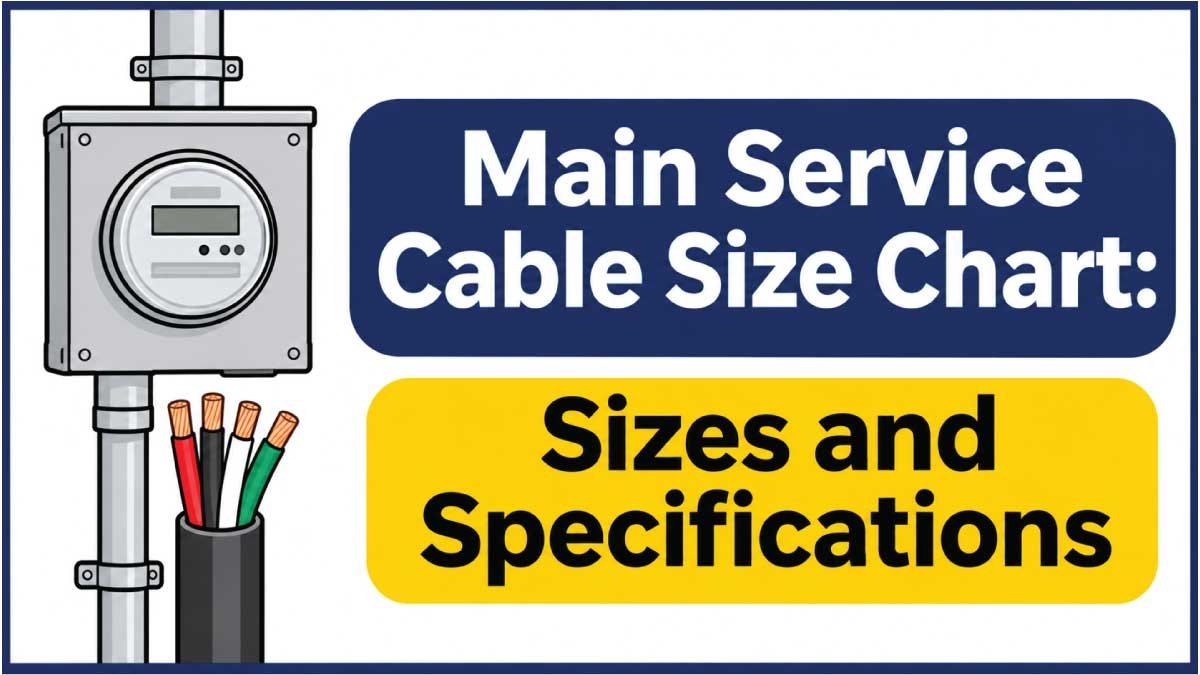
The main service cable is one of the most important components of a residential electrical system. It carries electrical power from the utility supply to the home’s main electrical panel, where electricity is distributed to individual circuits. Selecting the correct service cable size is essential for handling the building’s electrical demand, maintaining voltage stability, and preventing conductor overheating.
A main service cable size chart helps electricians, contractors, and homeowners understand common conductor sizes, service ampacity, copper and aluminum options, and cable specifications. The correct size depends on the electrical service rating, calculated load, conductor material, cable insulation, installation method, and applicable electrical regulations.
This guide explains standard main service cable sizes, common residential service ratings, cable types, conductor specifications, and important factors involved in selecting the appropriate electrical service cable.
What Is a Main Service Cable?
A main service cable is an electrical conductor or cable assembly that supplies power from the utility service connection to a building’s main electrical distribution equipment.
In a typical residential electrical system, service conductors connect the utility supply to the service disconnect and main panel. Their primary function is to deliver sufficient electrical current to support the household’s total electrical demand.
Main service cables are generally larger than ordinary branch-circuit wires because they supply multiple electrical circuits and appliances.
Common applications include:
- Residential electrical service connections.
- Main electrical panel connections.
- Service entrance installations.
- Electrical meter connections.
- Main distribution equipment.
- Certain feeder installations.
The service cable must be appropriately sized to handle the calculated electrical load without exceeding its permitted temperature or voltage-drop limits.
Main Service Cable Size Chart
Main service cable sizes are selected according to the electrical service rating and conductor material. Copper and aluminum conductors have different electrical properties, so their required sizes are not identical.
The following chart provides common conductor sizes for qualifying North American, single-phase residential services under the National Electrical Code (NEC) dwelling-service sizing provisions.
| Service Rating | Copper Cable Size | Aluminum Cable Size |
|---|---|---|
| 100 Amps | 4 AWG | 2 AWG |
| 110 Amps | 3 AWG | 1 AWG |
| 125 Amps | 2 AWG | 1/0 AWG |
| 150 Amps | 1 AWG | 2/0 AWG |
| 175 Amps | 1/0 AWG | 3/0 AWG |
| 200 Amps | 2/0 AWG | 4/0 AWG |
| 225 Amps | 3/0 AWG | 250 kcmil |
| 250 Amps | 4/0 AWG | 300 kcmil |
| 300 Amps | 250 kcmil | 350 kcmil |
| 350 Amps | 350 kcmil | 500 kcmil |
| 400 Amps | 400 kcmil | 600 kcmil |
This reference is based on NEC Table 310.12 for qualifying 120/240-volt, single-phase dwelling services and feeders. It is permitted only when the applicable requirements are satisfied and no additional ampacity adjustment or correction factors are required. Other service arrangements and jurisdictions can require different conductor sizes. <Cite refs={[“turn296976search0″,”turn296976search1”]}/>
Important: This chart is not a universal cable-selection table. The actual installation must account for conductor insulation, terminal temperature ratings, ambient temperature, conductor grouping, service configuration, utility requirements, and local electrical codes.
Common Main Service Cable Sizes and Their Applications
Residential electrical services use different conductor sizes depending on the building’s calculated electrical demand.
100-Amp Main Service Cable
A 100-amp electrical service is found in some smaller residential properties and homes with relatively modest electrical requirements.
Under the qualifying NEC dwelling-service provisions, common conductor options include:
- 4 AWG copper.
- 2 AWG aluminum.
Potential applications include:
- Smaller residential buildings.
- Homes with moderate electrical loads.
- Properties with limited high-demand equipment.
- Certain smaller electrical distribution systems.
The actual service rating must be determined through an electrical load calculation.
150-Amp Main Service Cable
A 150-amp service provides greater electrical capacity than a 100-amp installation.
Common conductor sizes under the qualifying NEC table include:
- 1 AWG copper.
- 2/0 AWG aluminum.
This service rating may be used in residential properties with additional electrical equipment and greater household power requirements.
200-Amp Main Service Cable
A 200-amp service is a common residential electrical service arrangement in North America.
The qualifying NEC conductor sizes are:
- 2/0 AWG copper.
- 4/0 AWG aluminum.
Potential applications include:
- Larger residential properties.
- Homes with electric cooking equipment.
- Properties with multiple major appliances.
- Homes with substantial heating and cooling loads.
- Residential electrical distribution systems designed for 200 amps.
A 200-amp service does not automatically mean every installation requires the same cable construction or termination arrangement. The service design must be evaluated as a complete system.
300-Amp Main Service Cable
A 300-amp service is used in larger residential or specialized electrical installations.
The qualifying NEC table lists:
- 250 kcmil copper.
- 350 kcmil aluminum.
These larger conductors are designed for higher electrical service ratings and require suitable service equipment, connectors, and installation methods.
400-Amp Main Service Cable
A 400-amp service provides substantial electrical capacity and may be used in large homes or properties with extensive electrical equipment.
Common conductor sizes under the qualifying NEC table include:
- 400 kcmil copper.
- 600 kcmil aluminum.
These installations require professional load calculations, appropriate service equipment, and careful coordination with the utility provider.
Types of Main Service Cables
Main service conductors are available in different cable constructions and insulation types. The appropriate selection depends on whether the installation is overhead, underground, or connected through an approved raceway.
1. Service Entrance Cable (SE Cable)
Service entrance cable is designed for certain electrical service installations.
Common varieties include:
- SEU cable.
- SER cable.
SEU Cable
SEU cable commonly contains two insulated conductors and a concentric bare neutral conductor. It is used in certain single-phase residential service applications where permitted.
SER Cable
SER cable commonly contains multiple insulated conductors and a grounding or neutral conductor arrangement appropriate to its application.
It is frequently used for certain residential feeder installations.
The two constructions are not interchangeable. Their permitted applications depend on the electrical system and applicable code.
2. Underground Service Cable
Underground service conductors are designed for installations where electrical supply cables are routed below ground.
Depending on the jurisdiction and installation, suitable options may include:
- USE cable.
- Approved underground-rated cable assemblies.
- Individual conductors installed in suitable raceways.
Important characteristics include:
- Appropriate moisture resistance.
- Suitable insulation ratings.
- Compatibility with underground installation conditions.
- Protection against mechanical damage where required.
Not every underground-rated cable is permitted for every indoor or service-entrance application.
3. THHN and THWN-2 Conductors
THHN and THWN-2 are common insulation designations for individual electrical conductors.
They are frequently used in approved conduit systems.
Characteristics include:
- Thermoplastic insulation.
- Different environmental and temperature ratings.
- Availability in copper and aluminum versions where manufactured.
- Suitability for specific conduit installations.
THWN-2 conductors are designed for wet-location applications when installed according to their listing and applicable requirements.
4. XHHW-2 Cable
XHHW-2 conductors use cross-linked polyethylene insulation.
They are used in certain service and feeder installations.
Common characteristics include:
- Thermoset insulation.
- Resistance to moisture under the applicable rating.
- Availability in different conductor sizes.
- Suitability for approved raceway and electrical distribution applications.
The final conductor selection must account for the equipment termination ratings and installation conditions.
Copper vs. Aluminum Main Service Cable
Copper and aluminum are the two main conductor materials used in residential service installations.
Both can be suitable when properly sized and installed, but they have different electrical and mechanical characteristics.
| Specification | Copper Cable | Aluminum Cable |
|---|---|---|
| Electrical conductivity | Higher | Lower |
| Weight | Heavier | Lighter |
| Conductor size for comparable performance | Generally smaller | Generally larger |
| Material cost | Generally higher | Generally lower |
| Flexibility | Depends on construction | Depends on construction |
| Connection requirements | Compatible copper-rated terminals | Aluminum-rated compatible terminals |
| Common applications | Branch circuits and service conductors | Larger service and feeder conductors |
Advantages of Copper Service Cable
Copper offers several benefits:
- High electrical conductivity.
- Smaller conductor dimensions for comparable electrical performance.
- Good mechanical strength.
- Widely available electrical connectors.
- Established use in residential electrical installations.
Its main disadvantages are higher material cost and greater weight compared with aluminum.
Advantages of Aluminum Service Cable
Aluminum is widely used in larger electrical distribution systems.
Its advantages include:
- Lower weight.
- Generally lower material cost.
- Availability in large conductor sizes.
- Suitability for many service and feeder applications.
However, aluminum conductors require appropriate sizing, compatible connectors, and correct termination procedures.
Important: Copper and aluminum conductors must never be connected using incompatible terminals. Use electrical equipment and connectors specifically listed for the conductor material.
Main Service Cable Specifications
Understanding the technical specifications of a main service cable helps determine whether it is suitable for a particular electrical installation.
1. Conductor Size
Conductor size refers to the cross-sectional area of the metal conductor.
In North America, it is commonly expressed using AWG or kcmil.
- AWG is used for smaller and medium-sized conductors.
- kcmil is commonly used for larger electrical conductors.
A larger conductor generally has lower resistance for the same material and length.
2. Conductor Material
The material determines important electrical and mechanical characteristics.
Common materials include:
- Copper.
- Aluminum.
- Copper-clad aluminum where permitted.
The material must be identified before selecting the conductor size and connector system.
3. Insulation Type
Insulation protects the conductor against electrical contact and environmental exposure.
Common designations include:
- THHN.
- THWN-2.
- XHHW-2.
- USE.
- Other approved service cable insulation types.
Each designation has specific temperature, moisture, and installation requirements.
4. Voltage Rating
The voltage rating identifies the electrical system conditions for which the cable is approved.
Residential service cables must be suitable for the nominal voltage and installation arrangement of the electrical system.
5. Temperature Rating
Electrical conductors have insulation temperature ratings, commonly including 60°C, 75°C, and 90°C.
However, the usable ampacity may be limited by the temperature rating of connected terminals and electrical equipment.
The highest insulation temperature rating cannot automatically be used as the final ampacity rating.
6. Number of Conductors
Main service cable assemblies can contain different conductor arrangements.
Common residential configurations include:
- Two ungrounded conductors and one grounded neutral conductor.
- Two ungrounded conductors, one neutral conductor, and a separate equipment grounding conductor where required.
The correct arrangement depends on the electrical service configuration and applicable wiring requirements.
Also Read:
Main Service Cable Size by Conductor Diameter
AWG and kcmil identify conductor dimensions using standardized sizing systems.
The following table provides approximate bare conductor diameters and cross-sectional areas for common service cable sizes.
| Conductor Size | Diameter (mm) | Area (mm²) |
|---|---|---|
| 4 AWG | 5.19 | 21.15 |
| 3 AWG | 5.83 | 26.67 |
| 2 AWG | 6.54 | 33.62 |
| 1 AWG | 7.35 | 42.41 |
| 1/0 AWG | 8.25 | 53.49 |
| 2/0 AWG | 9.27 | 67.43 |
| 3/0 AWG | 10.40 | 85.03 |
| 4/0 AWG | 11.68 | 107.22 |
| 250 kcmil | 12.70 | 126.68 |
| 300 kcmil | 13.90 | 152.00 |
| 350 kcmil | 15.00 | 177.35 |
| 400 kcmil | 16.00 | 202.68 |
| 500 kcmil | 17.90 | 253.35 |
| 600 kcmil | 19.50 | 304.02 |
These are approximate nominal dimensions of bare conductors. Insulated cable diameter is larger and varies with the conductor construction and insulation thickness.
Also Read:
How to Choose the Correct Main Service Cable Size
Selecting a main service cable requires an evaluation of the building’s electrical requirements and installation conditions.
1. Calculate the Total Electrical Load
The first step is determining the expected electrical demand of the property.
A residential load calculation may include:
- General lighting and receptacles.
- Kitchen appliances.
- Electric cooking equipment.
- Water heaters.
- Heating and air-conditioning systems.
- Laundry equipment.
- Electric vehicle charging equipment.
- Other permanently installed electrical loads.
The calculated demand helps determine the required service rating.
The total of all appliance nameplate ratings should not automatically be treated as the final service demand. Applicable electrical demand factors and load calculation rules must be used.
2. Determine the Service Rating
After calculating the electrical demand, the appropriate service rating can be selected.
Common North American residential service ratings include:
- 100 amps.
- 125 amps.
- 150 amps.
- 200 amps.
- 300 amps.
- 400 amps.
The service rating must be compatible with the electrical panel, service disconnect, utility supply, and conductor design.
3. Select Copper or Aluminum Conductors
Identify the conductor material before determining the required cable size.
Copper and aluminum have different ampacity characteristics, so their dimensions cannot be compared using AWG numbers alone.
4. Consider Cable Length and Voltage Drop
Long service conductors can experience voltage drop.
This becomes particularly important when the distance between the supply connection and service equipment is substantial.
A larger conductor may be necessary to maintain acceptable voltage under load.
5. Evaluate Installation Conditions
Several conditions can affect conductor ampacity:
- Ambient temperature.
- Number of current-carrying conductors.
- Conduit installation.
- Insulation temperature rating.
- Underground or outdoor exposure.
- Heat dissipation.
- Terminal temperature limitations.
The appropriate correction and adjustment factors must be applied when required.
6. Check Utility and Local Code Requirements
Electrical utilities may specify requirements for:
- Service entrance conductors.
- Meter connections.
- Overhead service connections.
- Underground service installations.
- Approved cable materials.
- Service disconnect arrangements.
The local authority having jurisdiction and utility provider must be consulted before installation.
Also Read:
Overhead vs. Underground Main Service Cables
Residential electrical services generally receive power through overhead or underground connections.
Each arrangement has different cable and installation requirements.
Overhead Service Cable
An overhead service uses conductors routed through the air from the utility distribution system to the building’s service connection.
Common characteristics include:
- Exposure to outdoor environmental conditions.
- Support requirements.
- Suitable weather-resistant construction.
- Required clearances from buildings and other structures.
The utility may supply and maintain some or all of the overhead service conductors, depending on the local arrangement.
Underground Service Cable
An underground service routes electrical conductors below ground.
Common characteristics include:
- Protection against moisture.
- Appropriate underground cable or raceway construction.
- Required burial depth.
- Mechanical protection where necessary.
- Suitable underground connection equipment.
Underground service installations must follow local utility specifications and electrical code requirements.
Common Main Service Cable Installation Mistakes
Incorrect service cable selection can create serious electrical problems.
Using an Undersized Service Cable
An undersized conductor may overheat when carrying the building’s electrical load.
Always calculate the service demand and verify conductor ampacity.
Ignoring Temperature Ratings
A cable with a high insulation temperature rating may still be limited by the connected equipment’s terminal rating.
Always apply the appropriate ampacity rules.
Selecting Cable Based Only on Service Amperage
The service rating is important, but it does not describe every installation condition.
Conductor material, cable length, insulation, and installation method also matter.
Using Incompatible Connectors
Connectors must be approved for the conductor material and size.
Incorrect connections can cause excessive resistance and overheating.
Ignoring Voltage Drop
Long service conductor runs may require larger conductors than the minimum ampacity calculation indicates.
Failing to Coordinate With the Utility
Service installations must be compatible with the utility’s connection and metering requirements.
Never assume that a cable suitable for one utility installation will automatically be accepted by another.
Frequently Asked Questions About Main Service Cable Sizes
What Size Cable Is Used for a 100-Amp Main Service?
Under the qualifying NEC single-phase dwelling-service table, 4 AWG copper or 2 AWG aluminum conductors are listed for a 100-amp service.
Other installation conditions and electrical standards may require different sizes.
What Size Cable Is Required for a 200-Amp Main Service?
The qualifying NEC dwelling-service table lists 2/0 AWG copper or 4/0 AWG aluminum for a 200-amp service.
The final selection must account for applicable adjustment factors, correction factors, and equipment ratings.
Is Copper Better Than Aluminum for Main Service Cable?
Copper offers higher electrical conductivity for the same conductor dimensions. Aluminum is lighter and often more economical for larger service conductors.
Both can be suitable when properly sized and installed using compatible electrical equipment.
What Is the Difference Between SER and SEU Cable?
SER and SEU are different service entrance cable constructions.
SER commonly contains multiple insulated conductors and a grounding or neutral arrangement suitable for certain feeder applications. SEU generally contains two insulated conductors and a concentric bare neutral.
Their permitted uses differ and must be verified against the applicable electrical code.
Can Main Service Cable Be Installed Underground?
Yes, but the conductor or cable must be specifically approved for the underground installation method.
The required burial depth, protective raceway, and cable construction depend on local electrical regulations.
Does a Longer Main Service Cable Need a Larger Size?
Potentially. Longer conductor runs experience greater voltage drop.
An electrician may select a larger conductor to maintain acceptable voltage at the service equipment or connected loads.
Can I Replace a 100-Amp Service With a 200-Amp Service?
A service upgrade may be possible, but it requires an evaluation of the electrical load, utility supply, service entrance conductors, meter equipment, main panel, grounding system, and local approval requirements.
It should be completed by qualified electrical professionals.
What Is the Difference Between a Service Cable and a Feeder Cable?
Service conductors carry electricity from the utility supply to the service equipment.
Feeder conductors carry power from service equipment or another distribution source to downstream panels or electrical distribution equipment.
Their sizing requirements may differ depending on the electrical system and applicable code.
Conclusion
Selecting the correct main service cable size is essential for a safe and reliable residential electrical supply. Common North American residential service ratings include 100, 150, 200, 300, and 400 amps, with different copper and aluminum conductor sizes available for each rating.
The appropriate cable depends on the calculated electrical load, service configuration, conductor material, insulation rating, cable length, installation environment, and local electrical requirements.
Use the main service cable size chart as a starting reference, but never select service conductors using amperage alone. Always verify the applicable electrical code, utility specifications, and equipment ratings with a qualified electrical professional.