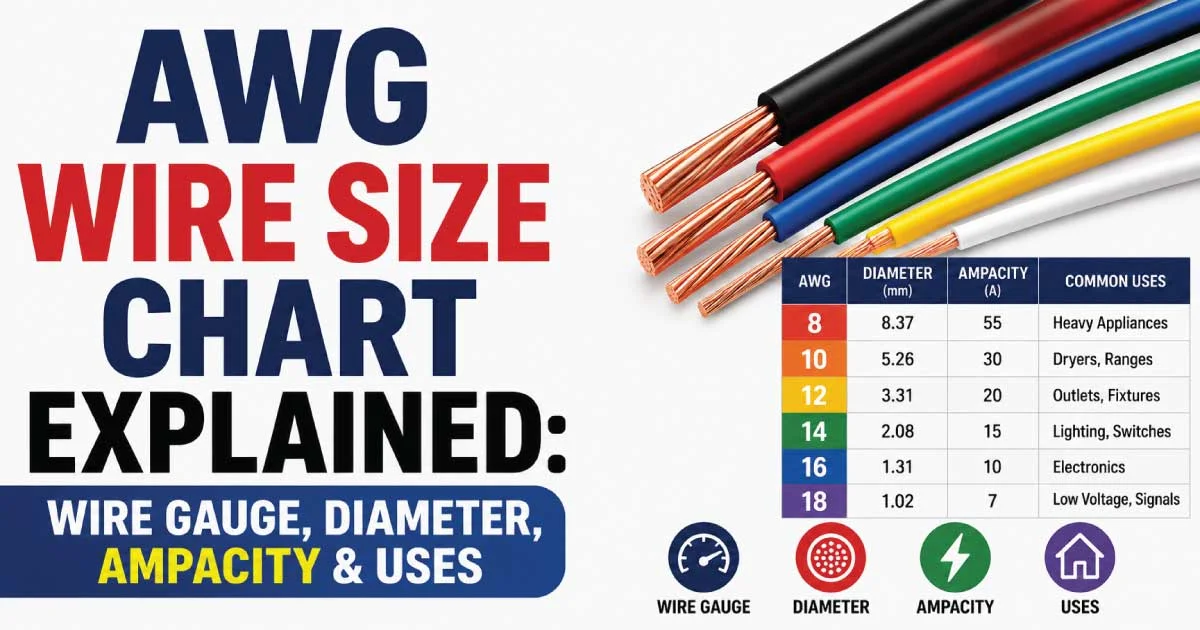
The AWG (American Wire Gauge) Wire Size Chart is a standardized measurement system used to identify the diameter, cross-sectional area, and current-carrying capacity of electrical wires. It is one of the most widely recognized wire sizing systems in North America and is essential for electricians, engineers, manufacturers, and DIY enthusiasts.
Choosing the correct wire gauge ensures electrical safety, minimizes voltage drop, improves efficiency, and prevents overheating in residential, commercial, and industrial electrical systems.
The AWG numbering system works differently from what many people expect. As the gauge number decreases, the wire diameter increases.
For example, a 10 AWG wire is thicker than a 14 AWG wire, while a 2 AWG cable is much larger than an 8 AWG cable. Understanding this relationship is the first step toward selecting the correct wire for any electrical application.
Understanding the American Wire Gauge (AWG) System
The American Wire Gauge system was developed to create a uniform standard for measuring electrical conductors. Before this standard, manufacturers often produced wires with varying dimensions, making compatibility and performance inconsistent.
The AWG system measures:
- Wire diameter
- Cross-sectional area
- Electrical resistance
- Current carrying capacity (ampacity)
- Weight per unit length
Because electrical performance depends heavily on conductor size, AWG plays a critical role in designing safe electrical installations across multiple industries.
How the AWG Numbering System Works
Unlike many measurement systems, AWG numbers become smaller as wire size becomes larger. Each decrease in gauge number represents an increase in wire diameter and current capacity.
For example:
- 20 AWG is thinner than 18 AWG.
- 14 AWG is thicker than 16 AWG.
- 6 AWG is much larger than 12 AWG.
- 1 AWG is larger than 2 AWG.
- 4/0 AWG (0000 AWG) is among the largest standard wire sizes.
This reverse numbering system can seem confusing initially, but it becomes intuitive with regular use.
Why the AWG Wire Size Chart Is Important
Selecting the wrong wire size can create serious electrical hazards. A wire that is too small may overheat, while an oversized wire increases installation costs without providing additional benefits for many applications.
Using the correct AWG wire size helps:
- Prevent overheating
- Reduce voltage drop
- Improve electrical efficiency
- Increase equipment lifespan
- Meet electrical code requirements
- Ensure safe current flow
Whether installing household wiring or industrial machinery, referring to an AWG wire size chart is considered a best practice.
Key Measurements Included in an AWG Wire Size Chart
A standard AWG chart contains multiple technical specifications beyond the gauge number.
Common measurements include:
- AWG size
- Wire diameter
- Cross-sectional area
- Resistance per 1,000 feet
- Maximum ampacity
- Circular mil area
- Weight
These specifications allow professionals to select conductors based on electrical load, distance, insulation type, and installation conditions.
How Wire Diameter Changes Across AWG Sizes
Wire diameter directly affects electrical performance. Larger conductors provide lower resistance, allowing them to carry higher currents without excessive heating.
For example:
| AWG | Approximate Diameter |
|---|---|
| 20 AWG | 0.032 inches |
| 18 AWG | 0.040 inches |
| 16 AWG | 0.051 inches |
| 14 AWG | 0.064 inches |
| 12 AWG | 0.081 inches |
| 10 AWG | 0.102 inches |
| 8 AWG | 0.129 inches |
As diameter increases, electrical resistance decreases significantly.
Relationship Between Wire Size and Resistance
Electrical resistance is one of the most important factors in conductor selection.
Smaller wires have:
- Higher resistance
- Greater voltage loss
- More heat generation
Larger wires provide:
- Lower resistance
- Better efficiency
- Reduced energy loss
- Improved current flow
This is why long electrical runs often require larger conductors than short circuits carrying the same current.
AWG Wire Size Chart Overview
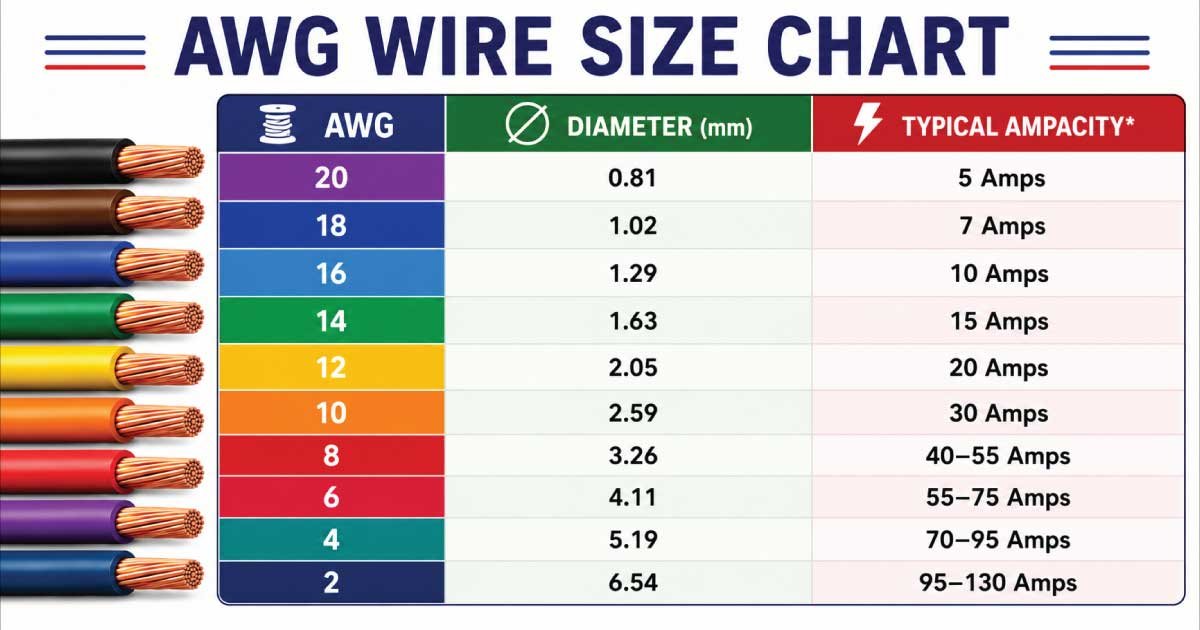
Below is a simplified AWG wire size chart for commonly used conductors.
| AWG | Diameter (mm) | Typical Ampacity* |
|---|---|---|
| 20 | 0.81 | 5 Amps |
| 18 | 1.02 | 7 Amps |
| 16 | 1.29 | 10 Amps |
| 14 | 1.63 | 15 Amps |
| 12 | 2.05 | 20 Amps |
| 10 | 2.59 | 30 Amps |
| 8 | 3.26 | 40–55 Amps |
| 6 | 4.11 | 55–75 Amps |
| 4 | 5.19 | 70–95 Amps |
| 2 | 6.54 | 95–130 Amps |
AWG Wire Size Chart PDF
The AWG Wire Size Chart provides a quick reference for common American Wire Gauge (AWG) sizes, wire diameters, and their typical ampacity ratings. It helps electricians, DIY users, and engineers choose the correct wire size for residential, automotive, and light industrial electrical projects, improving both safety and electrical performance.
*Actual ampacity depends on insulation, installation method, temperature, and electrical code.
Common Residential Wire Sizes
Residential electrical systems commonly use only a few AWG sizes because household circuits generally operate within predictable current ranges.
Typical residential wire sizes include:
- 14 AWG – Lighting circuits
- 12 AWG – Standard wall outlets
- 10 AWG – Water heaters and dryers
- 8 AWG – Electric ranges
- 6 AWG – Large appliances and subpanels
Using the proper gauge ensures compliance with electrical safety standards.
Common Commercial and Industrial Wire Sizes
Commercial and industrial facilities often require much larger conductors due to higher electrical demands.
Frequently used wire sizes include:
- 4 AWG
- 2 AWG
- 1 AWG
- 1/0 AWG
- 2/0 AWG
- 3/0 AWG
- 4/0 AWG
These conductors power heavy equipment, large motors, transformers, switchgear, and industrial distribution panels.
What Is Ampacity?
Ampacity refers to the maximum electrical current that a conductor can safely carry without exceeding its temperature rating.
Several factors influence ampacity:
- Wire size
- Conductor material
- Insulation type
- Ambient temperature
- Installation method
- Number of bundled conductors
An AWG wire size chart provides general ampacity values, but final conductor selection should always consider installation conditions.
Copper vs Aluminum AWG Wire Sizes
Both copper and aluminum conductors use the same AWG numbering system, but their electrical characteristics differ significantly.
Copper wire advantages:
- Higher conductivity
- Smaller size for the same current
- Greater durability
- Better corrosion resistance
Aluminum wire advantages:
- Lower cost
- Lighter weight
- Easier transportation
- Common in utility power distribution
Because aluminum has higher resistance, a larger AWG size is generally required to carry the same current as copper.
Solid Wire vs Stranded Wire
AWG sizing applies to both solid and stranded conductors.
Solid wire
- Single conductor
- Easier termination
- Lower cost
- Common in building wiring
Stranded wire
- Multiple small conductors
- Greater flexibility
- Better vibration resistance
- Ideal for equipment, vehicles, and machinery
Although construction differs, both are classified using the same AWG standard.
Factors That Affect Wire Size Selection
Choosing the correct wire gauge involves more than matching ampacity.
Important considerations include:
- Circuit length
- Voltage drop
- Current load
- Installation environment
- Ambient temperature
- Future expansion
- Electrical code requirements
- Conductor material
- Insulation rating
Evaluating these factors helps ensure safe, reliable, and efficient electrical performance.
Voltage Drop and Wire Size
Voltage drop occurs when electrical energy is lost as current travels through a conductor.
Longer wire runs experience greater voltage loss due to increased resistance. Increasing conductor size helps minimize these losses and improves equipment performance.
Many electrical professionals aim to keep voltage drop below:
- 3% for branch circuits
- 5% for total feeder and branch circuits combined
Selecting a larger AWG wire is often the simplest solution for long-distance installations.
Benefits of Using an AWG Wire Size Chart
An AWG wire size chart simplifies electrical planning and helps professionals make accurate conductor selections for virtually any project.
Major benefits include:
- Faster wire selection
- Improved electrical safety
- Reduced installation errors
- Better system efficiency
- Lower energy losses
- Longer equipment life
- Easier code compliance
- More accurate project planning
Understanding and using the AWG wire size chart is one of the most valuable skills for anyone working with electrical systems.