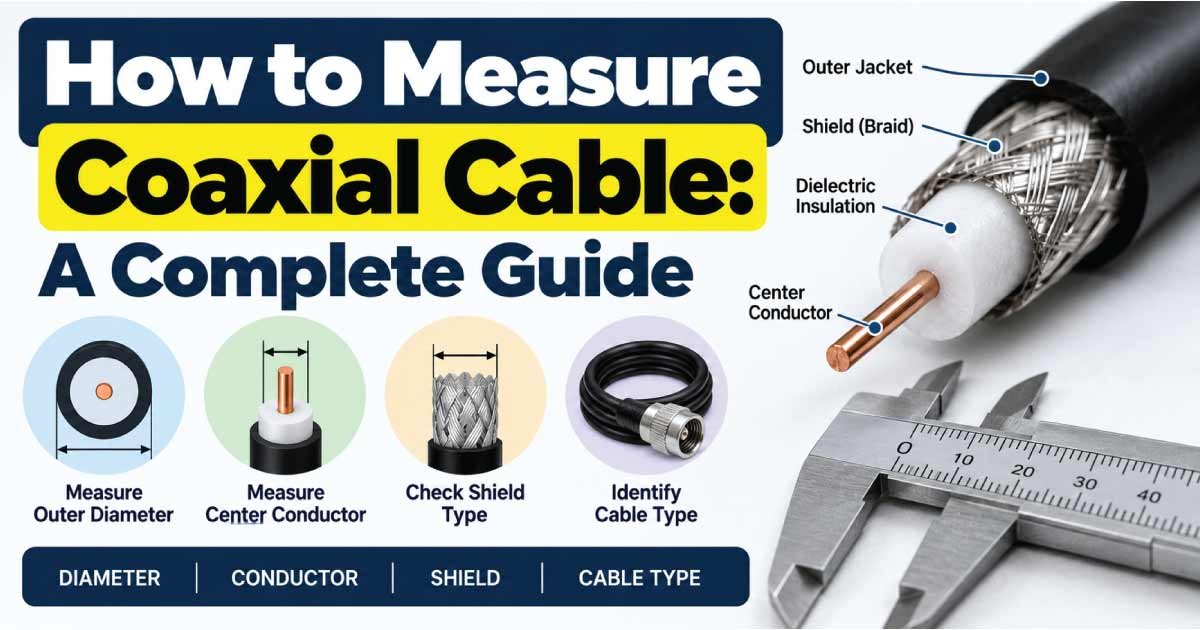
Learning how to measure coaxial cable correctly is useful when identifying an existing cable, selecting connectors, checking cable compatibility, or replacing a damaged section. Coaxial cables come in many sizes and constructions, and their outside diameter, conductor dimensions, connector type, and impedance can all affect compatibility.
Unlike ordinary electrical wire, coaxial cable has several layers that work together. A typical coaxial cable contains a center conductor, dielectric insulation, metallic shield, and outer jacket. Measuring only one part does not tell you the complete cable size.
This guide explains how to measure coaxial cable using a digital caliper, ruler, circumference method, and connector measurements. It also explains how to distinguish coaxial cable diameter from conductor size, identify common cable dimensions, avoid measurement mistakes, and choose the right connector or replacement cable.
What Is Coaxial Cable?
Coaxial cable, commonly called coax cable, is a cable designed with concentric layers around a central conductor. The center conductor carries the signal, while the surrounding dielectric and shield help control the cable’s electrical characteristics.
A typical coaxial cable consists of:
- Center conductor — carries the electrical signal.
- Dielectric — separates the center conductor from the shield.
- Shield — provides electrical shielding and forms the outer conductor.
- Outer jacket — protects the cable from physical and environmental damage.
The construction gives coaxial cable a controlled geometry that is important for signal transmission.
Coaxial cables are widely used for:
- Television and satellite signals
- CCTV systems
- Radio-frequency equipment
- Antenna connections
- Broadband communications
- Test equipment
- Networking applications
- Industrial electronics
Because coaxial cable is used for high-frequency signals, physical dimensions alone are not enough to identify its electrical characteristics.
What Does Coaxial Cable Size Mean?
When someone asks for the “size” of a coaxial cable, they may be referring to several different dimensions.
The most common physical measurement is the overall outside diameter.
However, other measurements may also be important:
| Measurement | What It Describes | Typical Unit |
|---|---|---|
| Overall diameter | Complete outside diameter of cable | mm or in |
| Center conductor diameter | Diameter of central conductor | mm or in |
| Shield diameter | Dimension around the shield | mm or in |
| Dielectric diameter | Diameter of insulating material | mm or in |
| Cable length | Distance from end to end | m or ft |
| Connector diameter | Physical connector dimensions | mm or in |
For most replacement and installation work, overall cable diameter is the easiest physical measurement to obtain.
However, if you are trying to identify a specific coaxial cable type, you may also need its printed designation, impedance, construction, and manufacturer information.
Why Measure Coaxial Cable?
There are several practical reasons to measure coaxial cable.
Connector Selection
Many coaxial connectors are designed for particular cable sizes and constructions. The cable’s outside diameter can help determine whether a connector is physically compatible.
Cable Identification
If the printing on the cable jacket is damaged or unreadable, measuring the cable can provide useful physical information for comparison with manufacturer specifications.
Replacement Cable Selection
When replacing an existing cable, measuring the old cable helps establish its physical dimensions. However, the replacement should also match the required electrical characteristics.
Installation Planning
Cable diameter can help determine whether a cable will fit through:
- Conduit
- Cable clips
- Grommets
- Bushings
- Cable glands
- Equipment openings
- Protective tubing
Checking Connector Fit
A connector that appears similar may not fit every coaxial cable. Cable diameter and connector specifications should be checked together.
Tools Needed to Measure Coaxial Cable
You do not need specialized equipment for a basic diameter measurement.
Digital Caliper
A digital caliper is generally the best practical tool for measuring the outside diameter of coaxial cable.
It provides a direct reading in millimeters or inches and is more precise than a standard ruler.
Use the caliper when measuring:
- Small coaxial cables
- CCTV cables
- RF cables
- Antenna cables
- Television coax
- Laboratory cables
Ruler
A ruler can be used for approximate measurements, particularly with larger coaxial cables.
However, it is harder to obtain precise readings on small cables.
Flexible Measuring Tape
A flexible tape is useful when the cable is too large or difficult to measure directly with a caliper.
It can also be used to measure circumference and calculate the approximate diameter.
Micrometer
A micrometer can provide high precision, but care is required because excessive measuring pressure can compress the outer jacket or deform a flexible cable.
For most general coaxial cable measurements, a caliper is more convenient.
How to Measure Coaxial Cable Diameter With a Caliper
A digital caliper provides a simple way to determine the outside diameter of a coaxial cable.
Step 1: Inspect the Cable
Before measuring, examine the cable jacket.
Look for printed information such as:
- Cable type
- Manufacturer
- Model designation
- Impedance
- Voltage information
- Standards or certification markings
If the cable has readable markings, record them. They may be more useful for identification than diameter alone.
Step 2: Select an Undamaged Section
Choose a straight section of cable that is not crushed, stretched, kinked, or damaged.
A damaged section may have a different diameter from the original cable.
Step 3: Zero the Caliper
Close the caliper jaws completely and check that the display reads zero.
Select millimeters or inches according to your preference.
Step 4: Position the Cable
Place the coaxial cable between the outside measuring jaws.
Position the caliper approximately perpendicular to the cable.
The jaws should contact opposite sides of the outer jacket.
Step 5: Close the Jaws Gently
Bring the jaws into contact with the cable.
Do not squeeze the cable tightly.
A flexible outer jacket can compress under pressure, causing the displayed measurement to be smaller than the actual free-standing diameter.
Step 6: Record the Reading
Read the measurement from the caliper.
For example, if the caliper displays:
6.8 mm
the approximate outside diameter of the measured section is 6.8 mm.
Step 7: Repeat the Measurement
Measure the cable at several locations.
If the readings are consistent, you can have greater confidence in the measurement.
If they vary significantly, check whether the cable has:
- An irregular jacket
- A damaged section
- An oval shape
- Different construction
- Compression from installation
How to Measure Coaxial Cable Without a Caliper
A ruler can provide an approximate diameter when a caliper is unavailable.
Place the cable next to a ruler and estimate the distance across the widest part.
For better results, measure several times and use a representative value rather than relying on a single visual estimate.
Another method is to measure the circumference.
Circumference Method
Wrap a flexible measuring tape around the outside of the coaxial cable.
Then calculate:
Diameter = Circumference ÷ π
For example, if the measured circumference is approximately 21.99 mm:
Diameter = 21.99 ÷ 3.14159
Diameter ≈ 7.0 mm
This method is especially useful for larger cables.
Remember that the tape should sit around the cable without compressing the outer jacket.
How to Measure the Center Conductor of Coaxial Cable
Sometimes you need to measure the center conductor rather than the complete cable.
This is a different measurement from overall cable diameter.
If the center conductor is exposed and accessible, a suitable precision measuring tool can be used to determine its diameter.
However, do not strip or damage an installed coaxial cable simply to measure the conductor.
For a cable that is already terminated or installed, consult the cable’s manufacturer information whenever possible.
The center conductor may be:
- Solid copper
- Copper-clad material
- Stranded conductor
- Another specified conductive construction
Therefore, conductor diameter alone does not completely identify a coaxial cable.
How to Measure Coaxial Cable Connector Size
Connector compatibility is an important part of coaxial cable selection.
Different coaxial connector families have different physical designs and applications. Examples include:
- BNC
- F-type
- N-type
- SMA
- SMB
- TNC
- RCA-style coaxial connectors
Do not select a connector based only on its appearance.
When measuring a cable for connector replacement, record:
- Overall cable diameter
- Cable construction
- Connector type
- Connector gender where applicable
- Cable impedance
- Manufacturer’s connector compatibility information
For crimp, compression, or specialized RF connectors, the connector manufacturer may specify an exact cable type or diameter range.
Common Coaxial Cable Diameter Examples
Coaxial cable dimensions vary significantly according to design and application. The following table illustrates approximate example measurements for understanding diameter, not a universal cable-size standard.
| Cable Category | Example Outside Diameter | Typical Consideration |
|---|---|---|
| Small RF coax | ~2–4 mm | Compact equipment |
| Miniature coax | ~3–5 mm | Electronics and RF assemblies |
| General-purpose coax | ~5–8 mm | Communications and video |
| Larger coax | ~8–12 mm | Specialized or lower-loss applications |
| Heavy coax | 12 mm+ | High-power or specialized installations |
Actual dimensions depend on the cable design and manufacturer. Always compare the measured diameter with the manufacturer’s dimensional drawing or datasheet when an exact fit is required.
Coaxial Cable Diameter vs. Impedance
A common misunderstanding is that coaxial cable diameter determines its impedance.
It does not.
Coaxial cable impedance is influenced by the relationship between the center conductor, dielectric material, and surrounding conductor geometry.
Common nominal impedance values include 50 Ω and 75 Ω, but the correct impedance depends on the application.
For example:
- Many RF systems use 50 Ω coaxial cable.
- Many video and television applications use 75 Ω coaxial cable.
The outside diameter can provide a physical clue, but it should not be used as the sole method of determining impedance.
If impedance matters, check the cable marking or manufacturer datasheet.
How to Identify Coaxial Cable Using Measurements
Measurement can help narrow down the possibilities when identifying an unknown coaxial cable.
A useful identification process is:
1. Check the Jacket Markings
Look for printed codes, cable designations, manufacturer names, or electrical ratings.
2. Measure the Outside Diameter
Use a digital caliper to obtain the overall diameter.
3. Examine the Connector
Identify whether the cable has a BNC, F-type, N-type, SMA, or another connector.
4. Determine the Application
Consider where the cable is being used.
For example:
- Television
- CCTV
- Antenna
- Radio
- Test equipment
- Industrial electronics
5. Compare With Manufacturer Information
Use the available measurements and markings to compare against technical datasheets.
This approach is more reliable than identifying a cable from diameter alone.
How to Measure Coaxial Cable Length
Diameter and length are different measurements.
To measure cable length, straighten the cable as much as practical without stretching it and measure from one end to the other.
For long cables, a measuring wheel or suitable tape can be useful.
When recording a cable specification, keep the measurements separate:
Example:
- Overall diameter: 7.0 mm
- Length: 15 m
- Impedance: As specified by manufacturer
Do not confuse the physical diameter with cable length or conductor size.
Common Mistakes When Measuring Coaxial Cable
Accurate measurement depends as much on technique as on the measuring tool.
Measuring the Connector Instead of the Cable
The connector may be larger than the cable itself.
If you need the cable diameter, measure the outer jacket, not the connector body.
Squeezing the Jacket
Applying excessive caliper pressure can deform flexible coaxial cable.
Use light, consistent contact pressure.
Measuring a Bent Section
A sharply bent or kinked cable may not have its normal circular shape.
Measure a straight, undamaged section.
Assuming Diameter Identifies the Cable
Two cables can have similar physical diameters while having different electrical properties.
Check the cable designation and technical documentation.
Ignoring Impedance
A cable’s physical fit does not guarantee that it is electrically suitable.
Verify impedance and other electrical specifications for RF and signal applications.
Using the Wrong Connector
Connector compatibility depends on more than general size. The connector must be appropriate for the specific cable construction and application.
Tips for Accurate Coaxial Cable Measurement
Use these practical tips when measuring coaxial cable:
- Use a digital caliper whenever precise diameter information is required.
- Measure an undamaged, straight section.
- Avoid compressing the outer jacket.
- Take multiple readings.
- Record whether the measurement is the overall outside diameter or another dimension.
- Keep mm and inches clearly separated.
- Check jacket markings before identifying the cable.
- Verify impedance from reliable documentation.
- Check connector manufacturer specifications before ordering replacement connectors.
- For critical applications, use the manufacturer’s dimensional drawing rather than relying only on a physical measurement.
When Manufacturer Specifications Are Necessary
A physical measurement is useful, but it cannot provide every specification needed to select coaxial cable.
Manufacturer documentation may be required for:
- Characteristic impedance
- Attenuation
- Frequency range
- Velocity factor
- Shielding performance
- Conductor construction
- Dielectric material
- Maximum operating voltage
- Temperature rating
- Minimum bend radius
- Connector compatibility
- Cable dimensions and tolerances
This is especially important in RF, communications, laboratory, broadcast, and high-frequency applications, where cable construction can directly affect signal performance.
Frequently Asked Questions About Measuring Coaxial Cable
How do I measure coaxial cable diameter?
Use a digital caliper to measure across the outside of the cable jacket. Position the caliper perpendicular to the cable, close the jaws gently, and record the measurement. Take several readings along an undamaged section to check consistency and avoid compressing the outer jacket.
How do I measure coaxial cable without a caliper?
You can use a ruler for an approximate outside diameter or measure the cable’s circumference with a flexible tape. Divide the circumference by π to calculate diameter. For example, a circumference of 21.99 mm corresponds to approximately 7.0 mm diameter.
Does coaxial cable diameter determine impedance?
No. Cable diameter alone does not determine impedance. Characteristic impedance depends on the relationship between the center conductor, dielectric material, and surrounding conductor. If impedance is important, check the cable marking or manufacturer’s technical documentation rather than estimating it from outside diameter.
How do I know what size coaxial connector I need?
Start by identifying the coaxial cable type, connector family, impedance, and outside diameter. Connector manufacturers often provide compatibility information for specific cable constructions. For crimp or compression connectors, use the manufacturer’s specified cable diameter and compatibility requirements instead of choosing solely by appearance.
Can I measure the center conductor through the cable jacket?
No. The center conductor is separated from the outside by the dielectric and shield, so its diameter cannot normally be measured accurately through the complete cable. If the cable must remain intact, use manufacturer specifications instead of stripping an installed cable just for measurement.
Conclusion
Knowing how to measure coaxial cable correctly helps with cable identification, connector selection, replacement planning, and installation. For most applications, the simplest approach is to use a digital caliper to measure the overall outside diameter of an undamaged section without compressing the jacket.
If a caliper is unavailable, you can estimate diameter with a ruler or calculate it from circumference. However, diameter should be treated as a physical measurement rather than a complete cable specification.
For reliable coaxial cable identification, combine the measured diameter with jacket markings, connector type, impedance, cable construction, and manufacturer documentation. This is particularly important for RF and communication systems, where selecting a physically compatible cable is not enough; its electrical characteristics must also match the application.