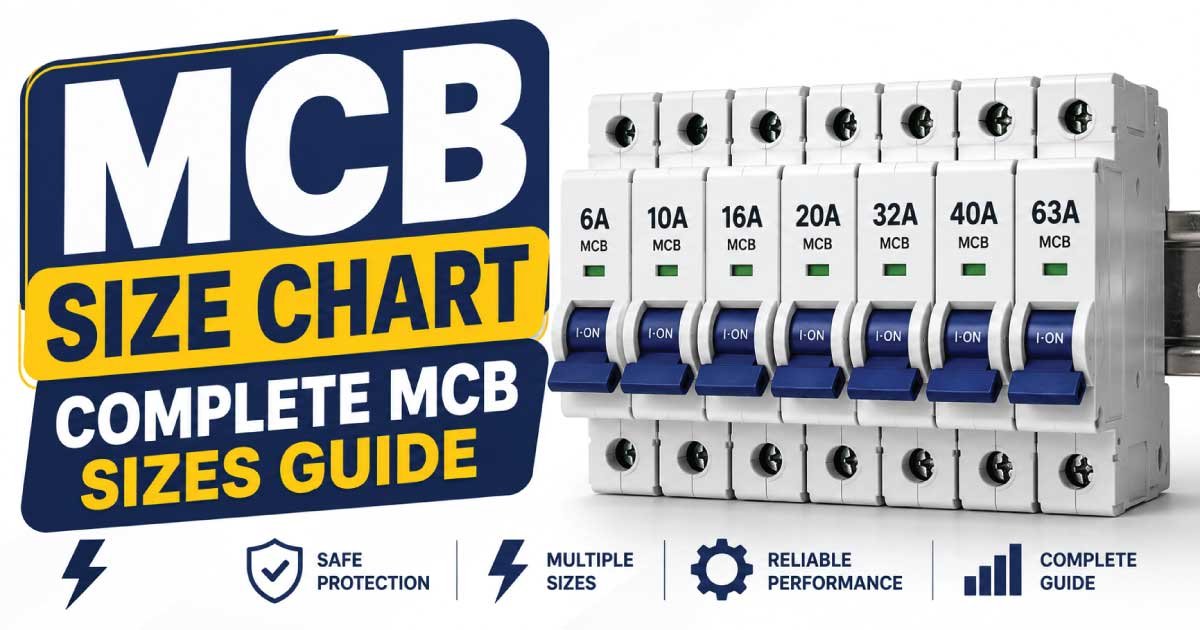
An MCB size chart helps electricians, contractors, and homeowners understand miniature circuit breaker ratings and their relationship with electrical loads, wire sizes, voltage, and circuit protection. Choosing the correct MCB is essential for protecting electrical wiring from excessive current.
MCBs are widely used in residential, commercial, and industrial electrical systems. Understanding amp ratings, pole configurations, tripping characteristics, wire compatibility, and load requirements makes it easier to select the appropriate miniature circuit breaker.
What Is an MCB?
A Miniature Circuit Breaker (MCB) is an automatic electrical protection device that disconnects a circuit when excessive current occurs. It protects electrical wiring and equipment from conditions such as overloads and short circuits.
MCBs are commonly used for:
- Lighting circuits
- Socket circuits
- Small appliances
- Residential distribution boards
- Commercial electrical panels
- Control circuits
- Small machinery
- Electrical equipment
Unlike a traditional fuse, an MCB can normally be reset after it trips once the fault has been corrected.
MCB Size Chart
MCB size is normally specified in amperes (A). The correct rating depends on the circuit load, conductor ampacity, voltage, installation conditions, and applicable electrical standards.
| MCB Rating | Typical Application | General Circuit Type |
|---|---|---|
| 2A | Control circuits | Low-load circuits |
| 4A | Control equipment | Small circuits |
| 6A | Lighting/control | Low-load circuits |
| 10A | Lighting | Small branch circuits |
| 16A | Lighting/socket circuits | Branch circuits |
| 20A | Socket circuits | General-purpose circuits |
| 25A | Small appliances | Dedicated circuits |
| 32A | Appliances | Higher-load circuits |
| 40A | Larger appliances | Dedicated circuits |
| 50A | High-load equipment | Dedicated circuits |
| 63A | Larger circuits | Distribution/equipment |
Applications are general examples. Actual MCB selection must be based on load calculations, conductor ampacity, equipment requirements, and applicable electrical standards.
How MCB Sizes Work
An MCB rating indicates the maximum current rating associated with the protective device. When the circuit current becomes excessive, the MCB operates and disconnects the electrical supply to help protect the wiring.
Common MCB ratings include:
- 6A for low-current circuits
- 10A for lighting applications
- 16A for common branch circuits
- 20A for socket circuits
- 32A for larger appliances
- 40A and above for higher-load applications
The correct MCB should be selected according to the complete circuit design.
MCB Size and Wire Size
The relationship between MCB size and wire size is critical because the protective device must adequately protect the conductor. A breaker should not be selected solely according to the electrical load without checking the cable’s permitted ampacity.
| Copper Wire Size | Common MCB Reference* |
|---|---|
| 1.0 mm² | 6–10A |
| 1.5 mm² | 10–16A |
| 2.5 mm² | 16–20A |
| 4 mm² | 20–32A |
| 6 mm² | 32–40A |
| 10 mm² | 40–50A |
| 16 mm² | 50–63A |
| 25 mm² | 63A+ |
General reference only. Actual cable ampacity depends on insulation, installation method, ambient temperature, grouping, conductor material, and applicable electrical standards.
Also Read: Copper Wire Size Chart: AWG & mm² Guide for Projects
What Determines MCB Size?
Selecting the correct MCB requires consideration of several electrical factors. The expected load is important, but cable ampacity, voltage, circuit type, equipment requirements, and installation conditions also affect the final breaker rating.
Important factors include:
- Connected load
- Cable ampacity
- Cable size
- Circuit voltage
- Load type
- Continuous loads
- Starting current
- Ambient temperature
- Installation method
- MCB characteristic
- Applicable electrical standards
A proper load calculation should be completed before selecting an MCB.
How to Calculate MCB Size
MCB sizing starts by determining the expected current of the connected electrical load. For a simple single-phase circuit, current can be estimated from power and voltage.
The basic relationship is:
Current (A) = Power (W) ÷ Voltage (V)
For example, a 2,000-watt load operating at 230 volts draws approximately:
2,000 ÷ 230 = 8.7A
The MCB should not automatically be selected as the next available rating. Cable ampacity, continuous loads, equipment requirements, and applicable standards must also be considered.
MCB Size for 230V Circuits
230V single-phase circuits are common in many residential and commercial electrical systems. MCB ratings vary according to the connected load and cable capacity.
Common ratings include:
- 6A
- 10A
- 16A
- 20A
- 25A
- 32A
- 40A
- 50A
- 63A
The appropriate MCB depends on the calculated circuit current and the cable’s permitted ampacity.
MCB Size for 240V Circuits
240V circuits are used for many appliances, equipment systems, and electrical installations. Depending on the electrical system, a suitable MCB configuration may be required to disconnect the appropriate conductors.
Applications can include:
- Electric water heaters
- Air conditioners
- Pumps
- Large appliances
- Workshop equipment
- Motors
- Dedicated electrical equipment
Always verify the equipment’s rated voltage and current before selecting the MCB.
Single-Pole MCB
A single-pole MCB protects one circuit conductor and is commonly used for single-phase branch circuits where the electrical system and applicable requirements permit this configuration.
Typical applications include:
- Lighting
- Small appliances
- Socket circuits
- Control circuits
- Residential branch circuits
The MCB rating should correspond to the circuit design and conductor protection requirements.
Double-Pole MCB
A double-pole MCB provides protection and switching for two poles of a circuit. It is commonly used for certain higher-voltage or multi-conductor circuits where simultaneous disconnection is required.
Double-pole MCBs may be used for:
- Water heaters
- Air conditioners
- Large appliances
- Motors
- Dedicated equipment
- Certain 240V circuits
The exact configuration depends on the electrical system and applicable standards.
Three-Pole MCB
A three-pole MCB is commonly used in three-phase electrical systems. It provides protection across three phases and is often used for commercial and industrial equipment.
Three-pole MCBs may be used for:
- Three-phase motors
- Industrial machinery
- Pumps
- Compressors
- Commercial equipment
- Distribution circuits
The MCB rating must be coordinated with the three-phase load and conductor capacity.
MCB Breaking Capacity
Breaking capacity indicates the maximum fault current that an MCB is designed to interrupt safely under specified conditions. It is an important specification when selecting an MCB for an electrical installation.
Common breaking-capacity ratings include:
- 4.5 kA
- 6 kA
- 10 kA
- Higher ratings for specific applications
The required breaking capacity depends on the prospective short-circuit current at the installation point.
MCB Tripping Characteristics
MCBs are available with different tripping characteristics. The characteristic determines how the breaker responds to overloads and short-duration current surges.
Common characteristics include:
| Type | General Characteristic | Typical Applications |
|---|---|---|
| Type B | More sensitive to short surges | Lighting and resistive loads |
| Type C | Higher tolerance for inrush | General appliances and equipment |
| Type D | Higher tolerance for large inrush | Motors and transformers |
The correct characteristic depends on the equipment and expected starting or inrush current.
Also Read: AWG Wire Size Chart: Gauge, Ampacity & Uses
Type B MCB
Type B MCBs generally operate within a lower instantaneous magnetic-trip range than Type C or Type D devices. They are commonly considered for circuits where high starting currents are not expected.
Typical applications can include:
- Residential lighting
- Resistive loads
- General-purpose circuits
- Small appliances
- Electronic equipment
The actual selection should follow the equipment requirements and applicable electrical standards.
Type C MCB
Type C MCBs tolerate higher short-duration current surges than Type B devices. They are commonly used where equipment produces moderate inrush current during startup.
Potential applications include:
- Small motors
- Pumps
- Air-conditioning equipment
- Fluorescent lighting
- Commercial equipment
- General inductive loads
The correct characteristic should be selected according to the expected starting current.
Type D MCB
Type D MCBs are designed for circuits where equipment can produce substantially higher inrush currents. They are generally associated with specialized loads rather than ordinary residential lighting circuits.
Potential applications include:
- Large motors
- Transformers
- Industrial machinery
- Certain welding equipment
- High-inrush electrical equipment
Type D should not be selected simply because it has a higher tolerance for startup current. The circuit’s fault protection requirements must also be considered.
MCB vs Fuse
Both MCBs and fuses provide overcurrent protection, but they operate differently. An MCB can generally be reset after tripping, while a conventional fuse must be replaced after its element operates.
| Feature | MCB | Fuse |
|---|---|---|
| Resettable | Yes | No |
| Reusable after trip | Generally yes | No |
| Overcurrent protection | Yes | Yes |
| Installation | Easy replacement/reset | Requires fuse replacement |
| Trip indication | Common | Depends on fuse type |
| Common use | Modern distribution boards | Many specialized applications |
The appropriate protection method depends on the electrical system and applicable requirements.
Common MCB Applications
MCBs are widely used across residential, commercial, and industrial electrical systems. Their compact design allows multiple protective devices to be installed within distribution boards.
Common applications include:
- Lighting circuits
- Socket outlets
- Kitchen circuits
- Water heaters
- Air conditioners
- Pumps
- Motors
- Commercial equipment
- Industrial control systems
- Distribution circuits
The MCB rating should always match the requirements of the individual circuit.
Key Points to Remember
An MCB size chart provides a useful reference for understanding common breaker ratings, but selecting the correct MCB requires more than matching an amp number to a cable size.
Remember these points:
- MCB ratings are measured in amperes.
- Cable ampacity is critical when selecting an MCB.
- Load calculations help determine circuit requirements.
- Type B, C, and D characteristics serve different applications.
- Breaking capacity must suit the installation.
- Pole configuration depends on circuit design.
- Equipment specifications should always be checked.
- Never increase an MCB rating simply to prevent nuisance tripping.
- Follow applicable electrical standards and manufacturer instructions.
MCB Size for Different Electrical Loads
The correct MCB size depends on the electrical load, cable capacity, operating voltage, and equipment requirements. Different appliances consume different amounts of current, so each circuit should be evaluated individually before selecting its protective device.
| Electrical Load | Common MCB Range* | Typical Circuit |
|---|---|---|
| LED Lighting | 6–10A | Lighting |
| General Sockets | 16–20A | Socket circuit |
| Refrigerator | 10–16A | Dedicated/general |
| Washing Machine | 16–20A | Dedicated circuit |
| Microwave | 16–20A | Appliance circuit |
| Dishwasher | 16–20A | Dedicated circuit |
| Water Heater | 20–32A+ | Dedicated circuit |
| Air Conditioner | 16–40A+ | Dedicated circuit |
| Electric Oven | 25–40A+ | Dedicated circuit |
| Electric Cooker | 32–50A+ | Dedicated circuit |
| Motor | 10–63A+ | Motor circuit |
General reference only. Actual MCB sizing must be based on the equipment nameplate, calculated load, conductor ampacity, starting current, and applicable electrical requirements.
MCB Size for Lighting Circuits
Lighting circuits generally have relatively low electrical loads, making smaller MCB ratings common. However, the total connected lighting load and cable size should still be considered when selecting the protective device.
Common lighting MCB ratings include:
- 6A
- 10A
- 16A
LED lighting normally consumes less power than traditional lighting, but a circuit can still contain many fixtures. Calculate the expected load and verify cable capacity before selecting the MCB.
MCB Size for Socket Circuits
Socket or receptacle circuits can supply several different appliances, so their potential load may be higher than a simple lighting circuit. The MCB should be selected according to the circuit design and expected simultaneous demand.
Common socket-circuit ratings include:
- 16A
- 20A
- 25A
- 32A
The number of outlets alone does not determine the breaker size. Connected load, cable size, installation method, and applicable requirements must also be considered.
MCB Size for Air Conditioners
Air conditioners can produce significant startup current, particularly when compressors and motors begin operating. Therefore, selecting an MCB only from the running wattage may produce an unsuitable result.
Before selecting an MCB for an air conditioner, check:
- Rated voltage
- Running current
- Starting current
- Manufacturer’s specifications
- Minimum circuit capacity
- Maximum overcurrent protection
- Cable size
- MCB characteristic
Some equipment may require a Type C or another appropriate characteristic depending on its starting current.
MCB Size for Water Heaters
Electric water heaters are generally connected to dedicated circuits because heating elements can consume substantial power. The correct MCB depends on the heater’s wattage, voltage, cable capacity, and installation requirements.
For example, determine:
Current = Power ÷ Voltage
A 3,000W heater operating at 230V draws approximately 13A under ideal conditions. The final MCB must still account for applicable continuous-load requirements and conductor ampacity.
MCB Size for Electric Ovens
Electric ovens can require considerably more current than ordinary household appliances. Their electrical requirements vary according to heating capacity, voltage, and manufacturer specifications.
Before choosing an MCB, check:
- Oven rated power
- Operating voltage
- Rated current
- Recommended cable
- Required MCB rating
- Manufacturer instructions
- Installation requirements
A dedicated circuit is commonly required for larger ovens.
MCB Size for Electric Cookers
Electric cookers can contain multiple heating elements and therefore have a relatively high electrical demand. Their circuit requirements should be determined from the appliance rating rather than a generic MCB chart.
Common considerations include:
- Total cooker power
- Rated voltage
- Maximum current
- Cable ampacity
- MCB rating
- Circuit configuration
- Installation method
Large cookers may require higher-rated circuits and suitable protective devices.
MCB Size for Refrigerators
Refrigerators normally consume less running power than large heating appliances, but the compressor can create a temporary starting current. The circuit should therefore be designed with the appliance characteristics in mind.
When selecting protection for a refrigerator, consider:
- Running current
- Compressor starting current
- Voltage
- Cable size
- MCB characteristic
- Manufacturer requirements
A correctly selected MCB should protect the circuit without causing unnecessary nuisance trips during normal compressor startup.
MCB Size for Washing Machines
Washing machines contain motors, pumps, electronic controls, and heating elements depending on the model. Their electrical demand can therefore vary significantly.
Before selecting the MCB, check:
- Washing machine rated power
- Voltage
- Running current
- Heating element rating
- Cable size
- Manufacturer recommendations
- MCB characteristic
A dedicated circuit may be appropriate depending on the installation requirements and local electrical standards.
MCB Size for Pumps
Electrical pumps commonly use motors that produce higher starting current than their normal running current. This makes MCB characteristic an important consideration in addition to the amp rating.
For pump circuits, check:
- Motor power
- Rated voltage
- Full-load current
- Starting current
- Cable length
- Cable size
- MCB characteristic
- Motor protection requirements
The MCB should work together with the appropriate motor protection rather than being treated as the only protective device.
MCB Size for Motors
Motor circuits require careful protection because motors can experience substantial inrush current during startup. The appropriate MCB rating and characteristic depend on motor size, starting method, voltage, and installation requirements.
Important factors include:
- Motor horsepower or kilowatt rating
- Full-load current
- Starting current
- Starting method
- Cable ampacity
- MCB characteristic
- Overload protection
- Short-circuit protection
For larger motors, dedicated motor protection equipment may be required.
MCB Size for Solar Systems
Solar electrical systems can include DC and AC circuits with different protection requirements. A standard AC MCB should not automatically be used on a DC photovoltaic circuit because DC interruption characteristics differ from AC.
Solar installations may require:
- DC-rated protective devices
- AC MCBs on suitable AC circuits
- Correct voltage rating
- Appropriate current rating
- Short-circuit protection
- Equipment-specific protection
- Manufacturer-approved components
Always use protective devices specifically rated for the electrical system in which they are installed.
MCB Size for Inverter Circuits
Inverter systems can contain both input and output circuits, and each side may have different electrical characteristics. The appropriate protective device depends on inverter power, voltage, current, cable size, and manufacturer requirements.
Before selecting an MCB, check:
- Inverter rated power
- DC input voltage
- AC output voltage
- Maximum current
- Cable size
- Manufacturer specifications
- Required protective-device rating
The inverter manufacturer’s installation documentation should be used for final protection requirements.
MCB Size for Single-Phase Circuits
Single-phase circuits are widely used in residential and small commercial installations. MCB selection depends on the connected load and cable ampacity.
A basic calculation for a single-phase resistive load is:
Current = Power ÷ Voltage
For example, at 230V:
1,150W ÷ 230V = 5A
The MCB cannot be selected from this result alone. Cable capacity, continuous load, equipment requirements, and applicable standards must also be checked.
MCB Size for Three-Phase Circuits
Three-phase systems are common in commercial and industrial applications. Their current calculation differs from single-phase systems because three phases contribute to the total power.
For a balanced three-phase load:
Power = √3 × Voltage × Current × Power Factor
Therefore:
Current = Power ÷ (√3 × Voltage × Power Factor)
Three-phase MCB selection should consider the calculated current, conductor ampacity, motor characteristics where applicable, and the required number of poles.
MCB Size and Cable Length
Cable length can affect voltage drop and overall circuit performance. Although cable length does not simply determine the MCB rating, long cable runs may require larger conductors to maintain acceptable voltage at the load.
For long circuits, consider:
- Cable resistance
- Voltage drop
- Load current
- Cable cross-sectional area
- Installation method
- Ambient temperature
- Starting current
A circuit may therefore require a larger cable even when the MCB rating remains unchanged.
Also Read: Solar Cable Size Chart: Choose the Right Cable Size
MCB Size and Voltage Drop
Voltage drop occurs when current flows through the resistance of a conductor. Excessive voltage drop can cause equipment to operate inefficiently or malfunction.
Voltage drop depends on:
- Cable length
- Conductor material
- Cable cross-sectional area
- Current
- Circuit configuration
- Operating temperature
The MCB protects against excessive current, while conductor sizing must also account for voltage-drop requirements where applicable.
MCB Breaking Capacity Selection
Breaking capacity is an important MCB specification because the device must be capable of safely interrupting the prospective short-circuit current at its installation point.
Common MCB breaking capacities include:
- 4.5 kA
- 6 kA
- 10 kA
- Higher ratings for specialized systems
A higher breaking-capacity MCB may be necessary where the available fault current is greater. The prospective fault current should be assessed when selecting the device.
B Curve vs C Curve vs D Curve MCB
MCB tripping curves determine how the breaker responds to short-duration current surges. Choosing the correct curve helps prevent unnecessary tripping while maintaining appropriate circuit protection.
| MCB Curve | General Use | Inrush Tolerance |
|---|---|---|
| B Curve | Lighting and resistive loads | Lower |
| C Curve | General inductive equipment | Medium |
| D Curve | High-inrush equipment | Higher |
The curve should be selected based on the actual equipment characteristics rather than simply choosing the highest available tolerance.
Common MCB Sizing Mistakes
Incorrect MCB selection can reduce electrical protection and cause repeated nuisance trips. Many sizing mistakes happen when users select a breaker based only on the appliance wattage or cable size without considering the complete circuit.
Common mistakes include:
- Selecting an MCB without calculating the load
- Ignoring cable ampacity
- Using the wrong MCB curve
- Ignoring starting current
- Using an unsuitable breaking capacity
- Installing an AC MCB on an unsuitable DC circuit
- Ignoring voltage drop
- Choosing a breaker simply because it is larger
- Using incompatible breakers in a distribution board
Proper circuit design avoids these problems.
How to Choose the Correct MCB Size
Selecting the correct MCB requires a coordinated approach involving the load, cable, electrical system, and protective device. The goal is to provide adequate protection without causing unnecessary interruptions during normal operation.
Follow these steps:
- Determine the connected load.
- Calculate the expected current.
- Identify continuous and starting loads.
- Select an appropriately sized cable.
- Verify cable ampacity.
- Select the appropriate MCB rating.
- Choose the correct tripping characteristic.
- Check breaking capacity.
- Verify voltage and pole configuration.
- Follow applicable electrical standards.
MCB Size Chart by Cable Size
Cable size is often used as a reference when selecting an MCB, but actual ampacity varies according to installation conditions. The following table provides general reference values rather than universal installation rules.
| Cable Size | Approx. MCB Reference |
|---|---|
| 1.0 mm² | 6–10A |
| 1.5 mm² | 10–16A |
| 2.5 mm² | 16–20A |
| 4 mm² | 20–32A |
| 6 mm² | 32–40A |
| 10 mm² | 40–50A |
| 16 mm² | 50–63A |
| 25 mm² | 63A+ |
| 35 mm² | 80A+ |
| 50 mm² | 100A+ |
Always verify actual conductor ampacity using the appropriate electrical standard and installation conditions.
FAQs:
What MCB size is best for 1.5 mm² wire?
A 10A or 16A MCB may commonly be associated with 1.5 mm² copper cable, depending on installation conditions and applicable standards. The final breaker should be selected from the actual cable ampacity and circuit design rather than cable size alone.
What MCB size is suitable for 2.5 mm² cable?
A 16A or 20A MCB is commonly used with 2.5 mm² copper cable, depending on installation conditions, conductor insulation, temperature, grouping, and applicable electrical requirements. Always verify the cable’s permitted ampacity before selecting the breaker.
What is the difference between B curve and C curve MCB?
B curve MCBs generally respond to lower short-duration current surges, while C curve MCBs tolerate higher inrush currents. B curve is commonly used for lighting and resistive loads, while C curve can suit moderate inductive loads.
What is the difference between MCB and MCCB?
MCBs are generally designed for lower-current branch and distribution circuits, while MCCBs are commonly used for higher-current applications and larger electrical systems. MCCBs often provide greater adjustment and protection options for commercial and industrial installations.
Can I use a higher-rated MCB?
You should not install a higher-rated MCB simply to prevent the existing breaker from tripping. The cable, equipment, panel, and circuit design must all support the higher rating. Increasing protection without verification can create an unsafe condition.
Final Thoughts
An MCB size chart is useful for comparing common breaker ratings, cable sizes, and electrical applications, but the chart should only be used as a starting reference. Correct MCB selection requires a complete evaluation of the electrical load and installation.
Before choosing an MCB:
- Calculate the circuit current.
- Check cable ampacity.
- Consider continuous loads.
- Check equipment starting current.
- Select the appropriate MCB curve.
- Verify breaking capacity.
- Confirm voltage and pole configuration.
- Check manufacturer requirements.
- Follow applicable electrical standards.
Properly selected MCB protection helps reduce the risk of conductor overheating, equipment damage, and electrical faults while providing reliable circuit protection.