Choosing the correct motor starter is important for protecting an electric motor from overloads, excessive current, and difficult starting conditions. The starter must be matched to the motor’s horsepower, voltage, full-load current, phase, starting method, and application.
A motor starter is not selected from horsepower alone. Two motors with the same horsepower can have different full-load currents because of differences in voltage, efficiency, power factor, and motor design.
The correct starter should also be compatible with the motor’s contactor, overload relay, control voltage, and protection requirements. For industrial applications, the manufacturer’s motor data and applicable electrical standards should always be used for final selection.
What Is a Motor Starter?
A motor starter is a device or combination of devices used to control and protect an electric motor.
A conventional motor starter generally consists of:
- Contactor
- Overload relay
- Control circuit
- Disconnect or short-circuit protection, where required
The contactor controls the motor’s power supply, while the overload relay helps protect the motor from sustained excessive current.
A starter allows a motor to be switched on and off safely while providing an appropriate method of overload protection.
Why Motor Starter Size Matters
An incorrectly sized starter can cause operating problems and potentially damage the motor or starter.
An undersized starter can experience:
- Contact overheating.
- Premature contact wear.
- Nuisance overload trips.
- Excessive heating.
- Reduced service life.
- Failure during motor starting.
An oversized starter may not provide the intended level of economical control, although a larger contactor can sometimes be appropriate when selected according to the manufacturer’s specifications.
The overload relay is particularly important because its adjustment must correspond to the motor’s actual rated current and the applicable protection requirements.
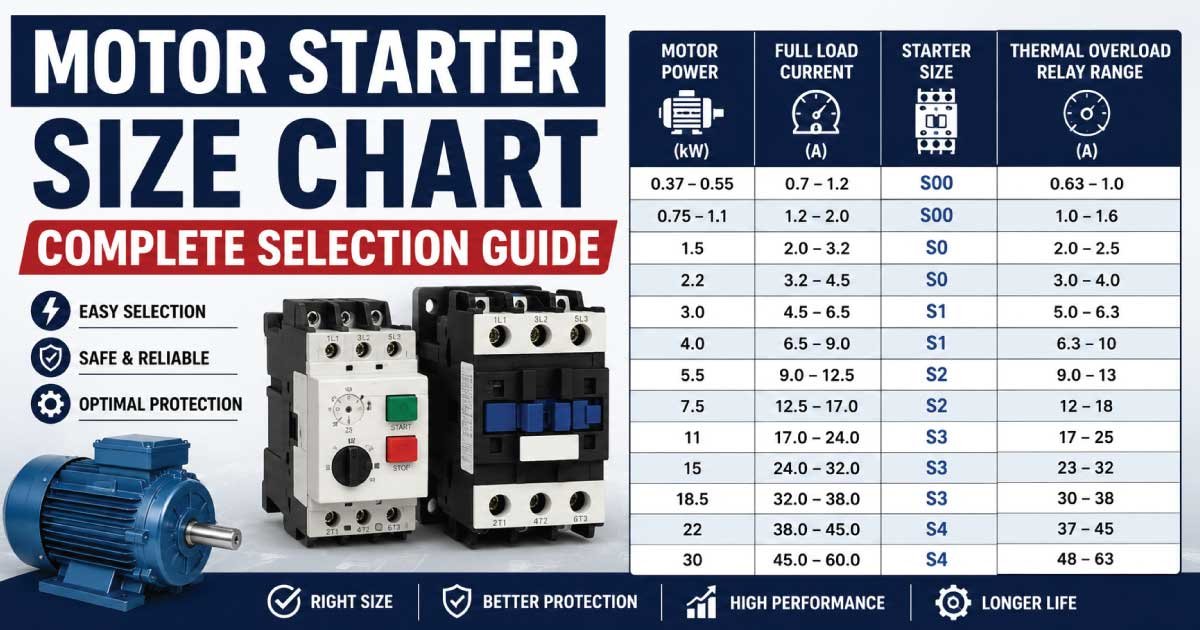
Motor Starter Size Chart
The following table provides a general reference for common three-phase motor starter applications. Actual starter selection should be based on the motor nameplate current and the manufacturer’s starter ratings.
| Motor Size | Approx. 460V 3-Phase FLC | Common Starter Size |
|---|---|---|
| 0.5 HP | 1.1 A | 9 A |
| 1 HP | 1.8 A | 9 A |
| 1.5 HP | 2.1 A | 9 A |
| 2 HP | 2.8 A | 9 A |
| 3 HP | 4.8 A | 9 A |
| 5 HP | 7.6 A | 9–12 A |
| 7.5 HP | 11 A | 12 A |
| 10 HP | 14 A | 18 A |
| 15 HP | 21 A | 25 A |
| 20 HP | 27 A | 32 A |
| 25 HP | 34 A | 40 A |
| 30 HP | 40 A | 40–50 A |
| 40 HP | 52 A | 65 A |
| 50 HP | 65 A | 80 A |
| 60 HP | 77 A | 80–95 A |
| 75 HP | 96 A | 110 A |
| 100 HP | 124 A | 150 A |
| 125 HP | 156 A | 185 A |
| 150 HP | 180 A | 225 A |
| 200 HP | 240 A | 300 A |
Important: These are general reference values. Motor starter contactors and overload relays must be selected according to the actual motor nameplate current, starter utilization category, manufacturer ratings, and applicable electrical code.
How to Select a Motor Starter Size
The most reliable selection method is:
- Read the motor nameplate.
- Identify the motor’s full-load current.
- Identify voltage and phase.
- Determine the motor’s horsepower or kW.
- Identify the motor starting method.
- Select a contactor with an appropriate utilization rating.
- Select an overload relay with a suitable adjustment range.
- Check short-circuit and overcurrent protection.
- Check the control-circuit voltage.
- Verify the starter manufacturer’s rating.
The motor nameplate current should normally be the primary starting point, rather than selecting a starter solely from horsepower.
Motor Starter Size by Horsepower
Horsepower provides a convenient way to estimate the appropriate starter range, but it should not replace checking the motor’s actual current.
Typical starter applications include:
- Small motors: 0.5–5 HP.
- Medium motors: 7.5–25 HP.
- Larger motors: 30–100 HP.
- Heavy industrial motors: 125 HP and above.
As motor horsepower increases, the contactor must be capable of switching the larger motor load and handling the associated starting and running conditions.
Motor Starter Size for 1 HP Motor
A 1 HP three-phase motor at approximately 460V may have a full-load current around 1.8A, depending on the motor design and applicable reference table.
A small contactor, such as a 9A-rated contactor, may be suitable for many applications.
However, the overload relay must have an adjustment range that properly accommodates the motor’s actual nameplate current.
Motor Starter Size for 5 HP Motor
A typical 5 HP, 460V three-phase motor may have a full-load current around 7.6A.
A starter in the 9A or 12A contactor range may be used depending on the manufacturer’s selection tables and utilization category.
The overload setting should be based on the motor’s nameplate and applicable requirements.
Motor Starter Size for 10 HP Motor
A typical 10 HP, 460V three-phase motor has a full-load current around 14A.
A contactor around 18A may be suitable for many applications.
The complete starter should include an overload relay whose adjustment range covers the actual motor current.
Motor Starter Size for 15 HP Motor
A typical 15 HP motor at 460V three phase has a full-load current around 21A.
A 25A-rated contactor may be appropriate for some applications.
The final selection should also consider:
- Motor duty.
- Starting frequency.
- Contact utilization category.
- Ambient temperature.
- Enclosure.
- Manufacturer’s recommendations.
Motor Starter Size for 20 HP Motor
A typical 20 HP, 460V three-phase motor has a full-load current around 27A.
A starter with a contactor rating around 32A may be suitable depending on the application.
For motors that start and stop frequently, the contactor’s switching duty should be carefully evaluated.
Motor Starter Size for 30 HP Motor
A typical 30 HP, 460V three-phase motor has a full-load current around 40A.
A 40A or 50A starter may be considered, depending on the manufacturer’s contactor rating.
The overload relay must have an appropriate range for the motor’s actual full-load current.
Motor Starter Size for 50 HP Motor
A typical 50 HP, 460V three-phase motor may have a full-load current around 65A.
A starter around the 80A contactor class may be appropriate for some applications.
At this motor size, proper coordination between the starter, overload relay, feeder conductors, and short-circuit protection becomes increasingly important.
Motor Starter Size for 100 HP Motor
A typical 100 HP, 460V three-phase motor can have a full-load current around 124A.
A starter with a contactor rating around 150A may be considered in suitable applications.
Large motors may also require additional consideration for:
- Starting current.
- Voltage drop.
- Starting method.
- Motor acceleration.
- Thermal conditions.
- Short-circuit protection.
Motor Starter Size and Motor Voltage
Voltage has a major effect on motor current.
For the same motor power, a higher operating voltage generally results in lower current.
For example, a three-phase motor operating at 230V will normally draw substantially more current than the same motor operating at 460V.
Therefore, a starter selected for a motor at one voltage should not automatically be used for the same horsepower motor at another voltage without checking the starter’s ratings.
Also Read: Automotive Wire Size Chart: Complete AWG Size Guide
Motor Starter Size for 230V Motors
At 230V three phase, motor current is higher than at 460V for the same horsepower.
For example, a 10 HP three-phase motor may draw roughly twice as much current at 230V as at 460V, depending on the motor’s characteristics.
This means the contactor and overload protection must be selected using the correct voltage-specific motor current.
Motor Starter Size for 460V Motors
460V three-phase systems are common in industrial facilities.
Because the current is lower than at 230V for the same power, smaller conductor and starter current ratings may sometimes be required.
Common industrial motor starter applications include:
- Pumps.
- Fans.
- Compressors.
- Conveyors.
- Machine tools.
- Blowers.
Motor Starter Size for Single-Phase Motors
Single-phase motors have different current characteristics from three-phase motors.
For a single-phase motor:
I = P ÷ (V × Efficiency × Power Factor)
The actual motor nameplate current should be used whenever available.
Single-phase motors may use:
- Magnetic starters.
- Contactors.
- Thermal overloads.
- Manual motor starters.
- Dedicated motor protection devices.
The starter must be rated for the motor’s voltage and single-phase load.
Motor Starter Contactor Size
The contactor is the switching component of a conventional starter.
Contactor ratings can be expressed using:
- Amperes.
- Horsepower.
- Utilization category.
- NEMA size.
- IEC contactor rating.
A contactor’s general ampere rating alone may not tell the entire story. Its rating must be appropriate for the type of motor load and switching duty.
NEMA Motor Starter Sizes
NEMA motor starters are commonly classified using standardized sizes.
Typical NEMA starter sizes include:
| NEMA Size | Approx. Motor Application at 460V |
|---|---|
| 00 | Small motors |
| 0 | Small motors |
| 1 | Small to medium motors |
| 2 | Medium motors |
| 3 | Larger motors |
| 4 | Large motors |
| 5 | Heavy-duty motors |
| 6 | Very large motors |
The actual horsepower range depends on voltage, motor type, starter construction, and the specific NEMA rating.
NEMA starter size should therefore be checked against the manufacturer’s horsepower and current tables.
IEC Motor Starter Sizes
IEC contactors are commonly specified by their rated operational current and utilization category.
Common contactor ratings include:
- 9A.
- 12A.
- 18A.
- 25A.
- 32A.
- 40A.
- 50A.
- 65A.
- 80A.
- 95A.
- 110A.
- 150A.
- 185A.
- 225A and larger.
For motor applications, AC-3 utilization rating is particularly important because it relates to switching squirrel-cage motors under typical operating conditions.
Motor Starter Overload Relay Size
The overload relay protects the motor against sustained overcurrent.
An overload relay should have an adjustment range that includes the motor’s actual nameplate current.
For example, if a motor has a rated current of 14A, an overload relay with a range such as 12–18A may be appropriate.
The exact overload setting depends on the motor, application, protection method, and applicable electrical requirements.
Do not simply set the overload to the maximum value on the relay.
Motor Starter and Overload Protection
A motor starter normally provides two different functions:
Contactor: Controls the motor’s electrical connection.
Overload relay: Helps protect the motor against sustained overload conditions.
Short-circuit protection is normally provided separately through appropriate protective devices.
This distinction is important because an overload relay is not intended to replace all short-circuit protection.
Direct-On-Line Motor Starter
A DOL starter, or direct-on-line starter, connects the motor directly to the supply when the contactor closes.
It is commonly used for smaller motors where the electrical system can tolerate the motor’s starting current.
Advantages include:
- Simple design.
- Low installation cost.
- Easy maintenance.
- Reliable operation.
- Simple control circuit.
The main disadvantage is that the motor can draw a high starting current.
Also Read: Glass Fuse Size Chart: Complete Size Guide
Star-Delta Motor Starter
A star-delta starter reduces starting current by initially connecting the motor windings in a star configuration and then switching to delta operation.
It is commonly used for suitable three-phase motors where reduced starting current is required.
The system typically uses:
- Main contactor.
- Star contactor.
- Delta contactor.
- Timer.
- Overload relay.
The motor must be designed with appropriate winding connections for this starting method.
Soft Starter vs Motor Starter
A conventional contactor starter provides simple switching and overload protection.
A soft starter uses power electronics to control the motor’s starting voltage and current.
Soft starters can help reduce:
- Starting current.
- Mechanical shock.
- Belt stress.
- Pump water hammer.
For larger motors, a soft starter may be preferred when controlled acceleration and reduced starting stress are required.
Motor Starter for Pump Applications
Pump motors often require careful starter selection because they can have significant starting loads.
Consider:
- Motor horsepower.
- Full-load current.
- Starting current.
- Pump load characteristics.
- Number of starts per hour.
- Ambient temperature.
- Enclosure rating.
For larger pumps, soft starters or variable frequency drives may be considered instead of conventional DOL starting.
Motor Starter for Compressor Applications
Compressors can place substantial demands on motor starting systems.
The starter should be selected according to:
- Motor full-load current.
- Starting current.
- Compressor type.
- Starting frequency.
- Motor duty.
- Supply voltage.
A starter that is adequate for a fan of the same horsepower may not necessarily be appropriate for a compressor because the starting and operating characteristics can differ.
Motor Starter for Conveyor Motors
Conveyor systems often require reliable starting and stopping.
For conveyor motors, consider:
- Motor horsepower.
- Starting torque.
- Belt load.
- Start frequency.
- Reversing requirements.
- Emergency-stop system.
For applications requiring frequent starts and stops, the contactor must have an appropriate duty rating.
How to Read a Motor Nameplate for Starter Selection
Before selecting a starter, record:
- Motor horsepower.
- kW.
- Voltage.
- Full-load amperes.
- Phase.
- Frequency.
- RPM.
- Service factor.
- Efficiency.
- Power factor.
- Duty rating.
The full-load current and voltage are especially important when selecting the contactor and overload relay.
Common Motor Starter Sizing Mistakes
Choosing a Starter Only by Horsepower
Horsepower is useful for preliminary selection, but actual motor current should also be checked.
Ignoring Motor Voltage
A 230V motor can draw substantially more current than a 460V motor with the same horsepower.
Using the Wrong Overload Range
The overload relay must accommodate the motor’s actual rated current.
Ignoring Contactor Duty
The contactor must be rated for the motor’s switching duty.
Ignoring Starting Conditions
Large motors can draw several times their normal running current during starting.
Confusing Contactor and Overload Ratings
The contactor switches the motor, while the overload relay provides motor overload protection.
Selecting by Amperes Without Checking Horsepower
The contactor must have an appropriate motor-load rating, not just a convenient ampere number.
Also Read: Crimp Connector Size Chart: Standard Sizes Explained
How to Select the Correct Motor Starter
Use the following procedure:
- Identify the motor horsepower or kW.
- Read the motor nameplate current.
- Identify the motor voltage.
- Determine single-phase or three-phase operation.
- Check motor frequency.
- Select a properly rated contactor.
- Verify the contactor’s utilization category.
- Select an appropriate overload relay range.
- Check short-circuit protection.
- Determine whether DOL, star-delta, soft-start, or another method is required.
- Check the control voltage.
- Verify enclosure and environmental requirements.
- Confirm the manufacturer’s starter selection.
- Verify compliance with applicable electrical standards.
Motor Starter Quick Reference
| Motor | Approx. 460V 3-Phase Current | General Contactor Reference |
|---|---|---|
| 1 HP | 1.8 A | 9 A |
| 2 HP | 2.8 A | 9 A |
| 3 HP | 4.8 A | 9 A |
| 5 HP | 7.6 A | 9–12 A |
| 7.5 HP | 11 A | 12 A |
| 10 HP | 14 A | 18 A |
| 15 HP | 21 A | 25 A |
| 20 HP | 27 A | 32 A |
| 25 HP | 34 A | 40 A |
| 30 HP | 40 A | 40–50 A |
| 40 HP | 52 A | 65 A |
| 50 HP | 65 A | 80 A |
| 75 HP | 96 A | 110 A |
| 100 HP | 124 A | 150 A |
These figures are general selection references, not a substitute for the motor nameplate, manufacturer contactor tables, overload settings, or applicable electrical standards.
Frequently Asked Questions
What size motor starter do I need?
The correct motor starter depends on the motor’s full-load current, voltage, phase, horsepower, starting method, and application. Start with the motor nameplate current, then select a contactor with an appropriate motor-load rating and an overload relay whose adjustment range covers the motor’s rated current.
What size starter is needed for a 10 HP motor?
A typical 10 HP, 460V three-phase motor has a full-load current of approximately 14A. An 18A contactor may be suitable for many applications, provided it has the correct motor utilization rating. The overload relay should also be selected to cover the actual motor nameplate current.
What starter size is suitable for a 20 HP motor?
A typical 20 HP, 460V three-phase motor has a full-load current around 27A. A 32A contactor may be appropriate in some applications. However, the actual motor current, contactor utilization category, overload range, and manufacturer’s selection table should be checked before installation.
How do I size a motor starter overload?
Start with the motor’s nameplate full-load current and select an overload relay with a suitable adjustment range. The final overload setting must follow the motor manufacturer’s instructions and applicable electrical requirements. Do not automatically set the relay to its maximum available value.
What is the difference between a contactor and a motor starter?
A contactor is primarily a switching device used to turn a motor on and off. A conventional motor starter generally combines a contactor with an overload relay and associated control components. Additional short-circuit protection is normally provided separately as required by the installation.
Can I use a larger motor starter than required?
A larger contactor can sometimes be used if it is correctly rated and compatible with the motor and control system. However, simply choosing a larger starter does not automatically improve motor protection. The overload relay, short-circuit protection, conductors, and control components must still be correctly selected.
What is the difference between DOL and star-delta starters?
A DOL starter applies full supply voltage directly to the motor during starting, making it simple but potentially producing high starting current. A star-delta starter initially reduces the starting conditions and then changes to normal delta operation, helping reduce starting current for suitable motors.
Final Thoughts
Selecting the right motor starter requires more than matching a starter to a motor’s horsepower. The most important factors include motor full-load current, voltage, phase, contactor rating, overload range, starting method, motor duty, and application conditions.
For common 460V three-phase motors, small motors may use contactors around 9A, while 10 HP motors may fall around the 18A class, 20 HP motors around 32A, 50 HP motors around 80A, and 100 HP motors around 150A, depending on the specific motor and starter manufacturer.
Always check the motor nameplate before making the final selection. The motor’s actual full-load current should be used to verify the overload relay, while the contactor must be rated for the motor load and switching duty.
For larger motors or demanding applications, consider whether DOL, star-delta, soft starter, or variable frequency drive (VFD) starting is most appropriate.
A properly selected starter improves motor reliability, reduces unnecessary trips, and provides appropriate overload protection for the complete motor-control system.