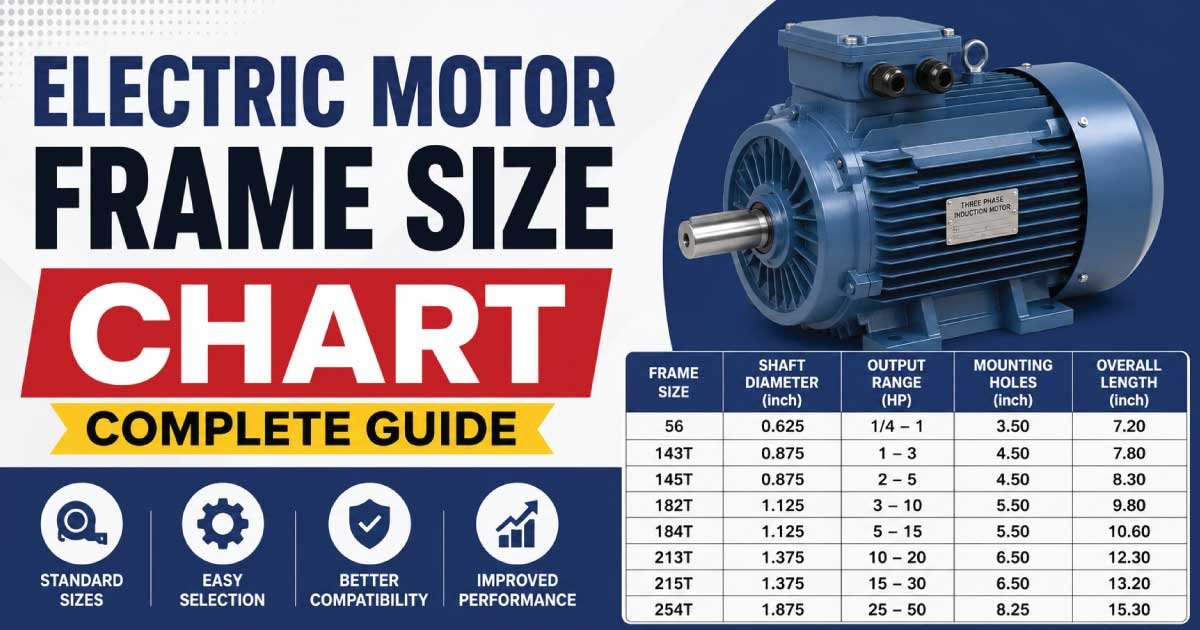
Electric motor frame size is one of the most important specifications when selecting a replacement motor or designing a new motor installation. The frame size determines the motor’s physical mounting dimensions, shaft dimensions, mounting-hole arrangement, and overall compatibility with the driven equipment.
Unlike horsepower or kilowatt ratings, motor frame size does not directly indicate the motor’s power output. Two motors with the same frame size can have different electrical characteristics, while motors with similar horsepower ratings may have different frame sizes depending on their design and manufacturer.
Understanding standard motor frame dimensions helps when replacing motors, selecting couplings, designing mounting bases, checking shaft alignment, and ensuring that a new motor fits an existing machine.
This complete guide explains common electric motor frame sizes, NEMA and IEC standards, frame dimensions, shaft measurements, mounting configurations, motor horsepower relationships, and how to select the correct frame for a replacement motor.
What Is an Electric Motor Frame Size?
An electric motor frame size is a standardized designation used to describe the motor’s physical dimensions and mounting configuration.
Depending on the motor standard, the frame designation can identify dimensions such as:
- Shaft height.
- Mounting-hole spacing.
- Shaft diameter.
- Shaft extension length.
- Motor foot dimensions.
- Mounting arrangement.
- Overall physical proportions.
For example, a motor may be identified as a NEMA 56, NEMA 145T, NEMA 184T, or an IEC 90, IEC 100, or IEC 112 frame.
The frame number is therefore especially important when replacing a motor that must physically fit existing equipment.
Electric Motor Frame Size Chart
The following table provides common NEMA and IEC frame references. Dimensions can vary according to the specific frame series, mounting arrangement, and manufacturer, so always verify the motor manufacturer’s dimensional drawing before ordering.
| Motor Frame | Standard/System | Approx. Shaft Center Height | Typical Applications |
|---|---|---|---|
| 56 | NEMA | 2.0 in / 50.8 mm | Small machinery |
| 56H | NEMA | 2.0 in / 50.8 mm | Small motors |
| 143T | NEMA | 3.5 in / 88.9 mm | Pumps and machinery |
| 145T | NEMA | 3.5 in / 88.9 mm | Industrial equipment |
| 182T | NEMA | 4.5 in / 114.3 mm | Industrial motors |
| 184T | NEMA | 4.5 in / 114.3 mm | Pumps and fans |
| 213T | NEMA | 5.25 in / 133.4 mm | Industrial machinery |
| 215T | NEMA | 5.25 in / 133.4 mm | Industrial equipment |
| 254T | NEMA | 6.25 in / 158.8 mm | Larger machinery |
| 256T | NEMA | 6.25 in / 158.8 mm | Industrial drives |
| 284T | NEMA | 7.0 in / 177.8 mm | Large industrial equipment |
| 286T | NEMA | 7.0 in / 177.8 mm | Pumps and compressors |
| 324T | NEMA | 8.0 in / 203.2 mm | Large motors |
| 326T | NEMA | 8.0 in / 203.2 mm | Industrial machinery |
The shaft center-height values above are useful reference dimensions, but a complete motor fit requires additional measurements.
What Does a Motor Frame Number Mean?
The meaning of a motor frame designation depends on the standard being used.
In the NEMA system, common frame designations include:
-
-
-
- 143T.
- 145T.
- 182T.
- 184T.
- 213T.
- 215T.
- 254T.
- 256T.
In the IEC system, common frame sizes include:
The NEMA and IEC systems use different dimensional conventions, so an IEC 90 motor should not automatically be assumed to be physically interchangeable with a NEMA 90 motor.
NEMA Motor Frame Sizes
NEMA frame sizes are widely used in North America and are also found in industrial equipment around the world.
NEMA motor frames commonly use designations such as:
56, 143T, 145T, 182T, 184T, 213T, 215T, 254T, and 286T.
NEMA frame standards help establish important physical dimensions so that motors from different manufacturers can be interchangeable when the motors meet the appropriate dimensional and performance requirements.
However, the motor’s complete dimensional drawing should still be checked before replacement.
IEC Motor Frame Sizes
IEC motors use metric frame designations.
Common IEC frame sizes include:
| IEC Frame | Approx. Shaft Height |
|---|---|
| 56 | 56 mm |
| 63 | 63 mm |
| 71 | 71 mm |
| 80 | 80 mm |
| 90 | 90 mm |
| 100 | 100 mm |
| 112 | 112 mm |
| 132 | 132 mm |
| 160 | 160 mm |
| 180 | 180 mm |
| 200 | 200 mm |
| 225 | 225 mm |
| 250 | 250 mm |
| 280 | 280 mm |
| 315 | 315 mm |
For IEC motors, the frame number is closely associated with the shaft center height in millimeters for many standard foot-mounted configurations.
NEMA vs IEC Motor Frame Sizes
NEMA and IEC are two major motor dimensional systems.
| Feature | NEMA | IEC |
|---|---|---|
| Common measurement system | Imperial | Metric |
| Typical frame designation | 56, 145T, 184T | 80, 90, 112 |
| Common use | North America | Europe and international markets |
| Shaft-height convention | Standardized NEMA dimensions | Frame height in mm |
| Mounting dimensions | NEMA standards | IEC standards |
| Interchangeability | Within compatible NEMA frames | Within compatible IEC frames |
A motor should be replaced with a frame that matches the original mounting standard and dimensions.
Motor Frame Size and Shaft Height
One of the most useful motor dimensions is the shaft center height.
Shaft height is measured from the mounting surface to the centerline of the motor shaft.
For example, an IEC 100 motor generally has a nominal shaft center height of:
100 mm
An IEC 132 motor generally has:
132 mm
For NEMA motors, the shaft center height is commonly expressed in inches.
A change in shaft height can create alignment problems even if the replacement motor has the same horsepower.
Motor Frame Size and Horsepower
Motor frame size and horsepower are related, but they are not the same thing.
A particular frame can sometimes accommodate different motor power ratings depending on:
- Motor speed.
- Enclosure.
- Cooling method.
- Motor design.
- Efficiency class.
- Manufacturer.
- Electrical frequency.
For example, two motors with the same frame size may have different horsepower ratings because one operates at a different speed or uses a different design.
Therefore:
Never select a replacement motor using horsepower alone.
The frame dimensions must also be checked.
Motor Frame Size and RPM
Motor speed can affect the power rating available within a particular frame.
Common motor speeds include:
- 900 RPM.
- 1,200 RPM.
- 1,500 RPM.
- 1,800 RPM.
- 3,000 RPM.
- 3,600 RPM.
Actual operating speed depends on frequency, pole count, slip, and motor design.
A slower motor may require a larger physical frame than a faster motor for the same power output because of torque and thermal considerations.
Motor Frame Size by IEC Series
IEC 56 Frame
IEC 56 motors are compact motors used for relatively small machinery and equipment.
Applications may include:
- Small pumps.
- Fans.
- Conveyors.
- Small machine tools.
- Light-duty equipment.
IEC 71 Frame
IEC 71 motors are slightly larger and are commonly used for small industrial equipment.
IEC 80 Frame
IEC 80 motors are widely used in:
- Pumps.
- Fans.
- Blowers.
- Conveyors.
- Small industrial machinery.
IEC 90 Frame
IEC 90 is a common industrial motor frame.
Applications include:
- Pumps.
- Compressors.
- Fans.
- Conveyors.
- Machine tools.
IEC 100 Frame
IEC 100 motors are suitable for larger loads and are commonly found in industrial equipment.
IEC 112 Frame
IEC 112 motors provide additional physical capacity for higher-power applications.
IEC 132 Frame
IEC 132 motors are widely used in medium-duty industrial machinery.
IEC 160 and Larger
Frames such as IEC 160, 180, 200, 225, 250, 280, and 315 are commonly associated with progressively larger industrial motors.
Also Read: AWG Wire Size Chart: Gauge, Ampacity & Uses
Motor Mounting Types
Motor frame size alone does not describe every mounting feature.
Common mounting arrangements include:
- Foot mounted.
- Flange mounted.
- Face mounted.
- Foot and flange mounted.
- Vertical mounted.
- Horizontal mounted.
The mounting arrangement is critical when replacing a motor.
For example, an IEC 100 foot-mounted motor may not be a direct replacement for an IEC 100 flange-mounted motor.
Foot-Mounted Motors
Foot-mounted motors have mounting feet that attach to a base or machine frame.
Common applications include:
- Pumps.
- Fans.
- Conveyors.
- Compressors.
- Industrial machinery.
When replacing a foot-mounted motor, check:
- Shaft height.
- Foot-hole spacing.
- Foot-hole diameter.
- Shaft diameter.
- Shaft extension.
- Overall dimensions.
Flange-Mounted Motors
Flange-mounted motors attach directly to compatible equipment through a flange.
Common flange configurations include:
- B5 flange.
- B14 flange.
- Other manufacturer-specific arrangements.
Flange dimensions and pilot diameters are particularly important.
A replacement motor must match the equipment’s flange and pilot dimensions.
Motor Shaft Dimensions
The motor shaft is another critical dimension.
When selecting a replacement motor, check:
- Shaft diameter.
- Shaft extension length.
- Keyway dimensions.
- Key size.
- Shaft end configuration.
- Shaft height.
Even if the motor frame appears identical, a different shaft diameter can make the replacement incompatible with the coupling, pulley, or driven machine.
Motor Frame Size and Mounting Dimensions
Important mounting dimensions may include:
H – Shaft center height.
A – Foot mounting-hole spacing along one axis.
B – Foot mounting-hole spacing along the other axis.
D – Shaft diameter.
E – Shaft extension length.
K – Mounting-hole diameter or related dimension depending on the standard.
These designations can vary by standard and manufacturer, so the motor dimensional drawing should always be used as the final reference.
How to Measure an Electric Motor Frame
If the original motor’s frame number is missing, you can measure the motor manually.
Step 1: Measure Shaft Height
Measure from the bottom mounting surface to the centerline of the shaft.
Step 2: Measure Mounting-Hole Spacing
Measure the distance between mounting holes.
Step 3: Measure Shaft Diameter
Use a caliper for accurate measurement.
Step 4: Measure Shaft Extension
Measure the exposed shaft length from the motor housing.
Step 5: Measure Keyway
Check the keyway width, depth, and length.
Step 6: Check Mounting Style
Determine whether the motor is:
- Foot mounted.
- Flange mounted.
- Face mounted.
- Vertical mounted.
These measurements can help identify a compatible replacement.
Also Read: Marine Wire Size Chart: Choose the Right AWG Size
How to Read a Motor Nameplate
The motor nameplate provides important information for identifying the correct replacement.
Look for:
- Frame size.
- Horsepower.
- kW.
- Voltage.
- Full-load current.
- Frequency.
- RPM.
- Phase.
- Service factor.
- Efficiency.
- Enclosure.
- Insulation class.
- Duty rating.
The frame designation is particularly useful when replacing a motor because it provides a starting point for determining physical compatibility.
Motor Frame Size and Enclosure
Motor enclosure type can affect the physical dimensions and application suitability.
Common motor enclosure types include:
TEFC
Totally Enclosed Fan Cooled motors are common in industrial environments.
They are widely used for:
- Pumps.
- Fans.
- Conveyors.
- Compressors.
- General industrial machinery.
ODP
Open Drip Proof motors have an open construction that allows cooling airflow through the motor.
They are generally intended for cleaner, relatively dry environments where the application permits.
The enclosure should be selected based on the installation environment.
Motor Frame Size and Efficiency
Modern motors are available in different efficiency classes.
Higher-efficiency motors may have design characteristics that differ from older motors.
When replacing an older motor, check:
- Frame size.
- Rated power.
- RPM.
- Full-load current.
- Efficiency.
- Starting characteristics.
- Enclosure.
- Mounting dimensions.
A newer high-efficiency motor may have the same frame designation but still require confirmation of all mounting and electrical dimensions.
Motor Frame Size for Pumps
Pump applications frequently depend on accurate motor dimensions because shaft alignment is critical.
When selecting a replacement pump motor, check:
- Frame size.
- Shaft diameter.
- Shaft length.
- Mounting height.
- Coupling dimensions.
- RPM.
- Horsepower.
- Flange or foot arrangement.
An incorrect frame can cause coupling misalignment and premature bearing or seal wear.
Motor Frame Size for Fans
Fans and blowers can also require precise motor-frame compatibility.
Important factors include:
- Motor frame.
- Shaft diameter.
- Shaft extension.
- Pulley size.
- Belt alignment.
- Mounting base.
- RPM.
A replacement motor with a different shaft position can cause belt misalignment even when its power rating is correct.
Motor Frame Size for Compressors
Compressors can have high starting torque and demanding operating cycles.
When replacing a compressor motor, check both mechanical and electrical characteristics.
Important specifications include:
- Frame size.
- Horsepower or kW.
- RPM.
- Voltage.
- Full-load current.
- Starting current.
- Service factor.
- Mounting dimensions.
Frame size alone is not enough for compressor motor selection.
Also Read: Wire Size Chart: Choose the Right Wire Size Every Time
Common Motor Frame Replacement Mistakes
Choosing the Same Horsepower Only
The replacement motor may have the correct horsepower but incompatible mounting dimensions.
Ignoring Shaft Diameter
A different shaft diameter may not fit the existing coupling or pulley.
Ignoring Shaft Height
Even a small difference can affect machine alignment.
Confusing NEMA and IEC
NEMA and IEC frames use different dimensional systems.
Ignoring Mounting Style
A foot-mounted motor cannot automatically replace a flange-mounted motor.
Ignoring RPM
The same horsepower at a different speed can have very different torque and application characteristics.
Ignoring Enclosure
A motor intended for a clean indoor environment may not be suitable for dusty, wet, or outdoor conditions.
How to Select a Replacement Motor Frame
Use this process:
- Record the original motor frame number.
- Record horsepower or kW.
- Record voltage.
- Record phase.
- Record frequency.
- Record RPM.
- Measure shaft diameter.
- Measure shaft extension.
- Measure shaft height.
- Measure mounting-hole spacing.
- Identify the mounting configuration.
- Check the enclosure.
- Compare the dimensional drawing.
- Verify shaft and coupling compatibility.
- Confirm electrical compatibility.
A dimensional drawing should always be used before purchasing a replacement motor when physical interchangeability matters.
Motor Frame Size Quick Reference
| Standard | Common Frame Sizes |
|---|---|
| NEMA | 42, 48, 56, 143T, 145T |
| NEMA | 182T, 184T, 213T, 215T |
| NEMA | 254T, 256T, 284T, 286T |
| IEC | 56, 63, 71, 80, 90 |
| IEC | 100, 112, 132, 160, 180 |
| IEC | 200, 225, 250, 280, 315 |
These frame sizes are common examples rather than a complete list of all motor frame designations.
Frequently Asked Questions
What does electric motor frame size mean?
Electric motor frame size identifies important physical characteristics of a motor, including shaft height and mounting dimensions. Depending on the standard, it can also relate to shaft diameter, mounting-hole spacing, and other dimensions. Frame size is particularly important when replacing a motor that must fit existing equipment.
Does motor frame size determine horsepower?
No. Frame size and horsepower are related but are not identical specifications. Motors with the same frame can have different power ratings depending on speed, design, enclosure, efficiency, and manufacturer. Always consider horsepower, RPM, electrical ratings, and physical dimensions together when selecting a motor.
What is the most common IEC motor frame size?
Several IEC frames are widely used, including 80, 90, 100, 112, and 132. The appropriate frame depends on the motor’s power, speed, mounting arrangement, and application. IEC frame numbers generally correspond closely to shaft center height in millimeters for standard foot-mounted motors.
What is a NEMA 56 motor frame?
A NEMA 56 frame is a commonly used small motor frame with a nominal shaft center height of approximately 2 inches or 50.8 mm. It is used in various small machinery and industrial applications. Other dimensions, including shaft and mounting-hole dimensions, should be verified from the motor drawing.
Can I replace a NEMA motor with an IEC motor?
Not necessarily. NEMA and IEC motors use different dimensional standards and mounting configurations. A replacement may require an adapter, modified mounting arrangement, or different coupling. Before replacing one system with the other, compare shaft height, shaft dimensions, mounting holes, flange dimensions, and electrical characteristics.
How do I find my electric motor frame size?
Check the motor nameplate first because the frame designation may be printed directly on it. If the information is missing, measure the shaft height, mounting-hole spacing, shaft diameter, shaft extension, and mounting arrangement. Comparing these measurements with the manufacturer’s dimensional drawings can help identify the frame.
Are all motors with the same frame size interchangeable?
Not always. Motors with the same standard frame may share important mounting dimensions, but enclosure, shaft configuration, mounting style, electrical characteristics, and manufacturer-specific features can differ. Always compare the complete dimensional drawing and electrical specifications before installing a replacement.
Final Thoughts
Electric motor frame size is a critical specification when selecting, replacing, or installing an electric motor. It helps determine whether the motor will physically fit the existing machine, but frame size alone does not guarantee compatibility.
Common NEMA frames include 56, 143T, 145T, 182T, 184T, 213T, and 215T, while common IEC frames include 56, 63, 71, 80, 90, 100, 112, 132, 160, and 180.
When replacing a motor, compare more than the frame number. Check shaft height, shaft diameter, shaft extension, mounting-hole spacing, keyway, mounting type, horsepower, RPM, voltage, phase, enclosure, and service requirements.
For IEC motors, the frame number often provides a quick indication of shaft center height. For NEMA motors, the frame designation follows a different dimensional system. This is why NEMA and IEC frame numbers should not be treated as directly interchangeable.
The safest approach is to record the existing motor’s nameplate information, measure the critical mechanical dimensions, and compare them with the replacement motor’s official dimensional drawing.
For critical industrial equipment, always verify the replacement motor with the equipment manufacturer or a qualified motor specialist before installation.