A generator breaker is an important protective device that helps protect the generator, connected conductors, and electrical distribution system from excessive current. Selecting the correct breaker requires more than simply matching the breaker to the generator’s kilowatt rating.
The correct generator breaker size depends on the generator output, operating voltage, single-phase or three-phase configuration, power factor, rated current, conductor ampacity, generator manufacturer’s specifications, and the type of connected load.
A breaker that is too small can trip unnecessarily during normal generator operation, while an incorrectly oversized breaker may fail to provide appropriate protection for the generator or connected wiring.
This guide explains how generator breaker sizing works, how to calculate generator current, common breaker sizes, single-phase and three-phase calculations, breaker selection by generator capacity, and common sizing mistakes.
What Is a Generator Breaker?
A generator breaker is an overcurrent protective device installed as part of a generator’s electrical system.
Depending on the generator design, it may be located:
- Inside the generator control panel.
- On the generator output.
- In a generator distribution panel.
- At a transfer switch.
- In an associated electrical distribution system.
The breaker can help protect conductors and equipment from excessive current caused by overloads or short circuits.
A generator breaker should be selected according to the generator manufacturer’s design and the complete electrical installation, rather than simply choosing the largest breaker that fits the generator.
Why Generator Breaker Size Matters
The breaker must be properly coordinated with the generator and conductors.
An incorrectly selected breaker can cause:
- Unnecessary nuisance tripping.
- Inadequate overload protection.
- Excessive conductor heating.
- Generator damage.
- Poor load performance.
- Unsafe electrical conditions.
For example, installing a breaker with a significantly higher rating than the generator’s rated output does not necessarily increase the usable generator capacity. The generator itself still has a maximum rated output.
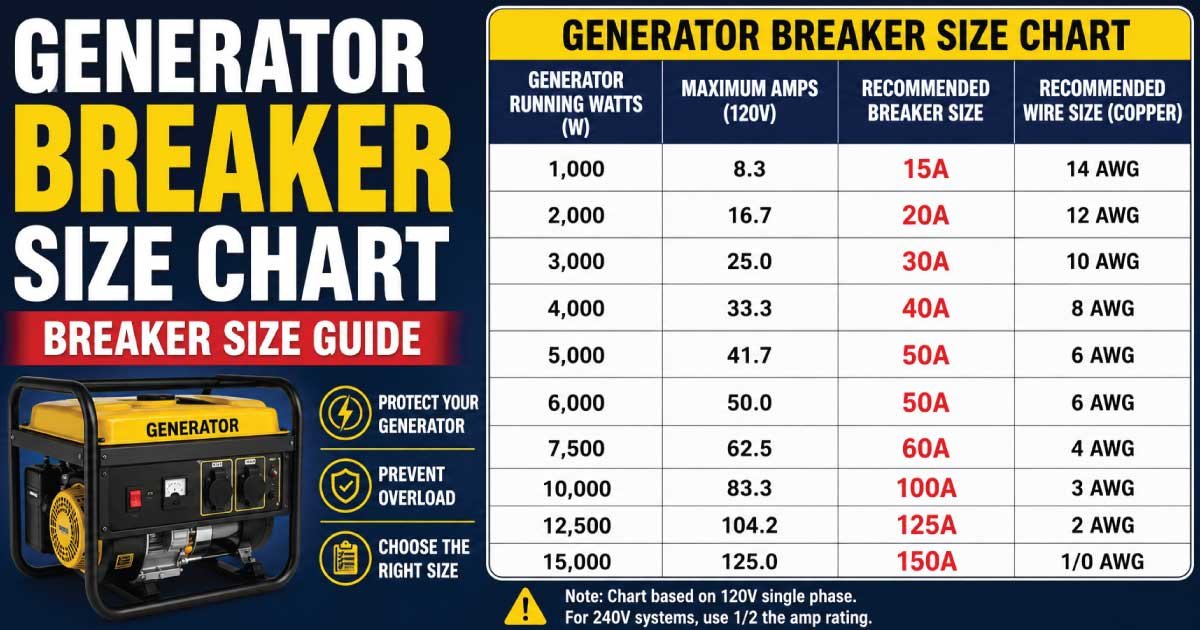
Generator Breaker Size Chart
The following table provides general reference values for common generator capacities. Actual breaker ratings must be verified against the generator nameplate, manufacturer instructions, conductor ampacity, and applicable electrical requirements.
| Generator Capacity | Approx. Current at 240V Single Phase | Common Breaker Range* |
|---|---|---|
| 2 kW | 8.3 A | 10–15 A |
| 3 kW | 12.5 A | 15–20 A |
| 5 kW | 20.8 A | 25–30 A |
| 7.5 kW | 31.3 A | 35–40 A |
| 10 kW | 41.7 A | 45–50 A |
| 12 kW | 50 A | 50–60 A |
| 15 kW | 62.5 A | 70 A |
| 20 kW | 83.3 A | 90–100 A |
| 25 kW | 104.2 A | 110–125 A |
| 30 kW | 125 A | 125–150 A |
| 40 kW | 166.7 A | 175–200 A |
| 50 kW | 208.3 A | 225–250 A |
| 75 kW | 312.5 A | 325–350 A |
| 100 kW | 416.7 A | 450–500 A |
*These are general reference ranges, not universal breaker-selection rules. Generator manufacturers may specify a particular breaker rating based on the alternator, engine, protection system, and generator design.
How Generator Breaker Sizing Works
Generator breaker sizing starts by determining the generator’s rated output current.
For a single-phase generator:
Current = Watts ÷ Voltage
For example, a 10,000-watt generator operating at 240V:
10,000 ÷ 240 = 41.7A
This gives the approximate rated current.
However, selecting a 50A breaker simply because it is the next common size is not automatically correct. The generator manufacturer may specify a different breaker rating, and the conductor and installation must also be appropriately rated.
Single-Phase Generator Breaker Calculation
For a single-phase generator:
I = P ÷ V
Where:
- I = current in amperes.
- P = generator output in watts.
- V = operating voltage.
For example:
Generator = 7,500W
Voltage = 240V
Current = 7,500 ÷ 240
Current = 31.25A
A suitable breaker may be in the 35A or 40A range depending on the generator design and applicable requirements.
The manufacturer’s specified breaker rating should take priority.
Three-Phase Generator Breaker Calculation
For a three-phase generator:
I = P ÷ (√3 × V × PF)
Where:
- I = current.
- P = real power in watts.
- V = line-to-line voltage.
- PF = power factor.
For a generator rated in kVA:
I = kVA × 1000 ÷ (√3 × V)
For example, a 100 kVA, 400V three-phase generator:
I = 100,000 ÷ (1.732 × 400)
I ≈ 144A
A breaker around 160A may be considered in some designs, but the generator manufacturer may specify a different rating.
Generator Breaker Size for 5 kW
A 5 kW generator at 240V single phase produces approximately:
5,000 ÷ 240 = 20.8A
A breaker in the 25A range may be considered depending on the generator manufacturer’s specifications.
For a 120V system, however, the current would be approximately:
5,000 ÷ 120 = 41.7A
This demonstrates why generator voltage must always be considered before selecting a breaker.
Generator Breaker Size for 10 kW
A 10 kW generator at 240V single phase produces approximately:
10,000 ÷ 240 = 41.7A
A 50A breaker may be common for some 10 kW generator configurations.
However, the actual breaker rating should be confirmed from the generator’s nameplate and installation manual.
A 10 kW generator operating at another voltage or phase configuration can have a different rated current.
Generator Breaker Size for 15 kW
A 15 kW generator at 240V single phase produces:
15,000 ÷ 240 = 62.5A
A breaker around 70A may be appropriate for some generator systems.
However, generator breaker ratings can be affected by:
- Generator alternator rating.
- Continuous load.
- Manufacturer design.
- Conductor size.
- Ambient temperature.
- Protection requirements.
Generator Breaker Size for 20 kW
For a 20 kW, 240V single-phase generator:
20,000 ÷ 240 = 83.3A
A breaker around 90–100A may be encountered in some installations.
The exact selection should be checked against the generator’s specified output breaker.
For standby generators, the transfer switch and feeder must also be rated appropriately.
Generator Breaker Size for 30 kW
A 30 kW generator at 240V single phase produces:
30,000 ÷ 240 = 125A
A breaker around 125A or 150A may be considered depending on the generator’s design.
For a three-phase generator, the current can be substantially different.
For example, a 30 kW, 400V three-phase generator at a power factor of 0.8 produces approximately:
54A
This could lead to a very different breaker selection.
Generator Breaker Size for 50 kW
A 50 kW generator operating at 240V single phase produces:
50,000 ÷ 240 = 208.3A
A breaker in the 225–250A range may be encountered in suitable installations.
A 50 kW three-phase generator will generally have a different current requirement.
At 400V three phase and 0.8 power factor:
I ≈ 90A
This demonstrates why generator phase and voltage are critical when calculating breaker size.
Generator Breaker Size for 100 kW
A 100 kW generator at 240V single phase would theoretically produce:
100,000 ÷ 240 = 416.7A
Large generators are commonly configured as three-phase systems.
For a 100 kW, 400V three-phase generator at 0.8 power factor:
I ≈ 180A
A breaker around 200A may be considered in some applications, but the generator manufacturer’s specified protection must be followed.
Also Read: Solar Cable Size Chart: Choose the Right Cable Size
Generator Breaker Size by kVA
Generators are frequently rated in kVA rather than kW, especially commercial and industrial models.
The relationship between kW and kVA is:
kW = kVA × Power Factor
Therefore:
kVA = kW ÷ Power Factor
For example, a generator rated:
100 kVA at 0.8 PF
has approximately:
100 × 0.8 = 80 kW
The breaker should be selected according to the generator’s actual rated current and manufacturer’s protection requirements.
Generator Breaker Size for 120V
Small portable generators may provide 120V output.
For example, a 3,000W generator at 120V:
3,000 ÷ 120 = 25A
A breaker rating around 25A may be encountered depending on the generator design.
However, many portable generators divide their output among multiple receptacles, so the total generator output and individual circuit ratings must be considered separately.
Generator Breaker Size for 240V
240V systems are common for residential standby generators and larger portable generators.
For a 10 kW generator:
10,000 ÷ 240 ≈ 41.7A
A 50A breaker may be used in some generator configurations.
For a 20 kW generator:
20,000 ÷ 240 ≈ 83.3A
A 90A or 100A breaker may be encountered.
Again, these values are starting points for calculation rather than universal breaker specifications.
Generator Breaker Size for 400V Three Phase
400V three-phase systems are common in commercial and industrial applications.
For a three-phase generator rated in kVA:
I = kVA × 1000 ÷ (1.732 × 400)
Examples:
| Generator Rating | Approx. Full-Load Current |
|---|---|
| 25 kVA | 36 A |
| 50 kVA | 72 A |
| 75 kVA | 108 A |
| 100 kVA | 144 A |
| 150 kVA | 217 A |
| 200 kVA | 289 A |
| 250 kVA | 361 A |
| 500 kVA | 722 A |
The breaker size should then be coordinated with the generator manufacturer, conductors, and installation design.
Also Read: Copper Wire Size Chart: AWG & mm² Guide for Projects
Generator Breaker vs Generator Output
A common misunderstanding is that a larger breaker allows a generator to produce more power.
It does not.
For example, if a generator is rated for approximately 42A, installing a 100A breaker does not turn it into a 100A generator.
The generator’s alternator, engine, and electrical system still determine its maximum rated output.
The breaker is primarily a protective device.
Generator Breaker and Cable Size
The generator breaker and cable must be properly coordinated.
For example:
Generator → Breaker → Cable → Transfer Switch
The conductor must have adequate ampacity for the intended installation and protective-device arrangement.
A breaker should not be selected independently from the cable.
Important cable factors include:
- Conductor size.
- Copper or aluminum.
- Insulation rating.
- Installation method.
- Ambient temperature.
- Number of current-carrying conductors.
- Cable length.
- Voltage drop.
Generator Breaker and Transfer Switch
Standby generators often connect to buildings through an automatic transfer switch.
A typical arrangement is:
Utility → Transfer Switch
Generator → Generator Breaker → Transfer Switch → Distribution Panel
The transfer switch must have an appropriate current rating.
For example, a generator with a 100A output breaker should not be connected through an inadequately rated transfer switch.
The generator breaker, transfer switch, feeder conductors, and distribution equipment should be designed as one coordinated system.
Generator Breaker for Motor Loads
Motors can create high starting currents.
Examples include:
- Air conditioners.
- Pumps.
- Compressors.
- Refrigerators.
- Workshop machinery.
A generator may have sufficient running capacity but still experience voltage or frequency problems when a large motor starts.
Breaker selection must account for the generator manufacturer’s requirements and the characteristics of the connected loads.
Do not simply increase the breaker rating to solve a generator starting problem.
Generator Breaker for Inverter Generators
Inverter generators use electronic power-conversion systems and may have different protection arrangements than conventional alternator generators.
The generator manufacturer’s specifications should be followed carefully.
Portable inverter generators may have:
- Built-in breakers.
- Electronic overload protection.
- Multiple receptacle circuits.
- Ground-fault protection.
- Specialized output protection.
Do not replace an integrated protective device with a larger breaker without manufacturer approval.
Generator Main Breaker
Large standby and industrial generators may have a main output breaker.
This breaker can provide protection for the generator output conductors and facilitate isolation of the generator from downstream equipment.
The main breaker rating may be specified by the generator manufacturer based on:
- Generator rated current.
- Alternator design.
- Fault characteristics.
- Output terminals.
- Protection requirements.
- Applicable standards.
For large generator installations, breaker selection should be performed as part of the complete electrical design.
Generator Breaker Tripping Problems
If a generator breaker trips repeatedly, possible causes include:
- Excessive connected load.
- Short circuit.
- Faulty equipment.
- Motor starting current.
- Undersized generator.
- Incorrect breaker selection.
- Overheating.
- Wiring problems.
Repeatedly resetting the breaker without finding the cause can be dangerous.
The load and generator system should be inspected by a qualified electrician or generator technician.
How to Choose the Correct Generator Breaker
Follow these steps:
- Identify the generator’s rated kW or kVA.
- Determine the output voltage.
- Determine whether the generator is single phase or three phase.
- Identify the generator’s rated current.
- Check the generator manufacturer’s recommended breaker.
- Check the cable ampacity.
- Check the transfer-switch rating.
- Consider the type of connected loads.
- Consider motor starting currents.
- Check ambient temperature and installation conditions.
- Verify the breaker interrupting rating.
- Confirm compliance with applicable electrical codes.
- Have the final installation inspected and tested.
The generator nameplate and manufacturer documentation should take priority over a generic sizing chart.
Common Generator Breaker Sizing Mistakes
Choosing a Breaker From kW Alone
Generator voltage and phase significantly affect current.
Installing a Larger Breaker to Prevent Tripping
A larger breaker does not increase generator capacity and can compromise protection.
Ignoring the Generator Nameplate
The manufacturer may specify a particular breaker rating.
Ignoring Cable Ampacity
The breaker and conductor must be properly coordinated.
Ignoring Motor Starting Loads
Large motors can cause temporary high current and generator voltage drop.
Using the Wrong Breaker Type
The breaker must be compatible with the generator’s electrical system.
Ignoring Interrupting Capacity
For larger installations, the breaker must have an adequate interrupting rating for the available fault current.
Generator Breaker Quick Reference
| Generator Size | Approx. Current at 240V 1-Phase | Typical Breaker Reference |
|---|---|---|
| 3 kW | 12.5 A | 15–20 A |
| 5 kW | 20.8 A | 25–30 A |
| 7.5 kW | 31.3 A | 35–40 A |
| 10 kW | 41.7 A | 45–50 A |
| 15 kW | 62.5 A | 70 A |
| 20 kW | 83.3 A | 90–100 A |
| 25 kW | 104.2 A | 110–125 A |
| 30 kW | 125 A | 125–150 A |
| 40 kW | 166.7 A | 175–200 A |
| 50 kW | 208.3 A | 225–250 A |
| 75 kW | 312.5 A | 325–350 A |
| 100 kW | 416.7 A | 450–500 A |
These values are general reference figures only. The actual breaker may differ based on generator design, voltage, phase, power factor, manufacturer specifications, conductor ampacity, and applicable electrical standards.
Also Read: AWG Wire Size Chart: Gauge, Ampacity & Uses
Frequently Asked Questions
What size breaker do I need for a generator?
The correct breaker depends on the generator’s rated current, voltage, phase, manufacturer specifications, and connected wiring. For example, a 10 kW generator at 240V produces about 41.7A, but the appropriate breaker must still be verified against the generator’s nameplate and installation requirements.
What size breaker is suitable for a 10 kW generator?
A 10 kW, 240V single-phase generator produces approximately 41.7A, so a 50A breaker is common for some installations. However, the generator manufacturer may specify a different breaker. Always use the specified breaker rating rather than relying only on the calculated current.
What breaker size is needed for a 20 kW generator?
A 20 kW generator operating at 240V single phase produces approximately 83.3A. A breaker around 90–100A may be encountered, but the final rating depends on the generator’s specifications, conductor ampacity, transfer switch, and applicable electrical requirements.
Can I use a bigger breaker on my generator?
You should not install a larger breaker simply to prevent nuisance tripping. A larger breaker does not increase generator capacity and may reduce protection for the generator or conductors. Any replacement breaker should match the generator manufacturer’s approved specifications.
Does generator voltage affect breaker size?
Yes. Generator voltage has a direct effect on current. For the same power output, a lower voltage produces higher current and generally requires different protective-device and conductor sizing. Phase configuration also significantly affects the current calculation.
Does a generator breaker protect the generator from overload?
A generator breaker provides overcurrent protection, but the complete generator protection system may include additional functions. Generator-specific controls can monitor overload, voltage, frequency, temperature, and other conditions. The manufacturer’s protection scheme should always be followed.
Why does my generator breaker keep tripping?
Repeated breaker tripping may result from excessive load, short circuits, faulty appliances, motor starting current, wiring problems, overheating, or an incorrect breaker rating. Do not repeatedly reset the breaker without identifying the cause. Have the generator and connected circuits inspected by a qualified professional.
Final Thoughts
Selecting the correct generator breaker size requires understanding the relationship between generator capacity, voltage, phase, rated current, cable ampacity, and protective-device requirements.
For a 240V single-phase system, a 5 kW generator produces approximately 20.8A, while a 10 kW generator produces approximately 41.7A. A 20 kW generator produces approximately 83.3A under the same voltage and phase conditions.
However, these calculations are only the starting point. The generator manufacturer’s specified breaker rating should take priority because generators can have unique alternator, engine, control, and protection characteristics.
For three-phase generators, current must be calculated differently, using the three-phase relationship between kW, kVA, voltage, and power factor.
The breaker must also be coordinated with the generator cable, transfer switch, distribution equipment, and connected loads. Large motor loads may require additional consideration because of their starting current.
Most importantly, do not install an oversized breaker simply because the generator trips. Repeated tripping should be treated as a potential indication of overload, wiring faults, equipment problems, or incorrect system design.
For permanent or high-power generator installations, breaker selection and wiring should be verified by a qualified electrician in accordance with the generator manufacturer’s instructions and applicable electrical codes.