
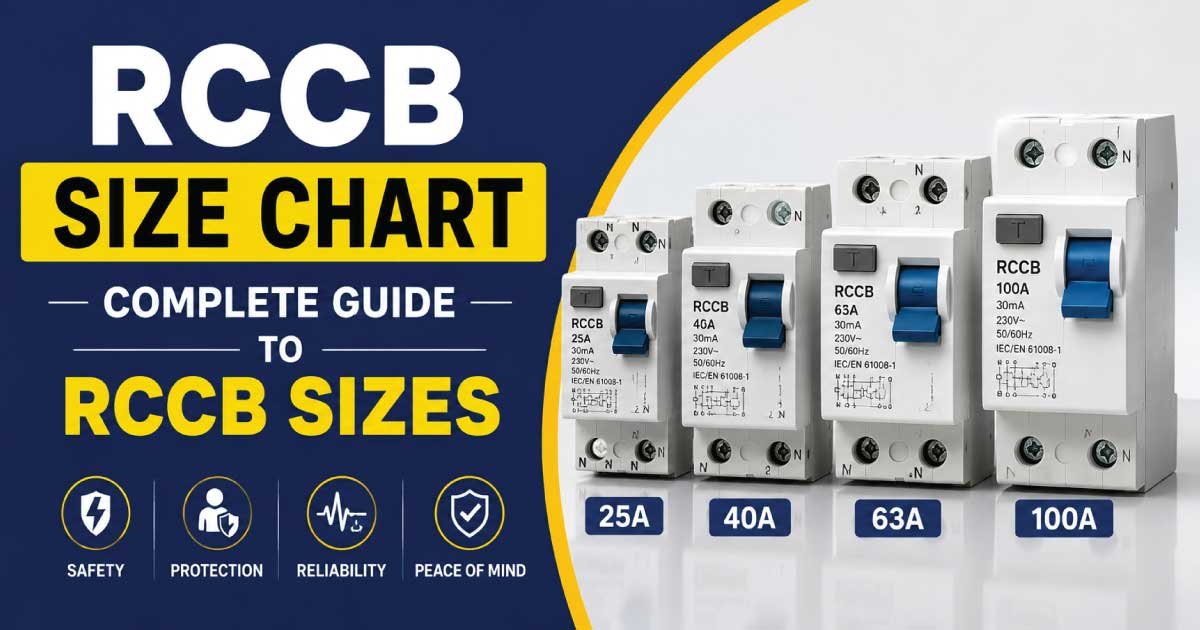
An RCCB, or Residual Current Circuit Breaker, is an important electrical safety device designed to protect people and electrical installations from leakage or residual current. It detects an imbalance between the current flowing through the live conductor and the current returning through the neutral conductor. When the difference exceeds its rated residual operating current, the RCCB disconnects the circuit.
Selecting the correct RCCB requires more than choosing an ampere rating. You need to consider the load current, rated voltage, number of poles, residual current sensitivity, type of RCCB, installation method, and upstream circuit protection.
RCCBs are commonly used in homes, offices, commercial buildings, workshops, industrial facilities, and electrical distribution boards. They are especially important in locations where protection against electric shock and earth leakage is required.
This complete guide explains RCCB ratings, common sizes, sensitivity values, pole configurations, RCCB selection, applications, wiring considerations, and the difference between RCCB and related protective devices.
What Is an RCCB?
RCCB stands for Residual Current Circuit Breaker.
It monitors the current flowing through the conductors of a circuit. Under normal conditions, the current leaving through the live conductor should approximately equal the current returning through the neutral conductor.
If some current flows to earth through a person, damaged insulation, or another unintended path, an imbalance occurs.
The RCCB detects this difference and trips the circuit.
For example:
Current through live = 10 A
Current through neutral = 9.97 A
The difference is:
10 A − 9.97 A = 0.03 A = 30 mA
If the RCCB is designed to trip at an appropriate residual-current level, it can disconnect the circuit.
An RCCB is therefore primarily a residual-current protection device, not a conventional overload-protection device.
Why RCCB Size Matters
Choosing the correct RCCB rating helps ensure that the device is suitable for the electrical circuit.
Important factors include:
- Rated current.
- Rated operating voltage.
- Number of poles.
- Residual current rating.
- RCCB type.
- Frequency.
- Short-circuit coordination.
- Upstream overcurrent protection.
- Installation environment.
- Applicable electrical standards.
An RCCB that is too small for the normal circuit load may nuisance-trip or become unsuitable for the application.
An RCCB with an unnecessarily high current rating may not provide the intended coordination with the circuit conductors and upstream protective equipment.
RCCB Size Chart
RCCBs are available in various current ratings. Common ratings include 16A, 25A, 40A, 63A, 80A, and 100A, although availability varies by manufacturer and market.
| RCCB Rated Current | Typical Application |
|---|---|
| 16A | Small dedicated circuits |
| 25A | Small residential circuits |
| 40A | Residential and light commercial circuits |
| 63A | Main residential or larger branch circuits |
| 80A | Higher-load distribution circuits |
| 100A | Large distribution applications |
| 125A+ | Specialized commercial and industrial systems |
The RCCB’s ampere rating should be selected based on the circuit design and manufacturer requirements. It should not be selected simply because a larger rating appears safer.
Common RCCB Current Ratings
16A RCCB
A 16A RCCB may be used with relatively small electrical circuits where the connected load and upstream protection are appropriately designed.
Possible applications include:
- Small dedicated equipment.
- Limited lighting circuits.
- Small appliances.
- Control circuits.
The exact application depends on the circuit’s overcurrent protection and wiring.
25A RCCB
25A RCCBs can be suitable for smaller residential or commercial distribution circuits.
They may be used where the expected continuous load is appropriately below the device rating.
40A RCCB
40A is a common rating in residential and light commercial installations.
It may be used for:
- Small distribution boards.
- Appliance circuits.
- Residential electrical protection.
- Small commercial loads.
63A RCCB
63A RCCBs are widely used for larger residential and commercial distribution circuits.
They may protect groups of circuits supplied from a distribution board when correctly coordinated with the upstream protective device.
80A and 100A RCCB
Higher-rated RCCBs are used for larger electrical systems.
Typical applications can include:
- Commercial distribution.
- Industrial panels.
- Large residential systems.
- Equipment distribution.
- Higher-current subpanels.
The conductor size and upstream protection must be appropriate for the installation.
RCCB Sensitivity Ratings
One of the most important RCCB specifications is its residual operating current, usually expressed in milliamperes or mA.
Common values include:
- 10 mA
- 30 mA
- 100 mA
- 300 mA
The sensitivity determines the residual current at which the RCCB is designed to operate under specified conditions.
30mA RCCB
A 30mA RCCB is commonly associated with additional protection against electric shock in many applications.
It is frequently used for:
- Socket-outlet circuits.
- Residential circuits.
- Bathrooms and other higher-risk locations.
- Portable equipment.
- General personnel protection applications.
However, the required protection level depends on the applicable electrical code and installation design.
100mA RCCB
100mA devices may be used where a higher residual-current threshold is appropriate, often for installation or equipment protection rather than the same level of additional personal protection associated with 30mA devices.
300mA RCCB
300mA RCCBs are commonly associated with broader installation-level protection and may be used where the goal includes reducing the risk associated with insulation leakage and electrical fire.
The correct sensitivity should always be determined according to the electrical system design and applicable standards.
RCCB Type Selection
RCCBs are available in different types based on the kinds of residual currents they can detect.
Common classifications include:
- Type AC.
- Type A.
- Type F.
- Type B.
The correct type depends on the connected equipment and the nature of possible residual currents.
Type AC RCCB
Type AC devices are intended for residual sinusoidal alternating currents.
They may be suitable for conventional AC loads where the expected residual current characteristics meet the device’s specifications.
Type A RCCB
Type A devices can detect residual alternating current and certain pulsating DC residual currents.
They are often considered for modern electronic equipment that may produce pulsating residual currents.
Type F RCCB
Type F devices are designed for certain applications involving equipment that can produce mixed-frequency residual currents.
They may be relevant to equipment such as certain variable-speed appliances.
Type B RCCB
Type B devices can detect a wider range of residual current waveforms, including certain smooth DC components.
They are used in specialized applications where equipment can generate these types of residual currents.
Always check the equipment manufacturer’s requirements before selecting the RCCB type.
RCCB Pole Sizes
RCCBs are available with different numbers of poles.
Common configurations include:
- 2-pole RCCB.
- 4-pole RCCB.
2-Pole RCCB
A 2-pole RCCB is commonly used in single-phase systems.
It normally switches and monitors the live and neutral conductors.
Common applications include:
- Houses.
- Apartments.
- Small offices.
- Single-phase equipment.
- Small commercial installations.
4-Pole RCCB
A 4-pole RCCB is commonly used in three-phase systems where the neutral is also switched.
It can monitor the relevant phase conductors and neutral according to the device design.
Typical applications include:
- Commercial buildings.
- Industrial facilities.
- Three-phase distribution boards.
- Large machinery.
- Three-phase electrical systems.
The number of poles should match the electrical system and the required switching arrangement.
Also Read: PVC Conduit Size Chart: Complete Size Guide
RCCB Voltage Rating
RCCBs are designed for specific operating voltages.
Common systems include:
- 230V single-phase.
- 400V three-phase.
- Other manufacturer-specific ratings.
The RCCB voltage rating must be compatible with the electrical system.
For a typical single-phase system, a 2-pole RCCB may be used where the device is rated for the system voltage.
For a three-phase system, a suitable 4-pole RCCB may be used when required by the system design.
Always verify the manufacturer’s voltage rating before installation.
RCCB Ampere Rating vs Load Current
The RCCB ampere rating should be coordinated with the circuit’s expected current.
For example, if a circuit normally carries approximately 25A, a 40A RCCB may be considered if the wiring, upstream protection, and system design are appropriate.
However, RCCB selection should not be based solely on the load’s normal current.
You must also consider:
- Cable ampacity.
- Overcurrent protection.
- Continuous load.
- Ambient temperature.
- Installation method.
- Manufacturer specifications.
An RCCB does not replace a properly rated circuit breaker for overload and short-circuit protection.
RCCB and MCB Difference
One of the most important concepts is understanding that an RCCB and an MCB perform different functions.
An MCB, or Miniature Circuit Breaker, primarily protects against:
- Overload.
- Short circuit.
An RCCB primarily protects against:
- Residual current.
- Earth leakage.
- Certain electric shock hazards.
For example:
MCB → Overcurrent protection
RCCB → Residual-current protection
A typical installation may require both devices.
RCCB vs RCBO
An RCBO, or Residual Current Circuit Breaker with Overcurrent protection, combines residual-current protection with overcurrent protection in a single device.
| Feature | RCCB | RCBO |
|---|---|---|
| Earth leakage protection | Yes | Yes |
| Overload protection | No | Yes |
| Short-circuit protection | No | Yes |
| Separate MCB required | Usually | Not for the same circuit |
| Individual circuit protection | Limited | Excellent |
RCCBs are often used with MCBs, while RCBOs can provide combined protection for individual circuits.
Also Read: Electrical Conduit Size Chart: Find the Right Size
RCCB Wiring Basics
The wiring arrangement depends on the RCCB type and electrical system.
For a typical single-phase RCCB:
Supply Live → RCCB → Load Live
Supply Neutral → RCCB → Load Neutral
Both live and neutral conductors must pass through the appropriate sensing mechanism according to the manufacturer’s wiring diagram.
The protective earth conductor normally does not pass through the RCCB’s sensing path in the same manner as the live and neutral conductors.
Incorrect neutral connections can cause unwanted tripping.
Always follow the manufacturer’s terminal markings and wiring diagram.
RCCB Installation in a Distribution Board
A common residential arrangement can include:
Utility Supply → Main Protection → RCCB → MCBs → Individual Circuits
The exact arrangement varies depending on the electrical system.
An RCCB can protect a group of downstream circuits, while individual MCBs provide overcurrent protection.
For greater selectivity, individual circuits may instead use RCBOs.
A qualified electrician should design and install the distribution board according to applicable electrical requirements.
RCCB Selectivity and Coordination
When multiple residual-current devices are installed, coordination becomes important.
For example, if an upstream RCCB and downstream RCCB have identical characteristics and settings, a fault may cause both devices to trip.
Proper coordination can help ensure that the protective device closest to the fault operates first.
Designers may consider:
- Different residual-current ratings.
- Time delays.
- Device characteristics.
- Manufacturer coordination tables.
This is particularly important in larger commercial and industrial installations.
RCCB for Home Use
RCCBs are widely used in residential electrical systems.
Potential applications include:
- Lighting.
- Socket outlets.
- Kitchen circuits.
- Outdoor circuits.
- Water heaters.
- Washing machines.
- Pumps.
- Air conditioners.
The required RCCB rating depends on the electrical distribution design.
For many personnel-protection applications, a 30mA residual-current device may be specified, but the exact requirements depend on local electrical regulations and the circuit type.
RCCB for Water Heaters
Water heaters are often treated as higher-risk electrical loads because they may be installed in areas where water is present.
An RCCB can provide additional protection against residual current.
When installing protection for a water heater, consider:
- Heater rated current.
- Circuit voltage.
- Cable size.
- MCB rating.
- RCCB sensitivity.
- Earthing system.
- Location.
- Applicable electrical regulations.
The RCCB should not be considered a substitute for proper grounding and bonding.
RCCB for Air Conditioners
Air conditioners can contain compressors, motors, and electronic controls that affect residual-current characteristics.
The appropriate RCCB type and rating should be selected according to the air-conditioner’s manufacturer recommendations.
Important factors include:
- Rated current.
- Starting characteristics.
- Inverter or non-inverter design.
- Residual-current waveform.
- Circuit voltage.
- Cable size.
Modern inverter-driven equipment may require a specific RCCB type.
RCCB for Industrial Applications
Industrial electrical systems often require more advanced protection and coordination.
Applications may include:
- Motors.
- Pumps.
- Machine tools.
- Control panels.
- Industrial heating systems.
- Production machinery.
- Three-phase equipment.
Industrial installations may require Type A, F, or B residual-current protection depending on the equipment.
The protection system should be designed by a competent electrical professional.
How to Select the Correct RCCB Size
Use the following process when choosing an RCCB:
- Determine whether the system is single-phase or three-phase.
- Determine the system voltage.
- Calculate the expected circuit load.
- Check the cable’s current-carrying capacity.
- Select the appropriate RCCB current rating.
- Determine the required residual-current sensitivity.
- Select the correct RCCB type.
- Choose the required number of poles.
- Coordinate the RCCB with MCBs or other overcurrent protection.
- Check short-circuit and installation requirements.
- Verify the manufacturer’s specifications.
- Test the completed installation.
This approach provides much better protection than selecting an RCCB based only on its ampere rating.
Also Read: EMT Conduit Size Chart: Standard Sizes Explained
RCCB Size Selection Example
Suppose a single-phase circuit has a calculated operating load of approximately 25A.
A suitable RCCB might have a current rating above the expected operating current, such as a 40A RCCB, provided that:
- The conductors are correctly rated.
- The upstream overcurrent protection is appropriate.
- The residual-current sensitivity is suitable.
- The voltage rating matches.
- The RCCB type is appropriate.
- The installation complies with applicable requirements.
The exact selection should be verified by the electrical system designer or qualified electrician.
Common RCCB Sizing Mistakes
Choosing Only by Ampere Rating
The current rating is only one RCCB specification. Sensitivity, type, voltage, and poles are also important.
Using an RCCB Instead of an MCB
An RCCB does not normally provide overload or short-circuit protection.
Ignoring RCCB Type
Modern electronic equipment may require a particular residual-current detection type.
Incorrect Neutral Wiring
Improper neutral connections can cause nuisance tripping.
Ignoring Cable Capacity
The RCCB and cable must be appropriately coordinated with the overcurrent protection.
Using the Wrong Pole Configuration
A single-phase and three-phase system may require different RCCB configurations.
Skipping Testing
The RCCB test function should be checked according to the manufacturer’s instructions and applicable requirements.
RCCB Test Button
Most RCCBs include a test button.
Pressing the test button creates an artificial residual-current condition that should cause the device to trip.
The test button is intended to verify that the tripping mechanism operates.
A proper test should result in:
RCCB ON → Press TEST → RCCB trips
If the RCCB does not trip when the test function is operated as instructed, the device should be investigated by a qualified person.
Do not continue relying on a protective device that fails its required test.
RCCB Nuisance Tripping
An RCCB that trips repeatedly may indicate a problem with the electrical installation or connected equipment.
Possible causes include:
- Insulation leakage.
- Faulty appliances.
- Moisture.
- Damaged wiring.
- Incorrect neutral connections.
- Cumulative leakage from multiple devices.
- Incompatible RCCB type.
- Equipment producing DC or high-frequency residual currents.
Repeatedly resetting the RCCB without finding the cause is not a safe solution.
The fault should be investigated by a qualified electrician.
RCCB and Earthing
RCCB protection works alongside the electrical earthing system.
An effective earthing and bonding system helps provide a safe path for fault current and supports the operation of protective devices.
An RCCB should not be viewed as a replacement for:
- Proper grounding.
- Protective bonding.
- Correct conductor sizing.
- Circuit protection.
- Safe installation practices.
Electrical safety depends on the complete protection system.
RCCB Size Chart by Common Application
| Application | Typical RCCB Rating Range | Common Sensitivity Consideration |
|---|---|---|
| Small residential circuit | 16–25A | Often 30mA where required |
| General home distribution | 25–40A | Often 30mA for personnel protection |
| Larger residential supply | 40–63A | Depends on installation |
| Small commercial panel | 40–63A | Depends on design |
| Large commercial distribution | 63–100A | Application dependent |
| Industrial distribution | 63–125A+ | Requires engineered selection |
These are general reference ranges rather than universal installation rules.
RCCB Size for Single Phase
Single-phase electrical systems commonly use 2-pole RCCBs.
Common current ratings include:
- 25A.
- 40A.
- 63A.
- 80A.
- 100A.
The appropriate rating depends on the circuit design and upstream protection.
For personnel protection, 30mA sensitivity is commonly used where required, but local regulations and equipment requirements must be followed.
RCCB Size for Three Phase
Three-phase systems commonly use 4-pole RCCBs when the neutral is switched and monitored as required.
Common ratings include:
- 40A.
- 63A.
- 80A.
- 100A.
- 125A.
The RCCB must be compatible with the three-phase system voltage and connected load.
Industrial equipment may also require a specific RCCB type based on the nature of its electronic power supplies and drives.
RCCB Current Rating vs Sensitivity
These two specifications should not be confused.
Current rating, such as 40A or 63A, indicates the rated current the device can carry under its specified conditions.
Residual-current rating, such as 30mA or 300mA, indicates the residual operating current associated with its earth-leakage protection function.
For example:
40A / 30mA RCCB
means:
- 40A = rated current.
- 30mA = residual operating current.
A 63A / 30mA RCCB has a higher current-carrying rating but the same nominal residual-current sensitivity.
How to Read an RCCB Label
An RCCB label may include several important markings.
Look for:
- Rated current: In
- Rated residual operating current: IΔn
- Rated voltage: Un
- Frequency.
- Number of poles.
- RCCB type.
- Manufacturer.
- Product standard.
- Wiring terminals.
- Test button information.
Understanding these markings makes it easier to select a replacement or compare different RCCB models.
Frequently Asked Questions
What size RCCB do I need for a house?
There is no single RCCB size that fits every house. Common ratings include 40A and 63A, but the correct selection depends on the home’s maximum demand, incoming supply, cable capacity, circuit arrangement, number of phases, and overcurrent protection. A qualified electrician should determine the final rating.
Is 30mA RCCB better than 100mA?
They serve different purposes. A 30mA RCCB provides a lower residual-current operating threshold and is commonly used where additional protection against electric shock is required. A 100mA device has a higher threshold and may be used for other protection purposes. The correct value depends on the installation requirements.
Does an RCCB protect against short circuits?
An RCCB normally does not provide dedicated overload and short-circuit protection. It is primarily designed to detect residual current. An MCB, fuse, or suitable overcurrent protective device is generally required alongside it unless an RCBO is used, which combines residual-current and overcurrent protection.
What is the difference between 30mA and 300mA RCCB?
The main difference is residual-current sensitivity. A 30mA RCCB is designed around a much lower residual-current threshold and is commonly associated with additional personnel protection. A 300mA RCCB operates at a higher residual-current level and may be used for broader installation protection.
Should I use a 2-pole or 4-pole RCCB?
A 2-pole RCCB is commonly used in single-phase systems, while a 4-pole RCCB is commonly used in three-phase systems where the neutral is also switched as required. The correct configuration depends on the electrical system and applicable wiring requirements.
Why does my RCCB keep tripping?
Repeated RCCB trips can result from earth leakage, damaged insulation, moisture, faulty appliances, incorrect neutral connections, cumulative leakage, or an unsuitable RCCB type. Do not repeatedly reset a tripping RCCB without investigating the cause. Have the electrical system checked by a qualified professional.
Can an RCCB replace an MCB?
No. A conventional RCCB is not normally a replacement for an MCB because the two devices provide different types of protection. An MCB protects against overload and short circuits, while an RCCB detects residual current. An RCBO can combine both functions in one device.
Final Thoughts
Choosing the correct RCCB requires consideration of several electrical characteristics rather than simply selecting the largest available ampere rating. The most important factors include rated current, residual-current sensitivity, voltage, number of poles, RCCB type, cable capacity, and coordination with overcurrent protection.
Common RCCB current ratings include 16A, 25A, 40A, 63A, 80A, and 100A, while common residual-current sensitivities include 30mA, 100mA, and 300mA. The appropriate combination depends on the electrical installation and the protection objective.
For many residential applications, 2-pole RCCBs are used in single-phase systems, while 4-pole devices are common in three-phase installations. Modern electronic equipment may also require a specific RCCB type, such as Type A, F, or B.
Most importantly, an RCCB should be considered part of a complete electrical protection system. Proper cable sizing, grounding, bonding, MCB or fuse protection, suitable RCCB selection, correct installation, and regular testing all contribute to electrical safety.
Always follow the manufacturer’s instructions, applicable electrical standards, and local regulations. For mains-voltage installations, RCCB selection and wiring should be carried out or verified by a qualified electrician.