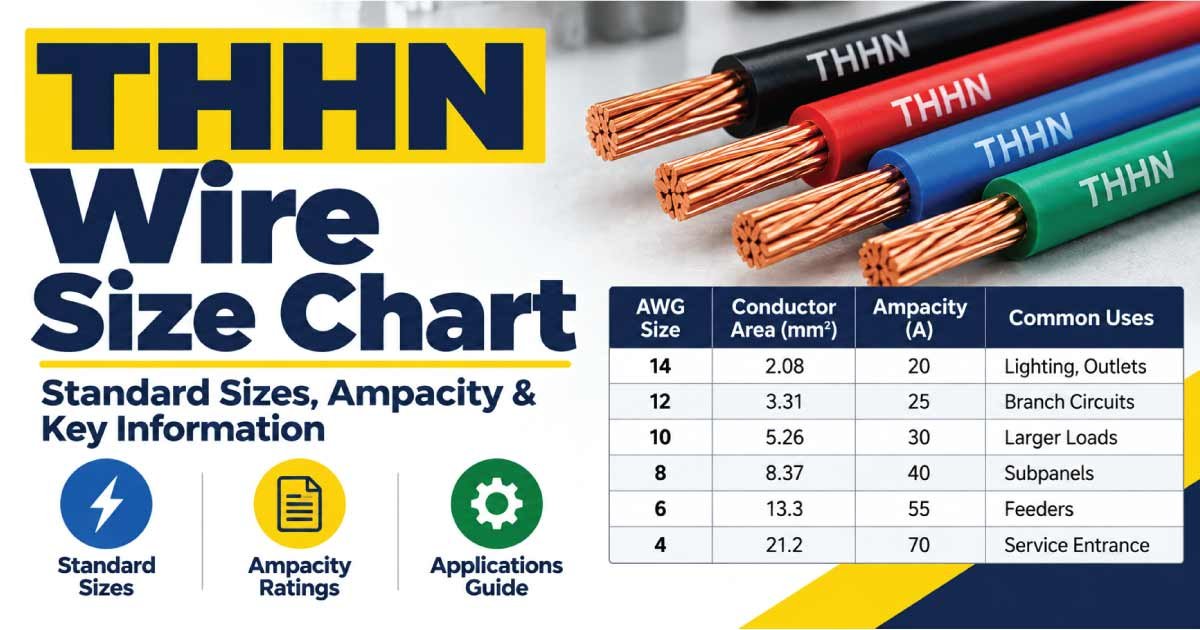
Choosing the correct wire size is essential for a safe and reliable electrical installation. A THHN wire size chart helps electricians, contractors, engineers, and DIY users compare American Wire Gauge (AWG) sizes with their allowable ampacity and typical applications.
THHN wire is widely used inside conduit, raceways, and similar wiring systems for branch circuits, feeders, and other electrical installations. Although THHN insulation is commonly rated for 90°C in dry locations, the allowable circuit ampacity is not determined by the 90°C rating alone. Terminal ratings, conductor count, ambient temperature, overcurrent protection, and applicable electrical codes must also be considered.
This guide explains common THHN wire sizes, copper ampacity ratings, voltage-drop considerations, wire selection, derating, applications, and common mistakes to avoid.
What Is THHN Wire?
THHN stands for Thermoplastic High Heat-resistant Nylon-coated wire. It is a single-conductor building wire with thermoplastic insulation and a nylon outer jacket.
THHN conductors are commonly used in conduit and raceway systems for commercial, industrial, and residential electrical applications. Many products are dual-rated as THHN/THWN-2, meaning the same conductor can also be used for wet-location applications when the product is specifically marked for that rating. Southwire, for example, specifies THHN for dry locations up to 90°C and THWN-2 for wet or dry locations up to 90°C.
Typical characteristics include:
- Copper or aluminum conductor options
- Thermoplastic insulation
- Nylon jacket
- Common 600 V rating
- Multiple AWG and kcmil sizes
- Suitable for installation in approved raceways and conduit
- THWN-2 dual-rated products can provide wet-location capability
The insulation temperature rating should not be confused with the final allowable ampacity of a completed circuit.
THHN Wire Size Chart
The following table provides commonly referenced copper conductor ampacities for THHN under the NEC ampacity framework. The 75°C and 90°C columns are useful when evaluating conductor capacity, but the applicable value depends on the installation and equipment termination requirements. The table is based on standard conditions and should not be treated as a substitute for a complete code calculation.
| AWG / Size | Copper 75°C (A) | Copper 90°C (A) | Typical THHN Applications |
|---|---|---|---|
| 14 AWG | 20 | 25 | Lighting and small branch circuits |
| 12 AWG | 25 | 30 | General branch circuits |
| 10 AWG | 35 | 40 | Larger branch circuits |
| 8 AWG | 50 | 55 | Larger loads and feeders |
| 6 AWG | 65 | 75 | Feeders and equipment |
| 4 AWG | 85 | 95 | Larger feeders |
| 3 AWG | 100 | 115 | Feeders and equipment |
| 2 AWG | 115 | 130 | High-current feeders |
| 1 AWG | 130 | 150 | Large feeders |
| 1/0 AWG | 150 | 170 | Service and feeder applications |
| 2/0 AWG | 175 | 195 | Large feeders |
| 3/0 AWG | 200 | 225 | High-capacity feeders |
| 4/0 AWG | 230 | 260 | Large service and feeder conductors |
These are table ampacities under standard conditions, not automatic breaker recommendations. For example, small-conductor overcurrent protection rules can limit the permitted protection for 14, 12, and 10 AWG copper conductors despite higher values appearing in temperature columns.
Understanding THHN Wire Gauge Sizes
AWG is the American Wire Gauge system used to identify conductor sizes. One important characteristic of AWG is that a smaller AWG number means a larger conductor.
For example:
- 14 AWG is smaller than 12 AWG.
- 12 AWG is smaller than 10 AWG.
- 10 AWG is smaller than 8 AWG.
- 4 AWG is larger than 6 AWG.
- 4/0 AWG is substantially larger than 4 AWG.
Larger conductors generally have greater current-carrying capacity and lower electrical resistance. However, choosing a larger wire does not automatically make every installation compliant. The conductor must still be compatible with the terminals, raceway, overcurrent protection, voltage-drop requirements, installation method, and applicable code.
For conductors larger than 4/0 AWG, sizing is commonly expressed in kcmil rather than ordinary AWG numbers.
THHN Copper Wire Ampacity
Ampacity means the maximum current a conductor is permitted to carry under specified conditions. THHN ampacity tables commonly show different values for 60°C, 75°C, and 90°C conductor temperature ratings.
For THHN, the 90°C rating is important because the insulation can withstand that conductor temperature under the conditions specified for its rating. However, you cannot simply select the highest number from the 90°C column and use it as the final circuit ampacity.
The electrical installation may require consideration of:
- Equipment terminal temperature limitations
- Ambient temperature
- Number of current-carrying conductors
- Conduit or raceway conditions
- Correction and adjustment factors
- Overcurrent protection requirements
- Conductor material
- Voltage-drop considerations
- Applicable NEC requirements
NEC ampacity tables are based on specified conditions, including an assumed ambient temperature of 30°C for the standard table.
75°C vs. 90°C THHN Ampacity
One of the most common sources of confusion is the difference between a conductor’s insulation temperature rating and the temperature column used during ampacity calculations.
A THHN conductor may have a 90°C insulation rating, but equipment terminals may impose a lower temperature limitation. In many common installations, the 75°C column is important when the equipment and applicable code requirements permit or require that rating.
The 90°C column can also be useful for correction and adjustment calculations, where permitted by the applicable rules.
For example, a 10 AWG copper conductor may have a table ampacity of:
- 35 A at 75°C
- 40 A at 90°C
That does not mean a 40-ampere breaker can automatically be installed with every 10 AWG THHN application. Small-conductor protection rules and other requirements can restrict the final selection.
Always evaluate the complete installation instead of using the 90°C value by itself.
How to Choose the Correct THHN Wire Size
Selecting THHN wire size requires more than matching a wire to a breaker. A reliable selection process considers the circuit’s electrical load and installation conditions.
1. Determine the Load
Start by calculating the expected current.
For a simple single-phase circuit:
Current = Power ÷ Voltage
For example, a 2,400-watt load operating at 120 volts would draw approximately:
2,400 ÷ 120 = 20 A
The actual design should account for the type of load and applicable continuous-load requirements rather than simply using the calculated operating current.
2. Select the Conductor Material
THHN is available with different conductor materials, particularly copper and aluminum.
Copper generally has lower resistance and is widely used for branch circuits and many commercial installations.
Aluminum can be advantageous for larger feeders and service conductors because of its lower weight and material cost, but the conductor and terminals must be properly rated for aluminum conductors.
Never substitute copper and aluminum ampacity values without checking the appropriate table.
3. Check the Ampacity
Compare the calculated load with the applicable ampacity table.
The selected conductor must have sufficient allowable ampacity after applicable correction and adjustment factors are considered.
4. Check the Overcurrent Protection
The breaker or fuse must provide appropriate protection for the conductor according to the applicable electrical code.
This is particularly important for smaller conductors because special overcurrent protection limitations may apply. NEC-based references identify common limits of 15 A for 14 AWG copper, 20 A for 12 AWG copper, and 30 A for 10 AWG copper unless an applicable exception permits otherwise.
5. Evaluate Voltage Drop
A conductor may have adequate ampacity but still produce excessive voltage drop over a long distance.
For long circuits, increasing the conductor size can reduce resistance and improve voltage performance.
Discover More:
THHN Wire Size and Voltage Drop
Voltage drop occurs because electrical conductors have resistance. As current travels through a conductor, some voltage is lost between the source and the load.
Voltage drop becomes more noticeable with:
- Long conductor runs
- Higher current loads
- Smaller conductors
- Low-voltage systems
- Sensitive electronic equipment
- Motors and equipment with starting-current demands
For example, a conductor that works well for a short 20-ampere branch circuit may not be the best choice for a very long run carrying the same current.
When voltage drop is a concern, calculate the circuit using the conductor’s resistance, circuit length, current, and system voltage. Increasing conductor size is one common method of reducing voltage drop.
The key point is that ampacity and voltage drop are separate considerations. A wire can meet the ampacity requirement while still requiring a larger size for acceptable voltage performance.
THHN Wire Derating and Adjustment Factors
THHN ampacity can be affected when installation conditions differ from the assumptions used in the basic ampacity table.
One important factor is the number of current-carrying conductors installed together in a raceway, cable, or similar installation.
When more current-carrying conductors share a raceway, heat can accumulate. The applicable adjustment factors can therefore reduce allowable conductor ampacity.
Ambient temperature can also affect conductor capacity. If the surrounding temperature is higher or lower than the standard reference condition, correction factors may be necessary.
Before finalizing a THHN conductor size, consider:
- Number of current-carrying conductors
- Ambient temperature
- Raceway conditions
- Conductor insulation rating
- Equipment termination temperature
- Conductor material
- Continuous-load requirements
- Applicable correction and adjustment factors
This is why a simple online wire-size chart should be viewed as a starting reference, not a complete electrical design calculation.
Discover More:
Common THHN Wire Sizes and Their Uses
Different AWG sizes are commonly associated with different types of electrical work.
14 AWG THHN
14 AWG copper is commonly associated with smaller branch-circuit applications. Under standard NEC small-conductor protection rules, it is generally limited to a 15-ampere overcurrent device unless an applicable exception applies.
12 AWG THHN
12 AWG copper is widely used for general branch circuits. Its standard ampacity is higher than 14 AWG, but final protection still depends on applicable code requirements.
10 AWG THHN
10 AWG copper is used for higher-current branch circuits and other applications requiring a larger conductor. Standard table values are higher than those for 12 AWG, while small-conductor protection requirements can still apply.
8 AWG and 6 AWG THHN
These sizes are commonly used for larger branch circuits, feeders, equipment connections, and other higher-current applications.
4 AWG and Larger THHN
Larger THHN conductors are frequently used in feeders, services, industrial equipment, and other high-current applications. Installation details become increasingly important because conduit fill, bending space, termination requirements, pulling tension, and voltage drop may influence conductor selection.
THHN vs. THWN-2
THHN and THWN-2 are closely related conductor designations, and many products carry both ratings.
The major distinction concerns environmental suitability.
| Characteristic | THHN | THWN-2 |
|---|---|---|
| Dry location | Yes | Yes |
| Wet location | No, unless another applicable rating permits it | Yes |
| Typical temperature rating | 90°C dry | 90°C wet or dry |
| Typical voltage | 600 V | 600 V |
| Common installation | Conduit/raceway | Conduit/raceway |
| Nylon jacket | Common | Common |
Many modern building wires are marked THHN/THWN-2, allowing the same conductor to be used in both dry and wet locations when installed according to its ratings. Southwire’s THHN/THWN-2 copper product documentation identifies THHN for dry locations and THWN-2 for wet or dry locations.
Always check the actual markings on the wire rather than assuming every THHN conductor has a wet-location rating.
Copper vs. Aluminum THHN Wire
Conductor material affects ampacity, resistance, physical characteristics, and installation requirements.
| Feature | Copper THHN | Aluminum THHN |
|---|---|---|
| Electrical conductivity | Higher | Lower |
| Typical conductor size for same current | Smaller | Often larger |
| Weight | Higher | Lower |
| Common applications | Branch circuits, feeders, equipment | Large feeders and services |
| Termination requirements | Standard copper-rated terminals | Aluminum-rated terminals required |
| Material cost | Generally higher | Generally lower |
Aluminum conductors can be a practical choice for larger electrical systems, but compatibility with terminals, connectors, installation practices, and applicable code requirements is essential.
Do not assume an aluminum conductor can use the same ampacity or termination method as a copper conductor of the same AWG size.
Discover More:
THHN Wire Size for Common Amp Ratings
A common mistake is searching for a wire size based only on the desired breaker rating. Breaker size alone is not enough to determine conductor size.
The correct process considers the load, conductor material, installation conditions, temperature limitations, adjustment factors, and applicable overcurrent protection rules.
For general orientation:
| Common Circuit Rating | Potential Copper THHN Starting Point | Important Consideration |
|---|---|---|
| 15 A | 14 AWG | Check small-conductor rules |
| 20 A | 12 AWG | Common branch-circuit size |
| 30 A | 10 AWG | Verify load and installation |
| 40 A | 8 AWG | Check terminal and ampacity requirements |
| 50 A | 6 AWG | Verify installation conditions |
| 60 A | 6 AWG or larger | Final size requires calculation |
| 70 A | 4 AWG or larger | Check all applicable factors |
| 80 A | 4 AWG or larger | Verify termination and ampacity |
| 100 A | 3 AWG or larger | Detailed design required |
These entries are not universal breaker-to-wire rules. They are starting points only. Actual conductor selection can change because of continuous loads, temperature, conductor count, voltage drop, terminal ratings, and other code provisions.
How to Read a THHN Wire Size Chart
A THHN wire chart becomes easier to use when you understand its columns.
First, locate the AWG size. Remember that lower AWG numbers represent larger conductors.
Next, identify the conductor material. Copper and aluminum have different ampacity values.
Then check the relevant temperature column. THHN products may have a 90°C insulation rating, but the applicable ampacity calculation can require another temperature limitation.
Finally, apply any required correction, adjustment, and overcurrent protection rules.
A simplified selection process is:
- Determine the circuit load.
- Identify copper or aluminum.
- Choose an initial conductor size.
- Check the applicable ampacity.
- Apply correction and adjustment factors.
- Check terminal temperature limitations.
- Check overcurrent protection.
- Evaluate voltage drop.
- Confirm conduit fill and installation requirements.
- Verify the final design against the applicable electrical code.
Common THHN Wire Sizing Mistakes
Incorrect wire selection can create overheating, nuisance tripping, equipment-performance problems, or unsafe installations.
Avoid these common mistakes:
- Choosing wire solely by breaker size
- Assuming the 90°C rating is always the usable ampacity
- Ignoring the number of current-carrying conductors
- Forgetting ambient-temperature correction
- Using copper values for aluminum conductors
- Ignoring voltage drop on long circuits
- Assuming every THHN wire is suitable for wet locations
- Failing to check terminal temperature ratings
- Mixing conductor sizes without understanding the applicable requirements
- Using an old or unofficial ampacity table without checking the applicable code edition
A wire-size chart is valuable for reference, but electrical installations should be designed and installed according to the applicable local requirements.
THHN Wire Installation Tips
Proper installation is just as important as choosing the correct wire size.
Keep these practices in mind:
- Verify the conductor’s markings before installation.
- Use conduit and fittings appropriate for the installation environment.
- Follow the manufacturer’s minimum bend-radius requirements.
- Avoid damaging insulation during pulling.
- Use connectors rated for the conductor material.
- Maintain appropriate conductor identification.
- Check conduit fill before pulling conductors.
- Consider pulling tension on long or difficult runs.
- Keep terminations clean and properly prepared.
- Follow the manufacturer’s torque specifications for terminals and connectors.
For larger conductors, mechanical installation considerations can become significant because the wire is heavier, stiffer, and more difficult to pull.
Frequently Asked Questions About THHN Wire Size
What is the most common THHN wire size?
There is no single most common THHN size for every application. 12 AWG and 14 AWG copper are widely associated with smaller branch circuits, while larger sizes such as 10, 8, 6, and 4 AWG are used for higher-current circuits and feeders. The appropriate size depends on the electrical load and installation requirements.
Is THHN wire rated for 90°C?
Yes, THHN is commonly rated for 90°C in dry locations. However, the 90°C insulation rating does not automatically mean the conductor can always be operated at its 90°C ampacity. Terminal ratings, correction factors, adjustment factors, and other applicable requirements must be evaluated.
Can THHN wire be used outdoors?
Standard THHN alone should not automatically be assumed suitable for wet locations. Many modern conductors are marked THHN/THWN-2, which provides a wet-location rating. Always check the actual markings and manufacturer’s specifications before using a conductor outdoors or in another potentially wet environment.
Does a larger THHN wire always carry more current?
Generally, a larger conductor has greater ampacity under comparable conditions. However, final allowable ampacity also depends on conductor material, temperature rating, ambient temperature, number of current-carrying conductors, installation method, and other requirements. Therefore, simply selecting a larger wire does not eliminate the need for proper circuit design.
How do I know what THHN wire size I need?
Start with the load current, then select an appropriate conductor material and preliminary wire size. Check the applicable ampacity table, apply correction and adjustment factors, verify terminal limitations and overcurrent protection, and evaluate voltage drop when necessary. For safety-critical work, the final selection should be verified against the applicable electrical code.
Conclusion
A THHN wire size chart is a useful starting point for understanding AWG sizes, ampacity, and common electrical applications. However, choosing the correct conductor requires more than matching a wire gauge to a breaker.
Always consider load current, conductor material, temperature ratings, terminal limitations, conductor count, ambient temperature, voltage drop, overcurrent protection, and installation conditions.
THHN is widely used for conduit and raceway wiring, while THHN/THWN-2 products can provide additional wet-location capability. Manufacturer documentation and the applicable electrical code should be checked whenever exact specifications or final conductor sizing are required.
The safest approach is to use the chart as a reference and then verify the complete circuit design before installation.