Choosing the correct wire size is essential for safe and reliable electrical installations. THWN wire size determines how much electrical current a conductor can carry without excessive heating, insulation damage, or unsafe operating conditions.
THWN is widely used in conduit, raceways, wet locations, commercial buildings, industrial systems, and other wiring applications where moisture resistance is required. However, selecting a wire based only on its physical diameter or amp rating can lead to mistakes.
This THWN wire size chart provides common copper and aluminum conductor ampacities and explains how to select the right size based on load current, temperature, installation conditions, voltage drop, and other important factors.
What Is THWN Wire?
THWN stands for Thermoplastic Heat and Water-resistant Nylon-coated wire. It is a type of insulated electrical conductor designed for use in both dry and wet environments.
THWN conductors typically have thermoplastic insulation with a nylon jacket or coating that provides additional protection. The wire is commonly installed inside conduit rather than used as a standalone cable.
The main characteristics of THWN wire include:
- Thermoplastic insulation
- Moisture and water resistance
- Nylon outer coating
- Suitable for conduit and raceway installations
- Commonly available with copper or aluminum conductors
- Typically rated for electrical systems up to 600 volts
- Available in a wide range of conductor sizes
One important distinction is between THWN and THWN-2. THWN is generally rated for 75°C in wet locations, while THWN-2 has a 90°C wet-location rating. The actual rating printed on the conductor should always be checked before installation.
THWN Wire Size Chart
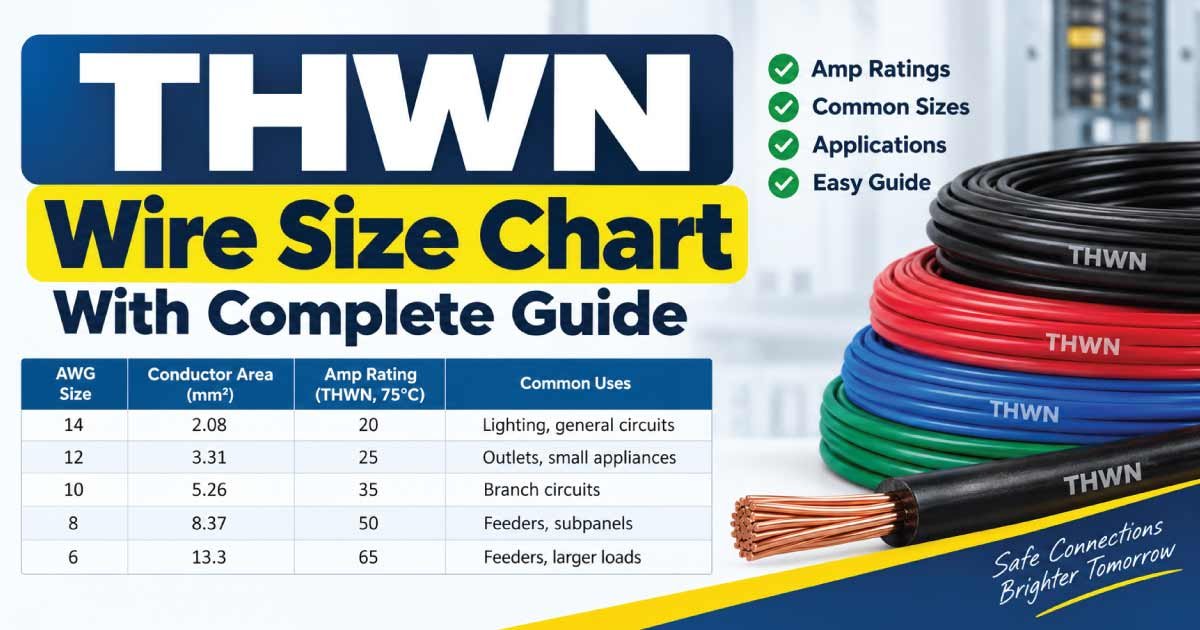
The following chart provides common 75°C ampacity values for THWN copper and aluminum conductors. These values are useful for understanding the relationship between conductor size and current-carrying capacity.
| Wire Size (AWG/kcmil) | Copper THWN 75°C (A) | Aluminum THWN 75°C (A) |
|---|---|---|
| 14 AWG | 20 A | — |
| 12 AWG | 25 A | 20 A |
| 10 AWG | 35 A | 30 A |
| 8 AWG | 50 A | 40 A |
| 6 AWG | 65 A | 50 A |
| 4 AWG | 85 A | 65 A |
| 3 AWG | 100 A | 75 A |
| 2 AWG | 115 A | 90 A |
| 1 AWG | 130 A | 100 A |
| 1/0 AWG | 150 A | 120 A |
| 2/0 AWG | 175 A | 135 A |
| 3/0 AWG | 200 A | 155 A |
| 4/0 AWG | 230 A | 180 A |
| 250 kcmil | 255 A | 205 A |
| 300 kcmil | 285 A | 230 A |
| 350 kcmil | 310 A | 250 A |
| 400 kcmil | 335 A | 270 A |
| 500 kcmil | 380 A | 310 A |
Important: The ampacity shown in a chart is not automatically the final allowable ampacity for every installation. Conductor temperature rating, terminal limitations, ambient temperature, number of current-carrying conductors, installation conditions, and applicable electrical requirements must also be considered.
For smaller conductors, the final permitted circuit rating can also be limited by the applicable overcurrent-protection rules.
How to Read a THWN Wire Size Chart
A THWN wire chart normally contains three important pieces of information: conductor size, conductor material, and ampacity.
Wire Size
Wire sizes are commonly identified using AWG, or American Wire Gauge, for smaller conductors.
AWG numbers work in reverse:
- 14 AWG is smaller than 12 AWG.
- 12 AWG is smaller than 10 AWG.
- 10 AWG is smaller than 8 AWG.
- 4 AWG is smaller than 2 AWG.
- 1/0 AWG is larger than 1 AWG.
Once conductor sizes become very large, they are generally identified in kcmil rather than AWG.
Ampacity
Ampacity is the maximum current a conductor can carry under specified conditions without exceeding its allowable temperature.
For example, a copper conductor with a listed 75°C ampacity of 65 A does not automatically mean it can be installed on a 65-amp circuit in every situation. Other installation requirements may reduce the usable ampacity.
Copper vs. Aluminum
The same physical conductor size does not necessarily have the same ampacity when made from different materials.
Copper generally has higher conductivity than aluminum, so a copper conductor can often carry more current than an aluminum conductor of the same nominal size.
THWN Copper Wire Ampacity
Copper is one of the most common conductor materials used with THWN insulation. Its high conductivity makes it suitable for residential, commercial, industrial, control, and equipment wiring.
Some commonly encountered copper THWN sizes include:
| Copper THWN Size | 75°C Ampacity | Common General Use |
|---|---|---|
| 14 AWG | 20 A | Small circuits |
| 12 AWG | 25 A | Branch circuits |
| 10 AWG | 35 A | Larger branch circuits |
| 8 AWG | 50 A | Equipment and feeders |
| 6 AWG | 65 A | Feeders and larger loads |
| 4 AWG | 85 A | Large feeders |
| 2 AWG | 115 A | High-current feeders |
| 1/0 AWG | 150 A | Large feeders |
| 4/0 AWG | 230 A | High-current systems |
These values are best viewed as reference ampacities, not as a universal circuit-sizing table.
THWN Aluminum Wire Size Chart
Aluminum THWN conductors are often considered for larger feeders and installations where reducing conductor cost or weight is important.
Because aluminum has lower conductivity than copper, a larger aluminum conductor is often required for the same electrical load.
| Aluminum THWN Size | 75°C Ampacity |
|---|---|
| 12 AWG | 20 A |
| 10 AWG | 30 A |
| 8 AWG | 40 A |
| 6 AWG | 50 A |
| 4 AWG | 65 A |
| 3 AWG | 75 A |
| 2 AWG | 90 A |
| 1 AWG | 100 A |
| 1/0 AWG | 120 A |
| 2/0 AWG | 135 A |
| 3/0 AWG | 155 A |
| 4/0 AWG | 180 A |
| 250 kcmil | 205 A |
| 300 kcmil | 230 A |
| 350 kcmil | 250 A |
| 400 kcmil | 270 A |
| 500 kcmil | 310 A |
For aluminum conductors, proper termination and compatibility with the equipment are especially important. Connections should be made using terminals and equipment listed for the conductor material and size.
Discover More:
THWN vs THWN-2 Wire
THWN and THWN-2 are closely related, but their temperature ratings differ.
| Feature | THWN | THWN-2 |
|---|---|---|
| Dry Location Rating | Typically 90°C | Typically 90°C |
| Wet Location Rating | Typically 75°C | Typically 90°C |
| Voltage Rating | Commonly 600 V | Commonly 600 V |
| Moisture Resistance | Yes | Yes |
| Nylon Coating | Commonly used | Commonly used |
| Typical Installation | Conduit/raceway | Conduit/raceway |
The “-2” designation is important because it indicates a higher conductor temperature rating in wet locations.
Many modern conductors are marked with multiple designations, such as THHN/THWN-2, meaning one conductor can satisfy more than one insulation classification when installed under the appropriate conditions.
Always check the actual markings printed on the wire rather than assuming that every nylon-coated thermoplastic conductor is THWN-2.
How to Choose the Correct THWN Wire Size
Selecting the correct THWN wire size requires more than matching the load to an ampacity number.
1. Determine the Load Current
Start by determining how much current the circuit is expected to carry.
For example, if equipment requires approximately 40 amps under the applicable calculation, you need a conductor with sufficient allowable ampacity after all required adjustments and corrections are applied.
Never select a wire simply because its chart ampacity is close to the load.
2. Identify the Conductor Material
Determine whether you are using:
- Copper
- Aluminum
A copper and aluminum conductor of the same size can have different ampacity values.
3. Check the Temperature Rating
The insulation rating matters, but so do the ratings of the equipment terminals and connections.
A conductor may have a 90°C insulation rating, but that does not necessarily mean the entire circuit can be operated using the 90°C ampacity.
The permitted ampacity may be limited by the equipment or termination temperature rating.
4. Account for Current-Carrying Conductors
When multiple current-carrying conductors are installed together in a raceway or cable system, ampacity adjustment may be required.
This can reduce the allowable ampacity of each conductor.
The number of conductors, their arrangement, ambient temperature, and installation method can therefore affect the final wire size.
5. Consider Voltage Drop
Ampacity is not the only consideration.
Long wire runs can experience voltage drop, which can affect equipment performance and efficiency. A conductor that is adequate from an ampacity perspective may need to be increased in size for a long-distance installation.
Voltage drop becomes particularly important for:
- Long feeder runs
- Motors
- Pumps
- HVAC equipment
- Large appliances
- Outdoor equipment
- Remote electrical panels
Discover More:
THWN Wire Size for Common Amp Loads
People often search for THWN wire sizes by asking questions such as “What size THWN wire do I need for 20 amps?” or “What size wire is needed for 50 amps?”
The following provides a simplified reference based on the 75°C copper values above:
| Approximate Load | Copper THWN Size to Evaluate | 75°C Ampacity |
|---|---|---|
| 20 A | 14 AWG | 20 A |
| 25 A | 12 AWG | 25 A |
| 35 A | 10 AWG | 35 A |
| 50 A | 8 AWG | 50 A |
| 65 A | 6 AWG | 65 A |
| 85 A | 4 AWG | 85 A |
| 100 A | 3 AWG | 100 A |
| 115 A | 2 AWG | 115 A |
| 130 A | 1 AWG | 130 A |
| 150 A | 1/0 AWG | 150 A |
| 175 A | 2/0 AWG | 175 A |
| 200 A | 3/0 AWG | 200 A |
| 230 A | 4/0 AWG | 230 A |
This is a starting reference, not a complete circuit-sizing calculation. The actual conductor selected may need to be larger depending on the application.
THWN Wire Size and Voltage Drop
Voltage drop is an important consideration when the distance between the electrical source and load is significant.
As conductor length increases, electrical resistance causes more voltage to be lost along the circuit.
Increasing conductor size generally reduces resistance and therefore reduces voltage drop.
For example, if two installations carry the same current but one has a much longer conductor run, the longer installation may require a larger conductor.
When evaluating voltage drop, consider:
- Circuit length
- Load current
- Conductor material
- Conductor size
- System voltage
- Single-phase or three-phase configuration
- Allowable voltage-drop target
Do not assume that the minimum ampacity conductor is automatically the best choice for a long run.
THWN Wire Applications
THWN conductors are useful in many electrical installations because of their moisture-resistant properties and suitability for conduit systems.
Common applications include:
- Residential branch-circuit wiring
- Commercial electrical systems
- Industrial wiring
- Feeders
- Conduit installations
- Wet-location wiring
- Outdoor electrical systems when installed according to applicable requirements
- Equipment connections
- Control and power circuits
- Electrical distribution systems
The exact application depends on the conductor marking, insulation properties, installation method, and applicable electrical requirements.
THWN Wire Size Selection Mistakes to Avoid
Choosing a conductor based only on a quick chart lookup can cause problems.
Using the Wrong Temperature Column
Do not automatically use the highest available temperature rating. The allowable ampacity depends on the complete installation and equipment ratings.
Ignoring Ambient Temperature
High ambient temperatures can reduce conductor ampacity. A wire installed in a hot environment may require correction.
Ignoring Conduit Fill
Even when ampacity is adequate, the raceway must have sufficient space for the conductors.
Conduit fill is a separate consideration from conductor ampacity.
Forgetting Voltage Drop
Long-distance circuits can require larger conductors even when the basic ampacity calculation appears acceptable.
Confusing THWN With THWN-2
THWN and THWN-2 are not identical temperature classifications in wet locations. Check the conductor markings carefully.
Assuming AWG Numbers Increase With Wire Size
AWG works in reverse. A 6 AWG conductor is larger than an 8 AWG conductor, while a 10 AWG conductor is smaller than an 8 AWG conductor.
Discover More:
THWN Wire Size FAQs
What is THWN wire used for?
THWN wire is commonly used for electrical wiring installed in conduit or raceways, including applications where moisture resistance is required. It can be used in residential, commercial, and industrial systems when the conductor’s markings and installation conditions meet the applicable requirements.
Is THWN wire suitable for wet locations?
Yes, THWN conductors are designed for wet-location applications within their specified temperature and voltage ratings. However, the exact marking matters. THWN and THWN-2 have different wet-location temperature ratings, so the conductor identification should always be checked before installation.
What is the difference between THHN and THWN wire?
THHN primarily identifies a heat-resistant, nylon-coated thermoplastic conductor for dry locations, while THWN identifies a conductor suitable for wet locations. Many modern conductors carry a combined THHN/THWN-2 marking and can satisfy both classifications when installed appropriately.
Is THWN wire copper or aluminum?
THWN wire is available with both copper and aluminum conductors. Copper generally provides higher conductivity for the same conductor size, while aluminum can be useful for larger electrical installations where conductor weight and material cost are important considerations.
How do I know what THWN wire size I need?
Determine the circuit load, conductor material, temperature ratings, installation conditions, number of current-carrying conductors, and voltage-drop requirements. Then select a conductor whose allowable ampacity meets the applicable requirements. For electrical installations, the final sizing should be verified against the governing electrical code and equipment requirements.
Final Thoughts on THWN Wire Size
The correct THWN wire size depends on much more than the amperage printed in a basic wire chart. Conductor material, insulation temperature rating, terminal limitations, ambient temperature, conductor count, installation method, voltage drop, and circuit requirements can all affect the final selection.
The chart above provides a useful starting point for comparing THWN copper and aluminum wire sizes, but it should not replace a complete electrical sizing calculation.
For any actual installation, verify the conductor markings, equipment requirements, applicable electrical code, and manufacturer instructions before selecting or installing the wire. When the installation involves high current, long conductor runs, complex raceways, or unusual conditions, qualified electrical expertise is especially important.