
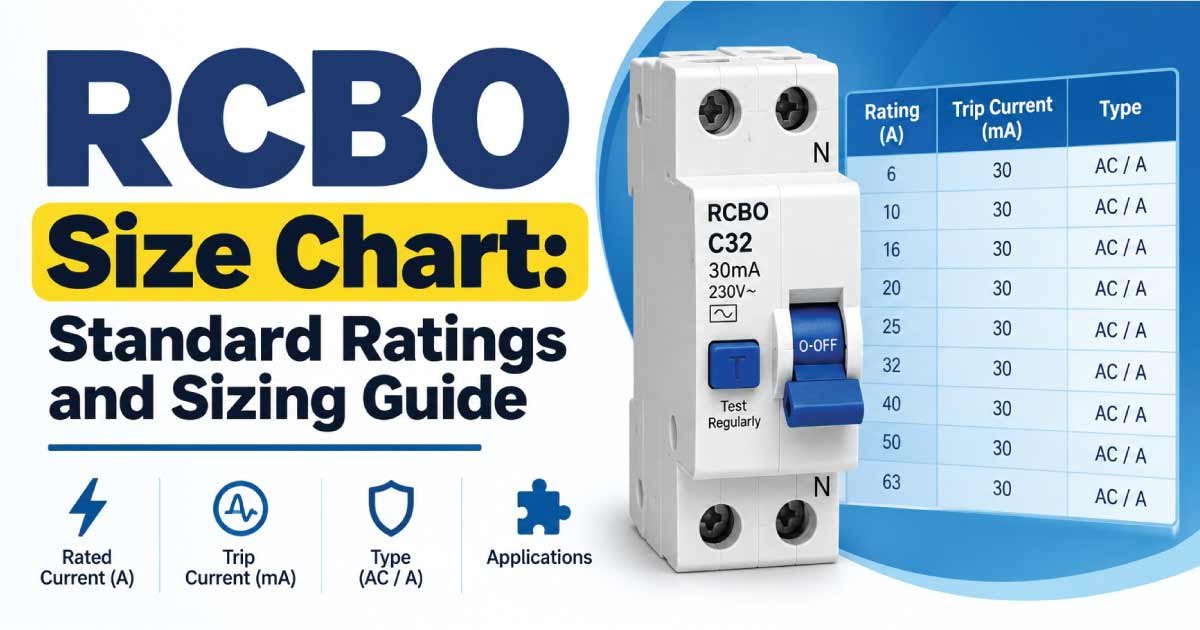
An RCBO size chart helps you choose the correct residual current circuit breaker with overcurrent protection for an electrical circuit. RCBOs combine the functions of an MCB and RCD, providing protection against overload, short circuits, and residual-current or earth-leakage faults.
Common RCBO ratings include 6A, 10A, 16A, 20A, 25A, 32A, 40A, 50A, and 63A. However, the correct rating depends on the circuit load, conductor size, installation method, voltage, fault conditions, and applicable electrical standards.
What Is an RCBO?
An RCBO (Residual Current Circuit Breaker with Overcurrent protection) is a protective switching device designed to provide two major types of electrical protection in one unit.
It combines:
- Overload protection
- Short-circuit protection
- Residual-current protection
- Earth-leakage protection
- Circuit isolation, depending on the device design
Unlike a conventional RCD, an RCBO also protects the circuit from excessive current. This makes it particularly useful for protecting individual lighting, socket, appliance, and dedicated equipment circuits.
The RCBO rating is normally expressed in amperes (A). For example, a 16A RCBO is designed for a circuit with a rated current of 16 amperes.
RCBO Size Chart
The following chart shows common RCBO current ratings and typical circuit applications. These applications are general examples rather than universal rules because the required breaker rating must be determined from the actual circuit design.
| RCBO Size | Typical Circuit Use | Approximate Single-Phase Load at 230V |
|---|---|---|
| 6A | Small lighting and control circuits | 1.38 kW |
| 10A | Lighting and small appliances | 2.30 kW |
| 16A | Lighting, sockets, small appliances | 3.68 kW |
| 20A | Socket and dedicated appliance circuits | 4.60 kW |
| 25A | Larger appliances and dedicated circuits | 5.75 kW |
| 32A | Heaters, cookers, air conditioners, larger loads | 7.36 kW |
| 40A | High-load dedicated circuits | 9.20 kW |
| 50A | Larger appliances and subcircuits | 11.50 kW |
| 63A | Feeders and high-current circuits | 14.49 kW |
The load figures are calculated using Power = Voltage × Current at 230V and represent a simple theoretical maximum. They should not be treated as the permitted continuous load for a particular installation.
Different RCBO product ranges may offer additional ratings, including smaller ratings and ratings above 63A.
Understanding RCBO Ampere Ratings
The number printed on an RCBO indicates its rated current (In).
For example:
- B6 = 6A RCBO with B-curve overcurrent protection
- B10 = 10A RCBO
- B16 = 16A RCBO
- B20 = 20A RCBO
- B32 = 32A RCBO
- C32 = 32A RCBO with C-curve characteristics
The ampere rating should never be selected simply because it matches the appliance’s maximum possible power. The breaker must also coordinate with the cable ampacity and installation conditions.
Common RCBO Sizes and Applications
6A RCBO
A 6A RCBO is commonly considered for low-current circuits such as small lighting, control, signaling, and similar loads.
It may be suitable where the calculated circuit current is comfortably below the device rating and the connected wiring is appropriately protected.
10A RCBO
A 10A RCBO is often used for relatively small electrical circuits.
Typical examples can include:
- Lighting circuits
- Small fixed equipment
- Control circuits
- Low-power appliances
The actual application depends on local wiring practices and circuit design.
16A RCBO
A 16A RCBO is one of the common ratings used in many IEC-style electrical installations.
It may be used for:
- Socket circuits
- Lighting circuits
- Small appliances
- Dedicated equipment
A 16A rating does not automatically mean every circuit using a particular cable size can use a 16A breaker. Cable installation conditions still need to be checked.
20A RCBO
A 20A RCBO is suitable for circuits designed to carry higher current than a typical 16A circuit.
Potential applications include:
- Dedicated appliances
- Socket circuits
- Small heaters
- Equipment circuits
The connected load and conductor capacity should be checked before selecting the breaker.
25A RCBO
A 25A RCBO is commonly considered for dedicated medium-load circuits.
Applications may include:
- Heating equipment
- Larger appliances
- Dedicated machinery
- Small air-conditioning equipment
The actual breaker size should be based on the calculated design current and cable protection requirements.
32A RCBO
A 32A RCBO is widely used for higher-load final circuits.
Possible applications include:
- Electric heaters
- Cooking equipment
- Air-conditioning units
- Larger appliances
- Dedicated power circuits
Motors and compressor-based equipment may require special consideration because their starting current can affect the choice of trip curve.
40A, 50A, and 63A RCBOs
Higher-rated RCBOs are generally used for larger dedicated circuits, distribution circuits, or equipment with higher electrical demand.
A 63A RCBO, for example, has a rated current of 63A, but that does not mean it should simply be installed whenever the calculated load approaches 63A. Cable capacity, voltage drop, fault protection, and device coordination must all be considered.
RCBO Size by Load Current
One of the first steps in selecting an RCBO is determining the circuit’s design current.
For a simple single-phase resistive load:
Current = Power ÷ Voltage
For example, a 3,000W load on a 230V supply has a theoretical current of:
3,000 ÷ 230 ≈ 13.0A
A suitable protective-device rating cannot be selected from this calculation alone. The cable rating, installation method, continuous-load requirements, temperature, grouping, and applicable code must also be considered.
For motors and other equipment, power factor and efficiency may also affect the calculation.
RCBO Size Chart by Common Load Range
The following table can be used as a planning reference, not as a substitute for circuit design calculations.
| Approximate Design Current | RCBO Rating to Evaluate | Example Applications |
|---|---|---|
| Up to 6A | 6A | Small lighting/control circuits |
| Up to 10A | 10A | Lighting, small equipment |
| Up to 16A | 16A | Sockets, small appliances |
| Up to 20A | 20A | Dedicated appliances |
| Up to 25A | 25A | Medium-load equipment |
| Up to 32A | 32A | Heating, larger appliances |
| Up to 40A | 40A | High-load equipment |
| Up to 50A | 50A | Large dedicated circuits |
| Up to 63A | 63A | High-current circuits |
The protective device must be coordinated with the conductor and the installation rather than selected solely from this table.
RCBO B Curve vs C Curve
The trip curve is another important part of RCBO selection.
B Curve RCBO
A B-curve RCBO generally has an instantaneous magnetic trip range of approximately 3–5 times its rated current.
B-curve devices are commonly considered for circuits with relatively low starting or inrush currents.
Typical applications include:
- Lighting
- General sockets
- Resistive loads
- Small appliances
C Curve RCBO
A C-curve RCBO generally has an instantaneous magnetic trip range of approximately 5–10 times its rated current.
It may be more appropriate for equipment with higher temporary starting currents, such as:
- Motors
- Pumps
- Compressors
- Some air-conditioning equipment
- Certain power tools
The curve should be selected based on the equipment and installation characteristics rather than simply choosing C-curve because it is “stronger.”
What Does 30mA Mean on an RCBO?
A common RCBO marking is 30mA.
This refers to the device’s rated residual operating current (IΔn), not its load-current rating.
For example:
B16 30mA RCBO
means:
- B = overcurrent trip characteristic
- 16A = rated current
- 30mA = residual-current operating sensitivity
The 30mA function is commonly used where additional protection against electric shock is required, subject to the applicable electrical regulations.
Other residual-current ratings, such as 10mA, 100mA, 300mA, may be available for specific applications.
Type AC vs Type A RCBO
RCBOs can have different residual-current sensing characteristics.
Type AC
Type AC devices are designed to detect sinusoidal AC residual currents.
Type A
Type A devices can detect AC residual current as well as certain pulsating DC residual currents.
This can make Type A protection appropriate for many modern circuits containing electronic equipment.
Potential applications include circuits supplying:
- LED drivers
- Electronic power supplies
- Computers
- Washing machines
- Modern appliances
- Power electronics
Always select the residual-current type according to the equipment and applicable requirements.
Discover More:
RCBO Pole Configuration
RCBOs are available in different pole configurations.
Common configurations include:
- 1P+N
- 2P
- 3P
- 3P+N
- 4P
A 1P+N RCBO is commonly used for single-phase circuits where the phase and neutral are accommodated according to the device design.
Three-phase installations may require multi-pole RCBOs.
The pole arrangement must match the electrical system, consumer unit or distribution board, and manufacturer’s specifications.
RCBO Breaking Capacity
Another important specification is the breaking capacity.
Common ratings include:
- 4.5kA
- 6kA
- 10kA
Breaking capacity indicates the prospective fault current that the device is designed to interrupt under its specified conditions.
A higher ampere rating does not automatically mean a higher breaking capacity.
For example, a 32A 6kA RCBO and a 32A 10kA RCBO have the same rated current but different short-circuit interruption capabilities.
The required breaking capacity must be appropriate for the prospective short-circuit current at the installation point.
RCBO Size and Wire Size
Choosing an RCBO requires coordination between the protective device and conductor.
A simplified planning relationship is:
Load current ≤ RCBO rating ≤ allowable conductor capacity
However, real installations are more complicated because conductor ampacity can change according to:
- Conductor material
- Cable insulation
- Ambient temperature
- Number of loaded conductors
- Grouping
- Installation method
- Raceway or conduit conditions
- Cable length
- Voltage drop
- Local electrical regulations
Therefore, there is no universal table saying that one particular wire size always requires one specific RCBO.
How to Choose the Correct RCBO Size
Follow these steps when selecting an RCBO.
1. Calculate the Load Current
Determine the expected operating current of the circuit.
For a basic single-phase load:
I = P ÷ V
For a three-phase load, the calculation may involve voltage, power factor, and efficiency.
2. Determine the Cable Size
Select a conductor that can safely carry the design current under the actual installation conditions.
3. Select the RCBO Rating
Choose an RCBO that provides suitable overload protection for the circuit conductor and load.
4. Check the Trip Curve
Choose B, C, or another appropriate characteristic according to the type of load and expected starting current.
5. Select Residual-Current Sensitivity
Determine whether the circuit requires 30mA or another residual-current rating.
6. Check Breaking Capacity
Confirm that the RCBO’s short-circuit rating is adequate for the installation.
7. Verify Compatibility
The RCBO must physically and electrically match the distribution board or consumer unit.
Discover More:
RCBO vs MCB vs RCD
Understanding the difference between these devices makes RCBO selection easier.
| Device | Overload Protection | Short-Circuit Protection | Residual-Current Protection |
|---|---|---|---|
| MCB | Yes | Yes | No |
| RCD/RCCB | No | No* | Yes |
| RCBO | Yes | Yes | Yes |
*An RCD generally requires suitable overcurrent protection upstream.
The major advantage of an RCBO is that it combines multiple protection functions into one circuit-level device.
Advantages of Using an RCBO
RCBOs offer several practical advantages in modern electrical installations.
- Individual circuit protection
- Combines MCB and RCD functions
- Helps limit nuisance shutdowns to the affected circuit
- Provides overload protection
- Provides short-circuit protection
- Provides residual-current protection
- Can save distribution-board space depending on the design
- Makes circuit-level protection easier to organize
A fault on one RCBO-protected circuit does not necessarily disconnect every other circuit in the installation.
Common RCBO Selection Mistakes
Several mistakes can result in poor circuit protection.
Choosing the RCBO Only by Load
A circuit drawing 20A does not automatically mean a 20A RCBO is correct. The cable and installation conditions must also be checked.
Ignoring the Trip Curve
A motor can have significant starting current. Using an unsuitable curve may cause nuisance tripping.
Ignoring Breaking Capacity
The RCBO must be capable of interrupting the prospective fault current where it is installed.
Confusing 30mA With Ampere Rating
A 30mA marking relates to residual-current protection. It does not mean the RCBO is rated at 0.03A for normal load current.
Using an Incompatible RCBO
RCBOs are not necessarily interchangeable between every consumer unit or distribution board. Physical mounting, busbar arrangement, terminal configuration, and manufacturer compatibility can matter.
Oversizing the RCBO
Installing a larger breaker to prevent nuisance tripping can leave the conductor inadequately protected.
Discover More:
RCBO Size Chart Quick Reference
| RCBO Rating | Common General Use |
|---|---|
| 6A | Small lighting/control circuits |
| 10A | Lighting and low-power circuits |
| 16A | Sockets and small appliances |
| 20A | Medium-load circuits |
| 25A | Dedicated appliance circuits |
| 32A | Larger appliances and heating |
| 40A | High-load dedicated circuits |
| 50A | Larger equipment circuits |
| 63A | High-current feeders/circuits |
This is a general reference chart, not a substitute for electrical design calculations or local code requirements.
Frequently Asked Questions
What are the common RCBO sizes?
Common RCBO ratings include 6A, 10A, 16A, 20A, 25A, 32A, 40A, 50A, and 63A. Some manufacturers also produce smaller or larger ratings. The correct size depends on the circuit design, cable capacity, load current, and applicable electrical requirements.
What size RCBO do I need for a 16A load?
A 16A load may require a 16A RCBO, but this cannot be determined from load current alone. The conductor rating, installation method, voltage drop, temperature, grouping, fault conditions, and local electrical requirements should also be checked before selecting the protective device.
What does 30mA mean on an RCBO?
The 30mA rating refers to the RCBO’s residual-current operating sensitivity. It is associated with earth-leakage protection rather than the normal circuit load rating. A device marked 16A 30mA is rated for 16A load current and has 30mA residual-current sensitivity.
Is a B-curve or C-curve RCBO better?
Neither is universally better. A B-curve RCBO is commonly suitable for circuits with low inrush current, while a C-curve RCBO may be appropriate for loads with higher starting currents, such as motors. The correct curve depends on the equipment and circuit characteristics.
Can an RCBO replace an MCB and RCD?
An RCBO can combine the overcurrent protection normally provided by an MCB with residual-current protection normally provided by an RCD. However, the specific device must be suitable for the installation, distribution board, earthing arrangement, and applicable electrical requirements.
Conclusion
An RCBO size chart is useful for quickly comparing common ratings from 6A through 63A, but selecting the correct RCBO involves more than matching the breaker rating to the appliance load.
You should consider the design current, cable size, installation method, trip curve, residual-current sensitivity, breaking capacity, pole configuration, and applicable electrical standards.
For reliable protection, the RCBO should be properly coordinated with the circuit conductor and equipment. When the installation conditions are uncertain, the final selection should be verified by a qualified electrical professional.