
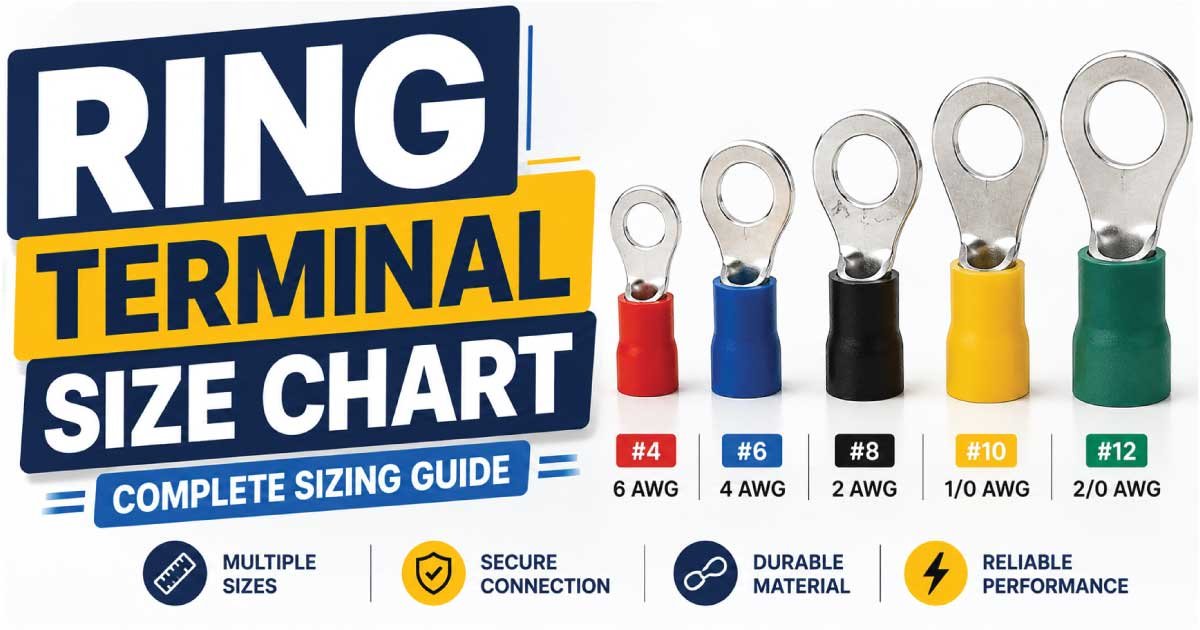
A ring terminal size chart helps identify the correct terminal for different wire sizes, stud diameters, insulation types, and electrical applications. Ring terminals are widely used in automotive wiring, control panels, batteries, grounding, appliances, and electrical equipment.
Choosing the correct ring terminal requires matching the wire gauge, conductor size, stud-hole diameter, terminal material, and insulation type. A properly selected terminal provides a secure connection and helps reduce resistance, loosening, and overheating.
What Is a Ring Terminal?
A ring terminal is an electrical connector with a circular opening that attaches to a screw, bolt, or threaded stud. The wire is secured inside the terminal barrel using crimping or another approved termination method.
Ring terminals are commonly used for:
- Ground wires
- Battery connections
- Automotive wiring
- Electrical panels
- Control circuits
- Appliances
- Industrial machinery
- Terminal blocks
- Switches
- Relays
The closed-ring design helps keep the terminal secured around the mounting stud.
How Does a Ring Terminal Work?
A ring terminal creates an electrical and mechanical connection between a wire and a threaded terminal. The conductor is inserted into the terminal barrel and secured, while the ring portion attaches to the equipment terminal.
A typical connection involves:
- Stripping the required wire length.
- Selecting the correct ring terminal.
- Inserting the conductor fully.
- Crimping the terminal with the correct tool.
- Inspecting the connection.
- Installing the ring over the stud.
- Tightening the terminal securely.
Correct installation helps create a reliable low-resistance electrical connection.
Ring Terminal Size Chart
Ring terminals are commonly identified by wire size and stud-hole diameter. The following chart provides general reference sizes for common electrical and automotive applications.
| Wire Size | Approx. AWG | Common Ring Hole | Typical Application |
|---|---|---|---|
| 0.5 mm² | 20 AWG | M3–M4 | Electronics |
| 0.75 mm² | 18 AWG | M3–M4 | Control wiring |
| 1.0 mm² | 17 AWG | M3–M5 | Electrical circuits |
| 1.5 mm² | 16 AWG | M4–M5 | Automotive/control |
| 2.5 mm² | 14 AWG | M4–M6 | General wiring |
| 4 mm² | 12 AWG | M5–M6 | Power circuits |
| 6 mm² | 10 AWG | M6–M8 | Battery/power |
| 10 mm² | 8 AWG | M6–M8 | Battery equipment |
| 16 mm² | 6 AWG | M8–M10 | High-current wiring |
| 25 mm² | 4 AWG | M8–M10 | Battery/power |
| 35 mm² | 2 AWG | M10–M12 | Large power cables |
| 50 mm² | 1/0 AWG | M10–M12 | High-current systems |
Exact ring-terminal dimensions and available hole combinations vary by manufacturer and terminal series.
Ring Terminal Size by Wire Gauge
Wire gauge is one of the primary measurements used to select a ring terminal. In systems using AWG, the terminal should be rated for the same conductor gauge as the wire being terminated.
Common wire sizes include:
- 22 AWG
- 20 AWG
- 18 AWG
- 16 AWG
- 14 AWG
- 12 AWG
- 10 AWG
- 8 AWG
- 6 AWG
- 4 AWG
- 2 AWG
- 1/0 AWG
Always check the terminal’s approved wire range rather than assuming that similarly sized wires use identical terminals.
Ring Terminal Size by Metric Wire Size
Metric cable and wire sizes are generally identified by cross-sectional area in square millimeters. Ring terminals are manufactured for specific conductor ranges that correspond to these measurements.
Common sizes include:
| Wire Size | Typical Ring Terminal Range |
|---|---|
| 0.5 mm² | Small electronics |
| 0.75 mm² | Control wiring |
| 1.0 mm² | Small electrical circuits |
| 1.5 mm² | General wiring |
| 2.5 mm² | Power/control wiring |
| 4 mm² | Medium power |
| 6 mm² | Battery/power |
| 10 mm² | High-current wiring |
| 16 mm² | Large power cables |
| 25 mm² | Battery/distribution |
| 35 mm² | Industrial power |
| 50 mm² | High-current systems |
The terminal barrel should be specifically rated for the conductor size.
Ring Terminal Stud Hole Size
The ring-hole diameter determines the size of the screw, bolt, or stud that can pass through the terminal. Common ring terminals are available for both metric and imperial hardware.
Common metric sizes include:
- M3
- M4
- M5
- M6
- M8
- M10
- M12
Common imperial hole sizes include:
- #4
- #6
- #8
- #10
- 1/4 inch
- 5/16 inch
- 3/8 inch
- 1/2 inch
The hole should provide the correct fit and clearance for the mounting hardware.
Ring Terminal M3 Size
An M3 ring terminal is designed for connections using approximately 3 mm metric mounting hardware. These small terminals are commonly used for electronics, control circuits, sensors, circuit boards, and low-current wiring.
Typical applications include:
- Electronic equipment
- Small control circuits
- Sensors
- Instrumentation
- Small grounding connections
The wire range must still be matched to the terminal barrel.
Ring Terminal M4 Size
An M4 ring terminal is commonly used for small electrical and control wiring. It provides a slightly larger mounting hole than an M3 terminal while remaining suitable for compact equipment.
Common applications include:
- Control panels
- Automotive accessories
- Small appliances
- Electronics
- Relay connections
- Ground wires
Select the terminal based on both the wire size and M4 mounting requirement.
Ring Terminal M5 Size
An M5 ring terminal is widely used in electrical, automotive, and industrial control applications. Its larger hole accommodates M5 studs or bolts while allowing a range of wire sizes depending on the terminal design.
Potential applications include:
- Automotive wiring
- Control panels
- Battery accessories
- Grounding
- Electrical equipment
- Small power connections
Always verify the terminal’s conductor range before crimping.
Ring Terminal M6 Size
An M6 ring terminal is commonly used for medium-size electrical connections. It can be found in automotive, battery, industrial, and power applications.
Applications include:
- Battery connections
- Grounding cables
- Electrical panels
- Motors
- Power equipment
- Automotive wiring
The M6 hole only identifies the mounting size; it does not determine the wire gauge.
Ring Terminal M8 Size
An M8 ring terminal is suitable for larger terminal studs and is commonly used with higher-current cables. Depending on the design, M8 terminals can accommodate a broad range of wire sizes.
Typical applications include:
- Batteries
- Alternators
- Motors
- Power distribution
- Grounding
- Industrial equipment
The terminal should be rated for the cable size and expected current.
Ring Terminal M10 Size
An M10 ring terminal is commonly used for larger power connections where a stronger mounting connection is required. It is frequently found in battery systems, industrial equipment, generators, and power distribution.
Before selecting an M10 terminal, check:
- Wire size
- Conductor material
- Current rating
- Ring-hole diameter
- Terminal material
- Crimping requirements
Ring Terminal M12 Size
An M12 ring terminal is designed for larger studs and heavy-duty electrical connections. These terminals can be used with large cables where the connection requires a substantial mounting interface.
Applications can include:
- Large batteries
- Generators
- Industrial machinery
- Power distribution
- Grounding systems
- Heavy equipment
Both the cable size and terminal hardware must be matched correctly.
Insulated Ring Terminals
Insulated ring terminals have a protective insulating sleeve around the crimp barrel. The insulation can help prevent accidental contact with nearby conductive components.
Common insulation materials include:
- PVC
- Nylon
- Polyolefin
- Heat-resistant materials
Insulated terminals are commonly used in:
- Automotive wiring
- Control panels
- Appliances
- Industrial equipment
- General electrical wiring
The insulation temperature and voltage suitability should match the application.
Non-Insulated Ring Terminals
Non-insulated ring terminals consist primarily of the conductive terminal and barrel without a permanent insulating sleeve. They are frequently used in professional wiring systems where additional insulation or terminal protection is provided separately.
Advantages include:
- Compact construction
- Easy visual inspection
- Suitable for specialized crimping
- Available in many sizes
- Useful for enclosed electrical assemblies
Additional insulation may be required depending on the installation.
Copper Ring Terminals
Copper ring terminals provide good electrical conductivity and are widely used for electrical connections. They are available in different sizes and can be designed for small control wires or larger power cables.
Common applications include:
- Battery connections
- Grounding
- Power wiring
- Automotive systems
- Industrial equipment
- Electrical panels
The copper terminal should match the conductor and environmental requirements.
Tinned Copper Ring Terminals
Tinned copper ring terminals have a protective tin coating that can improve resistance to corrosion. They are particularly useful in environments where moisture, humidity, or corrosive conditions may affect exposed metal surfaces.
Common applications include:
- Marine wiring
- Battery systems
- Outdoor equipment
- Automotive applications
- Industrial installations
Tinned copper terminals should still be selected according to the correct wire size and mounting hardware.
Ring Terminal Color Coding
Many insulated ring terminals use color coding to indicate their approximate wire-size range. However, color conventions can vary between manufacturers and standards.
Commonly encountered colors may include:
| Color | Typical Wire Range* |
|---|---|
| Red | Small wire |
| Blue | Medium wire |
| Yellow | Larger wire |
Color ranges are not universal. Always verify the manufacturer’s specified wire range printed on the packaging or product documentation.
Also Read: Welding Cable Size Chart: Choose the Right Cable Size
Ring Terminal Crimping
Correct crimping is essential for creating a reliable ring-terminal connection. The crimp must secure the conductor without cutting strands, deforming the terminal excessively, or leaving the wire loose.
A typical process includes:
- Select the correct terminal.
- Strip the specified insulation length.
- Insert the conductor fully.
- Position the correct crimp tool.
- Apply the specified crimp.
- Inspect the connection.
- Perform a suitable pull or visual check.
- Install the terminal on the stud.
Use a crimping tool designed for the specific terminal.
Ring Terminal Crimp Tool Size
The crimping tool should match the terminal and wire range. Different ring terminals require different die profiles and crimping methods.
Common tools include:
- Insulated terminal crimpers
- Non-insulated terminal crimpers
- Ratchet crimpers
- Hydraulic crimpers
- Specialized manufacturer-approved tools
Using ordinary pliers instead of a proper crimping tool can produce a weak or high-resistance connection.
How to Choose the Correct Ring Terminal
Selecting the correct ring terminal involves matching the wire, terminal hardware, material, and application. Physical fit alone is not enough to ensure reliable electrical performance.
Follow these steps:
- Identify the wire gauge.
- Determine metric cable size if applicable.
- Measure the mounting stud.
- Select the correct ring-hole diameter.
- Choose insulated or non-insulated construction.
- Match terminal material.
- Check current rating.
- Select the correct crimp tool.
- Verify environmental requirements.
- Follow manufacturer instructions.
Also Read: Electrical Wire Size Chart: Choose the Right Wire Gauge
Common Ring Terminal Sizing Mistakes
Incorrect ring-terminal selection can result in loose connections, damaged conductors, overheating, or terminal failure. Many problems occur when users select a terminal based only on its hole diameter.
Avoid these mistakes:
- Choosing the wrong wire range
- Using an incorrect stud-hole size
- Crimping with the wrong tool
- Cutting conductor strands
- Using an oversized terminal
- Using an undersized terminal
- Ignoring material compatibility
- Over-crimping
- Under-crimping
- Using damaged terminals
Key Points to Remember
A ring terminal size chart provides a useful reference for matching wire sizes with terminal hole dimensions. However, proper selection also requires considering conductor material, insulation, current rating, crimping method, and installation environment.
Always remember:
- Match the terminal to wire size.
- Verify the stud-hole diameter.
- Check conductor material.
- Select the correct terminal type.
- Use the correct crimping tool.
- Follow the specified crimping procedure.
- Check current and temperature ratings.
- Consider corrosion resistance.
- Inspect the finished connection.
- Follow manufacturer specifications.
Ring Terminal Size for Different Electrical Applications
Ring terminals are used across automotive, battery, marine, industrial, and household electrical systems. The correct terminal depends on wire size, stud diameter, current, conductor material, insulation, and environmental conditions.
| Application | Common Ring Terminal Type | Typical Wire Range* |
|---|---|---|
| Automotive Wiring | Insulated/Tinned Copper | 0.5–10 mm² |
| Battery Connections | Heavy-Duty Copper | 6–50 mm² |
| Grounding | Copper/Tinned Copper | 1.5–50 mm² |
| Control Panels | Insulated Copper | 0.5–6 mm² |
| Marine Wiring | Tinned Copper | 0.5–25 mm² |
| Solar Equipment | Copper/Tinned Copper | 2.5–16 mm² |
| Motors | Copper/Compression | 4–50 mm² |
| Industrial Equipment | Copper/Mechanical | 6–120 mm² |
| Generators | Heavy-Duty Copper | 16–120 mm² |
These are general application ranges. Actual terminal selection depends on the equipment, conductor, terminal hardware, current, temperature, and manufacturer specifications.
Also Read: Battery Cable Size Chart: Correct AWG Cable Guide
Ring Terminal for Automotive Wiring
Ring terminals are widely used in automotive electrical systems because their closed-ring design provides a secure connection around a screw or stud. They can be used for grounding, accessories, relays, batteries, and electrical components.
When selecting an automotive ring terminal, consider:
- Wire gauge
- Stud diameter
- Terminal material
- Insulation type
- Current rating
- Vibration resistance
- Corrosion resistance
Tinned copper terminals are commonly useful where moisture and corrosion are concerns.
Ring Terminal for Battery Cables
Battery connections can carry high currents, requiring ring terminals with suitable conductor capacity and mechanical strength. Larger battery cables generally require heavy-duty copper or tinned copper terminals.
Important factors include:
- Cable cross-sectional area
- Battery stud size
- Terminal thickness
- Current capacity
- Conductor material
- Corrosion resistance
- Crimping method
The terminal should fit tightly against the battery connection without excessive movement.
Ring Terminal for Ground Wires
Ring terminals are frequently used to connect grounding wires to equipment frames, grounding bars, chassis points, and electrical terminals.
A grounding ring terminal should:
- Match the grounding conductor.
- Fit the mounting stud.
- Provide reliable metal contact.
- Resist the expected environment.
- Have suitable current capacity.
- Be securely crimped.
Remove paint or coatings only where required by the applicable grounding method and equipment instructions.
Ring Terminal for Solar Wiring
Solar systems can use ring terminals for grounding, battery connections, inverter terminals, control wiring, and other suitable connections. Outdoor installations require terminals and materials appropriate for moisture, temperature, and environmental exposure.
Check:
- Solar cable size
- Terminal material
- Stud diameter
- Current rating
- Temperature rating
- Environmental rating
- Equipment manufacturer’s requirements
Use terminals approved for the specific solar installation rather than relying only on physical compatibility.
Ring Terminal for Marine Wiring
Marine environments expose electrical connections to moisture, salt, vibration, and corrosion. Tinned copper ring terminals are commonly used because their coating can provide improved corrosion resistance compared with uncoated copper.
For marine applications, consider:
- Tinned copper construction
- Correct wire size
- Sealed connections where required
- Proper crimping
- Heat-shrink protection
- Corrosion-resistant hardware
- Environmental rating
A suitable terminal alone does not eliminate the need for proper sealing and installation.
Ring Terminal for Control Panels
Control panels often contain many low-current connections for switches, relays, sensors, indicators, and control devices. Small insulated ring terminals can provide secure connections where ring-style termination is appropriate.
Consider:
- Wire gauge
- Terminal stud size
- Insulation rating
- Panel temperature
- Current rating
- Available clearance
Different circuits inside the same panel may require different terminal sizes.
Ring Terminal for Motors
Motor wiring can experience vibration and temperature changes, making a secure terminal connection important. Ring terminals can be used where the motor terminal design permits them.
Before selecting a terminal, verify:
- Motor current
- Wire size
- Terminal stud size
- Lug material
- Temperature rating
- Vibration conditions
- Manufacturer requirements
The finished connection should be properly crimped and tightened according to the specified torque.
Ring Terminal for Generators
Generators often use large conductors and heavy-duty terminals. Ring terminals for generator connections must be capable of handling the required current and fitting the generator’s terminal hardware.
Check:
- Generator output current
- Cable size
- Stud diameter
- Terminal material
- Current rating
- Temperature rating
- Short-circuit requirements
Large generator terminals may require compression lugs rather than small insulated ring terminals.
Ring Terminal for Inverters
Inverters can have high-current DC or AC connections. Ring terminals may be used on suitable inverter terminals when specified by the manufacturer.
Before selecting the terminal, check:
- Maximum current
- Cable size
- DC or AC connection
- Stud size
- Lug thickness
- Temperature rating
- Manufacturer specifications
The terminal must provide sufficient contact area and mechanical strength for the intended load.
Ring Terminal for Circuit Breakers
Ring terminals can be used with certain circuit-breaker terminals, auxiliary connections, or control wiring where the terminal design permits them.
The terminal should match:
- Breaker terminal type
- Wire size
- Stud or screw diameter
- Current rating
- Terminal material
- Required connection method
Never force a ring terminal onto a connection that requires a different termination style.
Ring Terminal for Switches and Relays
Small ring terminals are commonly used in control wiring for switches, relays, contactors, and similar components. The terminal provides a stable connection around a screw or stud.
Common considerations include:
- Wire gauge
- Stud diameter
- Terminal width
- Insulation type
- Current rating
- Crimping method
Ensure that the terminal does not interfere with nearby contacts or components.
Ring Terminal Wire Size
The wire size must fall within the terminal manufacturer’s approved conductor range. A terminal designed for a small wire should not be used with a significantly larger conductor simply because the ring hole fits.
Common wire sizes include:
| Wire Size | Approx. AWG | Common Application |
|---|---|---|
| 0.5 mm² | 20 AWG | Electronics |
| 0.75 mm² | 18 AWG | Control |
| 1.0 mm² | 17 AWG | Small circuits |
| 1.5 mm² | 16 AWG | Automotive/control |
| 2.5 mm² | 14 AWG | General wiring |
| 4 mm² | 12 AWG | Power |
| 6 mm² | 10 AWG | Battery |
| 10 mm² | 8 AWG | High current |
| 16 mm² | 6 AWG | Power/battery |
| 25 mm² | 4 AWG | High current |
Ring Terminal Hole Size
The ring hole must accommodate the correct mounting stud or bolt. A hole that is too small cannot be installed, while an excessively large hole may not provide the intended mechanical fit.
Common sizes include:
- M3
- M4
- M5
- M6
- M8
- M10
- M12
- #4
- #6
- #8
- #10
- 1/4 inch
- 5/16 inch
- 3/8 inch
Always compare the terminal dimensions with the actual mounting hardware.
Ring Terminal Insulation Types
Ring terminals are available with different insulation materials and designs. The correct insulation depends on voltage, temperature, environment, flexibility, and installation requirements.
Common options include:
| Insulation Type | General Characteristics |
|---|---|
| PVC | General electrical use |
| Nylon | Durable and commonly used |
| Polyolefin | Heat-shrink applications |
| Heat Shrink | Sealed/protected connections |
| Non-Insulated | Specialized installations |
Always verify the manufacturer’s temperature and voltage specifications.
Heat Shrink Ring Terminals
Heat-shrink ring terminals combine a conductive ring terminal with heat-shrink insulation. When properly installed, the insulation can provide additional protection against moisture, vibration, and environmental contamination.
Typical applications include:
- Automotive wiring
- Marine equipment
- Battery systems
- Outdoor electrical equipment
- Industrial machinery
The heat-shrink terminal must be installed using the correct crimping method and suitable heating procedure.
Ring Terminal Crimp Quality
A high-quality crimp should securely hold the conductor while maintaining a reliable electrical connection. Poor crimping can increase resistance and create heat under load.
Inspect the crimp for:
- Fully inserted conductor
- Proper barrel deformation
- No exposed excessive conductor
- No damaged insulation
- No loose strands
- Correct crimp location
- Secure mechanical grip
If the terminal manufacturer specifies a particular crimp profile, follow that specification.
How to Test a Ring Terminal Connection
After installation, the connection can be visually inspected and, where appropriate, electrically tested. Testing procedures depend on the application and equipment.
Check for:
- Proper terminal seating
- Correct hardware
- Secure tightening
- No loose strands
- No damaged insulation
- Appropriate continuity
- No abnormal heating under operation
Critical electrical systems should be tested according to applicable procedures and standards.
Ring Terminal vs Fork Terminal
Ring and fork terminals both provide connections to screws or studs, but their terminal shapes differ. A ring terminal has a fully closed opening, while a fork terminal has an open slot.
| Feature | Ring Terminal | Fork Terminal |
|---|---|---|
| Terminal opening | Closed | Open |
| Retention | High | Lower |
| Installation | May require screw removal | Can fit under some screws |
| Vibration resistance | Generally good | Application dependent |
| Common use | Power/ground | Control wiring |
The equipment terminal should determine which terminal style is appropriate.
Ring Terminal vs Spade Terminal
Ring terminals and spade terminals are both used for electrical connections, but they provide different installation characteristics. Ring terminals completely surround the mounting stud, while spade terminals have an open-ended design.
Ring terminals are often preferred where:
- Higher retention is required.
- Vibration is present.
- The connection should remain secured around the stud.
- The equipment allows ring termination.
Spade terminals can be convenient where frequent removal is required and the terminal design permits them.
How to Measure a Ring Terminal
An existing ring terminal can be measured to help identify a replacement. Several dimensions should be recorded rather than measuring only the ring hole.
Measure:
- Ring-hole diameter
- Barrel length
- Barrel inside diameter
- Overall length
- Terminal width
- Wire size
- Insulation diameter
Compare these measurements with the manufacturer’s product specifications.
How to Choose the Correct Ring Terminal
Selecting the correct ring terminal requires matching the wire, mounting hardware, electrical load, and environment.
Use this checklist:
- Identify wire gauge.
- Determine metric cross-sectional area if applicable.
- Measure stud diameter.
- Select ring-hole size.
- Choose terminal material.
- Select insulation type.
- Check current rating.
- Verify temperature rating.
- Choose the correct crimp tool.
- Follow manufacturer specifications.
Common Ring Terminal Installation Mistakes
Many ring-terminal failures result from poor crimping, incorrect wire preparation, or improper hardware selection.
Avoid:
- Using the wrong terminal size
- Cutting wire strands
- Stripping too much insulation
- Stripping too little insulation
- Using pliers instead of a crimper
- Using the wrong crimp die
- Under-crimping
- Over-crimping
- Leaving the terminal loose
- Using unsuitable terminal material
FAQs:
What size ring terminal do I need?
Choose a ring terminal that matches both the wire size and mounting stud diameter. For example, a terminal may be designed for 14 AWG wire with an M5 hole. Always check the manufacturer’s specified conductor range rather than selecting by hole size alone.
What is the most common ring terminal size?
There is no single universal ring terminal size because terminals are manufactured for different wire gauges and stud diameters. Small terminals such as M3–M5 are common in control wiring, while M6–M12 terminals are common for larger power connections.
What color is a ring terminal for 14 AWG wire?
Many insulated terminal systems commonly use blue for a medium wire-size range that can include 14 AWG, but color coding is not universal. Always verify the manufacturer’s stated wire range because terminal colors can differ between product families.
Can I use a ring terminal on a battery?
Yes, appropriately rated ring terminals are commonly used for battery connections. The terminal must match the battery stud size, cable gauge, current requirement, and environmental conditions. Heavy-duty or tinned copper terminals may be suitable for larger or corrosion-prone applications.
Are ring terminals better than fork terminals?
Ring terminals generally provide stronger retention because the terminal completely surrounds the mounting stud. Fork terminals can be more convenient where the screw does not need to be fully removed. The appropriate terminal depends on the equipment and installation requirements.
Final Thoughts
A ring terminal size chart makes it easier to match wire gauges with common ring-hole sizes and terminal types. However, proper selection requires more than matching two dimensions.
Before installing a ring terminal:
- Match the wire size.
- Verify the stud diameter.
- Check the terminal material.
- Select suitable insulation.
- Confirm current and temperature ratings.
- Use the correct crimping tool.
- Follow the specified crimp procedure.
- Check the finished connection.
- Tighten the terminal correctly.
- Follow manufacturer instructions and applicable electrical standards.
A correctly selected and installed ring terminal provides a secure electrical connection and can improve reliability in automotive, industrial, battery, control, and general electrical applications.