
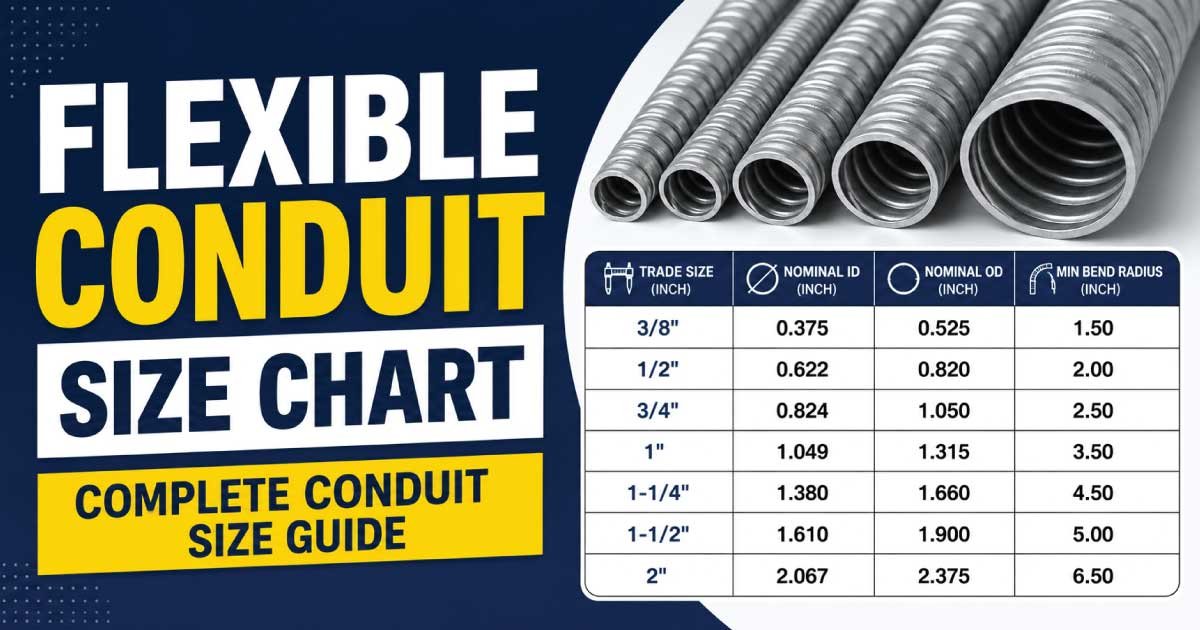
Flexible conduit is widely used to protect electrical wires and cables in residential, commercial, industrial, automotive, and machinery installations. Unlike rigid conduit, flexible conduit can bend around corners, obstacles, moving equipment, and difficult installation points. Choosing the correct size is important because the conduit must provide enough internal space for the conductors while also allowing wires to be installed without excessive pulling force.
The right conduit size depends on the number and diameter of wires, conductor insulation thickness, conduit type, bend radius, installation method, and applicable electrical codes. A properly sized flexible conduit helps protect cables from abrasion, moisture, mechanical damage, and environmental conditions while making future maintenance easier.
This guide explains flexible conduit dimensions, conduit trade sizes, fill capacity, common applications, wire combinations, sizing methods, and the factors to consider when selecting flexible electrical conduit.
Understanding Flexible Conduit Sizes
Flexible conduit is commonly identified by its trade size, such as 3/8 inch, 1/2 inch, 3/4 inch, 1 inch, 1-1/4 inch, and larger sizes. Trade size does not always represent the exact inside or outside diameter of the conduit.
The actual dimensions vary depending on the conduit construction and type.
Common flexible conduit types include:
- Flexible metallic conduit (FMC)
- Liquidtight flexible metal conduit (LFMC)
- Flexible nonmetallic conduit
- Liquidtight flexible nonmetallic conduit
- PVC-coated flexible conduit
- Corrugated flexible conduit
Because each type has different wall construction, the inside diameter and usable fill area can vary considerably even when the trade size is the same.
Common Flexible Conduit Trade Sizes
| Flexible Conduit Trade Size | Approximate Inside Diameter Range* | Typical Applications |
|---|---|---|
| 3/8 inch | 0.35–0.40 in | Small control wiring |
| 1/2 inch | 0.45–0.55 in | Lighting and small circuits |
| 3/4 inch | 0.70–0.80 in | General branch circuits |
| 1 inch | 0.95–1.05 in | Multiple conductors |
| 1-1/4 inch | 1.20–1.35 in | Larger cable groups |
| 1-1/2 inch | 1.45–1.60 in | Industrial wiring |
| 2 inch | 1.90–2.10 in | Large cable bundles |
| 2-1/2 inch | 2.35–2.65 in | Heavy-duty installations |
| 3 inch | 2.85–3.15 in | Large industrial cable runs |
| 4 inch | 3.80–4.15 in | Major cable installations |
*Actual dimensions depend on conduit construction and manufacturer. Always verify the manufacturer’s dimensional data before installation.
Why Flexible Conduit Size Matters
Selecting the correct conduit size is important for both electrical safety and installation quality.
A conduit that is too small can create several problems:
- Difficult wire pulling.
- Damaged wire insulation.
- Excessive pulling tension.
- Increased conductor heating.
- Poor cable arrangement.
- Difficult maintenance.
- Limited room for additional conductors.
A conduit that is appropriately sized provides sufficient room for conductors and allows the wiring system to be installed and maintained more easily.
Oversizing is generally less problematic from a fill perspective, but excessively large conduit can increase material costs and may be unnecessarily difficult to route or support.
Flexible Conduit Size vs Inside Diameter
One of the most important things to understand is the difference between trade size and actual inside diameter.
For example, a conduit identified as 1 inch does not necessarily have exactly 1.000 inch of usable internal diameter.
The internal diameter depends on:
- Conduit material.
- Wall thickness.
- Protective coating.
- Manufacturer.
- Conduit construction.
- Fittings and connectors.
This means that conduit selection should not be based solely on the trade-size label. Always check the actual internal diameter and applicable fill requirements.
Flexible Conduit Fill Capacity
Conduit fill refers to the amount of space occupied by conductors inside a raceway.
Electrical codes generally limit the percentage of conduit space that conductors can occupy. The exact allowable fill depends on factors such as the number of conductors and the applicable electrical standard.
As a general concept:
- One conductor may have a higher allowable fill percentage.
- Two conductors may have a different allowable fill percentage.
- Three or more conductors generally require more available free space.
This ensures that wires can be installed without excessive crowding and allows heat to dissipate appropriately.
For code-compliant installations, use the applicable electrical code and conductor dimensions rather than relying on a simplified chart.
How to Calculate Flexible Conduit Size
The basic sizing process involves determining the total cross-sectional area of all conductors and comparing it with the allowable conduit fill area.
Step 1: Identify the Conductors
Determine:
- Wire gauge.
- Conductor type.
- Insulation type.
- Number of conductors.
- Overall cable diameter if using multi-conductor cable.
The conductor’s outside diameter is important because insulation contributes to the space occupied inside the conduit.
Step 2: Determine the Conduit Internal Area
Use the manufacturer’s specifications to find the actual internal diameter.
The approximate internal cross-sectional area can be calculated using:
Area = π × D² ÷ 4
where D is the internal diameter.
Step 3: Calculate Total Wire Area
Determine the cross-sectional area occupied by each conductor and multiply it by the number of conductors.
For example, if identical cables are used:
Total wire area = Area of one conductor × Number of conductors
Step 4: Apply the Allowable Fill
Compare the total conductor area with the maximum permitted fill for the installation.
If the conductor area exceeds the allowable fill, select the next larger conduit size.
Flexible Conduit Size for Different Wire Gauges
The appropriate conduit size depends heavily on how many wires are being installed.
A single small conductor may fit comfortably inside a small conduit, while several larger conductors may require a much larger raceway.
Typical wire sizes found in flexible conduit installations include:
- 18 AWG
- 16 AWG
- 14 AWG
- 12 AWG
- 10 AWG
- 8 AWG
- 6 AWG
- 4 AWG
- 2 AWG
- Larger conductors for industrial applications
For example, a small control circuit with several 18 AWG wires can require much less conduit space than a power circuit containing multiple 6 AWG conductors.
Also Read: Automotive Wire Size Chart: Complete AWG Size Guide
Flexible Conduit Size for 12 AWG Wire
12 AWG wire is frequently used for branch circuits and medium-current electrical applications.
The conduit size depends on the number of conductors.
A small number of 12 AWG conductors may fit in 1/2-inch or 3/4-inch flexible conduit, depending on the specific wire construction and applicable fill rules.
When multiple conductors are installed, 3/4 inch, 1 inch, or larger conduit may be more appropriate.
Always calculate conductor fill using the actual wire dimensions.
Flexible Conduit Size for 14 AWG Wire
14 AWG conductors are smaller than 12 AWG conductors and therefore occupy less internal space.
They are commonly used for:
- Lighting circuits.
- Control wiring.
- Small branch circuits.
- Signage.
- Equipment controls.
A small number of 14 AWG wires can often be installed in smaller flexible conduit sizes, while larger wire bundles require additional internal space.
Flexible Conduit Size for 10 AWG Wire
10 AWG conductors are larger and are commonly used for higher-current circuits.
Applications may include:
- Equipment circuits.
- Motors.
- Heating equipment.
- Larger branch circuits.
- Industrial machinery.
Because 10 AWG conductors occupy more space, conduit fill should be calculated carefully when multiple wires are installed.
Flexible Conduit Size for 8 AWG and Larger Wire
Large conductors such as 8 AWG, 6 AWG, 4 AWG, and 2 AWG require substantially more internal conduit space.
These wire sizes may be used for:
- Large equipment.
- Motors.
- Subpanels.
- Industrial machinery.
- Battery systems.
- High-current power distribution.
When using larger conductors, pay close attention to both conduit fill and bending radius.
Flexible Metal Conduit Size
Flexible metal conduit, often called FMC, consists of a flexible metallic construction that provides mechanical protection for electrical conductors.
It is commonly used in:
- Commercial buildings.
- Industrial facilities.
- Lighting installations.
- Equipment connections.
- Electrical panels.
- Areas where flexibility is needed.
FMC trade sizes commonly range from small control-wiring sizes to several inches for larger installations.
The exact inside diameter varies according to the manufacturer and conduit construction.
Also Read: Cable Lug Size Chart: Find the Right Lug Size
Liquidtight Flexible Conduit Size
Liquidtight flexible conduit is designed for locations where electrical wiring may be exposed to moisture, water, oils, or other environmental conditions.
It is frequently used for:
- Outdoor equipment.
- Motors.
- Pumps.
- HVAC equipment.
- Industrial machinery.
- Washdown areas.
- Outdoor electrical connections.
Liquidtight conduit generally has additional outer construction compared with standard flexible conduit, so its internal dimensions can differ significantly from similarly labeled conduit.
Flexible Nonmetallic Conduit Size
Flexible nonmetallic conduit is lightweight and easy to route.
Depending on its construction, it can provide protection against:
- Moisture.
- Corrosion.
- Abrasion.
- Chemicals.
- Mechanical damage.
It is often selected where lightweight installation and corrosion resistance are important.
As with metallic flexible conduit, the actual inside diameter should be checked before determining conductor capacity.
Flexible Conduit for Outdoor Applications
Outdoor electrical installations require special attention to environmental conditions.
When selecting flexible conduit for outdoor use, consider:
- UV exposure.
- Rain.
- Moisture.
- Temperature.
- Chemical exposure.
- Mechanical damage.
- Required liquidtight rating.
Not every flexible conduit is suitable for outdoor or wet locations. The conduit and fittings must be listed or rated for the environment in which they are installed.
Flexible Conduit for Industrial Applications
Industrial environments often expose wiring systems to more demanding conditions than residential installations.
Flexible conduit may be used around:
- Motors.
- Pumps.
- Conveyors.
- CNC machinery.
- Robotic equipment.
- Control panels.
- Manufacturing equipment.
- Production machinery.
Industrial installations may require conduit with enhanced resistance to oil, chemicals, abrasion, vibration, and mechanical impact.
The correct conduit size should also account for future wiring requirements where appropriate.
Flexible Conduit and Bend Radius
Conduit size is not the only dimensional factor that matters. Bend radius is also important.
Flexible conduit can bend more easily than rigid conduit, but every conduit type has a recommended minimum bending radius.
A bend that is too tight can:
- Damage the conduit.
- Restrict the internal passage.
- Increase wire-pulling difficulty.
- Damage cable insulation.
- Create excessive mechanical stress.
When routing flexible conduit around machinery or tight spaces, follow the manufacturer’s minimum bend-radius specification.
Flexible Conduit Length and Wire Pulling
Long conduit runs can make wire installation more difficult.
As conduit length increases, friction between the wire and conduit can increase. Multiple bends can make the problem even worse.
For long runs:
- Select sufficient conduit size.
- Minimize unnecessary bends.
- Use appropriate pulling equipment.
- Use compatible wire-pulling lubricant when permitted.
- Avoid excessive pulling tension.
- Follow conductor manufacturer’s recommendations.
A slightly larger conduit can sometimes make a long installation considerably easier to wire.
Flexible Conduit Fittings and Connectors
Conduit sizing must also account for compatible fittings.
Common fittings include:
- Straight connectors.
- 90-degree connectors.
- Liquidtight connectors.
- Compression fittings.
- Threaded adapters.
- Couplings.
- Locknuts.
- Bushings.
The fitting must match the conduit type and trade size.
Using the wrong connector can compromise mechanical security, electrical continuity, grounding, or environmental protection.
Also Read: Cartridge Fuse Size Chart: Standard Sizes Explained
Flexible Conduit Size for Multiple Cables
When installing multiple cables rather than individual conductors, use the overall cable diameter for sizing.
For example, a multi-conductor cable may contain several insulated conductors inside a single outer jacket. The outer diameter of that cable determines the space it occupies in the conduit.
Do not simply calculate the area of the internal conductors while ignoring the cable jacket.
For multiple cables, calculate or verify the combined occupied area and compare it with the permitted conduit fill.
Flexible Conduit for Control Wiring
Control systems frequently use smaller conductors than power systems.
Flexible conduit can protect wiring for:
- Sensors.
- Switches.
- Relays.
- PLC inputs.
- PLC outputs.
- Instrumentation.
- Control panels.
- Machine controls.
Small control circuits may use compact conduit sizes, but separation requirements can apply when control, power, communication, and other circuit types share a raceway.
Always follow the applicable electrical code and equipment manufacturer’s requirements.
Flexible Conduit for Motors
Motors often require flexible conduit because vibration and movement can occur between the motor and fixed wiring system.
Flexible conduit allows a connection between:
- Motor and junction box.
- Motor and disconnect.
- Pump and control panel.
- HVAC equipment and electrical supply.
- Machinery and fixed conduit.
The conduit must be sized according to the motor conductors and selected for the mechanical and environmental conditions.
How to Choose the Right Flexible Conduit Size
Use the following procedure for practical conduit selection:
- Identify the conduit type required.
- Determine the number of conductors or cables.
- Find the outside diameter of each conductor or cable.
- Calculate the total conductor area.
- Check the applicable conduit-fill requirements.
- Compare the calculated area with the conduit manufacturer’s usable area.
- Consider wire-pulling distance.
- Consider the number and severity of bends.
- Check the minimum bend radius.
- Select compatible fittings and connectors.
- Verify environmental and temperature ratings.
- Confirm compliance with the applicable electrical code.
This process produces a more reliable result than selecting conduit solely by trade size.
Factors That Affect Flexible Conduit Selection
Several factors can change the required conduit size.
Number of Conductors
More conductors require more internal space.
Conductor Diameter
Larger wires require larger conduit.
Insulation Thickness
Two wires with the same conductor gauge can have different outside diameters because of insulation construction.
Circuit Length
Longer runs may benefit from larger conduit for easier pulling.
Number of Bends
More bends increase friction and pulling difficulty.
Environmental Conditions
Outdoor, wet, oily, hot, or corrosive environments may require specialized conduit.
Future Expansion
Where practical, additional conduit capacity can make future wiring modifications easier.
Common Flexible Conduit Sizing Mistakes
Choosing Conduit by Trade Size Alone
Trade size does not tell you the exact usable internal diameter.
Ignoring Wire Insulation Diameter
The insulation contributes to the overall space occupied inside the conduit.
Overfilling the Conduit
Excessive conductor fill can make installation difficult and may violate electrical code requirements.
Ignoring Bend Radius
A conduit route that is technically large enough may still be difficult to install if it contains excessively tight bends.
Mixing Incompatible Components
Conduit, fittings, connectors, and cable systems should be compatible and appropriately rated.
Using the Same Size for Every Installation
Different wire quantities and diameters require different conduit sizes.
Flexible Conduit Size Chart for Quick Selection
For preliminary planning, the following general guide can help:
| Conduit Size | Typical Use |
|---|---|
| 3/8 inch | Small control wiring |
| 1/2 inch | Small branch circuits and equipment wiring |
| 3/4 inch | General-purpose wiring |
| 1 inch | Multiple conductors and larger circuits |
| 1-1/4 inch | Larger conductor groups |
| 1-1/2 inch | Industrial power and control wiring |
| 2 inch | Large cable bundles |
| 2-1/2 inch | Heavy-duty cable installations |
| 3 inch | Large industrial runs |
| 4 inch | Major power and cable installations |
This table is a general planning reference. Actual conductor capacity must be determined from the cable dimensions, conduit type, fill requirements, and applicable electrical standards.
Frequently Asked Questions
What is the most common flexible conduit size?
There is no single universal size because conduit requirements depend on the number and size of conductors. Sizes such as 1/2 inch, 3/4 inch, and 1 inch are commonly encountered in many electrical installations, while industrial applications can require substantially larger conduit.
How do I know what size flexible conduit I need?
Determine the number and outside diameter of the conductors or cables, calculate their total occupied area, and compare it with the allowable conduit-fill area. Also consider conduit length, bends, environmental conditions, and the manufacturer’s specifications before selecting the final trade size.
Can multiple wires be placed inside flexible conduit?
Yes, multiple conductors can generally be installed in flexible conduit when the conduit is appropriately sized and the installation complies with applicable electrical requirements. The number and diameter of conductors determine the required internal space and allowable fill.
Is flexible conduit waterproof?
Not all flexible conduit is waterproof or suitable for wet locations. Products specifically listed as liquidtight are designed for applications requiring greater protection against moisture. Always check the conduit and fitting ratings before using them outdoors or in wet environments.
Does flexible conduit need to be larger for longer runs?
Not necessarily according to fill requirements, but a larger conduit can make long wire pulls easier. Long runs and multiple bends increase friction and pulling tension. Selecting a larger size may provide additional working space and reduce installation difficulty.
What is the difference between flexible conduit and liquidtight conduit?
Flexible conduit describes conduit designed to bend during installation, while liquidtight conduit is specifically constructed and listed to provide protection against moisture and liquids when properly installed with compatible fittings. Liquidtight products are commonly used around outdoor equipment, pumps, motors, and industrial machinery.
Final Thoughts
Selecting the correct flexible conduit size requires more than choosing a trade size that appears large enough. The number of conductors, conductor diameter, insulation thickness, conduit construction, allowable fill, circuit length, bend radius, and environmental conditions all affect the final selection.
For many smaller electrical installations, 1/2-inch, 3/4-inch, and 1-inch flexible conduit are useful starting points, while larger industrial systems may require conduit sizes of 1-1/4 inches, 2 inches, 3 inches, or more.
Always verify the actual inside diameter of the selected conduit and use the applicable electrical code for conductor-fill calculations. Choosing an appropriately sized conduit makes wire installation easier, protects the wiring system, and leaves enough room for safe operation and maintenance.
For a reliable installation, select the conduit first according to its environment and mechanical requirements, then size its internal capacity according to the actual conductors or cables being installed.