Choosing the correct Romex wire size is important for safe residential electrical wiring. The wire must be large enough to carry the expected electrical load without exceeding its allowable temperature or creating an unsafe condition.
Romex is a common name used for NM-B (nonmetallic-sheathed) cable, which contains insulated conductors and a grounding conductor inside an outer nonmetallic jacket. It is widely used for residential branch circuits in suitable dry locations.
This Romex wire size chart explains common wire sizes, ampacity, conductor configurations, applications, and important factors to consider when choosing NM-B cable. It also explains the difference between 14/2, 12/2, 10/2, 12/3, and other common Romex configurations.
What Is Romex Wire?
Romex is a commonly used trade name for nonmetallic-sheathed electrical cable. In modern electrical terminology, the generic product classification is generally NM-B cable.
Unlike individual THHN or THWN conductors, Romex contains multiple insulated conductors and a grounding conductor inside one outer jacket.
A typical NM-B cable may contain:
- Hot conductor
- Neutral conductor
- Equipment grounding conductor
- Nonmetallic outer jacket
The number and size of the conductors depend on the cable designation.
For example, 12/2 Romex generally contains two insulated 12 AWG conductors plus a grounding conductor, while 12/3 Romex contains three insulated 12 AWG conductors plus a grounding conductor.
Romex is commonly used for residential branch circuits, but it is not suitable for every environment or installation method.
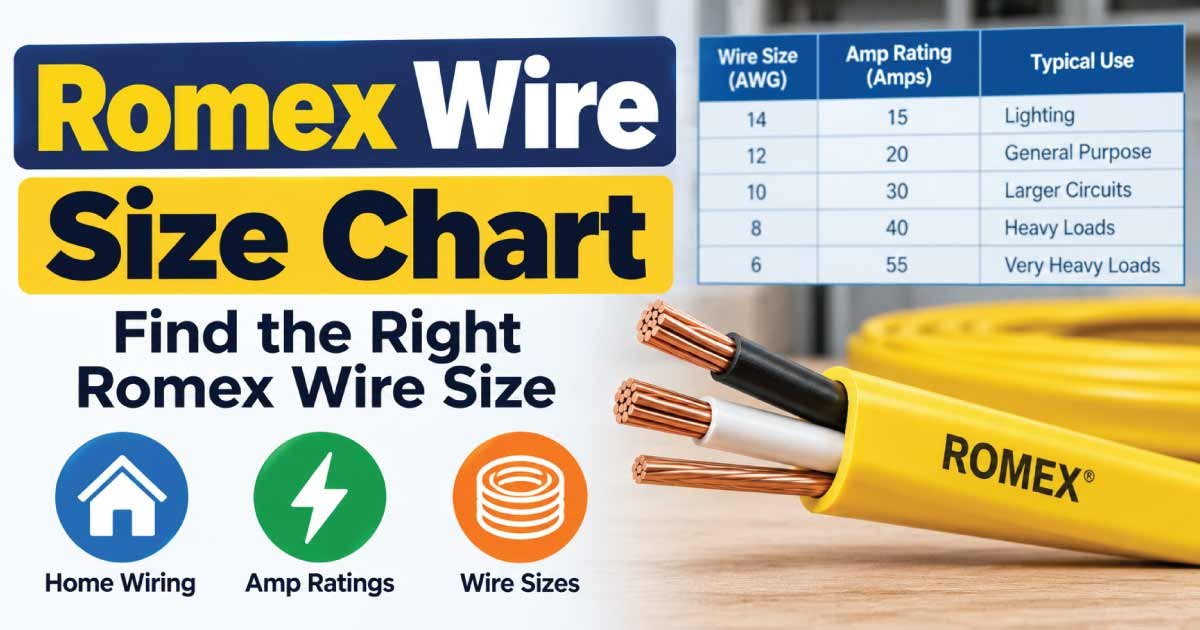
Romex Wire Size Chart
The following chart provides common NM-B/Romex configurations and typical conductor ampacity references.
| Romex Size | Conductor Size | *Typical 90°C Ampacity ** | Common Circuit Rating |
|---|---|---|---|
| 14/2 | 14 AWG | 25 A | 15 A |
| 14/3 | 14 AWG | 25 A | 15 A |
| 12/2 | 12 AWG | 30 A | 20 A |
| 12/3 | 12 AWG | 30 A | 20 A |
| 10/2 | 10 AWG | 40 A | 30 A |
| 10/3 | 10 AWG | 10 AWG | 30 A |
| 8/2 | 8 AWG | 50 A | 40 A |
| 8/3 | 8 AWG | 50 A | 40 A |
| 6/2 | 6 AWG | 65 A | 55 A |
| 6/3 | 6 AWG | 65 A | 55 A |
*The ampacity values shown are reference values for the conductor size under the applicable temperature column. The final allowable circuit ampacity can be limited by conductor rules, terminal ratings, adjustment factors, overcurrent protection requirements, and other installation conditions.
The common circuit rating column should not be treated as a universal rule for every installation. Always verify the applicable electrical requirements before selecting cable.
What Do Romex Numbers Mean?
Understanding the numbers printed on Romex cable makes wire selection much easier.
What Does 12/2 Romex Mean?
The 12 refers to the conductor gauge, while the 2 indicates the number of insulated current-carrying conductors.
A typical 12/2 NM-B cable contains:
- Black insulated conductor
- White insulated conductor
- Bare or covered grounding conductor
The grounding conductor is not normally counted in the “2” designation.
What Does 12/3 Romex Mean?
12/3 cable uses three insulated 12 AWG conductors, plus a grounding conductor.
It may be used for applications requiring an additional circuit conductor, such as certain three-way switching arrangements or multiwire circuits where permitted.
What Does 14/2 Romex Mean?
14/2 contains two insulated 14 AWG conductors plus a grounding conductor.
It is commonly associated with smaller residential branch circuits, subject to the applicable circuit requirements.
Discover More:
Romex Wire Sizes Explained
Romex is available in several conductor sizes. The correct size depends primarily on the electrical load and installation requirements.
14 AWG Romex
14 AWG is one of the smaller commonly used residential conductor sizes.
Typical applications can include appropriately sized lighting and small branch circuits.
A common configuration is:
- 14/2 NM-B
- 14/3 NM-B
The allowable circuit rating must be determined according to the applicable requirements rather than simply using the conductor’s maximum temperature-column ampacity.
12 AWG Romex
12 AWG is widely used for residential branch circuits.
Common configurations include:
- 12/2 NM-B
- 12/3 NM-B
12 AWG copper conductors are commonly associated with 20-amp circuits, provided the complete installation meets the applicable requirements.
10 AWG Romex
10 AWG is larger than 12 AWG and can carry more current under comparable conditions.
Common configurations include:
- 10/2 NM-B
- 10/3 NM-B
It is often considered for larger branch-circuit loads, but the exact circuit rating must be determined from the applicable code and equipment requirements.
8 AWG and 6 AWG Romex
Larger NM-B sizes such as 8 AWG and 6 AWG may be used for higher-current residential applications where NM-B cable is permitted.
They are less common than 14, 12, and 10 AWG cable for ordinary branch circuits.
Romex Wire Size for Amps
One of the most common questions is which Romex size is appropriate for a particular amperage.
The following is a simplified reference for common copper NM-B conductor sizes:
| Circuit Rating | Common Romex Size to Evaluate | Conductor |
|---|---|---|
| 15 A | 14/2 or 14/3 | 14 AWG copper |
| 20 A | 12/2 or 12/3 | 12 AWG copper |
| 30 A | 10/2 or 10/3 | 10 AWG copper |
| 40 A | 8/2 or 8/3 | 8 AWG copper |
| 50 A | 6/2 or 6/3 | 6 AWG copper |
These combinations are commonly encountered, but they should not be used as a substitute for a complete circuit-sizing calculation.
For example, a 30-amp circuit may require 10 AWG copper in a typical installation, but the actual installation must still satisfy all applicable requirements.
Romex Wire Size for 15 Amp Circuits
A 15-amp residential branch circuit commonly uses 14 AWG copper NM-B where permitted.
A typical cable may be 14/2 NM-B, consisting of:
- One ungrounded conductor
- One grounded conductor
- One equipment grounding conductor
14/3 can be used when an additional insulated conductor is required.
The circuit’s breaker, receptacles, switches, and other components must be compatible with the circuit configuration and applicable electrical requirements.
Romex Wire Size for 20 Amp Circuits
12/2 NM-B is commonly used for 20-amp residential branch circuits.
The cable contains:
- 12 AWG hot conductor
- 12 AWG neutral conductor
- Grounding conductor
For applications requiring another insulated conductor, 12/3 NM-B may be appropriate.
A 20-amp circuit is commonly used for higher-demand residential branch circuits, including certain kitchen, bathroom, utility, and equipment circuits, depending on the installation.
Romex Wire Size for 30 Amp Circuits
A common choice for a 30-amp residential circuit is 10 AWG copper NM-B, when NM-B is permitted for the application.
Both 10/2 and 10/3 configurations are available.
The appropriate configuration depends on the equipment and circuit design.
For example:
- 10/2 provides two insulated conductors plus ground.
- 10/3 provides three insulated conductors plus ground.
The equipment requirements determine which configuration is appropriate.
Romex Wire Size for 40 Amp Circuits
For a 40-amp circuit, 8 AWG copper is commonly evaluated.
An 8/2 or 8/3 NM-B configuration may be selected depending on the circuit design.
However, higher-current circuits require particular attention to:
- Conductor ampacity
- Equipment terminals
- Breaker rating
- Cable installation
- Temperature limitations
- Voltage drop
- Equipment instructions
Never increase the breaker size simply because a larger wire has been installed. The entire circuit must be designed and protected appropriately.
Romex Wire Size for 50 Amp Circuits
For some 50-amp residential applications, 6 AWG copper may be considered.
Common configurations include 6/2 and 6/3.
The required cable configuration depends on the equipment being supplied. A circuit serving equipment with different voltage or conductor requirements may need a different number of insulated conductors.
For large loads, always check the equipment nameplate and installation instructions before selecting the cable.
How to Choose the Correct Romex Wire Size
Selecting Romex involves several steps rather than simply matching a breaker to a wire gauge.
1. Determine the Load
Find the equipment’s electrical requirements.
Look for:
- Voltage
- Amperage
- Wattage
- Minimum circuit ampacity
- Maximum overcurrent protection
- Manufacturer requirements
For fixed equipment, the manufacturer’s specifications can be especially important.
2. Select the Conductor Size
After determining the load, choose a conductor size with sufficient allowable ampacity under the actual installation conditions.
3. Select the Number of Conductors
Determine whether the circuit requires:
- Two insulated conductors
- Three insulated conductors
- Grounding conductor
- Additional conductors for a particular wiring arrangement
This determines whether 12/2, 12/3, 10/2, 10/3, or another configuration is appropriate.
4. Check Installation Conditions
NM-B cable is not suitable for every location.
Consider:
- Dry versus wet locations
- Physical protection
- Temperature
- Cable routing
- Environmental conditions
- Exposure to damage
Where NM-B is not permitted, another wiring method may be required.
5. Consider Voltage Drop
Long cable runs can experience voltage drop.
Although the minimum conductor size may meet ampacity requirements, a larger conductor can sometimes be appropriate for a long run to help maintain voltage at the load.
Discover More:
Romex vs THHN and THWN Wire
Romex and individual THHN/THWN conductors serve different purposes.
| Feature | Romex / NM-B | THHN/THWN |
|---|---|---|
| Construction | Multi-conductor cable | Individual conductors |
| Typical Installation | Cable assemblies | Conduit/raceway |
| Common Residential Use | Branch circuits | Conduit wiring |
| Wet Locations | Generally not suitable | THWN is designed for wet locations |
| Installation Flexibility | Limited by cable construction | Greater conduit-system flexibility |
| Grounding Conductor | Included in cable | Installed separately as required |
The choice depends on the wiring method, location, local requirements, and project design.
Romex Wire Size and Voltage Drop
Voltage drop becomes increasingly important as cable length increases.
A long run has greater conductor resistance, which can reduce the voltage available at the equipment.
When evaluating voltage drop, consider:
- Cable length
- Load current
- Conductor material
- Wire gauge
- Circuit voltage
- Single-phase or other system configuration
For long runs, moving from a smaller conductor to a larger conductor can reduce resistance and voltage drop.
However, voltage-drop design should be calculated for the actual circuit rather than based on a simple distance rule.
Common Romex Wire Sizes and Applications
Different sizes and configurations are suited to different types of residential wiring.
| Romex Type | Typical Conductor Size | Common Uses |
|---|---|---|
| 14/2 | 14 AWG | Lighting and small branch circuits |
| 14/3 | 14 AWG | Switching and circuits requiring 3 insulated conductors |
| 12/2 | 12 AWG | General 20 A branch circuits |
| 12/3 | 12 AWG | Circuits requiring 3 insulated conductors |
| 10/2 | 10 AWG | Larger branch-circuit loads |
| 10/3 | 10 AWG | Equipment requiring 3 insulated conductors |
| 8/3 | 8 AWG | Higher-current residential equipment |
| 6/3 | 6 AWG | Large residential equipment circuits |
These are general examples, not a universal application chart. The actual cable must be selected according to the circuit design and applicable electrical requirements.
Discover More:
Common Romex Wire Size Mistakes
Several mistakes can lead to an improperly sized electrical circuit.
Using the Breaker as the Starting Point
The breaker and conductor must be coordinated, but simply choosing a wire based on breaker size can overlook load calculations and installation conditions.
Confusing 12/2 With 12/3
The number after the slash identifies the number of insulated conductors, not the conductor gauge.
Ignoring Cable Temperature Limitations
NM-B cable has specific temperature characteristics. Do not assume that the highest conductor temperature rating can always be used to determine the final circuit rating.
Using NM-B in Wet Locations
Standard NM-B cable is intended for locations where its installation is permitted. It should not automatically be treated as a wet-location wiring method.
Ignoring Voltage Drop
A cable can meet basic ampacity requirements but still experience significant voltage drop on a long run.
Choosing Wire Only by Physical Thickness
The outside diameter of a cable does not determine its electrical capacity. Always identify the conductor gauge, insulation type, conductor material, and applicable ratings.
Romex Wire Size FAQs
What size Romex wire do I need for 20 amps?
For a typical residential 20-amp branch circuit, 12 AWG copper NM-B, commonly sold as 12/2 Romex, is frequently used. The final selection must still comply with the applicable electrical requirements, circuit configuration, installation conditions, and equipment specifications.
What size Romex wire is used for a 15 amp circuit?
14 AWG copper NM-B, commonly 14/2 Romex, is often used for a 15-amp branch circuit where permitted. The circuit must be designed and protected according to the applicable electrical requirements, including conductor, breaker, receptacle, and installation considerations.
Can I use 12 gauge Romex on a 15 amp breaker?
Yes, a larger conductor can generally be used on a lower-rated circuit when the complete installation is compatible. Using 12 AWG instead of 14 AWG can provide additional conductor capacity, but it does not mean the breaker rating should automatically be increased.
What does 12/2 Romex mean?
12/2 means the cable contains two insulated 12 AWG conductors, along with an equipment grounding conductor. The two insulated conductors are commonly used as an ungrounded conductor and grounded conductor in a standard branch-circuit configuration.
Is Romex the same as NM-B wire?
Romex is commonly used as a trade name for nonmetallic-sheathed cable, while NM-B is the generic designation used for a particular type of nonmetallic-sheathed cable. In everyday electrical work, people often use “Romex” and “NM-B” interchangeably.
Final Thoughts on Romex Wire Size
The right Romex wire size depends on the electrical load, conductor gauge, number of insulated conductors, circuit rating, installation conditions, voltage drop, and applicable electrical requirements.
For common residential wiring, 14 AWG, 12 AWG, and 10 AWG NM-B are frequently encountered, while larger sizes are used for higher-current applications where the wiring method is permitted.
Remember that a wire-size chart is a starting point rather than a substitute for proper electrical design. Always check the cable markings, equipment instructions, applicable electrical code, and local requirements before installation. When working with unfamiliar or high-current circuits, qualified electrical assistance can help ensure the installation is safe and compliant.